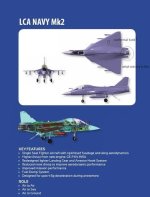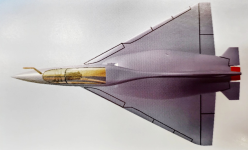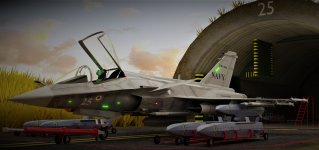

We do need a bigger jet for future, or at the very least a jet with high combat radius.
As longer range & faster missiles are proliferating, U.S. Navy is also looking to retreat its carriers further back in pacific than initially to operate relatively safely without being overwhelmed, One of the core requirements of FA-XX.
Chinese SSNs & surface combatants will also carry lot more longer range & faster missiles in future.
We need a carrier fighter having the capability to cover mallacca straight while carrier itself remaining 1500+km behind the straits,to reduce the number & density Of chinese( ship, sub, air launched) anti-ship vectors that have the range to strike the carrier, assuming we can restrict chinese fleet to operate behind the Strait.
Also, when i mention mtow, i'm focusing on the size, range etc performance of other fighters in similar mtow class, not MTOW itself.
We need a jet more in performance range of Su57, SCAF as our primary carrier fighter for post 2040s, operational combat radius of ~1500km along with being a stealth, not a Rafale class jet.
( though report also claim amca will have combat radius of 1500km, I find it hard to beleive, my estimates are 1200+km)
You can calculate the potential range by calculating the fuel fraction on full internal fuel.
LCA Mk2 = 35%
Rafale = 33%
MKI = 34%
F-35A = 38%
Su-35 = 38%
AMCA = 35%
TEDBF = 33%
AMCA and TEDBF have similar FF as MKI, but will come with a far more fuel efficient engine along with a more efficient airframe design. Both jets will comfortably surpass the MKI. AMCA should be able to approach Su-35's 3600 km ferry range, pretty much the same as the F-35A's range.
While AMCA will be a 900 nm fighter, American jets are expected to be 1000+ nm. But their operating environment is different. Plus the American jets will use 6th gen engines that could at least be 15-20% more efficient.
A slightly larger jet than AMCA for the IN should be able to match the US' 1000nm range requirement with a 5th gen engine. Of course, it's possible American jets will actually surpass 1000 nm, but we don't really need to match that.
As for IWB, 4.5-5 m long, 1-1.5 m wide single,should be sufficient.
Also, no. Of carrier fighter will be low, so they need to be qualitatively competent.
We want mission-centric designs, not platform-centric. If we try to match the PLAN's fighter capabilities with smaller carriers, we will lose. The IAF is in the same boat.
I also hope we can make them, but doesn't seem like we are gonna make big enough stealth drones to carry relatively larger anti-ship missiles like brahmos ng in iwb, most likely it will be carried externally.
Bomber designs are not constrained like fighters. We can put a 6.5m WB on a flying wing jet. 2 Brahmos NG are just 3T and need a single 1.4m wide bay, which is far lesser than AMCA's 2.2m wide bays.
Official naval planning reports and analysis suggest INS Vikramaditya has roughly 10–12 years of operational life remaining as of 2025, with a projected retirement around 2037. A structural audit is scheduled for 2035 to determine the feasibility of service beyond this period.
Even if the audit determines its still operationally & cost wise feasible for
Vikramaditya to service beyond 2040, it ain't gonna be a front line carrier.
It will go through. MLU will push it ahead of the IAC-1.

“INS Vikramaditya will serve Navy for 30 years”
India News:“INS Vikramaditya will serve Navy for 30 years”
This end of life story is for political reasons concerning the operation of a Russian carrier and preventing anymore delays of IAC-2. I wouldn't read too much into it. Come 2035, and Vikram will get MLU'd and TEDBF numbers will climb to 150 for all three carriers.
No one's stopping IN from getting 4 carriers before 2045.