
Indian Defence Exports
- Thread starter R!cK
- Start date
You are using an out of date browser. It may not display this or other websites correctly.
You should upgrade or use an alternative browser.
You should upgrade or use an alternative browser.




Any news on Philippine Army plan to acquire Brahmos?
MaxDefense Philippines : still under nego, as DND is still looking if this can be bought using annual GAA funds or foreign financing.
how many batteries the Philippine Army plan to acquire?
MaxDefense Philippines : original plan was originally 2 initially, but this may change now.
Philippine Army could acquire two Brahmos batteries.
Source: Maxdefense Philippines Facebook page.

Philippine, Indian armies launch staff talks to boost defense ties
The Philippine Army (PA) on Thursday launched the 1st Philippine Army–Indian Army (PA-IA) Army-to-Army Staff Talks (AAST) at its headquarters in Fort Bonifacio,
The Philippine Army (PA) on Thursday launched the 1st Philippine Army–Indian Army (PA-IA) Army-to-Army Staff Talks (AAST) at its headquarters in Fort Bonifacio, Taguig City, aimed at strengthening defense partnerships with international military forces.
The PA-IA AAST is set to become an annual activity between the two armies, providing a platform to propose short- and medium-term bilateral engagements through calendar year 2027.


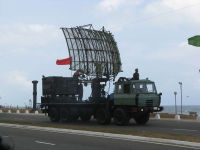
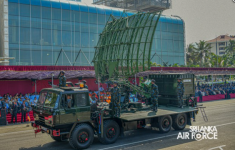
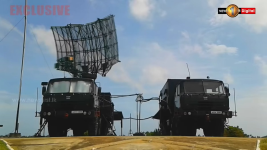
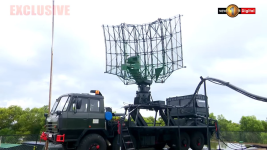
Indian made Indra MK-II radar operated by the Sri Lankan Air Force:

India’s Defense Exports Hit $4.1bn Record
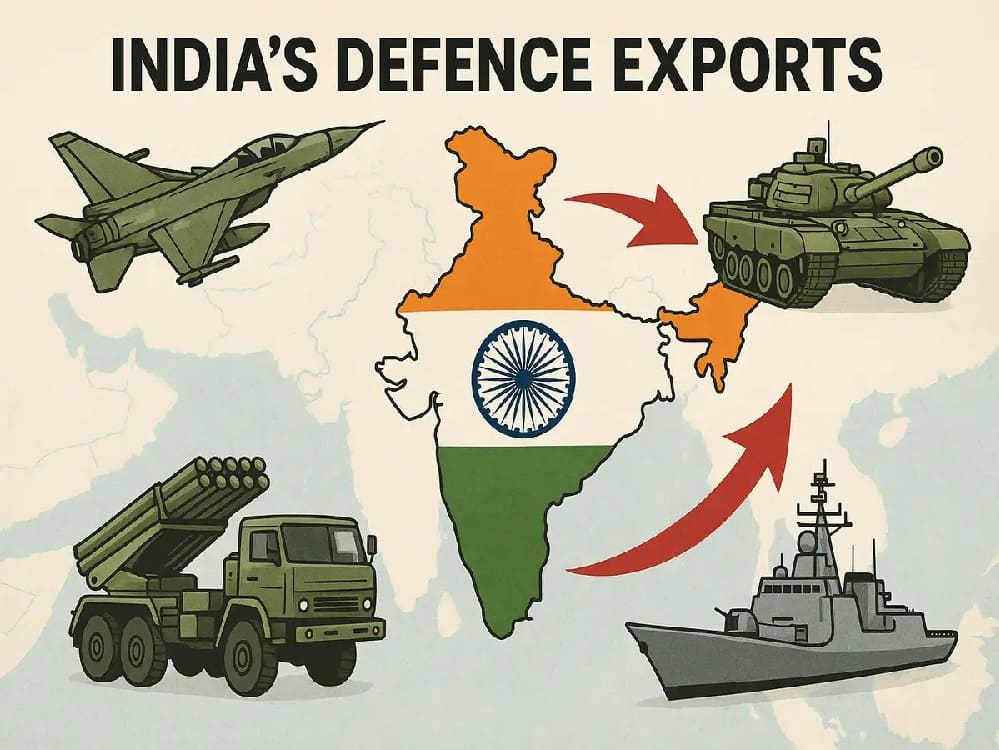
India's Defense Exports Hit $4.1bn Record
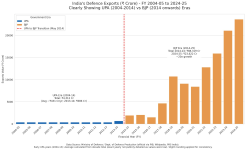
India’s defense exports hit a record high in FY2025-26, which gives New Delhi a stronger position in the global arms market. The Ministry of Defense said that exports reached ₹38,424 crore, or about $4.1 billion, in the fiscal year that ended in March 2026. That was a 62.66% increase from the previous year’s number of ₹23,622 crore.
For more Scholarly articles like this, visit Defense News Today.
India’s Export Momentum
India’s defense exports are no longer a small part of New Delhi’s defense policy. They are now part of a larger national plan to make India a major center for military manufacturing. Rajnath Singh, the Minister of Defense, said that the numbers indicate that people around the world are becoming more confident in India’s own defense capabilities. Furthermore, the numbers indicate that foreign buyers now see Indian systems as more mature, dependable, and ready for export. This growth is also a result of years of policy support. India has encouraged local production through Aatmanirbhar Bharat, making it easier to export goods and getting more businesses involved. So, the rise in exports is not an accident. It is the result of a long campaign in the business world.Public Firms Lead, Private Sector Rises
State-owned defense companies heavily link with India’s defense exports. Defense Public Sector Undertakings contributed 54.84% of exports in FY2025-26. However, private firms still delivered a major 45.16% share. That balance matters. Public firms provide scale, legacy platforms, and government-backed credibility. Meanwhile, private companies add speed, electronics expertise, subsystems, and niche manufacturing capacity. As a result, India’s export ecosystem now looks broader than before. It includes missiles, artillery systems, radar platforms, electronic components, and military subsystems. India’s equipment reportedly reaches more than 80 countries, giving New Delhi a wider defense diplomacy footprint.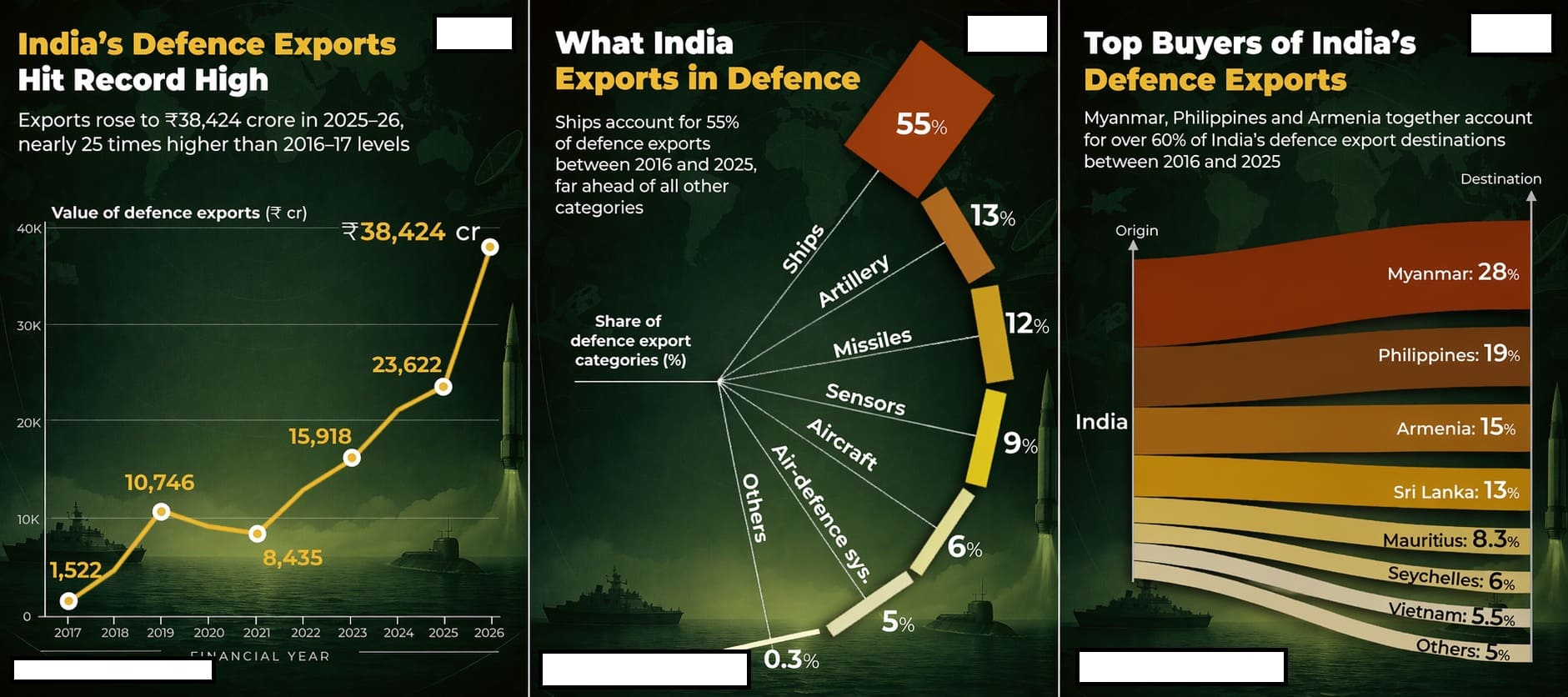
India’s Key Defense Exports
More and more of India’s defense exports are equipment that other countries’ militaries can use without having to buy full combat platforms. This includes sensors, communications systems, ammunition, artillery-related goods, and electronic hardware. But India’s most obvious export goals are systems like missiles, air defense systems, rocket artillery, and battlefield radars. These products give buyers a lot of power for a low price, which is especially useful in places that want to avoid buying from Western, Russian, or Chinese suppliers. Indian weapons might be a viable choice for countries with tight budgets because they work well and don’t cost much in terms of politics or money. So, New Delhi can focus on markets in Latin America, Africa, Asia, and the Middle East.Exports Rise, Imports Remain
India is still one of the biggest arms importers in the world, even with the record. According to SIPRI’s most recent data on arms transfers, India was the second-largest buyer of major arms from 2021 to 2025, after Ukraine. During that time, India made up 8.2% of all arms imports around the world, according to SIPRI. This scenario makes for a strategic conflict. India wants to sell more weapons to other countries, but it still buys many expensive systems from them. These include advanced sensors, combat aircraft, engines, submarines, and air defense systems. But this gap is normal for a defense company that is growing. Countries don’t usually go from relying on imports to being leaders in exports overnight. They build capacity slowly, not all at once.Why Defense Watchers Care
India’s defense exports are important because they show how New Delhi wants to plan for the future. Exports make money, but they also give you more power. Every sale of military equipment can lead to training links, maintenance contracts, and long-term security partnerships. Furthermore, being successful in exports helps Indian companies make better products and produce more of them. When you order more, the cost per unit goes down. They can also make India’s own military supply chains stronger. There are still problems to solve. India needs to show that it can provide adequate after-sales support, deliver on time, and keep its quality high. People who buy things will pay attention to how well Indian systems work under stress.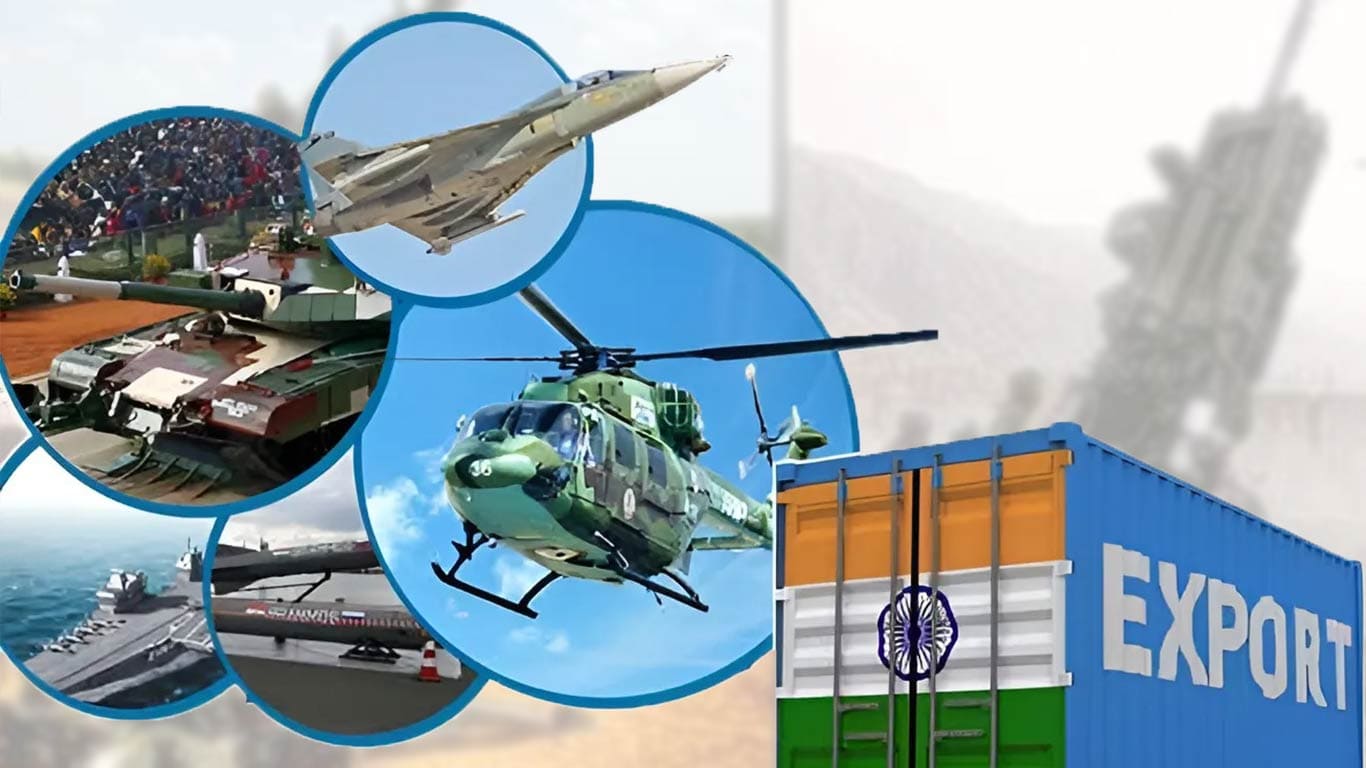
The Bigger Strategic Picture
India’s rise in exports shows ambition, not a full change. The country is getting stronger, but it still needs better engines, semiconductors, high-end avionics, and more integration of its systems. Still, the path is clear. India wants to go from being a buyer to a builder and then to an exporter. If things keep going at this rate, India’s defense exports could become a major part of New Delhi’s military diplomacy. One record year won’t be the most important test. Instead, it will be whether India can keep growing, deliver complicated systems on time, and compete in tough global markets.References
- https://www.pib.gov.in/PressReleasePage.aspx?PRID=2248124&lang=1®=3
- India's Defense Exports Hit $4.1bn Record DEFENSE NEWS TODAY
- https://www.sipri.org/sites/default/files/2026-03/fs_2603_at_2025.pdf
- Self-reliant India (Aatm Nirbhar Bharat Abhiyan) | IBEF
- India emerges as world's second largest arms importer: SIPRI

Indian military drone exports set to enter multifold growth phase
'First drone war' with Pakistan offers edge for makers to compete with China, Turkey
 asia.nikkei.com
The Indian military drone manufacturing industry is expected to enter a phase of rapid growth in coming years, as the order books of local makers swell following the South Asian nation's conflict with Pakistan last year, which has boosted their profiles as low-cost makers.
Flying Wedge Defence and Aerospace, an Indian startup founded in 2022 and yet to raise its Series A venture funding, secured a $30 million export order for its drone products in August last year. "We're now aiming to hit an export order book of $100 million over the next year-and-a-half," founder Suhas Tejaskanda told Nikkei Asia.
Such growth is not just limited to early-stage startups.
Smit Shah, president of the Drone Federation India, told Nikkei Asia that in the fiscal year through March 2026, about two-thirds of the revenue of up to 30 billion rupees ($317 million) from Indian drone sales came from military contracts. Revenues from military contracts are now "expected to grow four to fivefold by March 2028," Shah said, adding that drone exports, which make up under 10% of total revenue, would grow at a similar clip.
Drones have had a very limited presence in India's defense industry up to now. The country's total arms exports, for example, jumped 62% year on year to 384.24 billion rupees in the same fiscal year, but those of military drones likely made up less than 5% of the total, industry executives estimated.
However, the widespread usage of drones in the conflict between India and Pakistan in May last year -- dubbed the first "drone war" between the nuclear-armed neighbors -- put the spotlight on local companies like Solar Industries, NewSpace Research and Technologies and Zen Technologies, which saw their products deployed during the conflict.
Now, the country's drone companies are building on that reputation for battle-readiness to increase exports. They have to some extent already capitalized on the seismic shift in the perception of low-cost drones, driven by the success of such weapons in the Ukraine war and now the Middle East conflict pitting the U.S. and Israel against Iran.
Solar Industries, which makes a wide variety of weapon systems, including a multi-barrel rocket launcher, announced export orders worth over 28 billion rupees in stock exchange filings between November of last year and January of this year, all of which are expected to be delivered to customers over the next four years. Ideaforge, meanwhile, won a contract last month to sell surveillance drones to U.S. law enforcement agencies.
Drone-related businesses are also showing signs of growth.
Zen Technologies, which makes simulators for various military products such as submarines, expects to earn over 10 billion rupees in exports over the two years through March 2028, about half of which is expected to come from anti-drone systems, Chairman and Managing Director Ashok Alturi told Nikkei Asia. In the fiscal year through March 2025, these systems, which combine radar, optical detectors, jammers and cannons to intercept drones, accounted for over half of the company's total exports, worth 3 billion rupees.
Details on most of these deals are obscure. Solar Industries does not provide the share of drone-related products in its export orders. Flying Wedge's client for its export deal is only identified as a "Southeast Asian country."
But Flying Wedge's Tejaskanda said that the company is supplying its flagship long-range attack and surveillance drones, as well as interceptor drones, as part of the $30 million-export deal. The startup is also in talks with clients in Kenya and Portugal for future exports, he added.
Indian military drone makers are mostly competing with Chinese and Turkish manufacturers for supply contracts with the armed forces of countries in Southeast Asia and Africa, industry executives said.
"There are five major players in this ecosystem: Israel, U.S., Turkey, China and Iran," Tejaskanda said. "The first two are usually very expensive, and Iran faces challenges from the U.S. sanctions."
Price competitiveness is also a factor supporting export growth expectations.
For instance, Flying Wedge's Kaal Bhairav, a medium-altitude long-endurance (MALE) drone, costs between 10 million and 40 million rupees ($105,500 and $422,000), while a rival product by an American company costs $30 million a piece.
Indian drones, or unmanned aerial vehicles (UAVs), can also fill gaps left by other makers, said Shah from Drone Federation India.
"Very large UAVs will, for some time, be dominated by the West, and very small UAVs will continue to be dominated by China," Shah said. "But we have a very solid role to play when it comes to the tactical, medium-sized class of UAVs."
Moreover, the effective usage of drones like Iran's Shahed platform has decreased the importance of often expensive certifications, like NATO's standardization agreement, or STANAG, as clients are happy to forgo them in order to buy cheaper, battle-tested products, Tejaskanda said.
P.S. Apparently, Flying Wedge's export customer is Thailand.
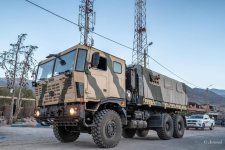
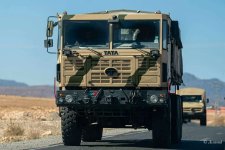
Some nice clicks of TATA 6×6 LPTA-1623 truck of Moroccan Army
Also
Also

Cyprus eyes Indian weapons citing battle tested capabilities in Operation Sindoor
In a strategic move to counter Turkish drones, Cyprus eyes Indian-made Nagastra and Sky Striker drones following their success in Operation Sindoor.
 www.wionews.com
Cyprus has expressed strong interest in purchasing Indian defence equipment, citing New Delhi’s military performance in last year’s conflict with Pakistan as a key factor in its decision. Cypriot officials said that Nicosia was impressed by India’s demonstrated capabilities during Operation Sindoor, the May 2025 military campaign against terrorist infrastructure in Pakistan that escalated into a brief but intense four-day conflict. "We know very well India's capabilities. India tested them in a real situation...," a Cypriot official said.
Development comes as Cyprus President Nikos Christodoulides held discussions with Prime Minister Narendra Modi in Delhi on Friday. The two sides signed a Roadmap for Bilateral Defence Cooperation (2026-2031), an MoU between Cyprus Defence & Space Industries Cluster (CyDSIC) and India’s Society of Indian Defence Manufacturers (SIDM), and a Technical Arrangement on Search and Rescue cooperation.
Aim is to "work more in two important sectors. The first one is defence. We are interested in buying from the Indian defence industry. The second one is to have India, Cyprus defence industries work together," the Cypriot official added.
Cyprus is eligible for €1.2 billion under the European Union’s defence funding instruments and is looking to enhance its military capabilities through partnerships with India. Officials said a Cypriot defence minister would soon visit India for detailed discussions on specific weapons and other processes.
Indian companies have been encouraged to use Cyprus as a "gateway to Europe", with existing investments already giving them access to the wider European market in defence, technology, and manufacturing.