Production Linked Incentive (PLI) Scheme : News & Updates

Ashwin

Agent_47
Staff member
Administrator
Nov 30, 2017
10,864
25,426
Bangalore
001LQLT.jpg


Introduction: A New Chapter in India's Growth Story
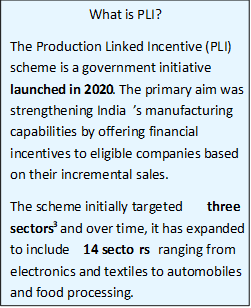
image003W4IC.png


From factory floors to innovation labs, India’s manufacturing sector is undergoing a quiet transformation, one powered by policy intent and industrial ambition. At the heart of this shift is the Production Linked Incentive (PLI) Scheme, which stands as a cornerstone of India’s ambition to raise manufacturing’s contribution to 25% of GDP and claim its place among the world’s leading industrial economies.

With an incentive outlay of ₹1.97 lakh crore, the scheme is more than just a financial package. Today, with 806 applications approved across 14 strategic sectors, the scheme reflects strong industry confidence and robust adoption.

The scheme aligns with national goals like Atmanirbhar Bharat and India’s vision of a $5 trillion economy. It fuels the Make in India movement by reviving domestic manufacturing at scale. It powers Digital India by driving local production of mobile phones, and electronics, making technology more accessible and affordable. And it aligns closely with the India Semiconductor Mission, which, backed by a ₹76,000 crore package, aims to provide financial support for investments in semiconductor fabrication, display manufacturing & chip design to strengthen India's integration into global electronics value chains.

Background: Genesis of the PLI Scheme

India’s services sector has long powered the economy, contributing over 50% to GDP. To create more balanced and resilient growth, the government turned focus to manufacturing: a key driver of jobs, exports, and self-reliance. In 2020, the Production Linked Incentive (PLI) Scheme was launched to boost domestic manufacturing through targeted, performance-based incentives across strategic sectors.

The PLI Scheme was first launched in April 2020, beginning with the Mobile Manufacturing and Specified Electronic Components, Critical Key Starting materials/Drug Intermediaries and Active Pharmaceutical Ingredients and Manufacturing of Medical Devices. Following its initial success, the scheme was progressively extended to cover 13 key sectors of the economy, including pharmaceuticals, automobiles and auto components, Textile Products, white goods, and specialty steel, among others.

Over time, the scheme attracted strong interest from both domestic and global players, leading to approvals of multiple projects in sectors such as electronics, bulk drugs, medical devices, and textiles. For example, in February 2021, the Union Cabinet approved the PLI scheme for the pharmaceuticals sector with an outlay of ₹15,000 crore. Similarly, in September 2021, a ₹25,938 crore PLI scheme for the automobile and auto component industry and PLI scheme for Drones and Drone Components with funding of ₹120 crore for 3 years was cleared.

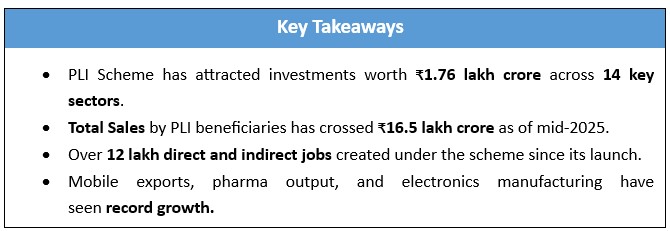
By November 2024, committed investments under the PLI scheme had reached ₹1.61 lakh crore. This momentum carried into 2025, with realized investments rising to about ₹1.76 lakh crore with 806 approved applications as more projects shifted from approval to active implementation. By focusing on sectors such as electronics, textiles, pharmaceuticals, and automobiles, the initiative links financial incentives to measurable results like increased production and incremental sales. This performance-based model attracts investments from both domestic and global players but also encourages businesses to embrace cutting-edge technologies and achieve economies of scale.

Sectoral Coverage: From Chips to Chemicals

The Production Linked Incentive (PLI) Scheme covers the following 14 critical sectors, with tailor-made incentives and performance frameworks
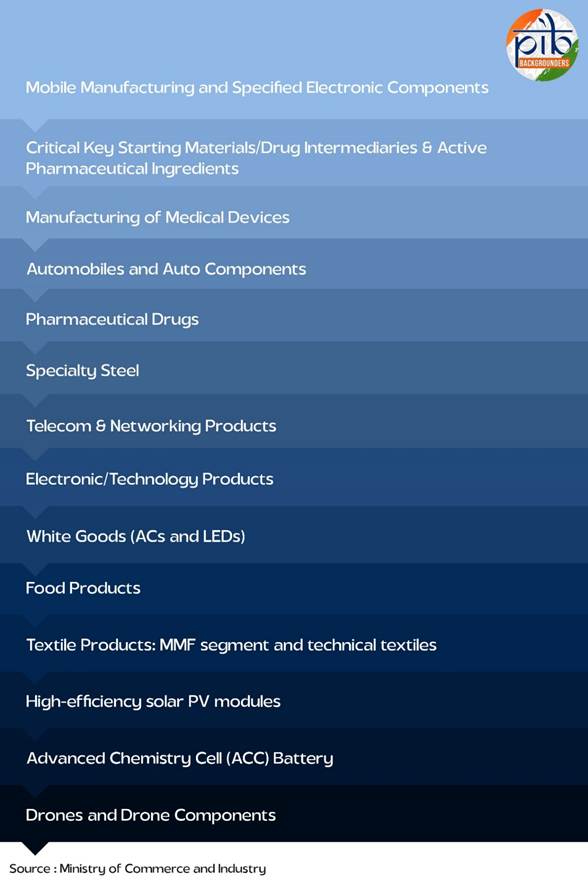
image004YNVE.jpg


Some of the top Performing Sectors under PLI Scheme include:

Electronics & Mobile Manufacturing

The electronics sector has emerged as a flagship success story under the PLI strategy, driven by strong policy backing through initiatives like the National Policy on Electronics (NPE) 2019. With this policy foundation in place, the PLI attracted both global OEMs and Indian champions, propelling India into the global electronics value chain. The impact has been substantial with production surging by 146%, from ₹2.13 lakh crore in FY 2020-21 to ₹5.25 lakh crore in FY 2024-25. PLI Scheme has encouraged major smartphone companies shifting its production to India. As a result, India has become a major mobile phone manufacturing country.
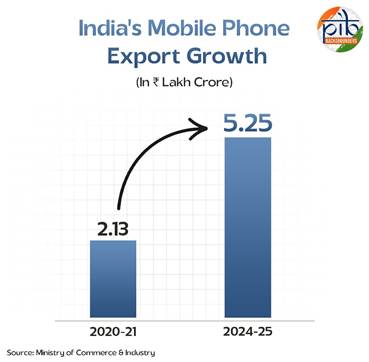
image005E4FH.jpg


Automobile & Auto Components
Under the PLI scheme, India has attracted committed investments worth ₹67,690 crore. As of March 2024, ₹14,043 crore has been invested, generating over 28,884 jobs. These schemes aim to make India a global EV and clean-tech hub by supporting and driving sustainable mobility aligned with the Faster Adoption and Manufacturing of Electric Vehicles (FAME) initiative. The Scheme proposes financial incentives for 19 categories of Advanced Automotive Technology (AAT) vehicles and 103 categories of AAT components to boost domestic manufacturing of Advanced Automotive Technology products and attract investments in the automotive manufacturing value chain.

Food Processing
With 171 approved applications under the PLI scheme till October 2024, the food processing sector has seen investments of over ₹8,910 crore, with ₹1,084 crore disbursed in incentives. The scheme complements initiatives like PM-Formalization of Micro Food Processing Enterprises (PM-FME) and Pradhan Mantri Kisan SAMPADA Yojana (PMKSY), aiming to modernize processing units, enhance branding of Indian food products, and boost value-added exports.

Pharmaceutical Drugs

Once heavily dependent on imports for essential raw materials, India’s pharma backbone is now regaining its strength. Thanks to focused PLI support, the country transitioned from a net importer (₹1,930 crore deficit in FY 2021-22) to a net exporter of bulk drugs (₹2,280 crore surplus in FY 2024-25). In the first three years, pharma sales under PLI crossed ₹ 2.66 lakh crore, including exports worth ₹ 1.70 lakh crore. The overall Domestic Value Addition in the Sector has been 83.70% as on March 2025.
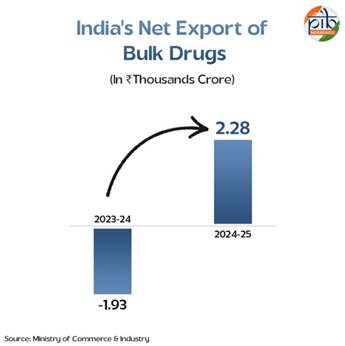
image006IY67.jpg


Solar PV Modules
Under the PLI for High-Efficiency Solar PV Modules, PLI Tranche I & II together aim to create nearly 48 GW of fully integrated manufacturing capacity. This is expected to reduce import dependence, strengthen domestic supply chains, and boost India’s energy security under the larger goals of Aatmanirbhar Bharat and the National Solar Mission. Under the PLI scheme for high-efficiency solar PV modules, investments worth ₹48,120 crore have been committed, generating nearly 38,500 direct jobs as of June 30, 2025.

Semiconductors
In a world driven by chips, India is scripting its own semiconductor story- bold, strategic, and future-focused. India, with six approved semiconductor projects already in various stages of execution, has now received Union Cabinet approval for four additional manufacturing units in Odisha, Punjab, and Andhra Pradesh. These projects, sanctioned under the India Semiconductor Mission (ISM) with an outlay of ₹4,600 crore, are expected to create direct employment for 2,034 skilled professionals and stimulate the broader electronics manufacturing ecosystem, leading to significant indirect job generation. With a vision to build a self-reliant semiconductor ecosystem by 2030, the government has rolled out dedicated incentives under the India Semiconductor Mission, complementing the broader PLI framework.

Textiles
The PLI Scheme for Textiles was approved with an outlay of Rs. 10,683 crore in September, 2021, to promote production of MMF Apparel, MMF Fabrics and products of Technical Textiles in the country to enable textile sector to achieve size and scale and to become competitive. Man-made Fibre (MMF) exports rose to around ₹ 525 Crore in FY 2024–25 (from ₹ 499 Crore in FY 2023–24), while technical textile exports climbed to ₹294 Crore, up from ₹200 Crore the previous year. Government of India is actively promoting textile and garment exports through various schemes/initiatives such as Rebate of State and Central Taxes and Levies (RoSCTL) scheme which supports zero-rated exports for apparel, garments, and made-ups, while other textile products are covered under the Remissions of Duties and Taxes on Exported Products (RoDTEP) scheme.
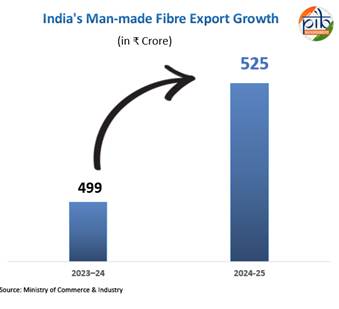
image007CFDP.jpg


White Goods (ACs and LED Lights)
Launched in April 2021 with an outlay of ₹6,238 crore, the PLI scheme for white goods aims to transform India from an assembly hub to a high-value manufacturing base. It targets a jump in domestic value addition from just 20–25% to 75–80% by 2028–29. So far, incentives worth ₹281.4 crore have been disbursed, bolstering India’s push for energy-efficient, globally competitive appliances. India has begun local production of key components such as compressors, copper tubes, heat exchangers, motors, and control assemblies for air conditioners, as well as LED chip packaging, drivers, engines, light management systems, and metallized films for capacitors in the LED segment. This shift is significantly reducing import dependency and strengthening domestic manufacturing capabilities.

Performance So Far

By November 2024, the scheme had attracted committed investments of ₹1.61 lakh crore, surpassing expectations and demonstrating strong industry confidence in India’s policy direction. Actual investments realized have continued to rise, reaching approximately ₹1.76 lakh crore by March-2025, as more projects moved from approval to implementation stages.
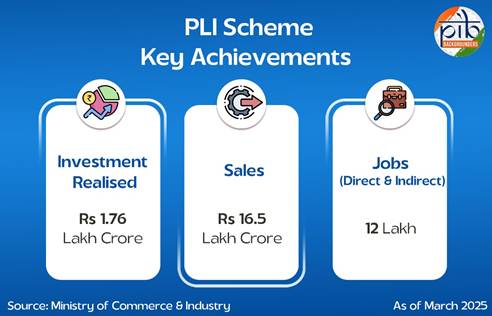
image0082L4X.jpg


The production impact has been remarkable. Total sales by PLI participants exceeded ₹16.5 lakh crore, reflecting impressive growth in key sectors such as electronics, pharmaceuticals, automotive, and textiles.

The PLI initiative has also emerged as a major job creator, generating over 12 lakh direct and indirect employment opportunities, while simultaneously fostering additional ecosystem development across Tier-2 and Tier-3 cities. Importantly, the scheme has catalyzed a fresh wave of FDI into the country, endorsing India as a preferred destination for high-value manufacturing in an evolving global scenario.
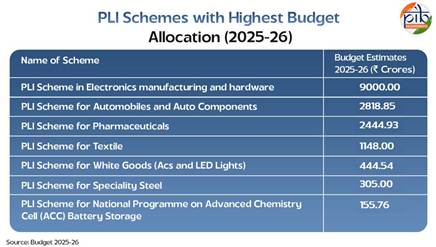
image00982M1.jpg


In a strong push to accelerate industrial growth, the Government has significantly increased budget allocations for key sectors under the PLI Scheme in 2025-26, reaffirming its commitment to strengthening domestic manufacturing.

The PLI scheme is expected to create a ripple effect across India’s MSME ecosystem. Anchor units in each sector are expected to develop new supplier and vendor networks throughout the value chain, with a significant share of these ancillary units emerging from the MSME sector.

The scheme has also led to the development of sector-specific clusters such as the display fabs and semiconductor parks in Gujarat, MMF clusters in Surat, and medical device parks in Andhra Pradesh and Tamil Nadu.
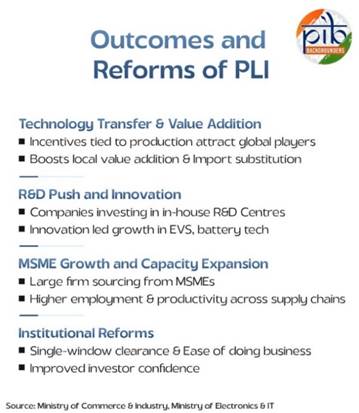
image010AQC6.jpg


Conclusion

From once being heavily reliant on imports to now emerging as a serious contender in global manufacturing, India’s industrial journey has entered a transformative chapter and the PLI scheme is a major part of it. With investments exceeding ₹1.76 lakh crore and tangible gains in output, exports, and employment generation, PLI has evolved from a policy instrument to a catalyst of structural change.

By backing sunrise sectors, powering innovation, and anchoring global supply chains closer to home, the scheme is doing more than just reshaping factories, it’s reshaping the future of India’s economy. By supporting key industries, encouraging export-oriented production, and promoting the adoption of advanced technologies, the PLI schemes are strategically strengthening India's manufacturing base.


India plans to soon offer incentives for companies to set up lithium and nickel processing plants to help boost output and meet rising demand for critical minerals, according to two sources and a government presentation reviewed by Reuters.

India is seeking to accelerate its energy transition and cut emissions by promoting clean energy initiatives like electric vehicles, though it lacks the technology to process critical minerals, a capacity that is largely dominated by China.

Nickel and lithium are critical to India's EV supply chain, especially when it comes to batteries, as New Delhi targets 30% electric car penetration and 80% for two-wheelers by 2030 from 4% and 6% at present.

The incentive plan proposes a 15% capital subsidy for eligible investments in lithium and nickel-processing projects starting on or after April 1, 2026, which would be subject to a cap, according to the presentation.

A 15% capital subsidy appears to be "realistic," one of the sources said.

Under the programme, incentives would be available for five years and capped at 40% of annual net sales turnover for lithium processing plants and 25% for nickel plants, the presentation showed.

To qualify for the incentives, lithium processing plants must have a minimum capacity of 30,000 metric tons, while nickel plants must have at least 50,000 tons, it showed.

The subsidy would be disbursed in stages, subject to minimum plant utilisation targets set by the government, the presentation showed.

The government initially plans to roll out the incentives for two lithium and two nickel projects to meet the country's demand by 2030, one of the sources and the presentation said.
 

PLI SCHEME FOR ADVANCE CHEMISTRY CELLS​

The Ministry of Heavy Industries is administering the Production Linked Incentive (PLI) scheme, namely “National Programme on Advanced Chemistry Cell (ACC) Battery Storage”, approved in May, 2021 with a total outlay of ₹18,100 crore to establish 50 GWh of domestic Advanced Chemistry Cell manufacturing capacity.

Out of the total targeted 50 GWh capacity, 40 GWh has been awarded to four beneficiary firms. As reported by the beneficiary firms, a cumulative investment of ₹3,237 crore and employment generation of 1,118 have been achieved under the scheme, till 31.12.2025.

This initiative of the Government of India has acted as a catalyst for Indian cell manufacturers to setup cell manufacturing units. Besides the PLI ACC scheme applicants, at least 10 manufacturers have announced a cumulative capacity of about 178 GWh in the country over the next five years. Further, PLI ACC scheme has raised demand for components like cathode active materials, anode active materials, foils, etc. Indian manufacturers have announced component manufacturing & recycling units.

Till date, no beneficiary firm has claimed any incentive under the PLI ACC scheme, and beneficiary-wise details of the capacity awarded and the actual capacity installed are as under:
Sl. No.
Beneficiary firms under PLI ACC Scheme
Capacity Awarded
(in GWh)
Capacity Installed
(in GWh)
1.
ACC Energy Storage Pvt. Ltd.
5
0
2.
Ola Cell Technologies Pvt. Ltd.
20
1
3.
Reliance New Energy Battery Storage Ltd.
5
0
4.
Reliance New Energy Battery Ltd.
10
0
TOTAL
40
1

The PLI ACC scheme is designed to build indigenous manufacturing to reduce the dependency on imports for ACCs. However, there is no restriction on the import of ACCs.

This information was given by the Minister of State for Heavy Industries, Shri Bhupathiraju Srinivasa Varma in a written reply in the Rajya Sabha.
 

PLI 1.2: Major Push to India’s Specialty Steel Ecosystem

The Government of India launched Production Linked Incentive (PLI) Scheme 1.2 for Specialty Steel, marking a significant milestone in the country’s efforts to strengthen high-value manufacturing and reduce import dependence in critical steel grades. The launch, held at Vigyan Bhawan in New Delhi, also witnessed the signing of Memoranda of Understanding (MoUs) with participating industry players, reflecting robust industry confidence in India’s long-term growth prospects.

Under PLI Scheme 1.2, 85 MoUs have been signed with 55 companies, committing investments of ₹11,887 crore. These projects are expected to add 8.7 million tonnes of specialty steel capacity by FY 2031, significantly expanding India’s capabilities in high-end steel segments such as electrical steel, alloy and stainless steels, coated products, and grades required for strategic sectors.
 

Aerolloy Technologies Signs MoUs with Ministry of Steel under PLI Scheme 1.2 for Titanium Alloys and Super Alloys​

New Delhi | February 10, 2026 – Aerolloy Technologies Limited (“Aerolloy”), a wholly owned subsidiary of PTC Industries Limited (“PTC”), today announced the signing of two Memoranda of Understanding (MoUs) with the Ministry of Steel, Government of India, under the Production Linked Incentive (PLI) Scheme 1.2 for Specialty Steel, covering Titanium Alloys and Super Alloys.

The MoUs were signed at the official signing ceremony organised by the Ministry of Steel, in the presence of the Honourable Union Minister of Steel, marking an important milestone in India’s efforts to build domestic manufacturing capability for high-value, strategic material categories.

Titanium Alloys and Super Alloys fall under the “Steel Grades for Strategic Sector” category and attract among the highest incentive rates under the scheme, applicable on incremental annual sales for the duration of the PLI period.

Strategic Materials for National Capability​

The PLI Scheme for Specialty Steel is a key Government of India initiative aimed at catalysing investment in advanced material categories, enabling the development of globally competitive manufacturing capacities, and strengthening domestic value chains for strategic sectors.

Aerolloy’s Unique End-to-End Capability​


Aerolloy’s selection under PLI Scheme 1.2 reflects its unique positioning within India’s advanced materials ecosystem. Aerolloy is the only company in India with a fully integrated, end-to-end manufacturing capability across both Titanium Alloys and Super Alloys, encompassing:
  • Alloy development and melting into aerospace-grade ingots,
  • Conversion into billets, bars, rods, sheets, and plates through forging and rolling,
  • Remelting and near-net-shape precision investment casting, and
  • Final machining of complex, flight-critical components,
all within a single, vertically integrated manufacturing ecosystem.

This depth of integration is critical for strategic sectors where traceability, process control, quality assurance, and long-term reliability are paramount.

Financial and Strategic Impact​

The PLI incentives under Scheme 1.2 are expected to provide meaningful financial benefits to Aerolloy and PTC by:
  • Enhancing returns on the substantial capital investments made in advanced melting, forging, rolling, casting, and machining infrastructure,
  • Improving operating leverage and cost competitiveness as volumes scale,
  • Supporting long-term earnings visibility in high-entry-barrier strategic material segments, and
  • Accelerating capital efficiency across Aerolloy’s integrated manufacturing platform.
 

Ministry of Heavy Industries invites bids through Global Tender for selection of beneficiaries to set up integrated Sintered Rare Earth Permanent Magnet manufacturing facilities of 6,000 MTPA capacity under the Scheme to Promote Manufacturing of Sintered Rare Earth Permanent Magnet​

Bidding process to be held online through a transparent Least Cost System (LCS) comprising two-stage process through CPP Portal

Tender documents are available online from today (20th March, 2026); Bid due date is 28th May, 2026; Technical Bids shall be opened on 29th May, 2026​


The Ministry of Heavy Industries has released the Request for Proposal (RFP) for selection of beneficiaries to set up integrated Sintered NdFeB Rare Earth Permanent Magnet (REPM) manufacturing facilities of 6,000 Metric Tonnes Per Annum (MTPA) capacity under the Scheme to Promote Manufacturing of Sintered Rare Earth Permanent Magnet.

With this bidding process, prospective applicants can submit their bids to establish integrated sintered NdFeB REPM manufacturing facilities in India and can be eligible for availing capital subsidy as well as sales-linked incentives under the Scheme. The bidding will be conducted online through a transparent Least Cost System (LCS) comprising two-stages (Technical Bid and Financial Bid) through Central Public Procurement (CPP) Portal.

The tender documents are available from 20th March, 2026. Pre-bid conference shall be held on 7th April, 2026.The bid due date is 28th May, 2026 and the Technical bids shall be opened on 29th May, 2026.

On 26th November 2025, the Union Cabinet chaired by Prime Minister Shri Narendra Modi approved the Scheme to Promote Manufacturing of Sintered Rare Earth Permanent Magnet with a financial outlay of Rs.7,280 crore. The Scheme is first-of-its-kind initiative aims to establish a total capacity of 6,000 Metric Tons per Annum (MTPA) of integrated Rare Earth Permanent Magnet manufacturing facilities in India, thereby enhancing self-reliance and positioning India as a key player in the global REPM market.

Under the Scheme, each beneficiary will be allocated a capacity ranging between 600 MTPA and 1,200 MTPA (in multiples of 100 MTPA). The Scheme provides a capital subsidy of ₹750 crore and, sales-linked incentive of ₹6,450 crore, with limited assured supply of NdPr oxide from IREL (India) Ltd. for the three lowest bidders.

Rare Earth Permanent Magnets are among the most powerful magnets in the world and are widely used in electric vehicles, wind turbines, high-end electronics, aerospace and defence systems. By building complete value chain from NdPr oxide to finished magnets in India, the Scheme is expected to significantly reduce import dependence in this sector.
 

Ministry of Heavy Industries invites bids through Global Tender for selection of beneficiaries to set up integrated Sintered Rare Earth Permanent Magnet manufacturing facilities of 6,000 MTPA capacity under the Scheme to Promote Manufacturing of Sintered Rare Earth Permanent Magnet​

Bidding process to be held online through a transparent Least Cost System (LCS) comprising two-stage process through CPP Portal​

Tender documents are available online from today (20th March, 2026); Bid due date is 28th May, 2026; Technical Bids shall be opened on 29th May, 2026​


The Ministry of Heavy Industries has released the Request for Proposal (RFP) for selection of beneficiaries to set up integrated Sintered NdFeB Rare Earth Permanent Magnet (REPM) manufacturing facilities of 6,000 Metric Tonnes Per Annum (MTPA) capacity under the Scheme to Promote Manufacturing of Sintered Rare Earth Permanent Magnet.

With this bidding process, prospective applicants can submit their bids to establish integrated sintered NdFeB REPM manufacturing facilities in India and can be eligible for availing capital subsidy as well as sales-linked incentives under the Scheme. The bidding will be conducted online through a transparent Least Cost System (LCS) comprising two-stages (Technical Bid and Financial Bid) through Central Public Procurement (CPP) Portal.

The tender documents are available from 20th March, 2026. Pre-bid conference shall be held on 7th April, 2026.The bid due date is 28th May, 2026 and the Technical bids shall be opened on 29th May, 2026.

On 26th November 2025, the Union Cabinet chaired by Prime Minister Shri Narendra Modi approved the Scheme to Promote Manufacturing of Sintered Rare Earth Permanent Magnet with a financial outlay of Rs.7,280 crore. The Scheme is first-of-its-kind initiative aims to establish a total capacity of 6,000 Metric Tons per Annum (MTPA) of integrated Rare Earth Permanent Magnet manufacturing facilities in India, thereby enhancing self-reliance and positioning India as a key player in the global REPM market.

Under the Scheme, each beneficiary will be allocated a capacity ranging between 600 MTPA and 1,200 MTPA (in multiples of 100 MTPA). The Scheme provides a capital subsidy of ₹750 crore and, sales-linked incentive of ₹6,450 crore, with limited assured supply of NdPr oxide from IREL (India) Ltd. for the three lowest bidders.

Rare Earth Permanent Magnets are among the most powerful magnets in the world and are widely used in electric vehicles, wind turbines, high-end electronics, aerospace and defence systems. By building complete value chain from NdPr oxide to finished magnets in India, the Scheme is expected to significantly reduce import dependence in this sector.

 
  • Like
Reactions: spice