Indian Unmanned Naval Vessel Developments


India set to enter select club as Navy readies to get delivery of weaponised unmanned intercept craft

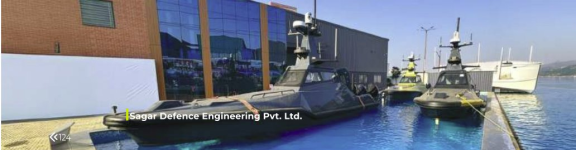
Indian Navy is set to get the delivery of the first batch of the country’s first-of-its-kind autonomous weaponised unmanned fast interceptor crafts (FICs) from a Pune-based defence company, Sagar Defence Engineering, that will help the naval force in securing its maritime boundaries and give a big boost to its special missions along the Indian coast. With the induction of these unmanned weaponised crafts in the Navy, India will join the league of countries that possesses the technology to develop weaponised swarm (vessel) capability

The first batch of two new FICs from Sagar Defence’s Pune factory was dispatched to the Navy on Friday for deployment “somewhere in the west coast”, sources told TOI. The Navy had placed orders for 12 such weaponised boat swarms after signing a deal with Sagar Defence on Jan 5 in 2022. Designed, developed and manufactured entirely in India, FIC stands as a testament to the nation’s vision of self-reliance in defence technologies under the iDEX–DIO framework.

Till now, the Navy has been dependent on Israel-made unmanned surface vessels and that too for only mine counter-measure purpose.

First batch of two interceptors being dispatched to the Navy from the Pune factory of Sagar Defence on Friday

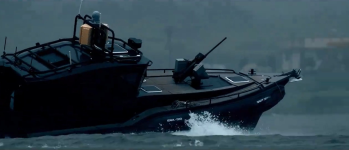
The unmanned interceptor craft is fitted with a 12.7 mm gun for close-range firepower and also equipped with the capability to deploy short-range missiles and loitering ammunition. Multiple fast interceptor crafts can be controlled from a single control station, multiplying force projection while reducing risk to human operators.

One of the most striking features of this interceptor craft is its ability to operate in a GPS-denied environment. Advanced navigation systems allow the craft to function reliably even under electronic warfare conditions, ensuring mission continuity where conventional platforms may falter. With an endurance exceeding two days at sea, the vessel offers sustained operational presence, enhancing maritime domain awareness.

Despite its unmanned nature, the craft is still capable of carrying over 14 personnel when required for special missions, adding to its operational flexibility for coastal operations, rapid insertion or evacuation roles. This layered weapon architecture enables the craft to respond decisively to a wide spectrum of threats, from asymmetric maritime challenges to high-intensity combat scenarios. Its operational range of over 400 nautical miles or approximately 800 km, positions it as a formidable asset for extended patrols and rapid response operations.

This technology capability is aligned with emerging global trends in network-centric and autonomous warfare, placing India firmly at the forefront of naval innovation.
 

Pune Inc | 10-year-old startup gets licence to build warships and submarines

Sagar Defence Engineering’s founder says the war in the Strait of Hormuz has revealed two critical opportunities: sea control and sea denial.

Written by: Dipanita Nath
Updated: Sep 30, 2026 07:38 PM IST
1791434843014.png
At Sagar Defence Engineering's shipyard in Andhra Pradesh. (Photo by special arrangement)

Pune-based Sagar Defence Engineering (SDE) has secured a licence to build warships and submarines for the Navy. Founded 10 years ago in a 150 sq-ft apartment, the startup has been building unmanned surface vehicles and unmanned underwater vehicles—technologies governed by the defence ministry’s strict regulatory framework.

Capt Nikunj Parashar, the former Merchant Navy officer who founded SDE, says, “The licence is proof that the government trusts organisations like us to undertake design, manufacturing, construction, integration, as well as testing, assembly, and supply of specific naval defence platforms and other ancillary associated systems.”

Parashar adds that the war in the Strait of Hormuz has revealed two critical opportunities: sea control and sea denial. The former means access and passing of traffic to the Strait that Iran and the US are controlling separately.

“Sea denial is of extreme importance and means that platforms are getting captured or the risk of vessels going down due to mines. This has made us understand that underwater domain awareness is the next big chapter in symmetric and asymmetric warfare of the future,” says Parashar.

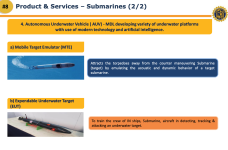
SDE has already been making unmanned underwater vehicles for the Navy’s mine countermeasure programmes. The Navy and the Coast Guard, among others, also use SDE’s maritime drones.

“These are completely built out of India except the engines and the radar,” says Parashar.

Young team of first-generation engineers

“SDE has a large team working on these projects, but you will be disappointed if you look for degree holders from the world’s top institutes here,” he adds.

The employees of the company, which Parashar says operates in a highly covert mode, have an average age of 23. “Most of us are from tier-III or tier-IV towns. Around 96 per cent of us come from families below the poverty line, children of traders, autorickshaw drivers, and laborers,” he says.

“It is our grit due to which we have managed to grow exponentially in a decade. We are driven by a dream of participating in India’s dream to become atmanirbhar by 2047,” Parashar adds.

https://indianexpress.com/article/c...icence-warships-submarines-for-navy-10900596/
 
SDE has already been making unmanned underwater vehicles for the Navy’s mine countermeasure programmes. The Navy and the Coast Guard, among others, also use SDE’s maritime drones.

Pretty natural evolution for a autonomous swarm boat with ~1500 km range to be eventually used for counter-mine missions. Was hoping for this for 2 years.
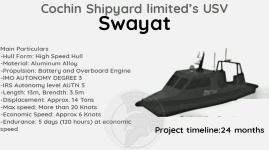
Sagar Defence Autonomous Weaponized Boat Swarm (AWBS):
View attachment 36936
View attachment 36937
View attachment 36938
View attachment 36939
Now if they could make a version of this boat for mine countermeasure role. That would plug a big capability gap in the navy.

In the MCMV tender the Navy states they want a 2, 800-ton ship (Almost the size of Kamorta class. Won't be surprised if the GRSE bids with a modified Kamorta class design). In terms of mine hunting equipment the MCMV is supposed to carry: 2x CASCADE-ASVs, 4x HW-AUVs, 20x ROVs & 1 NSUAS.

So, the CASCADE ASV will be the same as or a variant of the Matangi ASV:
1791436954929.png

CSL was also making a similar sized ASV. Still nowhere to be seen:
1791437017753.png

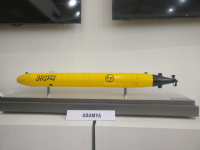
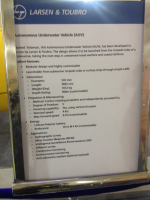
HW-AUV will probably be the same as or a variant of the L&T Adamya AUV :
1791437687514.png
1791437637965.png
The tender specifies that the HW-AUV should have the same diameter of a heavy torpedo & thus can be launched from torpedo launchers. The HW-AUV should weigh ~1 ton. Adamya is the closest match.

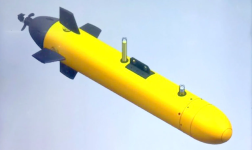
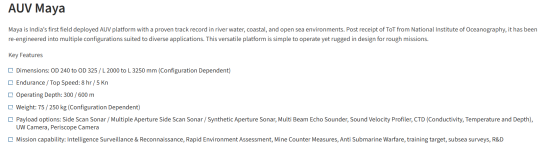
ROV will probably be the same as or a variant of the L&T Maya AUV:
1791438539081.png
Screenshot (1388).png
Maya's specs are the closest fit to the tender document.

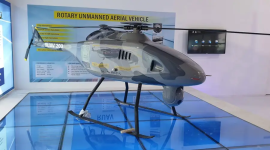
NSUAS will probably be the HAL RUAV-200 or a bigger variant of this:
1791438121631.png
Overall, the new MCMV project seems to have a coherent plan. It is largely based on tech that already exists & has plenty of room to grow & improve with time. Hope they can carry it through this time.
 
  • Informative
Reactions: Photon Vish