

Also, In my humble opinion, spending so much of money on the FCAS is a fools errand, Europe doesn't have a 5th gen of their own and hence want's to skip to 6th gen, unlike what India is developing, we don't even know what 6th gen capability will even be and considering most 6th gens have canards or tails, their airframe isn't very revolutionary either and many of the technologies will be likely shared between generations, we should just prioritise in the AMCA MK1 and MK2 to 5.5 gen category and buy 5.5 gen Su57 as stop gap, spending even half the money on what France expects us to spend on FCAS would provide our industry and indigenous capability with much greater returns than whatever this deal would bring, or we should collaborate with players like Russia who wouldn't ask for an arm an leg for such JV, Russia is a pioneer in the field and literally created the stealth doctrine, not to mention their expertise and experience on airframe design, engines, missiles, radars, control systems etc and the not so high per capita income would make a better choice for a country like India and historically Russia has been a much better technology sharing country than anyone else for us and considering the current Geopolitics involved, Russia wouldn't expect us to take a bad deal and would probably offer a very good deal acceptable to both countries.
India eyes 6th generation FCAS, looks at tying up with France for possible collaboration
- Thread starter Tatvamasi
- Start date
You are using an out of date browser. It may not display this or other websites correctly.
You should upgrade or use an alternative browser.
You should upgrade or use an alternative browser.

Broadly.Yes so what's in it for us especially given the huge bill that it comes with ? As I've pointed out before mfg expertise & project management comes with the Rafale.
Planes, locally built using critical components from French and non-critical components from India with specs that are fit for our usecase.
Drones, possibly built using Indian components. Fulfilling our usecase and built to our specs. Likely shared with France too.
IPRs associated, shared with France (like they did in Eurofailure).
Expansion of subsidiaries of French companies in India.
Experience at working on a frontier fighter jet project and how the project is run. Experience at how to control scope (most important).
Opportunity to export the same.
I think this is very much worth it. Lets face it, till date we have not run a complete fighter jet program successfully.
Trust is in delivery after signing contract. Simple. Nothing before.There has to be a minimum level of trust without which no business venture goes anywhere.
It was a business deal. We had an L2 vendor too. If the violation was bad enough, MoD could have moved to L2 vendor. Forces were happy with either AFAIK. But certainly how negotiations went afterwards, those "violations" were not of much consequence. Remember, we gave french deal for jets for carrier too. So MoD did not hate it enough. Again, we HAD options for navy jets too.What DA did was not just opportunistic & unethical , it was plain bad faith. Ideally they shouldn't be part of any future procurement. But we've severe limitations in terms of the alternatives . That's the only reason they're being entertained & they know that.
Possibly you feel it is bad faith but MoD does not feel it that strongly. Their behaviour supports it. Or may be there are mechanisms that are not disclosed. (read below).
Hard to tell. If the money is to be made France will certainly entertain Australia.Australia almost concluded a deal for 12 nos conventional submarines with France but pulled out at the last minute. You think France won't respond the next time Australia invite them to participate in another tender for submarines in spite of the bad blood ? Yet what'd be the level of trust if both actually sit down to sign an agreement ?
Atleast in west, deal ain't done till the paper is done. France also has history of walking out of eurofailure project. But then Germany walked out of FCAS. Do you gather French will not deal with Germans?
The standard way to deal with these kind of situation in formal setting is to compensate for lost time. Long term partners often do it. Sometimes it is included in formal invitation too. I do not know how dealing with MoD went. Who compensated whom and by how much.
I mean, ultimately, everything is bottom line. And money changes hands to account for violations or inconvenience. Not everything is disclosed formally. Seen such deals. Can not say if France and its customer have such arrangement or not. Most of the time it is cost of doing business.
I believe it is wrong to generalize this as purely french behaviour. DA's delivery has been good enough after signing contract.What do you think happened in the Scorpene deal ? Why don't you read up on why Naval Group's behaviour infuriated the IN ? And we aren't the only aggrieved party here.
Also, to be frank, I am not sure what infuriated IN. All I know is in parliament, delay in P75 was blamed on DCNS/NG having defects in their work and delay in providing needed modifications and critical items. That is more of a competence thing than anything else. If there was any other tussle or an angle that I do not know I will love to know.
From what I know, Norway itself cancelled supply of critical missiles (https://www.reuters.com/business/ae...ion-norway-over-axed-defence-deal-2026-05-19/) to Malaysia inspite of signing contracts and receiving payments. They look more like offender here.Earlier there were reports from Malaysia about much the same grievances that IN voiced. There used to be a member from Norway here who reported similar behaviour from le Francais . Norway wasn't convinced of NG's sincerity & awarded the tender to TKMS.
What grievances did Norway had with France? I have never seen any info about deals between DCNS and Norway that ultimtely went to TKMS. Norway signed deal with TKMS in 2017. French had proposed kalavari but they chose german subs due to better G2G deal.
What dirt was found here?
Honestly, I do not.Do you or do you not see a pattern in le Francais behaviour be it NG or DA ?
Integration is hard business. It will take a decent 10 year or so for new "HAL" to come to speed. I am all in for new HAL and its associated design agency so we can have competition in make in india projects. You need to duplicate or specialize design beauro/group because you want to weed out monopoly of DRDO/ADA/HAL.Don't know what're you talking about. I was referring to an alternative lead system integrator on the lines of HAL. Why would you need to duplicate the entire ecosystem ? Those vendors & sub contractors can & will remain the same .
I will just copy the darn Chinese structure. A PPP holding company with underlying subsidiaries specializing in different types of airplanes and competing for government projects. Design institutes should be attached with the subsidiary itself and their funding should come from their respective company. If a darn company is not working well, its good employees should be absorbed by other subsidiaries and/or completely revamped by firing management/leadership. Tie their bonuses to projects. Let them earn money by doing a great job.So please suggest an alternative Indian design house !
I believe IAF and MoD are already running some kind of study. DRDO etc were chatting about sixth gen. Right now FCAS is dead because Germany walked out. We need to figure out our requirements, France needs to consider who will join and will it be only India. Yes, things will take time to get the ball rolling but then thats what happen when JVs fall apart. I believe France will still complete the project by late 2040 or earlier.Before you start the program you need to have studies to understand the details of what the services require your own competence in delivering them a quality product & that too on time for which you've got to have a fair understanding of your industrial depth for the technologies you've to develop for this particular program.
This is a time consuming process & usually takes a good 4-5 years. Our aim in commencing negotiations with DA for FCAS besides figuring out the nature of the JV our work share contribution etc would be to understand what exactly are their detailed plans vis a vis the 6th Gen FA project?
Then we sit & try to harmonise that with the requirements of the IAF while figuring out what new technologies need to be developed our expertise in developing it time taken cost implications identification of vendors to partner in its development & areas where we'd be unable to bridge the gap.
Then comes the decision making about whether we can manage to get this technology thru consultancy or thru a JV for that particular technology & so on . After cost considerations are evaluated for all these scenarios will come the decision on whether we need a JV for the entire project or part of it or some specific areas like propulsion system.
The reason is, one of the biggest activity in fifth and likely sixth gen development is avionics, namely software part of it. F-35 famously spent a lot of time in this. Software with right AI has been accelarated 100x. I am personally using it for an industrial / infra kind of application in my own business. It is allowing me to do in 1 day what took several months. And this is low level core firmware work with signal processing. AI is next level stuff really.
I do believe it will be full JV. IAF is now really scared. They will push for JV. Unless some moron goes full retard in MoD, this JV is the only way out of our mess.
Whatever we can get from France to be honest. I believe it will be mostly in drones. Because first Germany was dealing with it. And second, it does not involve sixth gen propulsion etc.The issue isn't if they won't deliver a plane. The issue is what part in the development of it we play & what do we learn from it given the massive investment we're making.
Name few alternatives. ITAR free companies and supply chain outside of French aerospace industry which can do a sixth gen aircraft.And I've been pointing out that there are alternatives to ITAR we can explore assuming we do collaborate with a country which is heavily into ITAR stuff. Since we aren't I fail to see why should you raise the question repeatedly . You sure sound like a broken record all thru this post & the previous one.
I am asking it because US can apply ITAR sanction on us and deny the parts under ITAR. ITAR is their law and their companies need to comply with it. Eurofailure suffered from it.
:OThe AMCA Mk-1 is largely complete. What's awaited is the announcement of a system integrator . Post that it's a question of building the prototype getting it into trials & certification.
You have way too much confidence in a plane that has not yet flown! What if it crashes on first flight? What if it required major redesign on flying
I will not term it as anywhere near complete. Heck I am worried about its propulsion system. It clearly needs 120KN engine. I do not know what GE is selling it and is it enough to propell it.
Not to mention, I do not know if conformal EOTS is ready or not. I have more confidence in Virupaksha however.
First road block: Propulsion. GE says no and delays engine variant development. AMCA is dead in water. And GE can do it. GE is giving a variant of F414. Supposedly EPE variant with about 108 KN or so. And that, last I checked, was only a power point slide. That engine needs to be completed before we can open the flight envelop of AMCA MK-1.The winner should be announced this financial year. Work should commence on the prototype the next year . It's 3-4 years to build the prototype post which you have taxi trials & First Flight.
That's 2031 or 32 . It should be certified 5 years post First Flight post which or perhaps in between you take up building of the Mk-2 prototype . Where did you get the timeline of 2080 from ?
GE Aviation knows we want our own engine. So it see no future in selling us engines. It can keep us on hook for a long time by giving us a cock n bull story about variant development. I do not know what contingency we have.
Once this delay sets in, like in our previous projects it set in, in past, this will mean 10 year or more of delay. So IOC shifted by 10 years. We are looking at 2042 for IOC, assuming all other things go well.
And judging how much time and money F-35 took, we could be in long haul too for integration nightmare. I see 2030s unrealistically optimistic for even IOC.
Remember, right now GE has no benefit in making us successful. Unlike DA in making FACS success. Now assuming by 2041-42 you get IOC. 2050 you get FOC due to this and that certification and IAF requirement change (due to delays). You are looking at first assembly line in 2050s. Assuming you build 200 of this jet, we are looking at 2070 for that production to finish.
Assuming MK-2 variant with Indian engine is built in parallel since 2050, 10 more years for developing MK-2 variants. 2060. 20 years of production of MK2. We get to 2080.
Assuming MK-2 is actually sixth gen. That means a major airframe and avionics redesign and not just upgrade. Thats 15 years from 2050 or 2065. So till 2085 you get all your sixth gens.
Ofcourse, I am just winging the timeline. But I am more pessimistic because of what I have seen and what I foresee.
PS: Skipping AIP + Turkey + UK capability as agreed.

But here we all understand the "WHOLE" & "They" type people but they are small bunch of higher level people. PMO/MoD need to sideline/re-assign them.I do not and can not comment on ALL individual working in DRDO eco system. I can certainly say that as a WHOLE when it comes to aerospace development, they are bunch of jokers and they have childish plans and they need adult supervision of someone like DA in a JV who can keep scope of project in control properly.
I am sorry to say that the approach you are talking about? It does not work. Because they have two generations of jets under anvil right now. To give them one more generation to work on, even at a subcomponent level, without any competent supervision is an exercise is insanity.
When you are running late, the least you can do is not to take additional groundbreaking work atleast.
You highly highly underestimate what it takes to even build a plane let alone a sixth gen one.
BTW, sorry to disappoint you, we do not have ready to pick "talent" who can dream up how to build a sixth gen fighter lying around all over India. Such talent is developed in an ecosystem of aerospace industry that does not currently exist and will take several dacades to develop.
- We're not talking about giving anything to kind of people you refer to as "THEM" who should be filtered by PMO/MoD.
- Capability is tested in technical interview. Only constructive, optimistic people get through HR round.
- It is illogical to generalize, based on bunch of jokers, to underestimate 20-25 million people passed out of AICTE approved colleges since 2000 AD, have worked in industry since 10/20/30 years, many of whom have watched documentaries & videos on various tech every day.
- Every "groundbreaking" work has beginning & pessimism, procrastination delays starting point.
- Running late means collaborate on few things & make our original product, not full import or piggyback, get squeezed by capitalist nations.
FACS is not a guarentee against war. It is not a magic bullet. It is however, a credible effort to reduce iAF's capability cap in a faster manner that has built up due to our past delays in development and stupid procurement policies.
If a war happens in between, we will have to fight and face the consequences. What FACS does is that after 2040 or 2050, we would have lowered the capability gap that we have created vis a vis our enemies.
In its absence, even in 2050 we will likely be facing much wider capability gap.
- And i've said that we can get some FCAS as stopgap (although i would prefer only JV engine & some components), So you should feel happy.
- Capability gap reduces by gaining confidence & practically making something of our own from JV, not latching on & piggybacking, full imports, losing all hopes & confidence, generalizing incapability on entire nation based on bunch of jokers, discouraging, delaying,
- So in parallel the domestic effort also has to start today.
Dude. Take a look. How many companies in India are doing even basic spring manufacturing? Building their own machines to do basic metal work?
I know only one.
Try getting a simple Chainmail built in India. They will import from China and sell it to you. Our manufacturing in India is very very much behind. And so are our polytechnics.
Take a look at mech. engineering poly tech course work here: Government Polytechnic Mumbai – (An autonomous Institute of Government of Maharashtra)
Now tell me, how much do you see on CNC mills? CNC Routers? How much do you see on additive manufacturing? How much do you see in aerospace grade 3-d printing here? They do not even have PEEK manufacturing. Additive or Subtractive. They do not tech PEEK injection moulding. PEEK 3-d printing (PEEK is notoriously hard to print) or PEEK CNC machining.
This is not a research job or even engineering job. It is technician's work. You need these skills to be taught in polytechniques if you want to create such a workforce.
- You expect people here to be industrial journalist keeping track of 1000s of institutions? When since decades countless people have worked in steel plants, fabrication factories,that itself means 1000s of institutions are not same like the bad examples you give. Examples of startups in many domains give hope, encouragement, motivation, confidence.
- GoI/MoD needs to improve national management, arrange missing tools, initiate effort to make own products & also tools to avoid future imports, otherwise they'll be voted out in next election. And the opposition parties have loved import culture since decades.

LOL! Interestingly, my own research and development (I have a small and specialized business) is on this only. AI based monitoring of infra and prediction of infra failure. Lots of techniques that needed a team of PhD to conduct the analysis can now be done by a box sitting somewhere. Entire analytical techniques that were research only can now be deployed in field in an automated fashion.
If everything goes well, my work might get a chance to serve Canadian forces. The reason I am able to do so is because Canada really really needs deep technology in present climate.
It is really interesting time ahead that human expertise is being converted into automation systems.
All the best for your venture.
In India the issue is data sets are not available, or may be they lack this approach and depend completely on algorithms. They may train the tool but then there are always shortcomings due to lack of high grade data.

Before comparing the different aircraft currently presented as “sixth-generation fighters”, it may be useful to first define the operational need, independently of the technological solutions chosen to meet it.
In my view, the fundamental change is not simply a new generation of stealth, engines, sensors or weapons. It is a change in the architecture of air combat.
The objective was to concentrate on a single aircraft most of the capabilities required to perform the mission: sensors, electronic warfare, weapons, computing power, communications and survivability.
Even when aircraft were networked together, the network mainly increased the effectiveness of platforms which remained individually capable.
A sixth-generation combat system should go one step further.
Instead of concentrating the means on a platform, it should be able to concentrate the effects of distributed means on an objective.
Detection could be performed by one node, identification by another, electronic attack by a third, decision-making by another and the weapon launched by yet another platform.
The relevant combat entity is therefore no longer necessarily the individual aircraft, but the distributed combat system.
The system must be able to generate the required military effect, at the required place and time, in a highly contested environment, despite enemy attempts to detect, disrupt, deceive, isolate or destroy parts of the system.
This implies several requirements.
First, the system must maintain an information and decision advantage over the adversary.
Second, it must remain capable of producing effects despite attrition, jamming or the loss of individual nodes.
Third, the different functions of the combat system should be capable, whenever practical, of being distributed and dynamically recombined according to the mission.
Fourth, the architecture must provide sufficient mass. Concentrating every capability on a very small number of extremely expensive platforms eventually creates a force that cannot afford losses.
Finally, the system must be able to evolve rapidly as threats, sensors, weapons, software and tactics change.
Traditionally, survivability primarily meant making the combat aircraft itself difficult to detect and destroy.
In a distributed architecture, the operational requirement is broader:
the system must survive well enough to continue producing the required effect.
This does not necessarily mean that every component must penetrate the enemy threat environment.
The manned aircraft, for example, may remain outside the most dangerous area while sensors, electronic warfare assets or effectors operate further forward.
If the network is sufficiently resilient, avoiding exposure may be a perfectly valid alternative to making every platform capable of surviving deep penetration.
Stealth therefore remains a possible and important solution, but it should not be confused with the operational requirement itself.
The more functions are distributed between different platforms, the more the system depends on the network connecting them.
A sixth-generation architecture therefore cannot simply be “highly connected”. It must be resilient to the loss of connectivity.
If one sensor, relay or command node disappears, the system should ideally be able to reconstruct another sensor-to-effector chain using the remaining assets.
In other words, a distributed combat system should degrade gracefully rather than collapse when part of the network is lost.
This introduces an important design parameter:
How much dependence on the network is operationally acceptable?
There is probably no universal answer.
One architecture may accept a very high degree of network dependence and keep the manned aircraft well protected.
Another may require the manned aircraft to retain enough sensors, weapons and survivability to continue the mission autonomously if the distributed network is severely degraded.
This may ultimately explain some of the differences between future fighter programmes better than conventional “generation” labels.
A fourth- or fifth-generation aircraft can potentially operate inside a sixth-generation combat system.
A Rafale, F-35 or Typhoon does not become a sixth-generation aircraft merely because it is connected to drones and distributed sensors.
But it can become one of the nodes of a sixth-generation system if the system is capable of distributing and dynamically combining sensing, decision-making and effects.
This is important because it means that the network, collaborative combat concepts, autonomous systems and distributed effectors can be developed and tested before the future fighter itself is available.
Existing aircraft can therefore help develop the sixth-generation system and, perhaps even more importantly, help determine what capabilities really need to remain onboard the future manned platform.
A sixth-generation air combat system is a resilient and evolvable networked architecture in which combat functions can be distributed among multiple manned and unmanned nodes and dynamically combined to concentrate the required effects on an objective, while maintaining the ability to continue the mission despite attrition, disruption or partial loss of connectivity.
The “sixth-generation fighter” is then only one component of this architecture.
Its size, stealth, range, sensors, weapons, autonomy and even how deeply it needs to penetrate enemy airspace should not define the generation by themselves.
They should be regarded as solutions derived from the architecture and from the degree of network dependence that each country is prepared to accept.
With this definition in mind, it becomes much more interesting to examine the F-47/CCA, GCAP, FCAS/NGF and the emerging Chinese programmes and ask not simply which aircraft is the most advanced, but:
How does each programme distribute sensing, decision-making, survivability and weapons across the system, and what happens when the network starts to fail?
In my view, the fundamental change is not simply a new generation of stealth, engines, sensors or weapons. It is a change in the architecture of air combat.
From platform-centric to effect-centric warfare
Until now, combat aircraft have essentially been platform-centric.The objective was to concentrate on a single aircraft most of the capabilities required to perform the mission: sensors, electronic warfare, weapons, computing power, communications and survivability.
Even when aircraft were networked together, the network mainly increased the effectiveness of platforms which remained individually capable.
A sixth-generation combat system should go one step further.
Instead of concentrating the means on a platform, it should be able to concentrate the effects of distributed means on an objective.
Detection could be performed by one node, identification by another, electronic attack by a third, decision-making by another and the weapon launched by yet another platform.
The relevant combat entity is therefore no longer necessarily the individual aircraft, but the distributed combat system.
The operational requirement
The basic requirement could therefore be expressed as follows:The system must be able to generate the required military effect, at the required place and time, in a highly contested environment, despite enemy attempts to detect, disrupt, deceive, isolate or destroy parts of the system.
This implies several requirements.
First, the system must maintain an information and decision advantage over the adversary.
Second, it must remain capable of producing effects despite attrition, jamming or the loss of individual nodes.
Third, the different functions of the combat system should be capable, whenever practical, of being distributed and dynamically recombined according to the mission.
Fourth, the architecture must provide sufficient mass. Concentrating every capability on a very small number of extremely expensive platforms eventually creates a force that cannot afford losses.
Finally, the system must be able to evolve rapidly as threats, sensors, weapons, software and tactics change.
Survivability becomes a system property
This also changes the meaning of survivability.Traditionally, survivability primarily meant making the combat aircraft itself difficult to detect and destroy.
In a distributed architecture, the operational requirement is broader:
the system must survive well enough to continue producing the required effect.
This does not necessarily mean that every component must penetrate the enemy threat environment.
The manned aircraft, for example, may remain outside the most dangerous area while sensors, electronic warfare assets or effectors operate further forward.
If the network is sufficiently resilient, avoiding exposure may be a perfectly valid alternative to making every platform capable of surviving deep penetration.
Stealth therefore remains a possible and important solution, but it should not be confused with the operational requirement itself.
Network resilience is therefore central
There is, however, an obvious consequence.The more functions are distributed between different platforms, the more the system depends on the network connecting them.
A sixth-generation architecture therefore cannot simply be “highly connected”. It must be resilient to the loss of connectivity.
If one sensor, relay or command node disappears, the system should ideally be able to reconstruct another sensor-to-effector chain using the remaining assets.
In other words, a distributed combat system should degrade gracefully rather than collapse when part of the network is lost.
This introduces an important design parameter:
How much dependence on the network is operationally acceptable?
There is probably no universal answer.
One architecture may accept a very high degree of network dependence and keep the manned aircraft well protected.
Another may require the manned aircraft to retain enough sensors, weapons and survivability to continue the mission autonomously if the distributed network is severely degraded.
This may ultimately explain some of the differences between future fighter programmes better than conventional “generation” labels.
The aircraft and the system are not the same thing
This distinction leads to another important consequence.A fourth- or fifth-generation aircraft can potentially operate inside a sixth-generation combat system.
A Rafale, F-35 or Typhoon does not become a sixth-generation aircraft merely because it is connected to drones and distributed sensors.
But it can become one of the nodes of a sixth-generation system if the system is capable of distributing and dynamically combining sensing, decision-making and effects.
This is important because it means that the network, collaborative combat concepts, autonomous systems and distributed effectors can be developed and tested before the future fighter itself is available.
Existing aircraft can therefore help develop the sixth-generation system and, perhaps even more importantly, help determine what capabilities really need to remain onboard the future manned platform.
A possible definition
I would therefore propose the following working definition:A sixth-generation air combat system is a resilient and evolvable networked architecture in which combat functions can be distributed among multiple manned and unmanned nodes and dynamically combined to concentrate the required effects on an objective, while maintaining the ability to continue the mission despite attrition, disruption or partial loss of connectivity.
The “sixth-generation fighter” is then only one component of this architecture.
Its size, stealth, range, sensors, weapons, autonomy and even how deeply it needs to penetrate enemy airspace should not define the generation by themselves.
They should be regarded as solutions derived from the architecture and from the degree of network dependence that each country is prepared to accept.
With this definition in mind, it becomes much more interesting to examine the F-47/CCA, GCAP, FCAS/NGF and the emerging Chinese programmes and ask not simply which aircraft is the most advanced, but:
How does each programme distribute sensing, decision-making, survivability and weapons across the system, and what happens when the network starts to fail?

This country is already doomed. Whoever be in power in next 3 decades ( the present ruling side or, the opposition ) downfall is evident. Let me explain how.GoI/MoD needs to improve national management, arrange missing tools, initiate effort to make own products & also tools to avoid future imports, otherwise they'll be voted out in next election. And the opposition parties have loved import culture since decades.
Programmes like AMCA or, JV in FCAS project will need THE BEST TALENTS, BEST MINDS of your country be there. But what this country is doing now is equivalent to killing this potential. In the name of SOCIAL REPRESENTATION, HISTORICAL JUSTICE, SOCIAL UPLIFTMENT, how Nip in the Bud of THE BEST POTENTIAL MINDS is justifiable ? Especially in critical sectors like INNOVATION, DEFENCE, MEDICAL STUDIES.
From the experience of public organisations like HAL, NAL ... It is now clear that present methods of recruitment and involvement of people is not on right track.
No country , be is USA, RUSSIA, ISRAEL or, FRANCE, will give you their critical niche technology with complete know-how unless you develop your own.
The more dangerous thing is the parties / political organisations (who are or, maybe in power) are now promoting the same Framework to Private Sectors.
If Dumb heads are sent from our side to participate in FCAS JV , we'll get absolutely ZERO Critical know-how on the project and end up with mere Screw Driver Giri which we can see from our historical experience with various JV projects.
As far as the FCAS JV is concerned, I support the decision, but I've huge doubt about we'll get / be able to get any critical access to the project inspite of investing a big amount of money.
The system of this nation is defective from the root which can't be fixed merely by changing the Govt. ( I wish it was possible ) .
Unfortunately, Vote bank matters more here than true development.
Jai Hind.
That's what i'm also saying that no leader nation hands over latest tech unless other participants also have some same level of input or can be huge sponsors. We don't have either.This country is already doomed. Whoever be in power in next 3 decades ( the present ruling side or, the opposition ) downfall is evident. Let me explain how.
Programmes like AMCA or, JV in FCAS project will need THE BEST TALENTS, BEST MINDS of your country be there. But what this country is doing now is equivalent to killing this potential. In the name of SOCIAL REPRESENTATION, HISTORICAL JUSTICE, SOCIAL UPLIFTMENT, how Nip in the Bud of THE BEST POTENTIAL MINDS is justifiable ? Especially in critical sectors like INNOVATION, DEFENCE, MEDICAL STUDIES.
From the experience of public organisations like HAL, NAL ... It is now clear that present methods of recruitment and involvement of people is not on right track.
No country , be is USA, RUSSIA, ISRAEL or, FRANCE, will give you their critical niche technology with complete know-how unless you develop your own.
The more dangerous thing is the parties / political organisations (who are or, maybe in power) are now promoting the same Framework to Private Sectors.
If Dumb heads are sent from our side to participate in FCAS JV , we'll get absolutely ZERO Critical know-how on the project and end up with mere Screw Driver Giri which we can see from our historical experience with various JV projects.
As far as the FCAS JV is concerned, I support the decision, but I've huge doubt about we'll get / be able to get any critical access to the project inspite of investing a big amount of money.
If 4gen Rafale deal has been a roller-coaster ride then true 6gen is 2 notches above, with a capitalist nation.
It is like SE nations would like to be part of our top project like AMCA or S5 sub, etc.
Hence we need JV for engine & some components & our own PPP effort starting today for next 15-20 years.
The system of this nation is defective from the root which can't be fixed merely by changing the Govt. ( I wish it was possible ) .
Unfortunately, Vote bank matters more here than true development.
Jai Hind.
Changing govt.? The opp. parties happily created Pakistan & Bangladesh. Everybody knows they wan't to separate NE, JK, etc in the name of democracy, aided by caught foreign sleeper agents, seen in news.
Anyways, whatever be the unpredictable future, hopeless citizens start civil war, nation is not built, sustained like this.
Hence as per best educated guess also if we'll loose a future war, no matter how many decades it'll take to get right management, still if we think we're matured adults then at least we have to be individually strong, constructive, give our best.

GoI providing grants for tech/engineering currently is good, but to be truly Vixit it has to fund basic fundamental science and math. IMHO, a better use of this much money would be GoI building world class post-grad institutions on the higher end and vocational schools on the lower end.
Initially, I tried reaching out to Indian dry docks. Problem in India is, no one pays for automation because the Indian shipping companies usually focus on keeping cost low in the short term. In Canada, especially in arctics, they critically need automation to work with reduced workforce plus they need my kind of work to comply with rules here. Its just different priorities. So, I did what any business guy does. Pivot to who will pay.All the best for your venture.
In India the issue is data sets are not available, or may be they lack this approach and depend completely on algorithms. They may train the tool but then there are always shortcomings due to lack of high grade data.
Indeed, system of systems. A swarm of manned and unmanned systems where individually each node of the swarm may not be even better than past A/Cs but swarm as an entity is more effective in completing mission objectives.Instead of concentrating the means on a platform, it should be able to concentrate the effects of distributed means on an objective.
Detection could be performed by one node, identification by another, electronic attack by a third, decision-making by another and the weapon launched by yet another platform.
The relevant combat entity is therefore no longer necessarily the individual aircraft, but the distributed combat system.
Its same pattern that 2000s saw in computing. A cluster of mid-cost distributed server with specialization vs massive and costly mainframes. Scale out vs Scale up.
Yup. All features of classic scale out pattern.First, the system must maintain an information and decision advantage over the adversary.
Second, it must remain capable of producing effects despite attrition, jamming or the loss of individual nodes.
Third, the different functions of the combat system should be capable, whenever practical, of being distributed and dynamically recombined according to the mission.
Graceful degradation vs single system resiliance. Same pattern seen Mainframe vs cluster.This also changes the meaning of survivability.
Traditionally, survivability primarily meant making the combat aircraft itself difficult to detect and destroy.
In a distributed architecture, the operational requirement is broader:
the system must survive well enough to continue producing the required effect.
This does not necessarily mean that every component must penetrate the enemy threat environment.
The manned aircraft, for example, may remain outside the most dangerous area while sensors, electronic warfare assets or effectors operate further forward.
If the network is sufficiently resilient, avoiding exposure may be a perfectly valid alternative to making every platform capable of surviving deep penetration.
Stealth therefore remains a possible and important solution, but it should not be confused with the operational requirement itself.
Yup same learning from cluster/distributed computing. Packet switched networks instead of circuit switched networks. Peer to peer vs spoke and hub. Topological advantage by choosing an arechitecture that can survive a network split. Exactly why internet is architected in the way it is. Cool to see it is coming in fighter jets/airforce too.There is, however, an obvious consequence.
The more functions are distributed between different platforms, the more the system depends on the network connecting them.
A sixth-generation architecture therefore cannot simply be “highly connected”. It must be resilient to the loss of connectivity.
If one sensor, relay or command node disappears, the system should ideally be able to reconstruct another sensor-to-effector chain using the remaining assets.
In other words, a distributed combat system should degrade gracefully rather than collapse when part of the network is lost.
This introduces an important design parameter:
Till now Airforces were networked the way 80s and early 90s network used to work. Dedicated link level networks. I guess sixth gen will be more "distributed". Somewhat like internet.
Well, if you architect your fighting fleet as a spoke and hub architecture (say around an AWACS), it will lose networking when you blow up the AWACS. If you architect your fleet as peer to peer architecture, shooting down few drones, few fighters jets, even AWACS will not fully disable your fighting network. Because AWACS was just one node doing specific job.A sixth-generation air combat system is a resilient and evolvable networked architecture in which combat functions can be distributed among multiple manned and unmanned nodes and dynamically combined to concentrate the required effects on an objective, while maintaining the ability to continue the mission despite attrition, disruption or partial loss of connectivity.
The “sixth-generation fighter” is then only one component of this architecture.
Its size, stealth, range, sensors, weapons, autonomy and even how deeply it needs to penetrate enemy airspace should not define the generation by themselves.
They should be regarded as solutions derived from the architecture and from the degree of network dependence that each country is prepared to accept.
With this definition in mind, it becomes much more interesting to examine the F-47/CCA, GCAP, FCAS/NGF and the emerging Chinese programmes and ask not simply which aircraft is the most advanced, but:
How does each programme distribute sensing, decision-making, survivability and weapons across the system, and what happens when the network starts to fail?
Even that job may be distributed over a number of communicating drones instead of a single massive aircraft that is visible from far and very costly.

I agree. But the main concern is the present ruling side is ranting the same lines of the opposition to remain in power ; from FREEBIES in name of Gender, Caste etc. to DESTROYING the true Merit and promoting mediocrity & incompetence. The problem of BRAIN - DRAIN will increase by multiple folds in near future. This nation needs free quality education and health care for Kids upto 16 years age , not FREEBIES to GROWN ADULTS to promote vote bank politics.Changing govt.? The opp. parties happily created Pakistan & Bangladesh. Everybody knows they wan't to separate NE, JK, etc in the name of democracy, aided by caught foreign sleeper agents, seen in news.
Be it AMCA, FCAS JV or, any other future military project the present footsteps at root levels by the govt. & proposed footsteps of the opposition if they can form a Govt. in future, BOTH are looking disappointing & disastrous for the nation.
If this continues then darkness of a NEW COLONIZATION will devour this land again and then those people who are jumping in joy of their personal & group profit /gains will understand that they shoot themselves in their feet in addiction of revenge.
Last edited:
I agree. But the main concern is the present ruling side is ranting the same lines of the opposition to remain in power ; from FREEBIES in name of Gender, Caste etc. to DESTROYING the true Merit and promoting mediocrity & incompetence. The problem of BRAIN - DRAIN will increase by multiple folds in near future. This nation needs free quality education and health care for Kids upto 16 years age , not FREEBIES to GROWN ADULTS to promote vote bank politics.
Be it AMCA, FCAS JV or, any other future military project the present footsteps of the govt. & proposed footsteps of the opposition if they can form a Govt. in future, BOTH are looking disastrous for the nation.
If this continues then darkness of a NEW COLONIZATION will devour this land again and then those people who are jumping in joy of their personal & group profit /gains will understand that they shoot themselves in their feet in addiction of revenge.
I don't intend to get into politics but few things in short -
- All politicians across world rant about some things & try to get vote bank in different ways. it's like chess game, if they won't then opposition will, bitter truth. Bad guy is better than worse guy & worse guy better than worst guy. Like JK plot, other plots are going on in NE & other pockets.
- Currently there are skill development schemes -
= PMKVY 4.0: Pradhan Mantri Kaushal Vikas Yojana provides free, industry-relevant short-term training and tech-focused courses in areas like AI, robotics, and drones
= NAPS: The National Apprenticeship Promotion Scheme combines practical on-the-job training with partial stipend support transferred directly to bank accounts.
= JSS: Jan Shikshan Sansthan offers localized, community-based vocational training for rural youth and school dropouts.
= Cash Transfers (e.g., Ladli Behna Yojana): Handled primarily at state levels to provide immediate financial relief and consumption support for low-income households. To track and prevent the misuse of the Ladli Behna Yojana, state governments rely on strict digital auditing, biometric authentication, mandatory e-KYC Verification, Aadhaar-linked Direct Benefit Transfers (DBT), cross-departmental data tracking,legal & financial recovery if frauds/scams discovered.
Anyways, technically let's hope PPP & JV succeed in time.


This nation needs free quality education and health care for Kids upto 16 years age , not FREEBIES to GROWN ADULTS to promote vote bank politics.
If we are discussing AMCA, geo politics, discussing about 6th generation engine technologies, Satellite communication etc then trust me call and say we are very privileged due to our upbringing and how we are educated at home and at school irrespective of financial status. Even the people in government have no knowledge and they slowly learn in the span of 10-20 years what we are discussing now.
People are habitual free loaders in India. Few days back in west UP a sub inspector from UP Police was on raid so almost every one in the team picked up raided items and brought to their homes. His wife was saying why he brought washroom articles, should have brought some kitchen utensils or crockery instead.
You have no idea how much backward majority of population is mentally in India.
Unless until India is USD 10-15 trillion economy, this issue will remain. You can't bring a generation to tier 1 level overnight by just only educating them. 50 years more it would take. Good that from 100 years we have reduced it to 50 years now.
Hardly 5% in India are actually aware of geopolitics and nation, this is the ultimate reality.
If we are discussing AMCA, geo politics, discussing about 6th generation engine technologies, Satellite communication etc then trust me call and say we are very privileged due to our upbringing and how we are educated at home and at school irrespective of financial status. Even the people in government have no knowledge and they slowly learn in the span of 10-20 years what we are discussing now.
People are habitual free loaders in India. Few days back in west UP a sub inspector from UP Police was on raid so almost every one in the team picked up raided items and brought to their homes. His wife was saying why he brought washroom articles, should have brought some kitchen utensils or crockery instead.
You have no idea how much backward majority of population is mentally in India.
Unless until India is USD 10-15 trillion economy, this issue will remain. You can't bring a generation to tier 1 level overnight by just only educating them. 50 years more it would take. Good that from 100 years we have reduced it to 50 years now.
Hardly 5% in India are actually aware of geopolitics and nation, this is the ultimate reality.
While it's true that our nation is largely literate but uneducated, lazy, even urban people, but numbers should not be shocking actually.
My college senior worked on LCA in 2000s, he was batch topper in college, cracked GATE with good marks & got into HAL.
25 million people passed out of 9,000 AICTE approved colleges since 2000 AD.
25 million is just 1.67% of 1.5 billion national population.
Now this sounds sarcastic & alarming but we need to see how many needed to design & manufacture the sophisticated level &/or classified components in special access facilities for ISRO, BARC, DRDO, ADA, NAL, HAL, etc.
Remaining things are just usual unclassified H/w built by remaining population.
Many classified components are built such that its individual part makers don't know what they're making for, nor they need to know. Only special level access assembly team knows.
I always keep in mind the geographical size, population of Israel, Sweden, France, UK, Turkey, S.Korea, Japan & actual # of special access staff designing & making their best stuff.
Out of 25 million total tech people, # of people with good marks getting into DPSUs, private firms, for strategic tech only, would be 10s of 1000s, but special access staff - designers, top level assemblers &testers, etc would be 1000s.
Now these top 1000s of people, in any nation, don't need to bother about entire nation's population, but just focus on their goals.
But problem is some bad managers, both tech & non-tech.
The usual way of discussing sixth-generation fighters is to ask whether the aircraft is primarily an interceptor, an air-superiority fighter, a deep penetrator or a strike aircraft.
I increasingly think this is the wrong level of analysis.
The real transition may be from platform-centric combat to effect-centric combat.
Networking improved the effectiveness of those platforms, but the aircraft remained the fundamental combat unit.
A sixth-generation system can go further.
Detection may be performed by one node, electronic attack by another, battle management by another, and the weapon may come from yet another platform. What matters is no longer that one aircraft possesses all the required capabilities, but that the system can dynamically assemble the capabilities required to produce the desired effect.
This suggests the following working definition:
A sixth-generation air combat system is a resilient and evolvable networked architecture in which sensing, decision-making, electronic warfare and effects can be distributed among multiple crewed and uncrewed nodes and dynamically recombined around the operational objective, while retaining the ability to continue the mission despite attrition, disruption and partial loss of connectivity.
The sixth-generation fighter is then one component of this system rather than its definition.
Its stealth, range, sensors, weapons and onboard computing should be consequences of the architecture and of the degree of network dependence considered acceptable.
If aircraft A detects, aircraft B decides and aircraft C fires, what happens when the connection between them disappears?
This means that network resilience is not merely a communications requirement. It becomes a combat capability.
There are several possible answers.
One can make the links extremely resilient.
One can give the distributed nodes sufficient autonomy to continue their assigned mission while disconnected.
One can retain enough capability in the crewed aircraft for it to take over when the distributed system is severely degraded.
The most robust solution may eventually combine all three.
This creates a much more useful discriminator between sixth-generation programmes than the traditional air-to-air versus air-to-ground classification:
Where does the tactical system that continues the mission reside when the wider network starts to fail?
This is clearly not simply a new F-22. The CCA concept distributes sensing and effects away from the crewed aircraft.
However, the United States is simultaneously investing heavily in the intrinsic capability of the F-47 itself.
This suggests an architecture that is effect-centric in normal operation but retains a very powerful platform-centric fallback.
The F-47 can exploit distributed sensors and effectors when the network is functioning, while its range, stealth, sensors and weapons reduce the consequences if that wider system becomes degraded.
Open sources do not prove that this is the exact operational doctrine, but they strongly suggest that the United States is unwilling to make the crewed core platform completely dependent on the distributed network.
The RAF requires its Autonomous Collaborative Platforms to execute assigned tasks without continuous human control, including the ability to reconstitute capabilities within their network. It also explicitly requires them to operate in disaggregated, disconnected and degraded environments.
That is a very strong doctrinal statement.
The British solution is therefore not simply to make the communication link impossible to jam. It is to make the distributed system capable of continuing when connectivity becomes intermittent.
But GCAP is not purely a British aircraft.
Japan originally specified that its future fighter must be capable of playing a central role in future networked warfare, and Japan continues to insist on timely upgrades, freedom of modification, domestic support and collaboration with unmanned aircraft.
This is important.
The British FCAS environment may push towards substantial functional disaggregation, while Japan's Indo-Pacific requirements may favour a very capable and autonomous Core Platform.
The same GCAP aircraft could therefore support different degrees of network dependence according to the national operational environment.
This may explain why GCAP remains an extremely capable aircraft even though the British are simultaneously pursuing a highly distributed combat architecture.
Airbus described FCAS in 2020 as a system of systems in which the OODA loop could be distributed across platforms, dynamically combining sensing, shooting and battle-management capabilities to create more resilient effects paths.
The Remote Carriers were therefore not simply loyal wingmen.
The architecture already allowed functions traditionally concentrated on the fighter to be moved elsewhere in the system.
At the same time, Airbus described the NGF itself as a very-low-observable battle-management platform equipped with advanced active and passive sensors and capable of operating deep within enemy space.
So the original FCAS did not remove penetration from the crewed aircraft. Rather, it distributed penetration across the system: NGF, Remote Carriers and ultimately the weapons could penetrate to different depths according to their value and function.
This is particularly compatible with the French approach to strategic strike, where the crewed carrier does not necessarily have to be the ultimate penetrator. The overall raid creates the conditions required for the carrier to reach its launch area, while the weapon performs the final penetration.
The early Airbus concept described an Air Combat Cloud continuously capturing, sharing, merging and processing information from connected platforms.
It described the nominal distributed system very well.
It said much less publicly about disconnected operations.
One reasonable interpretation is therefore that the original architecture implicitly accepted a very high dependence on connectivity. Whether that was a conscious confidence in network resilience, a problem not yet solved, or simply work that remained classified cannot be established from open sources.
What is interesting is what happened next.
Airbus even states that it is moving from platform-centric development to software-centric capabilities, and describes future combat aircraft as nodes and decision-makers inside a distributed combat network.
This suggests an important evolution.
The original FCAS concept distributed the functions.
MARS increasingly distributes the intelligence required to manage those functions.
If that development is pushed far enough, the tactical collective itself can become resilient rather than relying on one platform to restore coherence whenever communications are degraded.
That would be a distinctly distributed solution to the problem.
For Rafale F5, Dassault describes a combat drone co-operated from the aircraft, sovereign and supervised onboard AI, and future systems designed to retain operational effectiveness in high-intensity combat and contested network conditions through collaborative combat and adaptable, resilient configurations.
This suggests — although it does not prove — a philosophy in which the crewed aircraft remains an important node of authority and tactical coherence.
Airbus appears more naturally attracted to intelligence distributed across the collective.
One could therefore caricature the two approaches as:
Dassault: preserve a strong tactical centre while progressively extending capabilities around it.
Airbus: distribute intelligence so that the collective itself becomes the tactical centre.
This distinction is our interpretation, not an officially declared industrial disagreement.
And it may ultimately be a false choice.
A highly resilient architecture could combine both: distributed execution and reconfiguration among the unmanned nodes, while the crewed aircraft retains human authority, a complete local tactical picture and enough intrinsic capability to remain useful after severe fragmentation of the network.
But a sequence of small, operationally validated steps does not necessarily reach the destination later than an architecture that attempts the full conceptual jump from the beginning.
Rafale connectivity, then F5 collaborative combat, then the UCAV, progressively greater autonomy and eventually a future fighter could move functions away from the crewed platform step by step.
Dassault itself describes Rafale development as a process of continuous improvement driven by technological progress and operational feedback.
Interestingly, Airbus also described FCAS as an incremental journey as early as 2020, arguing that doctrines, skills and technologies had to be introduced step by step before the final system arrived.
So the real difference may not be “incremental versus revolutionary”.
It may be where each designer prefers to place tactical intelligence and authority during that evolution.
A distributed Airbus-type collective could request a capability from a Dassault-type system — for example forward passive sensing, jamming or an available weapon — without directly controlling the individual Dassault platform.
The request would pass through a common interface. The receiving system would determine whether the request is authorised and compatible with its priorities, then execute it using its own internal architecture.
In other words:
share capabilities and intentions, not necessarily internal control.
This distinction between tasking and authority is fundamental.
It would allow centralised human authority and distributed machine execution to coexist.
And it would produce the fully effect-centric system we are looking for: after the loss of one node, the system searches for another available capability rather than assuming that the function has disappeared with the platform.
This interoperability model is an architectural proposal, not something that open sources show has already been implemented between Dassault and Airbus systems.
For each programme, the more important questions are:
Where is tactical intelligence located?
Where is decision authority located?
Which functions can be moved away from the crewed aircraft?
Which component penetrates how deeply?
How far can the distributed nodes separate?
Can autonomous nodes continue their mission after losing connectivity?
Can the system reconstruct a sensor-to-effector chain after losing individual nodes?
How capable is the crewed aircraft when the network becomes severely degraded?
And how rapidly can the allocation of functions evolve during the life of the programme?
This framework produces an interesting provisional result.
F-47/NGAD, GCAP and FCAS no longer look like three fundamentally different concepts.
All three are moving towards effect-centric distributed combat, while preserving a highly capable crewed aircraft.
Their differences may lie primarily in the preferred distribution of intelligence, authority and fallback capability, and in the degree of network dependence they are prepared to accept.
That is a much subtler difference than saying that one is an interceptor, another a penetrator and another a multirole fighter.
And it is probably much closer to what will actually determine the effectiveness of sixth-generation air combat.
I increasingly think this is the wrong level of analysis.
The real transition may be from platform-centric combat to effect-centric combat.
From concentrating capabilities on the aircraft to concentrating effects on the target
Until now, the basic philosophy of combat aircraft has been to concentrate as many useful capabilities as possible on one platform: radar, electronic warfare, weapons, computing power, communications and survivability.Networking improved the effectiveness of those platforms, but the aircraft remained the fundamental combat unit.
A sixth-generation system can go further.
Detection may be performed by one node, electronic attack by another, battle management by another, and the weapon may come from yet another platform. What matters is no longer that one aircraft possesses all the required capabilities, but that the system can dynamically assemble the capabilities required to produce the desired effect.
This suggests the following working definition:
A sixth-generation air combat system is a resilient and evolvable networked architecture in which sensing, decision-making, electronic warfare and effects can be distributed among multiple crewed and uncrewed nodes and dynamically recombined around the operational objective, while retaining the ability to continue the mission despite attrition, disruption and partial loss of connectivity.
The sixth-generation fighter is then one component of this system rather than its definition.
Its stealth, range, sensors, weapons and onboard computing should be consequences of the architecture and of the degree of network dependence considered acceptable.
The crucial variable: acceptable dependence on the network
Functional disaggregation creates an obvious vulnerability.If aircraft A detects, aircraft B decides and aircraft C fires, what happens when the connection between them disappears?
This means that network resilience is not merely a communications requirement. It becomes a combat capability.
There are several possible answers.
One can make the links extremely resilient.
One can give the distributed nodes sufficient autonomy to continue their assigned mission while disconnected.
One can retain enough capability in the crewed aircraft for it to take over when the distributed system is severely degraded.
The most robust solution may eventually combine all three.
This creates a much more useful discriminator between sixth-generation programmes than the traditional air-to-air versus air-to-ground classification:
Where does the tactical system that continues the mission reside when the wider network starts to fail?
F-47/NGAD: an effect-centric system with a very strong core platform
The F-47 is officially described by the US Air Force as the cornerstone of the NGAD Family of Systems. It combines next-generation stealth, sensor fusion, long-range strike and modularity, while being developed alongside Collaborative Combat Aircraft.This is clearly not simply a new F-22. The CCA concept distributes sensing and effects away from the crewed aircraft.
However, the United States is simultaneously investing heavily in the intrinsic capability of the F-47 itself.
This suggests an architecture that is effect-centric in normal operation but retains a very powerful platform-centric fallback.
The F-47 can exploit distributed sensors and effectors when the network is functioning, while its range, stealth, sensors and weapons reduce the consequences if that wider system becomes degraded.
Open sources do not prove that this is the exact operational doctrine, but they strongly suggest that the United States is unwilling to make the crewed core platform completely dependent on the distributed network.
GCAP: one core aircraft, potentially several national network philosophies
The British documents are unusually explicit about resilience.The RAF requires its Autonomous Collaborative Platforms to execute assigned tasks without continuous human control, including the ability to reconstitute capabilities within their network. It also explicitly requires them to operate in disaggregated, disconnected and degraded environments.
That is a very strong doctrinal statement.
The British solution is therefore not simply to make the communication link impossible to jam. It is to make the distributed system capable of continuing when connectivity becomes intermittent.
But GCAP is not purely a British aircraft.
Japan originally specified that its future fighter must be capable of playing a central role in future networked warfare, and Japan continues to insist on timely upgrades, freedom of modification, domestic support and collaboration with unmanned aircraft.
This is important.
The British FCAS environment may push towards substantial functional disaggregation, while Japan's Indo-Pacific requirements may favour a very capable and autonomous Core Platform.
The same GCAP aircraft could therefore support different degrees of network dependence according to the national operational environment.
This may explain why GCAP remains an extremely capable aircraft even though the British are simultaneously pursuing a highly distributed combat architecture.
FCAS/NGF: more effect-centric than it first appeared
The historical FCAS concept was already surprisingly radical.Airbus described FCAS in 2020 as a system of systems in which the OODA loop could be distributed across platforms, dynamically combining sensing, shooting and battle-management capabilities to create more resilient effects paths.
The Remote Carriers were therefore not simply loyal wingmen.
The architecture already allowed functions traditionally concentrated on the fighter to be moved elsewhere in the system.
At the same time, Airbus described the NGF itself as a very-low-observable battle-management platform equipped with advanced active and passive sensors and capable of operating deep within enemy space.
So the original FCAS did not remove penetration from the crewed aircraft. Rather, it distributed penetration across the system: NGF, Remote Carriers and ultimately the weapons could penetrate to different depths according to their value and function.
This is particularly compatible with the French approach to strategic strike, where the crewed carrier does not necessarily have to be the ultimate penetrator. The overall raid creates the conditions required for the carrier to reach its launch area, while the weapon performs the final penetration.
The weakness of the original FCAS concept: what happened when the network failed?
Here the open literature becomes much less convincing.The early Airbus concept described an Air Combat Cloud continuously capturing, sharing, merging and processing information from connected platforms.
It described the nominal distributed system very well.
It said much less publicly about disconnected operations.
One reasonable interpretation is therefore that the original architecture implicitly accepted a very high dependence on connectivity. Whether that was a conscious confidence in network resilience, a problem not yet solved, or simply work that remained classified cannot be established from open sources.
What is interesting is what happened next.
MARS may be the answer to this problem
Airbus now describes MARS Autonomy as distributed intelligence capable of orchestrating crewed and uncrewed platforms, autonomously allocating tasks and dynamically reconfiguring missions. Airbus demonstrated UAVs cooperating with only human supervision rather than continuous remote control.Airbus even states that it is moving from platform-centric development to software-centric capabilities, and describes future combat aircraft as nodes and decision-makers inside a distributed combat network.
This suggests an important evolution.
The original FCAS concept distributed the functions.
MARS increasingly distributes the intelligence required to manage those functions.
If that development is pushed far enough, the tactical collective itself can become resilient rather than relying on one platform to restore coherence whenever communications are degraded.
That would be a distinctly distributed solution to the problem.
A possible Dassault-Airbus philosophical difference
Dassault's current public language suggests another emphasis.For Rafale F5, Dassault describes a combat drone co-operated from the aircraft, sovereign and supervised onboard AI, and future systems designed to retain operational effectiveness in high-intensity combat and contested network conditions through collaborative combat and adaptable, resilient configurations.
This suggests — although it does not prove — a philosophy in which the crewed aircraft remains an important node of authority and tactical coherence.
Airbus appears more naturally attracted to intelligence distributed across the collective.
One could therefore caricature the two approaches as:
Dassault: preserve a strong tactical centre while progressively extending capabilities around it.
Airbus: distribute intelligence so that the collective itself becomes the tactical centre.
This distinction is our interpretation, not an officially declared industrial disagreement.
And it may ultimately be a false choice.
A highly resilient architecture could combine both: distributed execution and reconfiguration among the unmanned nodes, while the crewed aircraft retains human authority, a complete local tactical picture and enough intrinsic capability to remain useful after severe fragmentation of the network.
Different development philosophies can also converge on the same end state
Dassault's approach can sometimes appear conservative because it tends to advance through demonstrated increments.But a sequence of small, operationally validated steps does not necessarily reach the destination later than an architecture that attempts the full conceptual jump from the beginning.
Rafale connectivity, then F5 collaborative combat, then the UCAV, progressively greater autonomy and eventually a future fighter could move functions away from the crewed platform step by step.
Dassault itself describes Rafale development as a process of continuous improvement driven by technological progress and operational feedback.
Interestingly, Airbus also described FCAS as an incremental journey as early as 2020, arguing that doctrines, skills and technologies had to be introduced step by step before the final system arrived.
So the real difference may not be “incremental versus revolutionary”.
It may be where each designer prefers to place tactical intelligence and authority during that evolution.
Can different architectures cooperate?
Yes, provided that interoperability is defined at the level of capabilities and tasks rather than by forcing every participant to use the same internal architecture.A distributed Airbus-type collective could request a capability from a Dassault-type system — for example forward passive sensing, jamming or an available weapon — without directly controlling the individual Dassault platform.
The request would pass through a common interface. The receiving system would determine whether the request is authorised and compatible with its priorities, then execute it using its own internal architecture.
In other words:
share capabilities and intentions, not necessarily internal control.
This distinction between tasking and authority is fundamental.
It would allow centralised human authority and distributed machine execution to coexist.
And it would produce the fully effect-centric system we are looking for: after the loss of one node, the system searches for another available capability rather than assuming that the function has disappeared with the platform.
This interoperability model is an architectural proposal, not something that open sources show has already been implemented between Dassault and Airbus systems.
A better way to compare sixth-generation programmes
We should therefore stop asking primarily whether a future fighter is optimised for interception, air superiority or strike.For each programme, the more important questions are:
Where is tactical intelligence located?
Where is decision authority located?
Which functions can be moved away from the crewed aircraft?
Which component penetrates how deeply?
How far can the distributed nodes separate?
Can autonomous nodes continue their mission after losing connectivity?
Can the system reconstruct a sensor-to-effector chain after losing individual nodes?
How capable is the crewed aircraft when the network becomes severely degraded?
And how rapidly can the allocation of functions evolve during the life of the programme?
This framework produces an interesting provisional result.
F-47/NGAD, GCAP and FCAS no longer look like three fundamentally different concepts.
All three are moving towards effect-centric distributed combat, while preserving a highly capable crewed aircraft.
Their differences may lie primarily in the preferred distribution of intelligence, authority and fallback capability, and in the degree of network dependence they are prepared to accept.
That is a much subtler difference than saying that one is an interceptor, another a penetrator and another a multirole fighter.
And it is probably much closer to what will actually determine the effectiveness of sixth-generation air combat.

The usual way of discussing sixth-generation fighters is to ask whether the aircraft is primarily an interceptor, an air-superiority fighter, a deep penetrator or a strike aircraft.
I increasingly think this is the wrong level of analysis.
The real transition may be from platform-centric combat to effect-centric combat.
From concentrating capabilities on the aircraft to concentrating effects on the target
Until now, the basic philosophy of combat aircraft has been to concentrate as many useful capabilities as possible on one platform: radar, electronic warfare, weapons, computing power, communications and survivability.
Networking improved the effectiveness of those platforms, but the aircraft remained the fundamental combat unit.
A sixth-generation system can go further.
Detection may be performed by one node, electronic attack by another, battle management by another, and the weapon may come from yet another platform. What matters is no longer that one aircraft possesses all the required capabilities, but that the system can dynamically assemble the capabilities required to produce the desired effect.
This suggests the following working definition:
A sixth-generation air combat system is a resilient and evolvable networked architecture in which sensing, decision-making, electronic warfare and effects can be distributed among multiple crewed and uncrewed nodes and dynamically recombined around the operational objective, while retaining the ability to continue the mission despite attrition, disruption and partial loss of connectivity.
The sixth-generation fighter is then one component of this system rather than its definition.
Its stealth, range, sensors, weapons and onboard computing should be consequences of the architecture and of the degree of network dependence considered acceptable.
The crucial variable: acceptable dependence on the network
Functional disaggregation creates an obvious vulnerability.
If aircraft A detects, aircraft B decides and aircraft C fires, what happens when the connection between them disappears?
This means that network resilience is not merely a communications requirement. It becomes a combat capability.
There are several possible answers.
One can make the links extremely resilient.
One can give the distributed nodes sufficient autonomy to continue their assigned mission while disconnected.
One can retain enough capability in the crewed aircraft for it to take over when the distributed system is severely degraded.
The most robust solution may eventually combine all three.
This creates a much more useful discriminator between sixth-generation programmes than the traditional air-to-air versus air-to-ground classification:
Where does the tactical system that continues the mission reside when the wider network starts to fail?
F-47/NGAD: an effect-centric system with a very strong core platform
The F-47 is officially described by the US Air Force as the cornerstone of the NGAD Family of Systems. It combines next-generation stealth, sensor fusion, long-range strike and modularity, while being developed alongside Collaborative Combat Aircraft.
This is clearly not simply a new F-22. The CCA concept distributes sensing and effects away from the crewed aircraft.
However, the United States is simultaneously investing heavily in the intrinsic capability of the F-47 itself.
This suggests an architecture that is effect-centric in normal operation but retains a very powerful platform-centric fallback.
The F-47 can exploit distributed sensors and effectors when the network is functioning, while its range, stealth, sensors and weapons reduce the consequences if that wider system becomes degraded.
Open sources do not prove that this is the exact operational doctrine, but they strongly suggest that the United States is unwilling to make the crewed core platform completely dependent on the distributed network.
GCAP: one core aircraft, potentially several national network philosophies
The British documents are unusually explicit about resilience.
The RAF requires its Autonomous Collaborative Platforms to execute assigned tasks without continuous human control, including the ability to reconstitute capabilities within their network. It also explicitly requires them to operate in disaggregated, disconnected and degraded environments.
That is a very strong doctrinal statement.
The British solution is therefore not simply to make the communication link impossible to jam. It is to make the distributed system capable of continuing when connectivity becomes intermittent.
But GCAP is not purely a British aircraft.
Japan originally specified that its future fighter must be capable of playing a central role in future networked warfare, and Japan continues to insist on timely upgrades, freedom of modification, domestic support and collaboration with unmanned aircraft.
This is important.
The British FCAS environment may push towards substantial functional disaggregation, while Japan's Indo-Pacific requirements may favour a very capable and autonomous Core Platform.
The same GCAP aircraft could therefore support different degrees of network dependence according to the national operational environment.
This may explain why GCAP remains an extremely capable aircraft even though the British are simultaneously pursuing a highly distributed combat architecture.
FCAS/NGF: more effect-centric than it first appeared
The historical FCAS concept was already surprisingly radical.
Airbus described FCAS in 2020 as a system of systems in which the OODA loop could be distributed across platforms, dynamically combining sensing, shooting and battle-management capabilities to create more resilient effects paths.
The Remote Carriers were therefore not simply loyal wingmen.
The architecture already allowed functions traditionally concentrated on the fighter to be moved elsewhere in the system.
At the same time, Airbus described the NGF itself as a very-low-observable battle-management platform equipped with advanced active and passive sensors and capable of operating deep within enemy space.
So the original FCAS did not remove penetration from the crewed aircraft. Rather, it distributed penetration across the system: NGF, Remote Carriers and ultimately the weapons could penetrate to different depths according to their value and function.
This is particularly compatible with the French approach to strategic strike, where the crewed carrier does not necessarily have to be the ultimate penetrator. The overall raid creates the conditions required for the carrier to reach its launch area, while the weapon performs the final penetration.
The weakness of the original FCAS concept: what happened when the network failed?
Here the open literature becomes much less convincing.
The early Airbus concept described an Air Combat Cloud continuously capturing, sharing, merging and processing information from connected platforms.
It described the nominal distributed system very well.
It said much less publicly about disconnected operations.
One reasonable interpretation is therefore that the original architecture implicitly accepted a very high dependence on connectivity. Whether that was a conscious confidence in network resilience, a problem not yet solved, or simply work that remained classified cannot be established from open sources.
What is interesting is what happened next.
MARS may be the answer to this problem
Airbus now describes MARS Autonomy as distributed intelligence capable of orchestrating crewed and uncrewed platforms, autonomously allocating tasks and dynamically reconfiguring missions. Airbus demonstrated UAVs cooperating with only human supervision rather than continuous remote control.
Airbus even states that it is moving from platform-centric development to software-centric capabilities, and describes future combat aircraft as nodes and decision-makers inside a distributed combat network.
This suggests an important evolution.
The original FCAS concept distributed the functions.
MARS increasingly distributes the intelligence required to manage those functions.
If that development is pushed far enough, the tactical collective itself can become resilient rather than relying on one platform to restore coherence whenever communications are degraded.
That would be a distinctly distributed solution to the problem.
A possible Dassault-Airbus philosophical difference
Dassault's current public language suggests another emphasis.
For Rafale F5, Dassault describes a combat drone co-operated from the aircraft, sovereign and supervised onboard AI, and future systems designed to retain operational effectiveness in high-intensity combat and contested network conditions through collaborative combat and adaptable, resilient configurations.
This suggests — although it does not prove — a philosophy in which the crewed aircraft remains an important node of authority and tactical coherence.
Airbus appears more naturally attracted to intelligence distributed across the collective.
One could therefore caricature the two approaches as:
Dassault: preserve a strong tactical centre while progressively extending capabilities around it.
Airbus: distribute intelligence so that the collective itself becomes the tactical centre.
This distinction is our interpretation, not an officially declared industrial disagreement.
And it may ultimately be a false choice.
A highly resilient architecture could combine both: distributed execution and reconfiguration among the unmanned nodes, while the crewed aircraft retains human authority, a complete local tactical picture and enough intrinsic capability to remain useful after severe fragmentation of the network.
Different development philosophies can also converge on the same end state
Dassault's approach can sometimes appear conservative because it tends to advance through demonstrated increments.
But a sequence of small, operationally validated steps does not necessarily reach the destination later than an architecture that attempts the full conceptual jump from the beginning.
Rafale connectivity, then F5 collaborative combat, then the UCAV, progressively greater autonomy and eventually a future fighter could move functions away from the crewed platform step by step.
Dassault itself describes Rafale development as a process of continuous improvement driven by technological progress and operational feedback.
Interestingly, Airbus also described FCAS as an incremental journey as early as 2020, arguing that doctrines, skills and technologies had to be introduced step by step before the final system arrived.
So the real difference may not be “incremental versus revolutionary”.
It may be where each designer prefers to place tactical intelligence and authority during that evolution.
Can different architectures cooperate?
Yes, provided that interoperability is defined at the level of capabilities and tasks rather than by forcing every participant to use the same internal architecture.
A distributed Airbus-type collective could request a capability from a Dassault-type system — for example forward passive sensing, jamming or an available weapon — without directly controlling the individual Dassault platform.
The request would pass through a common interface. The receiving system would determine whether the request is authorised and compatible with its priorities, then execute it using its own internal architecture.
In other words:
share capabilities and intentions, not necessarily internal control.
This distinction between tasking and authority is fundamental.
It would allow centralised human authority and distributed machine execution to coexist.
And it would produce the fully effect-centric system we are looking for: after the loss of one node, the system searches for another available capability rather than assuming that the function has disappeared with the platform.
This interoperability model is an architectural proposal, not something that open sources show has already been implemented between Dassault and Airbus systems.
A better way to compare sixth-generation programmes
We should therefore stop asking primarily whether a future fighter is optimised for interception, air superiority or strike.
For each programme, the more important questions are:
Where is tactical intelligence located?
Where is decision authority located?
Which functions can be moved away from the crewed aircraft?
Which component penetrates how deeply?
How far can the distributed nodes separate?
Can autonomous nodes continue their mission after losing connectivity?
Can the system reconstruct a sensor-to-effector chain after losing individual nodes?
How capable is the crewed aircraft when the network becomes severely degraded?
And how rapidly can the allocation of functions evolve during the life of the programme?
This framework produces an interesting provisional result.
F-47/NGAD, GCAP and FCAS no longer look like three fundamentally different concepts.
All three are moving towards effect-centric distributed combat, while preserving a highly capable crewed aircraft.
Their differences may lie primarily in the preferred distribution of intelligence, authority and fallback capability, and in the degree of network dependence they are prepared to accept.
That is a much subtler difference than saying that one is an interceptor, another a penetrator and another a multirole fighter.
And it is probably much closer to what will actually determine the effectiveness of sixth-generation air combat.
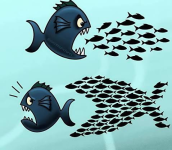
Top is till fifth generation
Bottom is sixth generation
Some node acts as mouth, some as tail. Mouth should be able to bite even if some of the tail nodes have lost.
The school of fish should still remain if some fishes are lost.
The basic difference between < 6 Gen and 6th Gen.

Wrong. The 500 million RMB was literally an estimate in reality they spent much more and admitted it too:Indian Tejas program spent 13320 thousand crore INR in development cost till 2016 when FOC was complete. This was Tejas MK1. (33 years in the making: What took Tejas so long to fly)
This is close to 2.03 billion dollar for a single engine light fighter jet. And even by 2016 the jet was not ready for induction.
J-10 Program allocated 500 million RMB in 1981 and was introduced in 2003. 500 RMB of 1981 will be about 1.08 billion USD today. You can double it and it will still be 2.16 billion USD in today money.
J-10 has been flying since 2003, two new models inducted and 600 produced. For Tejas, well, you know the story.
Tejas MK1 costs about 39 million dollars in FOC in 2023 dollars.
J10A, a heavier plane with more powerful engine costed 40 million in 2023 dollars.
Now for IJT.
(Long Road Ahead For HAL’s HJT-36 Sitara Intermediate Jet Trainer - Mobility Outlook)
(中国老坦克遭疯抢 净赚十几亿美元--万维读者网)
CAG says India allocated 180 Crore in 1999 for development. This will be about 42 million in 1999 conversion rate.
Further it says India spent about 467 Crore by 2005. This was about 108 million USD in 2005.
China had an equivalent project called JL-8/K-8 in 80s-early 90s with Pakistan which delivered jet in 92 onwards. Pakistan contributed 6 million in 1986 and China 18 (1:3) for a total development budget of 24 million dollars in 86. This would amount to 43 million in 2005. Even if you double it, it will be 86 million dollars. JL-8/K-8 was exported to massive number of countries.
The issue is not money. It is HAL. I do not trust HAL for 6th gen project or even 5th gen project. AMCA is going to have same issues. Do not hold your breath for it to attain IOC before 2040.
I mean, if J-35 is produced at the same rate JF-17 was produced, there is no reason to believe that by 2040 PAF will not have 100 J-35s.
37 billion RMB spent for J10 and J11 combined by 2002, no way J11 costed 36.5 billion RMB considering it wasn't even developed from scratch.
Thats roughly $4 billion. And you have to figure the money they spent on WS10 too ($1.53 billion)
In short, they spent much more on their indigenous fighter jet program than India ever did. J20 alone took $20 billion. Result is visible
I would therefore proceed with a genuine system-level specification that is deliberately agnostic regarding the physical solution. Numerical values will subsequently be derived from scenarios and simulations.
SCAF-FR — System Architecture Specification v0.2
Status: working proposal.
This text does not describe the official SCAF; it represents our statement of system requirements.
1. Guiding principle
SCAF-SYS-001 — Effect-centric architecture
The system must be designed to produce the effects required by the mission, rather than to maximize the capabilities of a specific platform *a priori*.
SCAF-SYS-002 — Functional allocation
Any operational function must be capable of being allocated to the node offering the best trade-off between effectiveness, survivability, availability, cost, and command authority constraints.
SCAF-SYS-003 — Platform independence
No function should be assigned to the NGF as a matter of principle if it can be performed more effectively by another node.
SCAF-SYS-004 — Dynamic reallocation
The system must be capable of reallocating a function following the loss, unavailability, or degradation of the node previously performing it.
SCAF-SYS-005 — Functional resilience
Resilience must be assessed based on the functions maintained, rather than merely the number of surviving platforms.
This is arguably our fundamental requirement.
2. Hierarchical architecture
I would propose three levels.
SCAF-ARC-001 — Theatre layer
A theatre layer must ensure overall planning, joint coordination, strategic resource allocation, and system optimization when accessible.
SCAF-ARC-002 — Tactical cell
The system must be capable of dynamically forming tactical cells composed of manned and unmanned nodes, sensors, effectors, and support assets tailored to the mission.
SCAF-ARC-003 — Autonomous tactical operation
A tactical cell must be capable of continuing a useful mission for a duration of T_iso following the loss of all links to the theatre layer.
T_iso remains to be determined based on scenarios. SCAF-ARC-004 — Node autonomy
An isolated node must retain the minimum functions necessary to remain safe, adhere to its authority constraints, and perform tasks that have been validly delegated to it.
SCAF-ARC-005 — Recursive degradation
Loss of the theater level must not automatically halt the cell; fragmentation of a cell must not automatically render its surviving nodes useless.
This is our translation of "graceful degradation."
3. Control plane / combat plane
This is likely one of the best borrowings from the field of computing.
SCAF-C2-001 — Separation of authority and execution
The system must conceptually separate the plane that defines intentions, authorities, rules, and priorities from the plane that executes tactical functions.
SCAF-C2-002 — Pre-authorised execution
An action that has already been validly authorized must not require continuous access to the higher level to continue execution.
SCAF-C2-003 — Mission package
Prior to potential isolation, each cell must possess a sufficient local mission state, including objectives, constraints, priorities, authorities, rules of engagement, and abort conditions.
SCAF-C2-004 — Authority persistence
Loss of network connectivity must never increase the rights held by a node.
SCAF-C2-005 — Authority granularity
Rights must be delegatable separately for observation, movement, jamming, designation, effector repositioning, engagement, and any other critical function.
Thus, "autonomy" does not become a simple ON/OFF switch.
4. Function allocation
SCAF-FNC-001 — Capability advertisement
Each node must be able to advertise the functions it is currently capable of providing, along with the associated key constraints.
Abstract example:
passive detection available, precision X;
relay available;
fuel available;
effect Y available;
availability until a specific time/deadline. SCAF-FNC-002 — Task by effect
A requesting system must be able to express a task in terms of a desired effect or capability without necessarily specifying the platform required to execute it.
SCAF-FNC-003 — Local acceptance
The system owning the node must retain the ability to accept, reject, or modify a request received from another subsystem, based on its own constraints and authority.
This directly addresses our Airbus ↔ Dassault issue.
SCAF-FNC-004 — Implementation opacity
A system must not need to know the internal implementation of another system in order to use a capability that the latter exposes.
In other words: military API.
SCAF-FNC-005 — Heterogeneous execution
A single operational function must be capable of being provided by different classes of nodes, provided mission physics allow for it.
5. Functional redundancy
SCAF-RES-001 — No critical single-function node
A function considered essential for mission continuation must not
depend on a single node without an explicitly accepted fallback solution.
SCAF-RES-002 — Heterogeneous redundancy
Redundancy may be provided by means of different types.
For example, threat localization could originate from:
NGF, CCA, ground, sea, space, or a combination of several measures.
SCAF-RES-003 — Performance degradation
The loss of the primary provider of a function may lead to reduced performance but must, as far as possible, avoid a total loss of the function.
SCAF-RES-004 — Mission-dependent redundancy
The required level of redundancy must be determined by the importance of the function within the specific mission.
6. Network
SCAF-NET-001 — Network as enhancer, not prerequisite
The wide-area network must significantly boost system performance without being a permanent prerequisite for any tactical action.
SCAF-NET-002 — Multi-path connectivity
Critical information must be able to travel via multiple physical or logical paths whenever possible.
SCAF-NET-003 — Local tactical network
A tactical unit must be able to maintain a local network even when its connection to the theater network is lost.
This is precisely our "tactical environment that sustains the mission."
SCAF-NET-004 — Intermittent connectivity
The system must be designed to handle intermittent communications as a normal operational state, rather than solely as an exceptional failure.
SCAF-NET-005 — Asynchronous operation
Functions must not all rely on the constant availability of a synchronized global state.
SCAF-NET-006 — Bandwidth degradation
A gradual reduction in throughput must result in prioritized service degradation rather than a simultaneous collapse of all functions.
7. Consistency and availability
Here, experience from distributed systems is directly applied.
SCAF-DAT-001 — Consistency classes
Each category of data or decision must have an explicitly defined required level of consistency. A tactical track does not have the same requirements as a rule of engagement.
SCAF-DAT-002 — Staleness tolerance
For each type of information, a maximum duration for using non-updated state data must be defined.
SCAF-DAT-003 — Availability preference
Functions where temporary divergence is acceptable must prioritize operational continuity in the event of a network partition.
SCAF-DAT-004 — Consistency preference
Functions where divergence could produce an unacceptable outcome must pause or restrict operations when consistency can no longer be guaranteed.
SCAF-DAT-005 — Explicit uncertainty
All fused information must carry a representation of its uncertainty, age, and provenance.
This seems extremely important to me: the system must know what it no longer knows.
8. Reconnection and reconciliation
SCAF-REC-001 — Partition history
An isolated cell must retain sufficient history to allow its state to be reconstructed after reconnection.
SCAF-REC-002 — State reconciliation
After reconnection, subsystems that have evolved independently must be able to merge their information without interrupting the mission.
SCAF-REC-003 — Conflict management
When two incompatible states exist, deterministic arbitration rules must define which one is retained or how uncertainty is propagated.
SCAF-REC-004 — Provenance
Every critical tactical element must be associated with its source, timestamp, and confidence level.
This bears a strong resemblance to IT replication issues.
9. Intelligence and decision-making
SCAF-AUT-001 — Distributed computation
Tactical computation must be capable of being distributed across multiple nodes.
SCAF-AUT-002 — Local replanning
A cell must be able to locally replan certain tasks following a change in the threat, the loss of a node, or the emergence of an opportunity. SCAF-AUT-003 — Delegated autonomy
A node's level of autonomy must be defined on a per-task basis, rather than solely by platform.
SCAF-AUT-004 — Human authority
Decisions explicitly reserved for human authority must remain technically impossible to execute without that authority.
SCAF-AUT-005 — Leadership migration
Where the architecture permits, the loss of a coordination node must allow for the transfer of certain coordination functions to another surviving node.
This is where the Airbus philosophy can complement the Dassault philosophy.
10. NGF
I would deliberately keep the NGF specifications very minimal at this stage.
SCAF-NGF-001 — High-capability node
The NGF must serve as a node with high capabilities in terms of computing, sensing, electronic warfare, communications, and mission management.
SCAF-NGF-002 — Local coherence
It must be capable of maintaining or reconstructing a local tactical picture following the loss of a significant portion of the network.
SCAF-NGF-003 — Independent utility
It must retain significant operational utility when isolated from its collaborative assets.
SCAF-NGF-004 — System-derived sizing
Its requirements regarding range, sensors, armament, electrical power, cooling, internal volume, and stealth must be derived from the system's functional analysis rather than being set independently.
This is crucial.
SCAF-NGF-005 — Evolvable role
The proportion of functions performed intrinsically by the NGF must be able to evolve over the program's lifecycle as distributed capabilities become more reliable.
This directly incorporates the "incremental steps" philosophy.
11. CCA / UCAV
SCAF-UAS-001 — Family architecture
The system must be capable of utilizing a family of unmanned platforms with varying costs, performance levels, and survivability characteristics.
SCAF-UAS-002 — Functional specialization
Platform specialization shall be permitted when the resulting economic or operational gain outweighs the cost of reduced versatility.
SCAF-UAS-003 — Common interfaces
Specialized platforms must, to the greatest extent possible, share common functional, software, and mission interfaces.
SCAF-UAS-004 — Attrition-aware design
The functional value concentrated within an attritable node must remain commensurate with the predicted probability of its loss.
SCAF-UAS-005 — Autonomous continuation
A CCA must possess explicitly defined behavior following a loss of data link: continue, hold, regroup, return, abort, or another pre-authorized mode.
12. Munitions
SCAF-WPN-001 — Weapon as system node
A munition capable of communication, sensing, or collaboration must be considered a temporary node within the system.
SCAF-WPN-002 — In-flight state update
Where relevant, the system must be capable of updating a munition's mission status or tactical information in-flight, within the limits of granted authority. SCAF-WPN-003 — Terminal autonomy
Loss of network connectivity after engagement must not necessarily prevent the munition from executing a previously authorized terminal function.
SCAF-WPN-004 — Collaborative effects
The system must enable cooperation between multiple effectors when beneficial, rather than treating each munition as an independent entity.
This is where we truly integrate the end effect into the architecture.
13. Support and refueling
SCAF-SUP-001 — Persistence as a system function
Range, endurance, and persistence must be treated as system functions rather than solely as characteristics of the NGF.
SCAF-SUP-002 — Distributed refueling
The architecture must be capable of integrating unmanned forward refueling assets.
SCAF-SUP-003 — Tanker multifunctionality
An unmanned tanker must be able to accommodate additional functions compatible with its volume, energy, and survivability constraints.
For example: ISR, relay, or computing capabilities.
SCAF-SUP-004 — Radius trade-off
Sizing of the NGF’s internal fuel capacity must be evaluated in conjunction with the availability of distributed refueling assets.
This is the MQ-25-style contribution integrated into the specification.
14. Multi-domain
SCAF-MD-001 — External capability integration
The system must be able to utilize capabilities provided by assets that do not fall directly under the air component.
SCAF-MD-002 — Sensor independence
An actionable track must not be conceptually tied to the domain of the sensor that generated it.
SCAF-MD-003 — Effector independence
The selection of an effector must be able to include air, land, or naval assets, depending on available authorities and interfaces.
SCAF-MD-004 — DSA integration
Surface-to-air defense systems must be able to participate in situational awareness sharing and, where rules permit, in shared sensor-decision-effector chains.
15. Security and compromise
SCAF-SEC-001 — Zero-trust principle
The mere presence of a node on the network must never be sufficient to establish trust in it.
SCAF-SEC-002 — Least privilege
Each node must possess only the rights necessary for its current mission.
SCAF-SEC-003 — Compartmentalization
The compromise of a node must not grant access to functions or information that the node did not require.
SCAF-SEC-004 — Quarantine
A cell must be capable of isolating a node suspected of being compromised while maintaining its own operational capability as much as possible.
SCAF-SEC-005 — Data trustworthiness
The system must be capable of reducing the trust placed in a source exhibiting behavior inconsistent with observations made by other nodes.
16. Open architecture and evolution
SCAF-EVO-001 — Stable functional interfaces
Interfaces describing functions, tasks, states, and authorities must evolve more slowly than the platforms that utilize them.
SCAF-EVO-002 — Hardware/software decoupling
The introduction of a new algorithm or software function must not necessitate modifications to all platforms when such changes are not physically required.
SCAF-EVO-003 — New node integration
It must be possible to integrate a new type of CCA, sensor, or effector without redefining the entire architecture.
SCAF-EVO-004 — Progressive delegation
The system must allow for the gradual increase of the level of delegation granted to autonomous functions following validation.
This aligns perfectly with the Dassault trajectory we discussed.
17. Validation: military chaos engineering
I consider this part essential.
SCAF-TST-001 — Fault injection
Validation must include the deliberate injection of faults and communication losses.
SCAF-TST-002 — Node loss testing
Any critical function must be tested following the destruction or unavailability of the node that served as its nominal provider.
SCAF-TST-003 — Network partition testing
Testing must include the splitting of a force into several independent sub-networks.
SCAF-TST-004 — Reconnection testing
The reconnection of sub-networks that have operated independently must be explicitly tested.
SCAF-TST-005 — Deceptive data testing
The system must be tested against erroneous, contradictory, delayed, or potentially compromised information.
SCAF-TST-006 — Graceful degradation metric
The primary evaluation criterion during a failure must be residual functional performance, rather than solely the technical availability of equipment.
For example:
100% nominal → satellite loss → 87% mission function;
ISR CCA loss → 73%;
partition → 61%;
rather than simply "network available / unavailable."
18. The resulting design principle
If I were to distill the roughly 70 requirements outlined above into four architectural rules, they would be:
1. Distribute functions when there is a benefit to doing so.
2. Never make a critical function more fragile by distributing it.
3. Retain enough local intelligence and state to continue the mission if the higher-level layer is lost.
4. Design from the outset how the system degrades, fragments, and subsequently rebuilds itself.
This begins to provide a fairly precise definition of what our French SCAF (Future Combat Air System) could look like.
What I find particularly satisfying is that we did not have to choose between Dassault and Airbus. On the contrary, experience in computing suggests that their respective intuitions may correspond to two necessary levels of the same system:
Dassault / scale-up: an extremely capable, coherent, and autonomous NGF (Next Generation Fighter).
Airbus / scale-out: a distributed collective capable of self-organization, resource reallocation, and surviving the loss of specific components.
And above that, a theater-level coordination layer that optimizes the whole system but whose loss must not halt combat operations.
SCAF-FR — System Architecture Specification v0.2
Status: working proposal.
This text does not describe the official SCAF; it represents our statement of system requirements.
1. Guiding principle
SCAF-SYS-001 — Effect-centric architecture
The system must be designed to produce the effects required by the mission, rather than to maximize the capabilities of a specific platform *a priori*.
SCAF-SYS-002 — Functional allocation
Any operational function must be capable of being allocated to the node offering the best trade-off between effectiveness, survivability, availability, cost, and command authority constraints.
SCAF-SYS-003 — Platform independence
No function should be assigned to the NGF as a matter of principle if it can be performed more effectively by another node.
SCAF-SYS-004 — Dynamic reallocation
The system must be capable of reallocating a function following the loss, unavailability, or degradation of the node previously performing it.
SCAF-SYS-005 — Functional resilience
Resilience must be assessed based on the functions maintained, rather than merely the number of surviving platforms.
This is arguably our fundamental requirement.
2. Hierarchical architecture
I would propose three levels.
SCAF-ARC-001 — Theatre layer
A theatre layer must ensure overall planning, joint coordination, strategic resource allocation, and system optimization when accessible.
SCAF-ARC-002 — Tactical cell
The system must be capable of dynamically forming tactical cells composed of manned and unmanned nodes, sensors, effectors, and support assets tailored to the mission.
SCAF-ARC-003 — Autonomous tactical operation
A tactical cell must be capable of continuing a useful mission for a duration of T_iso following the loss of all links to the theatre layer.
T_iso remains to be determined based on scenarios. SCAF-ARC-004 — Node autonomy
An isolated node must retain the minimum functions necessary to remain safe, adhere to its authority constraints, and perform tasks that have been validly delegated to it.
SCAF-ARC-005 — Recursive degradation
Loss of the theater level must not automatically halt the cell; fragmentation of a cell must not automatically render its surviving nodes useless.
This is our translation of "graceful degradation."
3. Control plane / combat plane
This is likely one of the best borrowings from the field of computing.
SCAF-C2-001 — Separation of authority and execution
The system must conceptually separate the plane that defines intentions, authorities, rules, and priorities from the plane that executes tactical functions.
SCAF-C2-002 — Pre-authorised execution
An action that has already been validly authorized must not require continuous access to the higher level to continue execution.
SCAF-C2-003 — Mission package
Prior to potential isolation, each cell must possess a sufficient local mission state, including objectives, constraints, priorities, authorities, rules of engagement, and abort conditions.
SCAF-C2-004 — Authority persistence
Loss of network connectivity must never increase the rights held by a node.
SCAF-C2-005 — Authority granularity
Rights must be delegatable separately for observation, movement, jamming, designation, effector repositioning, engagement, and any other critical function.
Thus, "autonomy" does not become a simple ON/OFF switch.
4. Function allocation
SCAF-FNC-001 — Capability advertisement
Each node must be able to advertise the functions it is currently capable of providing, along with the associated key constraints.
Abstract example:
passive detection available, precision X;
relay available;
fuel available;
effect Y available;
availability until a specific time/deadline. SCAF-FNC-002 — Task by effect
A requesting system must be able to express a task in terms of a desired effect or capability without necessarily specifying the platform required to execute it.
SCAF-FNC-003 — Local acceptance
The system owning the node must retain the ability to accept, reject, or modify a request received from another subsystem, based on its own constraints and authority.
This directly addresses our Airbus ↔ Dassault issue.
SCAF-FNC-004 — Implementation opacity
A system must not need to know the internal implementation of another system in order to use a capability that the latter exposes.
In other words: military API.
SCAF-FNC-005 — Heterogeneous execution
A single operational function must be capable of being provided by different classes of nodes, provided mission physics allow for it.
5. Functional redundancy
SCAF-RES-001 — No critical single-function node
A function considered essential for mission continuation must not
depend on a single node without an explicitly accepted fallback solution.
SCAF-RES-002 — Heterogeneous redundancy
Redundancy may be provided by means of different types.
For example, threat localization could originate from:
NGF, CCA, ground, sea, space, or a combination of several measures.
SCAF-RES-003 — Performance degradation
The loss of the primary provider of a function may lead to reduced performance but must, as far as possible, avoid a total loss of the function.
SCAF-RES-004 — Mission-dependent redundancy
The required level of redundancy must be determined by the importance of the function within the specific mission.
6. Network
SCAF-NET-001 — Network as enhancer, not prerequisite
The wide-area network must significantly boost system performance without being a permanent prerequisite for any tactical action.
SCAF-NET-002 — Multi-path connectivity
Critical information must be able to travel via multiple physical or logical paths whenever possible.
SCAF-NET-003 — Local tactical network
A tactical unit must be able to maintain a local network even when its connection to the theater network is lost.
This is precisely our "tactical environment that sustains the mission."
SCAF-NET-004 — Intermittent connectivity
The system must be designed to handle intermittent communications as a normal operational state, rather than solely as an exceptional failure.
SCAF-NET-005 — Asynchronous operation
Functions must not all rely on the constant availability of a synchronized global state.
SCAF-NET-006 — Bandwidth degradation
A gradual reduction in throughput must result in prioritized service degradation rather than a simultaneous collapse of all functions.
7. Consistency and availability
Here, experience from distributed systems is directly applied.
SCAF-DAT-001 — Consistency classes
Each category of data or decision must have an explicitly defined required level of consistency. A tactical track does not have the same requirements as a rule of engagement.
SCAF-DAT-002 — Staleness tolerance
For each type of information, a maximum duration for using non-updated state data must be defined.
SCAF-DAT-003 — Availability preference
Functions where temporary divergence is acceptable must prioritize operational continuity in the event of a network partition.
SCAF-DAT-004 — Consistency preference
Functions where divergence could produce an unacceptable outcome must pause or restrict operations when consistency can no longer be guaranteed.
SCAF-DAT-005 — Explicit uncertainty
All fused information must carry a representation of its uncertainty, age, and provenance.
This seems extremely important to me: the system must know what it no longer knows.
8. Reconnection and reconciliation
SCAF-REC-001 — Partition history
An isolated cell must retain sufficient history to allow its state to be reconstructed after reconnection.
SCAF-REC-002 — State reconciliation
After reconnection, subsystems that have evolved independently must be able to merge their information without interrupting the mission.
SCAF-REC-003 — Conflict management
When two incompatible states exist, deterministic arbitration rules must define which one is retained or how uncertainty is propagated.
SCAF-REC-004 — Provenance
Every critical tactical element must be associated with its source, timestamp, and confidence level.
This bears a strong resemblance to IT replication issues.
9. Intelligence and decision-making
SCAF-AUT-001 — Distributed computation
Tactical computation must be capable of being distributed across multiple nodes.
SCAF-AUT-002 — Local replanning
A cell must be able to locally replan certain tasks following a change in the threat, the loss of a node, or the emergence of an opportunity. SCAF-AUT-003 — Delegated autonomy
A node's level of autonomy must be defined on a per-task basis, rather than solely by platform.
SCAF-AUT-004 — Human authority
Decisions explicitly reserved for human authority must remain technically impossible to execute without that authority.
SCAF-AUT-005 — Leadership migration
Where the architecture permits, the loss of a coordination node must allow for the transfer of certain coordination functions to another surviving node.
This is where the Airbus philosophy can complement the Dassault philosophy.
10. NGF
I would deliberately keep the NGF specifications very minimal at this stage.
SCAF-NGF-001 — High-capability node
The NGF must serve as a node with high capabilities in terms of computing, sensing, electronic warfare, communications, and mission management.
SCAF-NGF-002 — Local coherence
It must be capable of maintaining or reconstructing a local tactical picture following the loss of a significant portion of the network.
SCAF-NGF-003 — Independent utility
It must retain significant operational utility when isolated from its collaborative assets.
SCAF-NGF-004 — System-derived sizing
Its requirements regarding range, sensors, armament, electrical power, cooling, internal volume, and stealth must be derived from the system's functional analysis rather than being set independently.
This is crucial.
SCAF-NGF-005 — Evolvable role
The proportion of functions performed intrinsically by the NGF must be able to evolve over the program's lifecycle as distributed capabilities become more reliable.
This directly incorporates the "incremental steps" philosophy.
11. CCA / UCAV
SCAF-UAS-001 — Family architecture
The system must be capable of utilizing a family of unmanned platforms with varying costs, performance levels, and survivability characteristics.
SCAF-UAS-002 — Functional specialization
Platform specialization shall be permitted when the resulting economic or operational gain outweighs the cost of reduced versatility.
SCAF-UAS-003 — Common interfaces
Specialized platforms must, to the greatest extent possible, share common functional, software, and mission interfaces.
SCAF-UAS-004 — Attrition-aware design
The functional value concentrated within an attritable node must remain commensurate with the predicted probability of its loss.
SCAF-UAS-005 — Autonomous continuation
A CCA must possess explicitly defined behavior following a loss of data link: continue, hold, regroup, return, abort, or another pre-authorized mode.
12. Munitions
SCAF-WPN-001 — Weapon as system node
A munition capable of communication, sensing, or collaboration must be considered a temporary node within the system.
SCAF-WPN-002 — In-flight state update
Where relevant, the system must be capable of updating a munition's mission status or tactical information in-flight, within the limits of granted authority. SCAF-WPN-003 — Terminal autonomy
Loss of network connectivity after engagement must not necessarily prevent the munition from executing a previously authorized terminal function.
SCAF-WPN-004 — Collaborative effects
The system must enable cooperation between multiple effectors when beneficial, rather than treating each munition as an independent entity.
This is where we truly integrate the end effect into the architecture.
13. Support and refueling
SCAF-SUP-001 — Persistence as a system function
Range, endurance, and persistence must be treated as system functions rather than solely as characteristics of the NGF.
SCAF-SUP-002 — Distributed refueling
The architecture must be capable of integrating unmanned forward refueling assets.
SCAF-SUP-003 — Tanker multifunctionality
An unmanned tanker must be able to accommodate additional functions compatible with its volume, energy, and survivability constraints.
For example: ISR, relay, or computing capabilities.
SCAF-SUP-004 — Radius trade-off
Sizing of the NGF’s internal fuel capacity must be evaluated in conjunction with the availability of distributed refueling assets.
This is the MQ-25-style contribution integrated into the specification.
14. Multi-domain
SCAF-MD-001 — External capability integration
The system must be able to utilize capabilities provided by assets that do not fall directly under the air component.
SCAF-MD-002 — Sensor independence
An actionable track must not be conceptually tied to the domain of the sensor that generated it.
SCAF-MD-003 — Effector independence
The selection of an effector must be able to include air, land, or naval assets, depending on available authorities and interfaces.
SCAF-MD-004 — DSA integration
Surface-to-air defense systems must be able to participate in situational awareness sharing and, where rules permit, in shared sensor-decision-effector chains.
15. Security and compromise
SCAF-SEC-001 — Zero-trust principle
The mere presence of a node on the network must never be sufficient to establish trust in it.
SCAF-SEC-002 — Least privilege
Each node must possess only the rights necessary for its current mission.
SCAF-SEC-003 — Compartmentalization
The compromise of a node must not grant access to functions or information that the node did not require.
SCAF-SEC-004 — Quarantine
A cell must be capable of isolating a node suspected of being compromised while maintaining its own operational capability as much as possible.
SCAF-SEC-005 — Data trustworthiness
The system must be capable of reducing the trust placed in a source exhibiting behavior inconsistent with observations made by other nodes.
16. Open architecture and evolution
SCAF-EVO-001 — Stable functional interfaces
Interfaces describing functions, tasks, states, and authorities must evolve more slowly than the platforms that utilize them.
SCAF-EVO-002 — Hardware/software decoupling
The introduction of a new algorithm or software function must not necessitate modifications to all platforms when such changes are not physically required.
SCAF-EVO-003 — New node integration
It must be possible to integrate a new type of CCA, sensor, or effector without redefining the entire architecture.
SCAF-EVO-004 — Progressive delegation
The system must allow for the gradual increase of the level of delegation granted to autonomous functions following validation.
This aligns perfectly with the Dassault trajectory we discussed.
17. Validation: military chaos engineering
I consider this part essential.
SCAF-TST-001 — Fault injection
Validation must include the deliberate injection of faults and communication losses.
SCAF-TST-002 — Node loss testing
Any critical function must be tested following the destruction or unavailability of the node that served as its nominal provider.
SCAF-TST-003 — Network partition testing
Testing must include the splitting of a force into several independent sub-networks.
SCAF-TST-004 — Reconnection testing
The reconnection of sub-networks that have operated independently must be explicitly tested.
SCAF-TST-005 — Deceptive data testing
The system must be tested against erroneous, contradictory, delayed, or potentially compromised information.
SCAF-TST-006 — Graceful degradation metric
The primary evaluation criterion during a failure must be residual functional performance, rather than solely the technical availability of equipment.
For example:
100% nominal → satellite loss → 87% mission function;
ISR CCA loss → 73%;
partition → 61%;
rather than simply "network available / unavailable."
18. The resulting design principle
If I were to distill the roughly 70 requirements outlined above into four architectural rules, they would be:
1. Distribute functions when there is a benefit to doing so.
2. Never make a critical function more fragile by distributing it.
3. Retain enough local intelligence and state to continue the mission if the higher-level layer is lost.
4. Design from the outset how the system degrades, fragments, and subsequently rebuilds itself.
This begins to provide a fairly precise definition of what our French SCAF (Future Combat Air System) could look like.
What I find particularly satisfying is that we did not have to choose between Dassault and Airbus. On the contrary, experience in computing suggests that their respective intuitions may correspond to two necessary levels of the same system:
Dassault / scale-up: an extremely capable, coherent, and autonomous NGF (Next Generation Fighter).
Airbus / scale-out: a distributed collective capable of self-organization, resource reallocation, and surviving the loss of specific components.
And above that, a theater-level coordination layer that optimizes the whole system but whose loss must not halt combat operations.
You are wrong. 37 billion RMB was development and INTRODUCTION cost of J10 and J11 in 2002 Yuan. You are comparing it with 500 million yuans in 1981. So this includes :37 billion RMB spent for J10 and J11 combined by 2002, no way J11 costed 36.5 billion RMB considering it wasn't even developed from scratch.
Development/Manufacturing cost of TWO programs. J10 and J11(import/production).
Introduction cost of J10A and J11.
Inflation in Yuan for 21 years from 1981 to 2002.
J-11, btw, is Chinese variant of Su-27 for which China agreed to pay 1.2 billion dollars in 1996.

What is a 5th gen ?Also, In my humble opinion, spending so much of money on the FCAS is a fools errand, Europe doesn't have a 5th gen of their own and hence want's to skip to 6th gen, unlike what India is developing, we don't even know what 6th gen capability will even be and considering most 6th gens have canards or tails, their airframe isn't very revolutionary either and many of the technologies will be likely shared between generations, we should just prioritise in the AMCA MK1 and MK2 to 5.5 gen category and buy 5.5 gen Su57 as stop gap, spending even half the money on what France expects us to spend on FCAS would provide our industry and indigenous capability with much greater returns than whatever this deal would bring, or we should collaborate with players like Russia who wouldn't ask for an arm an leg for such JV, Russia is a pioneer in the field and literally created the stealth doctrine, not to mention their expertise and experience on airframe design, engines, missiles, radars, control systems etc and the not so high per capita income would make a better choice for a country like India and historically Russia has been a much better technology sharing country than anyone else for us and considering the current Geopolitics involved, Russia wouldn't expect us to take a bad deal and would probably offer a very good deal acceptable to both countries.
According to LM it is a stealthy jet that can supercruise, as agile as an early F16, with sensor fusion, affordable. The sole west jet with all these assests is F22 (except affordability). Even F-35 is short on supercruise and agility.
So ?
