US - Israel - Iran War


Britain is in talks with European allies over releasing emergency diesel stockpiles after Donald Trump threatened to cut off US supplies of the fuel.

Ministers held calls with counterparts from the European Commission, Germany, France, Italy and Ireland on Thursday to discuss whether to draw down reserves after the Trump administration told Germany and France to release their stockpiles to help ease soaring global energy prices or face a US export ban.


The warning, first reported by Reuters, marks an escalation of pressure on Europe as Trump considers a potential wider ban to help lower domestic fuel prices before the US midterm elections in November.

A US official told the news agency: “It is in Europe’s best interest to ⁠work with the United States as we pursue multiple pathways to boost the supply of refined products and lower costs for consumers.”

Martin McCluskey, the UK minister for local energy, was reportedly on the call with EU countries on Thursday.

The Trump administration has been frustrated with France and Germany for what it considers their not following through on commitments to release oil and petrol stocks.

Fuel stations across Europe are unlikely to run dry, because Europe produces about 70% of the diesel it consumes from domestic refineries. It also stores fuels in reserve. But experts fear that competing for cargoes on the global market would lead to higher market prices.

It was unclear whether the UK would be included in such a ban, but the loss of US supply would drive prices up sharply at the pumps because the UK does not refine enough diesel to meet domestic demand. About a third of UK diesel imports last year came from the US.

The average price of a litre of diesel in the UK hit a new all-time high on Wednesday of 199.72p, according to the motoring body the RAC.

John Healey, the chancellor, admitted earlier this week that UK diesel prices were “extreme” and said the government was in discussion with the US over trying to stop a ban.

The US war in Iran has disrupted energy supplies via the strait of Hormuz and sent the price of oil soaring. Before the war, in February, Brent crude – the international benchmark for oil prices – traded at about $72 a barrel. It was above $101 on Thursday.

Releasing more stocks would represent a problem for European countries, which need to balance the need to bring down domestic fuel prices with keeping high stocks for a potential worsening energy crisis over the winter if the Iran war continues.
 
  • Like
Reactions: _Anonymous_
What would happen if the used SpaceX Starship to put half a dozen 20t Tungsten rods in orbit with a DU core and guidance and planted them into Iran's Natanz site from orbit with an impact velocity of ~4km/s?
How about trying out your concept in erm..Paddyland first , eh Paddy? If it works there it can be duplicated in many places including Iran.
 

Britain is in talks with European allies over releasing emergency diesel stockpiles after Donald Trump threatened to cut off US supplies of the fuel.

Ministers held calls with counterparts from the European Commission, Germany, France, Italy and Ireland on Thursday to discuss whether to draw down reserves after the Trump administration told Germany and France to release their stockpiles to help ease soaring global energy prices or face a US export ban.


The warning, first reported by Reuters, marks an escalation of pressure on Europe as Trump considers a potential wider ban to help lower domestic fuel prices before the US midterm elections in November.

A US official told the news agency: “It is in Europe’s best interest to ⁠work with the United States as we pursue multiple pathways to boost the supply of refined products and lower costs for consumers.”

Martin McCluskey, the UK minister for local energy, was reportedly on the call with EU countries on Thursday.

The Trump administration has been frustrated with France and Germany for what it considers their not following through on commitments to release oil and petrol stocks.

Fuel stations across Europe are unlikely to run dry, because Europe produces about 70% of the diesel it consumes from domestic refineries. It also stores fuels in reserve. But experts fear that competing for cargoes on the global market would lead to higher market prices.

It was unclear whether the UK would be included in such a ban, but the loss of US supply would drive prices up sharply at the pumps because the UK does not refine enough diesel to meet domestic demand. About a third of UK diesel imports last year came from the US.

The average price of a litre of diesel in the UK hit a new all-time high on Wednesday of 199.72p, according to the motoring body the RAC.

John Healey, the chancellor, admitted earlier this week that UK diesel prices were “extreme” and said the government was in discussion with the US over trying to stop a ban.

The US war in Iran has disrupted energy supplies via the strait of Hormuz and sent the price of oil soaring. Before the war, in February, Brent crude – the international benchmark for oil prices – traded at about $72 a barrel. It was above $101 on Thursday.

Releasing more stocks would represent a problem for European countries, which need to balance the need to bring down domestic fuel prices with keeping high stocks for a potential worsening energy crisis over the winter if the Iran war continues.
It's fairly clear at the moment that the world cannot afford both wars. And the war in Ukraine is being driven solely by European support to the Jewish comedian.

So either Europe withdraws support & helps with a Cease Fire or it can watch its economy go down the drain along with the rest of the world.

I say this for once the Mullah regime in Iran was directly engaged in war by the US the outcome could only be either the Trump administration goes or the one in Iran does.

And since it's next to impossible the Trump administration is going anywhere ,till such time the mullah regime isn't deposed we'd continue to see these periodic episodes of war interspersed with talks about peace, talks about talks, talks about final resolution of the problem & so on.

The ball is in Europe's court .
 
The G7 will proceed with the release of reserves.


The Group of Seven nations are to release as much as 100 million barrels of emergency oil and diesel stocks after pressure from the Trump administration to quell rising fuel prices.

The release, being coordinated by the International Energy Agency, will take place over the next four months, Emmanuel Macron, France’s president told journalists in a briefing on Friday. He is also the current chair of the G7.

The G7 would like to trigger a drop in fuel pries, he said.

The decision came after the US floated the possibility of a debilitating diesel-export ban if European countries didn’t release more supplies. Such a move would threaten a crucial source of supply for the continent, which leans heavily on imports to cover a diesel-production shortfall.

Trump said in a social media post on Friday that he welcomed the latest action.

“Europe has just agreed to release a massive amount of their heavily stocked Diesel Oil,” Trump said. “The process will begin immediately.”

Diesel’s premium over crude, a key measure of market strength, slumped as traders priced in the extra supply.

The IEA already coordinated a plan to release of 400 million barrels in March soon after the Iran war broke out, but US President Donald Trump has criticized Europe for not making those barrels available fast enough.

“We have all committed together to releasing these strategic reserves in the proportions I mentioned, with a focus on diesel, and we are all committed to ensuring there are no export bans, and President Trump, in particular, was very clear on this point,” Macron said.
 
  • Like
Reactions: Asterion Moloc

1790974631509.png


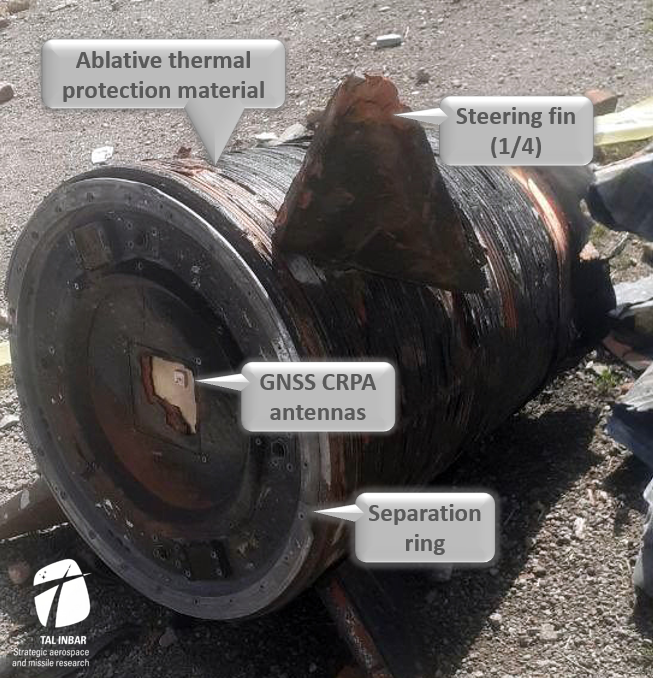
Visible components of Kheybar Shekan include an ablative composite heat shield and four-element Controlled Reception Pattern Antenna, or CRPA, whose integration indicates that Iranian engineers are combining survivable re-entry structures with electronic counter-countermeasures intended to preserve navigational accuracy under hostile jamming.

(DEFENCE SECURITY ASIA) — Newly surfaced imagery of Iran’s Kheybar Shekan re-entry vehicle provides the clearest public evidence yet that Tehran has integrated anti-jamming satellite navigation with a maneuverable warhead, potentially improving strike precision and resilience against electronic warfare.

The photographs and video, show wreckage apparently recovered following combat operations in northwestern Iran, offering an unprecedented view inside the medium-range ballistic missile’s previously concealed guidance and thermal-protection architecture.

Visible components include an ablative composite heat shield and four-element Controlled Reception Pattern Antenna, or CRPA, whose integration indicates that Iranian engineers are combining survivable re-entry structures with electronic counter-countermeasures intended to preserve navigational accuracy under hostile jamming.

Missile specialists, identified these features through visual assessment, although neither the precise antenna model nor its operational performance can be established without forensic examination of recovered components.

The antenna closely resembles Chinese multi-constellation designs, raising the possibility of imported hardware, adapted commercial technology, design emulation, or indirect technical influence, but current imagery does not prove formal Chinese government involvement or an authorized technology-transfer arrangement.


A Controlled Reception Pattern Antenna uses several coordinated elements and onboard signal processing to distinguish legitimate satellite signals from interference, steering reception toward navigation satellites while creating electronic nulls against jammers transmitting from identifiable directions.

Unlike a single conventional antenna, the four-element array can compare signal phase and strength across its geometry, allowing beamforming algorithms to suppress hostile energy while maintaining access to usable Global Navigation Satellite System transmissions.

This capability could support signals from China’s BeiDou constellation alongside GPS, GLONASS or Galileo, giving the missile several navigation options and reducing dependence upon any single constellation during politically contested or electronically degraded combat conditions.


..............................................................................................

PS: Trump dismissed that Chinese entities are used for missile guidance.
 
The Group of Seven nations are to release as much as 100 million barrels of emergency oil and diesel stocks after pressure from the Trump administration to quell rising fuel prices.

The release, being coordinated by the International Energy Agency, will take place over the next four months, Emmanuel Macron, France’s president told journalists in a briefing on Friday. He is also the current chair of the G7.
So the world uses 30m B of diesel a day, and they are releasing a 3 day supply, which won't dent the price or supply of diesel in any real way,

I'm sure BMD will have a link saying not to worry, With Trump saying, they are getting more oil out of the gulf than ever before,
The videos of burning ships are AI created and we will ignore the $$B cost to the US, of the blockade
 
Last edited:
So the world uses 30m B of diesel a day, and they are releasing a 3 day supply, which won't dent the price or supply of diesel in any real way,

I'm sure BMD will have a link saying not to worry, With Trump saying, they are getting more oil out of the gulf than ever before,
The videos of burning ships are AI created and we will ignore the $$B cost to the US, of the blockade
Some are being hit but very few, ultimately Gulf countries are getting far more out to customers than Iran is. Dozens of time more.


The regime is looking north to rescue its oil exports after the blockade shut its Persian Gulf route, but that escape plan is failing too.Before the war, more than 80 percent of Iran’s trade tonnage moved through the Persian Gulf. The blockade has effectively shut Iran’s main oil-export route: no new crude cargo has cleared toward Asian markets since mid-July.August loadings fell to roughly 160,000–255,000 barrels a day, from about 2 million before the war.
Trucking oil across borders can move, at most, around 40,000 barrels a day, about 2 percent of pre-war exports.The oil already at sea is running down. The floating stockpile outside the blockade fell from roughly 90 million barrels in mid-July to about 29 million. Meanwhile, usable onshore storage was estimated at around 39 million barrels, with roughly 1.8 million barrels a day of exports displaced. If that estimate holds, Iran could face forced production cuts within weeks. Shutting mature oil fields risks lasting damage. Restarting them is not as simple as turning a tap.
The land routes are already jammed. Around 3,700 trucks were backed up at the Turkish crossing, with waits reaching 20 days. At the main Pakistan crossing, about 700 trucks were waiting while around 40 were allowed through. These corridors can keep some trade moving. They cannot replace tankers, deep-water ports or access to buyers and banks.The Caspian is an import route, not an oil-export escape hatch. Northern ports handle only a small share of Iran’s total port capacity, and Caspian vessels carry a fraction of what a large oil tanker can move. The Neka pipeline brings Caspian crude into Iranian refineries. It does not carry southern Iranian oil to China.
Iran’s northern routes also depend on neighboring countries, their infrastructure and their willingness to risk sanctions. That is not a reliable substitute for a major export system.The economic pressure is spreading. The free-market rial passed 2.5 million to the dollar in late September, while inflation continues to devastate household purchasing power. Oil and petrochemical revenues face the same export bottleneck.The Islamic Republic is not landlocked. It is export-locked. Its northern corridors can bring in some supplies, but they cannot replace the Persian Gulf route its oil economy depends on. The blockade is trapping the regime’s most important export while its alternatives choke under the strain.