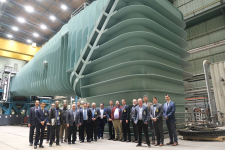
NSTL Large Cavitation Tunnel, Visakhapatnam

Ashwin

Agent_47
Staff member
Administrator
Nov 30, 2017
10,796
25,169
Bangalore

Rajnath visits US Navy testing facility as India plans something similar


New Delhi: Defence minister Rajnath Singh on Saturday visited a modern US Navy testing facility for ships and submarines at Memphis in Tennessee at a time when India is looking at setting up a similar facility for locally produced platforms, the defence ministry said on Sunday.

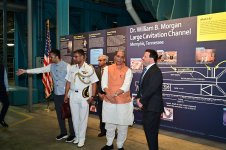
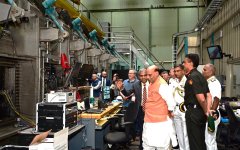
Singh visited the William B Morgan large cavitation channel (LCC) at the Naval Surface Warfare Center in Memphis, where senior officials briefed him on one of the world’s largest and most technically advanced high-speed, variable-pressure water tunnel facilities.

He was accompanied by senior navy and DRDO (Defence Research and Development Organisation) officials.

“The discussions intend to support the ongoing proposal for establishment of a similar facility for indigenous design and development in India,” the defence ministry said in a statement.

The LCC is part of the Naval Surface Warfare Center Carderock Division, one of the US Navy’s preeminent research and development facilities that specialises in critical ship and submarine design.

Operational since 1991, it provides significant cost savings for testing large-scale models of advanced ship and submarine system designs and full-scale torpedoes in a controlled environment, according to the US Navy.

It permits the US Navy to measure submarine and surface ship power, efficiency, and propeller noise by using models in a controlled but realistic environment. The facility has commercial use too.

Singh was greeted by deputy under secretary of the US Navy for Policy Anne Gebhards and Naval Surface Warfare Center and Undersea Warfare Center Commander Rear Admiral Todd Evans.

“Witnessed the pathbreaking experiments at the facility. India and the US look forward to work together and benefit from each other’s experiences,” Singh wrote on X.

Singh’s Memphis visit came on the back of meetings with US national security advisor Jake Sullivan and secretary of defence Lloyd Austin in Washington.

These talks spanned an array of critical areas, including the impact of global developments on geopolitics, pressing regional security dynamics, broadening cooperation in the Indo-Pacific region, and deepening defence industrial collaboration.

Singh arrived in Washington on August 22 on a four-day visit that is being closely watched as India is negotiating deals worth billions of dollars with the US, including the purchase of the General Atomics MQ-9B remotely piloted aircraft systems and the joint production of GE F414 engines in the country.

Earlier, Singh also interacted with captains of several American defence companies in Washington, including General Atomics and GE, and outlined the emerging co-development and co-production opportunities in India while enumerating reforms initiated by the government to make the country an attractive destination for foreign original equipment manufacturers and an alternative export hub.

In 2023, India and the US concluded a new roadmap for defence industrial cooperation with the goal of fast-tracking technology cooperation and co-production in critical areas, including air combat and land mobility systems, intelligence, surveillance, and reconnaissance, munitions, and the undersea domain.
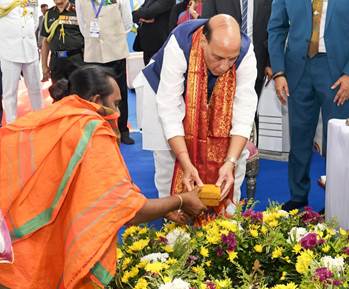
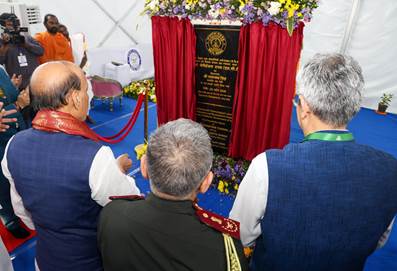
 

Raksha Mantri lays foundation stone of Large Cavitation Tunnel at NSTL, Visakhapatnam to boost naval research & testing capabilities

The project will position India as a strong naval power & leader in defence technology: Shri Rajnath Singh​

Posted On: 03 APR 2026 8:13PM by PIB Delhi

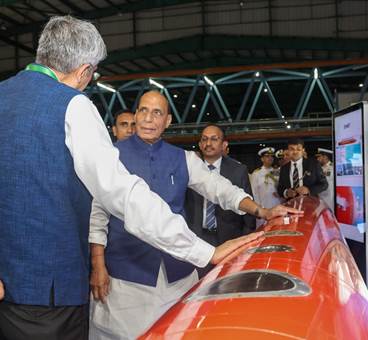
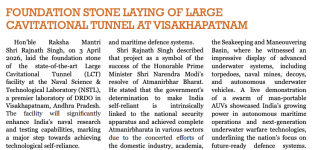
Raksha Mantri Shri Rajnath Singh, on April 03, 2026, laid the foundation stone of the state-of-the-art Large Cavitation Tunnel (LCT) facility at the Naval Science & Technological Laboratory (NSTL), a premium laboratory of DRDO in Visakhapatnam, Andhra Pradesh. The facility will significantly enhance India’s naval research and testing capabilities, marking a major step towards achieving technological self-reliance.

image001BNNY.jpg


image002UOJA.jpg


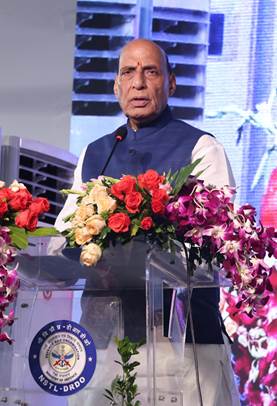
Addressing scientists, researchers, and personnel at NSTL, Raksha Mantri asserted that India, with this initiative, will be able to design, develop and test its equipment, systems & sub-systems indigenously utilising its own resources, position itself as a strong naval power & a leader in defence technology. “Until now, even after successfully developing equipment, systems, and sub-systems, we often had to look abroad for critical testing. This situation will now change. This facility is not merely an infrastructure project, but an enabling system, which will strengthen our capabilities in advancing propulsion systems, enable focused efforts on noise reduction and further strengthen stealth capabilities. It will serve as a foundational backbone for the design and development of submarines & ships, supporting future advancements in naval engineering and maritime defence systems,” he said.

image00381JE.jpg


Shri Rajnath Singh described the project as a symbol of the success of Prime Minister Shri Narendra Modi’s resolve of Aatmanirbhar Bharat. He stated that the Government’s determination to make India self-reliant is intrinsically linked to the national security apparatus, and despite challenges, the country has achieved complete Aatmanirbharta in various sectors due to the concerted efforts of the domestic industry, academia, MSMEs, youth, and researchers.

During the visit, Raksha Mantri was briefed about the NSTL projects/programmes by the Secretary, Department of Defence R&D and Chairman DRDO Dr Samir V Kamat.

image004FWW8.jpg


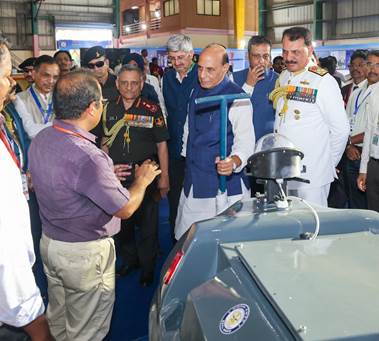
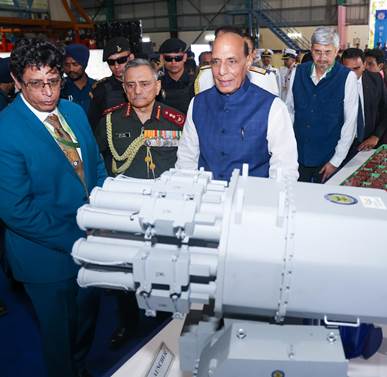
Shri Rajnath Singh also visited the Seakeeping and Manoeuvring Basin, where he witnessed an impressive display of advanced underwater systems, including torpedoes, naval mines, decoys, and autonomous underwater vehicles (AUVs).

A live demonstration of a swarm of man-portable AUVs showcased India’s growing prowess in autonomous maritime operations and next-generation underwater warfare technologies, underlining the nation’s focus on future-ready defence systems. Raksha Mantri also inspected some of the vital products realised as spin-off technologies by the Naval Systems Materials cluster labs post Operation Sindoor.

Shri Rajnath Singh commended NSTL for carrying out research and setting benchmarks in a number of areas, including torpedo systems, underwater mines, decoys, and AUVs, while propelling India forward on the path to becoming a formidable naval power. He also acknowledged the demonstration of swarm technology and ongoing work in lithium-ion battery development, calling them crucial for future warfare preparedness.

image005A3VE.jpg


image00604UF.jpg


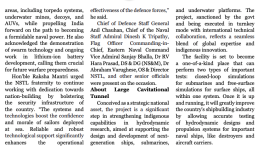
Raksha Mantri urged NSTL to continue working with dedication towards nation-building by bolstering the security infrastructure of the country. "The systems and technologies boost the confidence and morale of sailors deployed at sea. Reliable and robust technological support significantly enhances the operational effectiveness of the defence forces," he said.

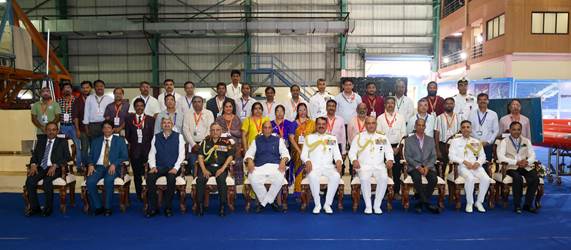
Chief of Defence Staff General Anil Chauhan, Chief of the Naval Staff Admiral Dinesh K Tripathi, Flag Officer Commanding-in-Chief, Eastern Naval Command Vice Admiral Sanjay Bhalla and other senior officials were present on the occasion.

image0079367.jpg


About Large Cavitation Tunnel

Conceived as a strategic national asset, the project is a significant step in strengthening indigenous capabilities in hydrodynamic research, aimed at supporting the design and development of next-generation ships, submarines and underwater platforms. The project, sanctioned by the Government and being executed in turnkey mode with international technical collaboration, reflects a seamless blend of global expertise and indigenous innovation.

The facility is poised to emerge as a globally unique infrastructure with its capability to conduct both closed-loop simulations essential for submarine studies and free surface simulations critical for surface ship research within a single integrated setup. Once operational, it will significantly enhance the country’s shipbuilding ecosystem by enabling precise validation of hydrodynamic designs and propulsion systems for major naval platforms, including destroyers and aircraft carriers.

VK/Savvy/SS

Raksha Mantri Shri Rajnath Singh, as a part of his ongoing tour to the US, visited the William B Morgan Large Cavitation Channel (LCC) in the Naval Surface Warfare Centre (NSWC) at Memphis, Tennessee.
Source

This is from last August. Meaning, this is being built with the help of the US Navy.
 

Now that "international technical collaboration" has been confirmed, we need to take a second look at Rajnath Singh's 2024 visit to the William B. Morgan Large Cavitation Channel (LCC) at the US Navy's Surface Warfare Centre, Tennessee.

GVz27KKWYAAd-l0.jpg

GVz23uSWUAAO8Nf.jpg


"The discussions also intend to support the ongoing proposal for the establishment of similar facilities for indigenous design and development in India."

It's not known if the international assistance being mentioned is indeed from the US, or from some other party. What's also not known is the nature of the collaboration. I doubt complete know-how/know-why transfer was undertaken, more likely the foreign partner served to validate our LCT design against their baseline.

That's because I doubt such a transfer would have not only been approved but also materialized in under 2 years' time. Our LCT design was in all likelihood ready/almost ready by that point.

Full view of the Morgan LCC:

Dr. William B. Morgan Large Cavitation Channel, USN Surface Warfare Center, Memphis TN.png