
Medium Transport Aircraft (MTA) for IAF
- Thread starter Fatalis
- Start date
-
- Tags
- embraer c-390
You are using an out of date browser. It may not display this or other websites correctly.
You should upgrade or use an alternative browser.
You should upgrade or use an alternative browser.


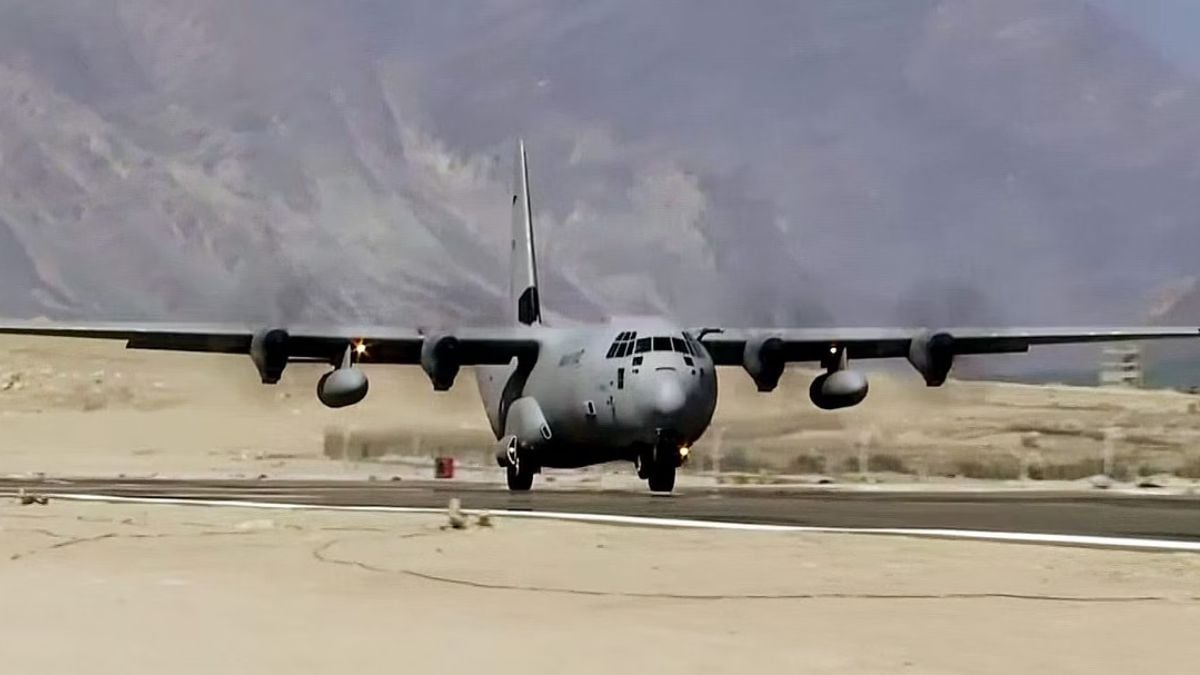
C-130J-30 vs C-390: Lockheed lays out its case for India’s medium transport aircraft deal
The American aerospace major is competing with Embraer for what is the largest military transport aircraft contract, seeking to replace the ageing AN 32s and the IL-76 operated by the IAF.
 theprint.in
New Delhi: Drawing from India’s experience of its fleet of the C-130J-30 Super Hercules, Lockheed Martin has sharpened its pitch saying the aircraft offers far greater usable capacity and operational flexibility than its nearest competitor—Brazil’s Embraer C-390 Millennium for the mega Medium Transport Aircraft (MTA) programme.
The American aerospace major is competing with Embraer for what is the largest military transport aircraft contract, seeking to replace the ageing AN 32s and the IL-76 operated by the IAF.
While the numbers sought by the IAF formally in a Request for Proposal sent out to Indian players is for 60 aircraft, it is expected to go up subsequently.
European aviation major Airbus has dropped out of the contest, leaving the C-130J-30 and C-390 as principal contenders.
The Request for Proposal (RFP) for the programme was issued on 12 August, with bids due by 2 December.
Lockheed is offering the latest version of the C-130J-30, known as the C-130J-30 Block 8.1.2 to the IAF with 12 aircraft to be built at its facility in Marietta, Georgia, while the remaining 48 would be manufactured in India in partnership with Tata Advanced Systems Limited (TASL). The RFP states a minimum of 40 percent indigenous content.
Speaking to ThePrint, Robert Toth, Vice President, Strategy & Business Development, Air Mobility and Maritime Missions at Lockheed Martin, underlined that what the IAF has and what the company is offering is the C-130J–30 and not just the C-130J that everyone believes it is.
“Many of the characteristics that get attributed to the C-130J are actually of the C-130H or the original version of the C-130J, which was a shorter version,” he said.
He said that when people say that C-130J has a capacity of 18-19 tonnes, they are wrong because the C-130J-30 that the IAF uses has a capacity of 22 tonnes.
The C-130J-30 is a stretched version of the Hercules, with the fuselage extended by about 14 feet to provide additional internal cargo space.
The difference is significant, with the IAF’s RFP stating that the aircraft should have a minimum capacity of 18 tonnes and a maximum of 30.
The Embraer aircraft has a capacity of 26 tonnes and falls in between.
‘It’s about volume, not weight’
One of Toth’s central arguments is that maximum payload weight alone does not determine the effectiveness of a tactical transport aircraft.He argued that in most logistics missions, the aircraft runs out of available cargo volume before reaching their maximum payload weight.
“When you think about moving cargo, it is really a math problem, the amount of items you need to move over a specific period of time,” Toth, a former C-130J pilot with the US Air Force said.
He claimed that compared to the C-390, the C-130J-30 can carry 60 percent more passengers, 45 percent more fully combat-loaded paratroopers and 30 percent more litter positions for casualty evacuation.
He also claimed the C-130J-30 can accommodate eight standard cargo pallets compared to the seven on the C-390, a 15 percent difference.
These figures are Lockheed Martin’s own comparative claims and they did not give specific numbers.
However, the company’s website says it can carry 128 combat troops and 92 paratroopers.
Lockheed argues that the additional usable floor space of the C-130J-30 therefore matters more than a simple comparison of maximum payload figures.
The company also pointed to the aircraft’s ability to operate from short and austere runways and at high-altitude airfields.
Lockheed argues that its aircraft possess the best short-field takeoff/landing performance, highest pallet/passenger/litter capacity, lowest fuel use rate, greater range, lower carbon footprint, combat proven survivability, and best unprepared airfield capability/durability.
Toth also said that The C-130J-30 requires fewer sorties to complete combat troop deployments and humanitarian operations.
Its ability to transport more personnel and equipment with fewer sorties allows faster delivery of forces for contingency and humanitarian operations while also reducing overall operational costs, he said.
India’s experience with the Hercules
The IAF inducted its first C-130J-30 aircraft in 2010 and has since used the platform extensively for a range of operations.Toth said the Indian fleet has accumulated around 58,000 flight hours while maintaining a availability ration of above 85 percent.
The aircraft have been used for operations ranging from disaster relief to the evacuation of Indian citizens from conflict zones.
One of the most daunting tasks that the aircraft did was landing at Daulat Beg Oldi (DBO) in Ladakh at an altitude of about 16,600 feet.
The aircraft has also been used for operations in Afghanistan and Sudan, as well as humanitarian assistance missions, including ongoing operations in Nepal.
Lockheed is placing considerable emphasis on this operational experience as it makes its case for the MTA.
The company says the global C-130J fleet has accumulated more than three million flight hours across roughly 28 operators, creating what it describes as a large pool of operational experience and feedback for continuous upgrades to the aircraft.
New aircraft more advanced than IAF’s existing C-130Js
The aircraft proposed for the MTA programme would not be identical to the C-130Js currently operated by India. The existing Indian aircraft are Block 6 configuration, while Lockheed says it intends to offer the latest Block 8.1.2 configuration for the MTA.The newer configuration incorporates upgrades to communications, navigation, avionics and software, among other improvements, he said without getting into details.
Lockheed also says it has the capability to upgrade India’s existing 12 aircraft to the same configuration.
That upgrade, however, would be a separate contract and is not part of the current MTA proposal, he said.
Toth argued that if the upgrade is undertaken, it would allow the IAF eventually to operate a common fleet of 72 C-130J-30s, the existing 12 plus the 60 MTA aircraft, that will come with common training, maintenance and logistics infrastructure.
Four engines versus two
Another key part of Lockheed’s pitch is the C-130J’s four-engine turboprop configuration. The company argues that the configuration provides greater engine redundancy during operations in difficult environments, particularly at high-altitude and high-temperature airfields.Its executives contrasted this with the C-390, which uses two turbofan jet engines.
The Lockheed argument is that an aircraft losing one engine can still continue its mission or complete a take-off or landing in circumstances where a twin-engine aircraft would have less redundancy.
This is being presented by Lockheed as an operational advantage, particularly given India’s geography, which ranges from sea-level environments to some of the world’s highest military airfields, he said.
Lockheed highlights Tata partnership
The company is also seeking to make its existing industrial presence in India a central part of its case. Under the MTA proposal, 48 of the 60 aircraft would be produced in India with TASL.Lockheed says its relationship with Tata goes back more than a decade and that the two companies have already established manufacturing capabilities in India through their joint ventures.
One of these facilities in Hyderabad has produced 265 C-130J empennages, Toth underlined.
He pointed to its work on S-92 helicopter cabins and F-16 fighter wings as evidence that the industrial ecosystem required for a major aircraft production programme already exists.
Lockheed says more than 500 Indian suppliers, including around 140 MSMEs, form part of its global supply chain.
Its argument is that this existing network would allow it to scale up production for the MTA programme faster than a manufacturer starting to establish an Indian ecosystem only after winning the contract.
Lockheed is also setting up a C-130J maintenance, repair and overhaul facility in Bengaluru.
The company says the facility is on schedule to be completed by the end of 2026, with the first Indian aircraft expected to enter the facility around the first or second quarter of 2027.
C-130J-30 vs C-390: Lockheed lays out its case for India’s medium transport aircraft deal
The American aerospace major is competing with Embraer for what is the largest military transport aircraft contract, seeking to replace the ageing AN 32s and the IL-76 operated by the IAF.
New Delhi: Drawing from India’s experience of its fleet of the C-130J-30 Super Hercules, Lockheed Martin has sharpened its pitch saying the aircraft offers far greater usable capacity and operational flexibility than its nearest competitor—Brazil’s Embraer C-390 Millennium for the mega Medium Transport Aircraft (MTA) programme.
The American aerospace major is competing with Embraer for what is the largest military transport aircraft contract, seeking to replace the ageing AN 32s and the IL-76 operated by the IAF.
While the numbers sought by the IAF formally in a Request for Proposal sent out to Indian players is for 60 aircraft, it is expected to go up subsequently.
European aviation major Airbus has dropped out of the contest, leaving the C-130J-30 and C-390 as principal contenders.
The Request for Proposal (RFP) for the programme was issued on 12 August, with bids due by 2 December.
Lockheed is offering the latest version of the C-130J-30, known as the C-130J-30 Block 8.1.2 to the IAF with 12 aircraft to be built at its facility in Marietta, Georgia, while the remaining 48 would be manufactured in India in partnership with Tata Advanced Systems Limited (TASL). The RFP states a minimum of 40 percent indigenous content.
Speaking to ThePrint, Robert Toth, Vice President, Strategy & Business Development, Air Mobility and Maritime Missions at Lockheed Martin, underlined that what the IAF has and what the company is offering is the C-130J–30 and not just the C-130J that everyone believes it is.
“Many of the characteristics that get attributed to the C-130J are actually of the C-130H or the original version of the C-130J, which was a shorter version,” he said.
He said that when people say that C-130J has a capacity of 18-19 tonnes, they are wrong because the C-130J-30 that the IAF uses has a capacity of 22 tonnes.
The C-130J-30 is a stretched version of the Hercules, with the fuselage extended by about 14 feet to provide additional internal cargo space.
The difference is significant, with the IAF’s RFP stating that the aircraft should have a minimum capacity of 18 tonnes and a maximum of 30.
The Embraer aircraft has a capacity of 26 tonnes and falls in between.
‘It’s about volume, not weight’
One of Toth’s central arguments is that maximum payload weight alone does not determine the effectiveness of a tactical transport aircraft.
He argued that in most logistics missions, the aircraft runs out of available cargo volume before reaching their maximum payload weight.
“When you think about moving cargo, it is really a math problem, the amount of items you need to move over a specific period of time,” Toth, a former C-130J pilot with the US Air Force said.
He claimed that compared to the C-390, the C-130J-30 can carry 60 percent more passengers, 45 percent more fully combat-loaded paratroopers and 30 percent more litter positions for casualty evacuation.
He also claimed the C-130J-30 can accommodate eight standard cargo pallets compared to the seven on the C-390, a 15 percent difference.
These figures are Lockheed Martin’s own comparative claims and they did not give specific numbers.
However, the company’s website says it can carry 128 combat troops and 92 paratroopers.
Lockheed argues that the additional usable floor space of the C-130J-30 therefore matters more than a simple comparison of maximum payload figures.
The company also pointed to the aircraft’s ability to operate from short and austere runways and at high-altitude airfields.
Lockheed argues that its aircraft possess the best short-field takeoff/landing performance, highest pallet/passenger/litter capacity, lowest fuel use rate, greater range, lower carbon footprint, combat proven survivability, and best unprepared airfield capability/durability.
Toth also said that The C-130J-30 requires fewer sorties to complete combat troop deployments and humanitarian operations.
Its ability to transport more personnel and equipment with fewer sorties allows faster delivery of forces for contingency and humanitarian operations while also reducing overall operational costs, he said.
India’s experience with the Hercules
The IAF inducted its first C-130J-30 aircraft in 2010 and has since used the platform extensively for a range of operations.
Toth said the Indian fleet has accumulated around 58,000 flight hours while maintaining a availability ration of above 85 percent.
The aircraft have been used for operations ranging from disaster relief to the evacuation of Indian citizens from conflict zones.
One of the most daunting tasks that the aircraft did was landing at Daulat Beg Oldi (DBO) in Ladakh at an altitude of about 16,600 feet.
The aircraft has also been used for operations in Afghanistan and Sudan, as well as humanitarian assistance missions, including ongoing operations in Nepal.
Lockheed is placing considerable emphasis on this operational experience as it makes its case for the MTA.
The company says the global C-130J fleet has accumulated more than three million flight hours across roughly 28 operators, creating what it describes as a large pool of operational experience and feedback for continuous upgrades to the aircraft.
New aircraft more advanced than IAF’s existing C-130Js
The aircraft proposed for the MTA programme would not be identical to the C-130Js currently operated by India. The existing Indian aircraft are Block 6 configuration, while Lockheed says it intends to offer the latest Block 8.1.2 configuration for the MTA.
The newer configuration incorporates upgrades to communications, navigation, avionics and software, among other improvements, he said without getting into details.
Lockheed also says it has the capability to upgrade India’s existing 12 aircraft to the same configuration.
That upgrade, however, would be a separate contract and is not part of the current MTA proposal, he said.
Toth argued that if the upgrade is undertaken, it would allow the IAF eventually to operate a common fleet of 72 C-130J-30s, the existing 12 plus the 60 MTA aircraft, that will come with common training, maintenance and logistics infrastructure.
Four engines versus two
Another key part of Lockheed’s pitch is the C-130J’s four-engine turboprop configuration. The company argues that the configuration provides greater engine redundancy during operations in difficult environments, particularly at high-altitude and high-temperature airfields.
Its executives contrasted this with the C-390, which uses two turbofan jet engines.
The Lockheed argument is that an aircraft losing one engine can still continue its mission or complete a take-off or landing in circumstances where a twin-engine aircraft would have less redundancy.
This is being presented by Lockheed as an operational advantage, particularly given India’s geography, which ranges from sea-level environments to some of the world’s highest military airfields, he said.
Lockheed highlights Tata partnership
The company is also seeking to make its existing industrial presence in India a central part of its case. Under the MTA proposal, 48 of the 60 aircraft would be produced in India with TASL.
Lockheed says its relationship with Tata goes back more than a decade and that the two companies have already established manufacturing capabilities in India through their joint ventures.
One of these facilities in Hyderabad has produced 265 C-130J empennages, Toth underlined.
He pointed to its work on S-92 helicopter cabins and F-16 fighter wings as evidence that the industrial ecosystem required for a major aircraft production programme already exists.
Lockheed says more than 500 Indian suppliers, including around 140 MSMEs, form part of its global supply chain.
Its argument is that this existing network would allow it to scale up production for the MTA programme faster than a manufacturer starting to establish an Indian ecosystem only after winning the contract.
Lockheed is also setting up a C-130J maintenance, repair and overhaul facility in Bengaluru.
The company says the facility is on schedule to be completed by the end of 2026, with the first Indian aircraft expected to enter the facility around the first or second quarter of 2027.
If we buy C 130 ,.we should insist on the Rapid Dragon Missile Launching Techniques to be a part of the Deal
This is a very useful capability
A large number of missiles can be launched from a single C 130
Embraer and Mahindra Group Advance Plans for C-390 Millennium Industrialization in India; Identify Nagpur as the Location for Assembly Facility, if selected

Mumbai, October 1, 2026 – Embraer (NYSE: EMBJ/ B3: EMBJ3) and Mahindra Group are continuing preparatory discussions and planning activities regarding an industrial and support ecosystem for the C-390 Millennium in India, as the companies jointly pursue the Indian Air Force (IAF) Medium Transport Aircraft (MTA) programme.
As part of their ongoing preparations, Mahindra and Embraer are working with the Government of Maharashtra and have identified Nagpur for a potential Final Assembly Line for Embraer C-390 Millennium aircraft production in India. The proposed facility would support the local assembly and industrialisation of the aircraft in India, subject to the Embraer C-390 Millennium being selected by the Government of India and an order being placed under the IAF’s MTA programme.
The companies are working closely with the Maharashtra Government on completion of the associated processes, with the objective of ensuring that the required industrial infrastructure can be progressed expeditiously if the programme is awarded to the partnership.
Bosco da Costa Junior, President & CEO Embraer Defense & Security,
“Embraer is pleased to deepen its partnership with Mahindra as we advance our preparations to bring the C-390 Millennium’s industrial capabilities to India. Identifying Nagpur as a potential location for an assembly facility is an important step in building a robust, long-term aerospace ecosystem in the country. We value the support of the Government of Maharashtra and look forward to working closely with our partners to strengthen India’s indigenous aerospace and defence capabilities, subject to the C-390 Millennium being selected for the Indian Air Force programme.”
Vinod Sahay, Member of the Group Executive Board, Mahindra Group,
“Mahindra is committed to building a globally competitive aerospace ecosystem in India and to creating meaningful manufacturing and technology capabilities that contribute to the country’s Atmanirbhar Bharat ambitions. As we work with Embraer on the C-390 Millennium, we are preparing the industrial ecosystem required to support the programme at scale. Nagpur offers a compelling opportunity for such a capability, and we are very grateful to the Government of Maharashtra on expeditiously allotting the land in Nagpur and helping with the related requirements. These preparations are, of course, subject to the selection of the C-390 Millennium by the Government of India and the placement of the IAF order.”
The proposed Nagpur facility would be a state-of-the-art facility in India bringing knowhow on aircraft assembly, system integration, manufacturing engineering, local supply chain development and others into the country. Subject to the programme award, the partnership intends to progressively integrate Indian aerospace companies into the C-390 Millennium ecosystem, to deliver manufacturing, aftermarket
services, training and lifecycle support, in line with the Government of India’s Make in India and Atmanirbhar Bharat objectives.
Embraer and Mahindra entered into a Strategic Cooperation Agreement in October 2025 to jointly advance the C-390 Millennium for the IAF’s MTA programme, building on their earlier MoU signed in February 2024. The agreement envisages collaboration on industrialisation, local manufacturing, assembly, supply chain development and MRO activities in India. In February 2026, the companies also announced plans to work towards establishing a C-390 Millennium MRO capability in India, subject to the aircraft’s selection under the MTA programme.
The C-390 Millennium is a multi-mission military transport aircraft designed to perform a range of missions including troop and cargo transport, airdrop operations, medical evacuation, search and rescue, firefighting and humanitarian missions. The aircraft has a payload capacity of up to 26 tonnes and is designed to operate from temporary or unpaved runways.
The proposed industrialisation programme would leverage Embraer’s aerospace engineering and aircraft manufacturing expertise with Mahindra’s established manufacturing capabilities and extensive Indian industrial ecosystem. The companies will continue to engage with the Government of India, the Indian aerospace ecosystem and the Government of Maharashtra as they progress preparations for the programme.