
US Military Updates & Discussions
- Thread starter BMD
- Start date
You are using an out of date browser. It may not display this or other websites correctly.
You should upgrade or use an alternative browser.
You should upgrade or use an alternative browser.
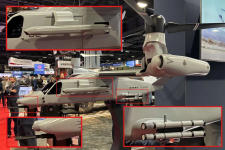
Bell Reveals Armed MV-75A Cheyenne II for Future Marine Corps Sea Denial and Precision Strike Missions
Bell’s armed MV-75A Cheyenne II concept hints at a Marine tiltrotor role in strike, escort and sea denial missions.
 www.armyrecognition.com
Competition Starts For Next U.S. Army Long-Range Missile | Aviation Week
A competition is underway to develop the U.S. Army’s next long-range, surface-to-surface missile for potential use on the Lockheed Martin High Mobility Artillery Rocket System (HIMARS).
 aviationweek.com
The Army wants the AHSS missile to offer more range than the 1,000-km-plus (621.3-mi.) reach of the Precision Strike Missile Increment 4, of which the contract was stripped from Lockheed and reopened to competitive bidding earlier this year.
Army officials in late 2024 revealed plans to develop a PRSM Increment 5 with greater range and the ability to launch from an autonomous vehicle. But the DEVCOM spokesperson clarified that AHSS represents a different concept, including an option to be launched from a crewed HIMARS.

Castelion Raises $1B Series C to Scale Production of Low-Cost Hypersonic Weapons - Castelion
Funding drives Blackbeard to maximum production rate and accelerates a new longer-range strike system.
 www.castelion.com
Army to take autonomous breaching F-250 to NTC this fall
Army to take autonomous breaching F-250 to NTC this fall | InsideDefense.com
The Army ran an F-250 truck through semi-autonomous mine-clearing and drone-defense tests during its Project Sandhills 2.0 prototyping series last week ahead of a continued assessment of the vehicle at the National Training Center at Ft. Irwin, CA, in October.
The Army ran an F-250 truck through semi-autonomous mine-clearing and drone-defense tests during its Project Sandhills 2.0 prototyping series last week ahead of a continued assessment of the vehicle at the National Training Center at Ft. Irwin, CA, in October. The Army fitted breaching capabilities onto the back of a Ford F-250 truck integrated with Forterra’s autonomy stack for the exercise, based at Ft. Bragg, NC. The truck included Edda, an artificial intelligence-powered counter-drone 12-gauge shotgun system from 9 Mothers
Competing Bradley Fighting Vehicle Replacement Prototypes Delivered To The U.S. Army (Updated)
American Rheinmetall and General Dynamics Land Systems are facing off to supply the Army's future XM30 Mechanized Infantry Combat Vehicle.

Competing Bradley Fighting Vehicle Replacement Prototypes Delivered To The U.S. Army (Updated)
American Rheinmetall and General Dynamics Land Systems are facing off to supply the Army's future XM30 Mechanized Infantry Combat Vehicle.
 www.twz.com
More Altius-700M footage.

 www.anduril.com
View: https://x.com/anduriltech/status/2094819579088539705?s=20
Altius | Anduril
Altius is an autonomous air vehicle launched from ground, air, or sea for ISR, SIGINT, EW, comms relay, and coordinated strikes with modular payloads.
7in dia.
33lb warhead
160km range
View: https://x.com/anduriltech/status/2094819579088539705?s=20
In the United States, Voltaic Marine has unveiled an air defense system based on the AEU39 unmanned surface vessel. The uncrewed craft is equipped with a retractable RiwP (Remote Integrated Weapons Platform) turret featuring a 30mm cannon and anti-aircraft missiles, including the FIM-92 Stinger and APKWS II. The AEU39 has an operational range of over 9,200 km. Its hybrid electric propulsion system—incorporating solar panels and a 300 kWh energy storage system—enables up to 15 days of autonomous operation at sea and speeds of up to 41 km/h. The vessel is rated for sea states up to 4 and has a payload capacity of 1,800 kg.

View: https://x.com/NatSecLedger/status/2097653337227227325?s=20
- Covenant targets mid-six-figure price per Anthem missile at full-rate production
- Startup has booked about $150 million in orders and expects to begin generating cash this year
- Dallas, Germany and Israel plants target combined output of 12,000 missiles a year
Executives said the missile was built with an eye toward the Pacific. "We were designed for the China fight," said Covenant President Abby Denburg.
Military planners envision using ground-launched weapons designed to strike from allied islands near China, such as the Philippines — a stretch of roughly 2,000 miles that would put Chinese targets within range without relying on manned aircraft or naval strike groups.
The operational environment is characterized by sophisticated integrated air defense systems, electronic warfare threats, and the need for long-range strike capabilities that combine speed, survivability, and affordability. Successful prototypes will demonstrate the ability to achieve threshold range performance of approximately 1,000 nautical miles from a ground-launched vector, with strike accuracy maintaining a circular error probable of less than 10 meters in contested conditions.
More on that, looks like a version of PrSM may get an RDE propulsion system.
Lockheed Martin’s July 2026 agreement with rotating detonation startup Venus Aerospace suggests the technology may finally be preparing for liftoff. The companies will evaluate the potential of Venus’s rotating detonation rocket engine for use in future long-range precision-fires systems and connect Venus’s prototypes with Lockheed’s missile-integration work. Lockheed Martin’s venture capital arm also participated in Venus’s $91 million financing round earlier in July. The company has also established a relationship with a competitor; in January 2026, Lockheed and GE Aerospace jointly tested a liquid-fueled rotating detonation ramjet for hypersonic missiles.