
Not related to the thread. However, an absolute delight to read my good sir. Our friends from across the border can yell all they want about physical traits. However, they have neglected their brains for far too long and have been found lacking ever since.Although this isn't related to the thread in question, the stance that maamu takes is one that most Paxtanis employ to defend consanguineous marriages.
I'd answer this by referring the reader to what I read sometime back about the Modus Operandi ( MO) of the Tableeghi Jamaat ( TeJ) . This organization was founded early last century to eliminate impurities ( read Hindu influences ) which were part of the way Muslims practiced their religion in the sub continent.
Their missionary activities were essentially focused on the Muslims of Nuh or Mewati Muslims who going by the standard definition of Muslims were only nominal Muslims.
They hardly read the Quran, had no Alims or Maluanas amongst them to guide them in Islamic practises & so on . As a result they celebrated both Hindu & Muslim festivals, kept the Ramadan fast which again wasn't universal among them , made the Haj if possible , indulged in intoxicants , didn't observe halal mostly or sacrificed for Eid al Azha & if they did, didn't sacrifice a cow but abstained from beef & consanguineous marriages or cousin marriages.
There were a lot of other points of differences with Orthodox Islam apart from the ones listed but for the purpose of this post I'm exercising brevity . Incidentally this is where the term Ganga Jumni tehzeeb comes from. It symbolises the half conversion to Islam.
Sufi missionaries who indulged in such conversions were often criticised by the ulema for these half baked conversions. The Sufis on the other hand were more pragmatic. Their thought was if we get them to partially convert that's one foot in the doorway. Eventually full conversion would follow. Events proved them right for a whole host of reasons that will require discussion for another day as it'd be a pretty elaborate one .
Coming back to the MO employed by the TeJ which in turn was something out of the playbook of early Islamic missionaries, the first task was the feeding of beef to the new convert after the proclamation of the Kalma Shahada.
This was important for the first test of a true convert was the casting away of ritual taboos of the previous religion to establish sincerity of conversion. In Iran the convert was supposed to torture or kill a dog since a dog is considered holy in Zoroastrianism.
Incidentally in late medieval India after the Gurus when Sikhi was faced with annihilation & they began to aggressively proselytize to increase their numbers, they used to feed neo converts with pork apart from ensuring the meat of any animal they had ( goat sheep fowl other birds) were slaughtered thru jhatka as opposed to halal. This meat was sanctified as kutha meat. This was also done to prevent spies getting into their fold .
The next item on the agenda was to arrange cousin marriages since this was a taboo among caste Hindus then & now. The logic was the same as the one on getting the convert to eating beef which is to break down old taboos & ensure full conversion to Islam .
These were the steps the TeJ missionaries adopted to ensure full conversion to Islam. As late as the 1970s those missionaries themselves admitted to being only partially successful aa they got the Mewatis to eat beef, abjure alcohol, become namaazis but couldn't pursuade the bulk of them to indulge in consanguineous marriages. And this was after 4-6 centuries after their nominal conversion to Islam.
So maamu here belongs to an Indic group who were more fully converted to Islam as compared to other groups . This is subjective as sub continental Muslims are also grave worshipers something you won't find in Arabia except for among the Shi'as which is an entirely different story altogether.
It's another matter that maamu's compatriots love their sisters a little too much even by Islamic standards since consanguineous marriages in Paxtan are among the highest in the Islamic world. Let's just say that's how Paxtanis celebrate Raksha Bandhan .
BTW consanguineous marriages are present in South India among few Hindu communities & there too it's among maternal cousins or maternal uncle & niece marriages although it's a dying tradition unlike what it is in Islam especially Paxtan where the trend is growing .
Finally Christianity doesn't prohibit consanguineous marriages it just became out of fashion before it was deemed to be medically unsafe to do so. Having said that it also wasn't custom among the majority of trbes or peoples of Europe who followed Christianity to indulge in consanguineous marriages even before their conversion nor were there considerations to do so like what the TeJ indulged in. The Renaissance & Enlightenment opened up Christian societies who did observe these practices essentially in the Middle East & possibly Southern Europe to change like no other.
Incidentally European Royalty practiced consanguineous marriages till the 20th century . The kings of Germany & UK were first cousins IIRC at the onset of WW-1 & the Russian king too was related to both kings being either their first or second cousin .
Interestingly the late Queen Elizabeth & her husband Prince Philip were distant cousins.
Islamic Republic of Pakistan : News, Discussions & Updates
- Thread starter Butter Chicken
- Start date
You are using an out of date browser. It may not display this or other websites correctly.
You should upgrade or use an alternative browser.
You should upgrade or use an alternative browser.


That physique part is mostly another trope Paxtanis indulge in. I'm spent a few years in the Gulf , almost a year as part of my assignment in Paxtan as service & training manager traveling the length & breadth of the country & a year of my working life in London . Physically there's little to distinguish between North Indians & Paxtanis especially Sindhis & Punjabis.Not related to the thread. However, an absolute delight to read my good sir. Our friends from across the border can yell all they want about physical traits. However, they have neglected their brains for far too long and have been found lacking ever since.
Pashtuns & Balochis are different though even there the average height would be 5'9". Seeing 6" + Pasthuns or Balochis wasn't rare but it wasn't usual either .
If mammu's stereotype of the typical Indian being short scrawny & dark is to be considered, the same is applicable to more than 80% of Paxtani Punjabis & Sindhis.
These stereotypes which Paxtanis subject us to including daal khor is what Pasthuns use for them. Not many here may be familiar with the Pashtun Punjabi Musalmaan feud. It goes back a millennium & it's about to ignite with full ferocity after nearly 2 centuries of calm mostly.
Those 2 centuries being that of Sikh rule which put a permanent stop to Afghan incursions post Abdali also resulted in permanent loss of what's now KPK - FATA, followed by British rule followed by that of Fauji Foundation. The latter is growing increasingly weak & as they further weaken the Afghans will be that much more emboldened.
As far as brains go the punjabi musalmaan is cunning, good at flattery, full of bluster & false bravado but ultimately cowardly. They're also amazingly susceptible to flattery.
Alhamdulillah!
Last edited:
A Pak! beggar Infiltrated during DoLund Trump and Putin meeting....


Well Safriz is not totally wrong, traditionally south states practice 'Cross-cousin marriage' and 'Avunculate marriage', but good thing is that also is coming down with passing of time.LOL. Ask the avg Hindu what he or she thinks of any Abrahamic culture including Christianity or goras in general. Hint hint: it's not good feelings at all.
Physique is not the only measure of human capability, it's also intelligence which those regions you listed AND your own country severely lack. Pakistan a country of 250 million people can't even produce it's own self designed car or even motorcycle. Reason? Bcus of this:
View attachment 45915
Bangladesh is Muslim too but take a look at their cousin marriage data. It's uniquely Pakistani to engage in ape breeding behavior in the subcontinent.
One more thing I noticed in this chart that Kerela does't practice this and is pleasant surprise to me. Here I stand corrected in my assumption.
These things indicates that progressive societies improve over time and adopt to better practices.

Even then cousin marriage in the south is 2 times less than in Pakistan. Im from the south and I personally have seen only 1 or 2 cases of such marriages.Well Safriz is not totally wrong, traditionally south states practice 'Cross-cousin marriage' and 'Avunculate marriage', but good thing is that also is coming down with passing of time.
One more thing I noticed in this chart that Kerela does't practice this and is pleasant surprise to me. Here I stand corrected in my assumption.
These things indicates that progressive societies improve over time and adopt to better practices.

Indian Muslims don't practice inbreeding though, it's cultural here. If our "scriptures" were to be analysed by Momineens, then Hindu scriptures would preach hatred for disbelievers, call for a holy war against those who don't believe in Dharma, declare monotheism as the greatest of sins, and stuff like "disbelievers are but one nation, and those who support them are one of them", "those who don't worship idols must be annihilated" and stuff like that, which inspires a lot of Hindus to do attacks like Pahalgam, 26/11, 9/11, and maybe almost every single terror attack on earth.So....before you call us out. Read your hindu religious text. Cousin marriage is totally allowed and very widely done in Hindu culture.
If you call us *censored* due to that. So are you.
Your Indian inferiority complex makes yiu try to copy the Christians of Europe and elsewhere, who call us *censored* due to cousin marriage, which we do.
But they don't do that because its forbidden in Christianity.
Not the genetic humbug.
For context the entire Afghanistan and central Asia does cousin marriage, and look at their physique.
Inferiority complex of what? You guys think anyone here feels inferior to you or your ummah? We file more patents a year than your entire ummah will in nearly 3 years, same is the state of affairs in any industrial and research output metric, despite not having more barrels of oil than people.
And by the way we have "गोत्र" system practiced specifically to prevent marrying any female/male of same lineage however distant it may be.

Itchy Boots in Pakistan. This vlog shows what common people think when they see a solo female biker is exploring Pakistan… may be due to curiosity or may be the culture. It seems that her journey is not sponsored by Pakistan Tourism Dept.

Although this isn't related to the thread in question, the stance that maamu takes is one that most Paxtanis employ to defend consanguineous marriages.
I'd answer this by referring the reader to what I read sometime back about the Modus Operandi ( MO) of the Tableeghi Jamaat ( TeJ) . This organization was founded early last century to eliminate impurities ( read Hindu influences ) which were part of the way Muslims practiced their religion in the sub continent.
Their missionary activities were essentially focused on the Muslims of Nuh or Mewati Muslims who going by the standard definition of Muslims were only nominal Muslims.
They hardly read the Quran, had no Alims or Maluanas amongst them to guide them in Islamic practises & so on . As a result they celebrated both Hindu & Muslim festivals, kept the Ramadan fast which again wasn't universal among them , made the Haj if possible , indulged in intoxicants , didn't observe halal mostly or sacrificed for Eid al Azha & if they did, didn't sacrifice a cow but abstained from beef & consanguineous marriages or cousin marriages.
There were a lot of other points of differences with Orthodox Islam apart from the ones listed but for the purpose of this post I'm exercising brevity . Incidentally this is where the term Ganga Jumni tehzeeb comes from. It symbolises the half conversion to Islam.
Sufi missionaries who indulged in such conversions were often criticised by the ulema for these half baked conversions. The Sufis on the other hand were more pragmatic. Their thought was if we get them to partially convert that's one foot in the doorway. Eventually full conversion would follow. Events proved them right for a whole host of reasons that will require discussion for another day as it'd be a pretty elaborate one .
Coming back to the MO employed by the TeJ which in turn was something out of the playbook of early Islamic missionaries, the first task was the feeding of beef to the new convert after the proclamation of the Kalma Shahada.
This was important for the first test of a true convert was the casting away of ritual taboos of the previous religion to establish sincerity of conversion. In Iran the convert was supposed to torture or kill a dog since a dog is considered holy in Zoroastrianism.
Incidentally in late medieval India after the Gurus when Sikhi was faced with annihilation & they began to aggressively proselytize to increase their numbers, they used to feed neo converts with pork apart from ensuring the meat of any animal they had ( goat sheep fowl other birds) were slaughtered thru jhatka as opposed to halal. This meat was sanctified as kutha meat. This was also done to prevent spies getting into their fold .
The next item on the agenda was to arrange cousin marriages since this was a taboo among caste Hindus then & now. The logic was the same as the one on getting the convert to eating beef which is to break down old taboos & ensure full conversion to Islam .
These were the steps the TeJ missionaries adopted to ensure full conversion to Islam. As late as the 1970s those missionaries themselves admitted to being only partially successful aa they got the Mewatis to eat beef, abjure alcohol, become namaazis but couldn't pursuade the bulk of them to indulge in consanguineous marriages. And this was after 4-6 centuries after their nominal conversion to Islam.
So maamu here belongs to an Indic group who were more fully converted to Islam as compared to other groups . This is subjective as sub continental Muslims are also grave worshipers something you won't find in Arabia except for among the Shi'as which is an entirely different story altogether.
It's another matter that maamu's compatriots love their sisters a little too much even by Islamic standards since consanguineous marriages in Paxtan are among the highest in the Islamic world. Let's just say that's how Paxtanis celebrate Raksha Bandhan .
BTW consanguineous marriages are present in South India among few Hindu communities & there too it's among maternal cousins or maternal uncle & niece marriages although it's a dying tradition unlike what it is in Islam especially Paxtan where the trend is growing .
Finally Christianity doesn't prohibit consanguineous marriages it just became out of fashion before it was deemed to be medically unsafe to do so. Having said that it also wasn't custom among the majority of trbes or peoples of Europe who followed Christianity to indulge in consanguineous marriages even before their conversion nor were there considerations to do so like what the TeJ indulged in. The Renaissance & Enlightenment opened up Christian societies who did observe these practices essentially in the Middle East & possibly Southern Europe to change like no other.
Incidentally European Royalty practiced consanguineous marriages till the 20th century . The kings of Germany & UK were first cousins IIRC at the onset of WW-1 & the Russian king too was related to both kings being either their first or second cousin .
Interestingly the late Queen Elizabeth & her husband Prince Philip were distant cousins.
Can you put light on how and why Pakistani society widely embraced cousin marriage. Long back they shared Vedic culture/ system with India, then they leaned toward Buddhism during King Kanishka, Both religion doesn't support cousin marriage. Islam shouldn't be single reason as it permits but doesn't promote this. As for as I know that is was part of Arab culture but at present Arabs are also much behind Pakistanis in this field. This thing Pakistanis took with them to US, UK and Europe also and maintaining same.
Only thing comes to my mind that may be their earlier tribal culture may also have supported and promoted this.
Can you put light on how and why Pakistani society widely embraced cousin marriage. Long back they shared Vedic culture/ system with India, then they leaned toward Buddhism during King Kanishka, Both religion doesn't support cousin marriage. Islam shouldn't be single reason as it permits but doesn't promote this. As for as I know that is was part of Arab culture but at present Arabs are also much behind Pakistanis in this field. This thing Pakistanis took with them to US, UK and Europe also and maintaining same.
Only thing comes to my mind that may be their earlier tribal culture may also have supported and promoted this.
Identity crisis. Since it's inception, pakistan wants to be part of the arabic world, the caliphate, ummah etc.. but they still haven't been accepted in the circle. And it showed throughout their history.
They have tried every means possible to arabize themselves, rewrite history, brainwash population to the extent of extremity of Arabic muslims. Went hardcore islam. The Afghan war, iran revolution didn't help their case either.
The only reason they have somewhat of a say in OIC is because of their alliance with USA/China and nuclear status. Not because of the Muslim population.
It's same with many of the Indian muslims, but you don't see india having a seat in OIC. And it's not for the lack of trying. Past govts tried hard to pander for a seat either for their belief, politics, vote bank.. but india didn't get it. Because India wasn't important. It wasn't an ally of either US or China. There isnt too much difference between indian and Pakistani muslims when it comes to how they view islam. Only difference is indian muslims were relatively shielded from Afghan war and war on terror and its impact on the psyche of people.
Now, as for tribal influence.. i am skeptic of it cause the tribal areas were never allowed to assimilate with the punjabi pakistan which basically rules there and is main voice of Pakistan we hear. KPK, POK, Baloch are mired in clashes since early days. They got guns later.
But this is my speculation based on my limited understanding of domestic politics of pk, not any factual research on my part.
I literally gave you the template the TeJ follows with the information they copied it from early Islamic missionaries especially the Sufis explaining the rationale behind those conversions & steps taken to ensure the convert & their descendants stay converted.Can you put light on how and why Pakistani society widely embraced cousin marriage. Long back they shared Vedic culture/ system with India, then they leaned toward Buddhism during King Kanishka, Both religion doesn't support cousin marriage. Islam shouldn't be single reason as it permits but doesn't promote this. As for as I know that is was part of Arab culture but at present Arabs are also much behind Pakistanis in this field. This thing Pakistanis took with them to US, UK and Europe also and maintaining same.
Only thing comes to my mind that may be their earlier tribal culture may also have supported and promoted this.
Didn't you read that post ?
Once consanguinity is normalised , ecosystems thus developed gets normalised as well ensuring this cycle is repeated. Ideally modern education should break this bond but Islam has proved to be resilient or impervious or impermeable depending on your PoV to modern ideas & rational thought
I am in search of some deeper and Historical perspective on subject thus asked you. Here Google also didn't help much. Points which were bothering me are:I literally gave you the template the TeJ follows with the information they copied it from early Islamic missionaries especially the Sufis explaining the rationale behind those conversions & steps taken to ensure the convert & their descendants stay converted.
Didn't you read that post ?
Once consanguinity is normalised , ecosystems thus developed gets normalised as well ensuring this cycle is repeated. Ideally modern education should break this bond but Islam has proved to be resilient or impervious or impermeable depending on your PoV to modern ideas & rational thought
1. Once they they had great knowledge in general as one of the famous university Taxila were situated in that area.
2. They were always closer to old trade routes of that time than India thus had reach to new development in general.
3. Islam was spread in very large area very fast, but we find that highest degree of consanguinity in Pakistan only, not even Arabs are closer to it.
4. It was very common in jews in the past, but came down considerably fast.
5. Middle period India (Including Pakistan, Bangladesh) was ruled by Muslims who followed similar philosophy/ culture, If conversion philosophy were same then effect should also have been same, but cousin marriage percentage in Indian Muslims is considerably less than Pakistan.
Thanks in advance if you can quench it, else I may be able to reach answers in due time.

The Taxila University was destroyed in the 5th century by the Huns a good 3 centuries before the Arabs appeared in Sind .I am in search of some deeper and Historical perspective on subject thus asked you. Here Google also didn't help much. Points which were bothering me are:
1. Once they they had great knowledge in general as one of the famous university Taxila were situated in that area.
2. They were always closer to old trade routes of that time than India thus had reach to new development in general.
3. Islam was spread in very large area very fast, but we find that highest degree of consanguinity in Pakistan only, not even Arabs are closer to it.
4. It was very common in jews in the past, but came down considerably fast.
5. Middle period India (Including Pakistan, Bangladesh) was ruled by Muslims who followed similar philosophy/ culture, If conversion philosophy were same then effect should also have been same, but cousin marriage percentage in Indian Muslims is considerably less than Pakistan.
Thanks in advance if you can quench it, else I may be able to reach answers in due time.
I've a different theory though I doubt your question can be answered by any one theory assuming it can be answered at all .
Beginning 5th century BCE the North West part of the sub continent in which I'd include most if not all of Afghanistan underwent massive changes on a frequent basis much more than what's India proper today.
You had the Achaememid Empire followed by the Greeks , then the Bactrian Greeks followed by the Indo Greeks , the Scythians or Sakas , the Indo Parthians , the Kushans & lastly the Huns rule over that region in succession. In between you also had the Sassanid Empire rule those parts at different points in time.
I believe this to be the foundational reason why Indic religions didn't gain root for things there were much more unsettled than in mainland India proper with the result the gradual evolutionary changes we saw it take place in mainland India wasn't seen in those parts .
Add to that the orthodoxy in mainland India saw them as interlopers or mlecchas even if they shared the same belief systems as in North India or Madhya Desha.
This much can be gleaned from extant manuscripts in our possession including from the Hunnic period in Afghanistan ruling over what's now KPK - FATA & Pakistani Punjab.
There is evidence that consanguineous marriages were practised in those parts by the Huns who intermixed with the local population there much to the disgust of the orthodoxy here . How widespread was it is unknown ? But Brahmins from Madhya Desha refused invitations from kings of these regions to minister to their populations with the result they had to utilise the services of Brahmins from those parts who were viewed as inadequately informed in scriptures by the orthodoxy here at best or at worst weren't considered Brahmins at all .
You can also see glimpses of it in the Mahabharata in the Karna Parva where some of the most angry sarcastic & critical exchanges are to be found in the dialogues exchanged between Karna & his charioteer Shalya who respecting the boon he'd granted the Pandavas under instructions from Vasudeva Krishna sought to undermine the confidence of Karna who was intent on duelling Arjuna.
Just for your information Shalya was the King of Madra which coincides with the Sialkot region of Paxtan or thereabouts while Karna was very much part of the milieu of Madhya Desha being born & raised here even if he was later annointed king of Anga which is in & around Bhagalpur region of Bihar.
Some of the points I've raised here were part of that exchange. I'd encourage you to go through it if possible.
Once the Turco Afghans invaded thru the NW displacing the local population , conquering them & forcing them to accept Islam , the latter were squeezed between the Arab & their remnants in Sind & South Punjab & these new Turco Afghans to the North.
Those who could , fled with the rest gradually converting & later intermixing with invading population settled there , the practises of those invaders being implemented with the Sufi missionaries aiding it .
As to why has it continued till date , it makes sense to them as landholding remains within the extended family more so since divisions render it smaller given the increasing sizes of those families , dispute resolution becomes easier especially if X & Y are brother & sister married to A & B another set of brother & sister , the implication being any ill treatment of a girl in a different household would be reciprocated here .
Moreover it's not as if Arab countries don't have the same degree of consanguinity. IIRC Iraq , Morocco etc have a very high degree of consanguinity either at par with Paxtan or in the same bandwidth give or take.
Finally Indian Muslims are a much more diverse group with less concentrated population centers in mainland India as compared to what it was in Afghanistan & Paxtan say before independence going back a few centuries.
Bangladesh is different coz up until the Mughals most of what's now Bangladesh was uninhabitable. It was a mixture of swampland , riverine flood plains & forests. It still is .
The Mughals deployed Sufis who brought their followers there to clear the land for cultivation , preach Islam to the local aborigines & gift those lands to them . Eventually they invited people from other parts of their empire to settle there which mostly included the underprivileged folk who got free land to cultivate if they converted .
Hence if you notice the concept of caste itself isn't very strong in Bangladesh . It wouldn't be wrong to say it's practically non existent which means traditional clan bonds are non existent. Hence no pressure or reason for consanguineous marriages.
Don't know if this explains the phenomenon of consanguinity in Paxtan & the lack of it thereof in other parts of the sub continent but some of the points raised here would've definitely played its part . Trust that answers your query.
Yes, this is the brain candy I was seeking from you. I like to understand historical perspective on social issues but couldn't got opportunity to study history after 10th, but I know your level of knowledge thus approched you... Thanks buddy...The Taxila University was destroyed in the 5th century by the Huns a good 3 centuries before the Arabs appeared in Sind .
I've a different theory though I doubt your question can be answered by any one theory assuming it can be answered at all .
Beginning 5th century BCE the North West part of the sub continent in which I'd include most if not all of Afghanistan underwent massive changes on a frequent basis much more than what's India proper today.
You had the Achaememid Empire followed by the Greeks , then the Bactrian Greeks followed by the Indo Greeks , the Scythians or Sakas , the Indo Parthians , the Kushans & lastly the Huns rule over that region in succession. In between you also had the Sassanid Empire rule those parts at different points in time.
I believe this to be the foundational reason why Indic religions didn't gain root for things there were much more unsettled than in mainland India proper with the result the gradual evolutionary changes we saw it take place in mainland India wasn't seen in those parts .
Add to that the orthodoxy in mainland India saw them as interlopers or mlecchas even if they shared the same belief systems as in North India or Madhya Desha.
This much can be gleaned from extant manuscripts in our possession including from the Hunnic period in Afghanistan ruling over what's now KPK - FATA & Pakistani Punjab.
There is evidence that consanguineous marriages were practised in those parts by the Huns who intermixed with the local population there much to the disgust of the orthodoxy here . How widespread was it is unknown ? But Brahmins from Madhya Desha refused invitations from kings of these regions to minister to their populations with the result they had to utilise the services of Brahmins from those parts who were viewed as inadequately informed in scriptures by the orthodoxy here at best or at worst weren't considered Brahmins at all .
You can also see glimpses of it in the Mahabharata in the Karna Parva where some of the most angry sarcastic & critical exchanges are to be found in the dialogues exchanged between Karna & his charioteer Shalya who respecting the boon he'd granted the Pandavas under instructions from Vasudeva Krishna sought to undermine the confidence of Karna who was intent on duelling Arjuna.
Just for your information Shalya was the King of Madra which coincides with the Sialkot region of Paxtan or thereabouts while Karna was very much part of the milieu of Madhya Desha being born & raised here even if he was later annointed king of Anga which is in & around Bhagalpur region of Bihar.
Some of the points I've raised here were part of that exchange. I'd encourage you to go through it if possible.
Once the Turco Afghans invaded thru the NW displacing the local population , conquering them & forcing them to accept Islam , the latter were squeezed between the Arab & their remnants in Sind & South Punjab & these new Turco Afghans to the North.
Those who could , fled with the rest gradually converting & later intermixing with invading population settled there , the practises of those invaders being implemented with the Sufi missionaries aiding it .
As to why has it continued till date , it makes sense to them as landholding remains within the extended family more so since divisions render it smaller given the increasing sizes of those families , dispute resolution becomes easier especially if X & Y are brother & sister married to A & B another set of brother & sister , the implication being any ill treatment of a girl in a different household would be reciprocated here .
Moreover it's not as if Arab countries don't have the same degree of consanguinity. IIRC Iraq , Morocco etc have a very high degree of consanguinity either at par with Paxtan or in the same bandwidth give or take.
Finally Indian Muslims are a much more diverse group with less concentrated population centers in mainland India as compared to what it was in Afghanistan & Paxtan say before independence going back a few centuries.
Bangladesh is different coz up until the Mughals most of what's now Bangladesh was uninhabitable. It was a mixture of swampland , riverine flood plains & forests. It still is .
The Mughals deployed Sufis who brought their followers there to clear the land for cultivation , preach Islam to the local aborigines & gift those lands to them . Eventually they invited people from other parts of their empire to settle there which mostly included the underprivileged folk who got free land to cultivate if they converted .
Hence if you notice the concept of caste itself isn't very strong in Bangladesh . It wouldn't be wrong to say it's practically non existent which means traditional clan bonds are non existent. Hence no pressure or reason for consanguineous marriages.


Actually that phenomenon of inverting the customs/taboos is even older according Jan Assmann, he called it 'normative inversion' on how jewish laws and customs were inverted from the Egyptian laws and customs.I literally gave you the template the TeJ follows with the information they copied it from early Islamic missionaries especially the Sufis explaining the rationale behind those conversions & steps taken to ensure the convert & their descendants stay converted.
Didn't you read that post ?
Once consanguinity is normalised , ecosystems thus developed gets normalised as well ensuring this cycle is repeated. Ideally modern education should break this bond but Islam has proved to be resilient or impervious or impermeable depending on your PoV to modern ideas & rational thought

Jan Assmann - Wikipedia
Last edited:
Jan Assman is a pioneer & legend in his field. Our very own S.N. Balagangadhara owes much to his studies in explaining to the west what modern Hinduism stands for & how did we get here often clashing swords with the establishment & self proclaimed Indologists in the West on this & various issues pertaining to Hinduism & India.Actually that phenomenon of inverting the customs/taboos is even older according Jan Assmann, he called it 'normative inversion' on how jewish laws and customs were inverted from the Egyptian laws and customs.
Jan Assmann - Wikipedia
en.m.wikipedia.org
S. N. Balagangadhara - Wikipedia
An apt antidote to the venom spread in international academia mostly by our own kind - the coolies, both by those out there & in here. Unfortunately he's not as well known in India as he ought to be.
Nor is there any understanding of him or his work & how to co opt him & his work against what they themselves & the nation aa a whole are up against in this war of narratives by the powers that be viz the chaddis from Nagpur with their anti intellectual stance .
Returning to your point, I don't think what applied to the Jewish Egyptian paradigm necessarily applies to the Islamic Sanatani context for in the former the Jews were reduced to slavery at one point by the Egyptians whereas the Islamic Sanatani dynamic was one of conqueror & conquered.
Egyptians didn't force their religion on the Jews though they detested them. Wasn't the case of Islam vis a vis Sanatan Dharma.
You're in luck . I got some of the references to what people in Madhya Desha thought about people in Madra & beyond.Yes, this is the brain candy I was seeking from you. I like to understand historical perspective on social issues but couldn't got opportunity to study history after 10th, but I know your level of knowledge thus approched you... Thanks buddy...
If you're interested in pre Islamic history in Afghanistan with a particular emphasis on the Turk Shahi & their successors the Hindu Shahi dynasty follow the handle Pagan.
He's an original Afghan Hindu or Afghan Hindu Pashtun as he describes himself which is to say he's a descendant of those Hindus who didn't convert to Islam at the time of the Arab followed by the Saffarid & later the Turkic conquest of Afghanistan.
In other words he doesn't belong to the latter day stock of Sikhs & Hindus who made their way to Afghanistan mostly during Mughal rule & later where Kabul & Kandahar were part of the Mughal Empire up until the time of Shah Jahan & Zebu & were there until quite recently.
I got the reference for consanguinity during Hunnic Rule from him. Lots of interesting vignettes in his T/L. Check him out if interested

All Pakistani cryptocurrency adventure should be under watch. This is basically to get away with tracing and avoiding FATF

 www.dnaindia.com
Jaish-e-Muhammad launched the drive to collect PKR 3.910 billion or Rs 3,910 crore to expand its network, build new 313 'markaz' or the 'terrorist hubs'. The Pakistan Army's wing ISI allegedly helped the JeM build a parallel financial ecosystem using digital wallets like SadaPay and EasyPaisa.
The nefarious designs of Pakistan's intelligence agency ISI, the Masood Azhar-led terrorist organisation Jaish-e-Muhammad (JeM), and its bid to raise massive funds, cheating the Financial Action Task Force (FATF), have been exposed. According to media reports, the ISI allegedly assisted the JeM in establishing a parallel financial ecosystem, utilizing digital wallets such as SadaPay and EasyPaisa to raise a substantial amount of money. The system was designed in such a way that banks were not involved; instead, money was transferred directly to digital wallets. After diverting the money to one wallet, it was distributed among small, nondescript, local-level digital wallets, from which the operatives withdrew the funds. Cash was taken out from these wallets through agents by paying a small fee.
It is believed that Jaish-e-Muhammad launched the drive to collect PKR 3.910 billion, or Rs 3,910 crore, to expand its network, build 313 new 'markaz,' or 'terrorist hubs,' recruit new fighters and pay them, and buy sophisticated weapons like light machine guns, AK-47s, mortars, rocket launchers, and even small shoulder-launched missiles. JeM planned to spend PKR 12.5 million, or Rs 1.25 crore, on building each markaz. According to reports, a mid-sized markaz costs just PKR 4–5 million. If 313 'markaz,' or centres are built, the actual expense is closer to PKR 1.23 billion, leaving a surplus of Rs 2,700 crore. This money was to be spent on buying weapons.
he modus operandi was simple. Muslims across the world, particularly those of the Pakistani diaspora, were asked to donate to building mosques and madrasas. A separate fund was created to help the people of the Gaza Strip, though the money was siphoned off. Muslim donors were encouraged to pay using wallets. Besides, Jaish-e-Muhammad started collecting money from mosques on Fridays. This collection was in cash and was distributed among different branches and operatives of the Pakistan-based terrorist organisation. A separate Al Rahmat Trust was used for funneling another PKR 10 crore annually through bank accounts under fake trustees.
The digital wallets were used to create a complicated network of individuals who transferred money from one wallet to another in such a way that it became almost impossible to track them. Masood Azhar’s brother, Talha Al Saif, collected money using SadaPay linked to a number registered under JeM’s Haripur commander Aftab Ahmad. Azhar’s son Abdullah Azhar collected donations using EasyPaisa, while JeM’s Khyber Pakhtunkhwa commander, Syed Safdar Shah, received money using another wallet in Mansehra. The money was transferred from one individual's account to another a number of times using a network. The network of wallets can be understood by one example: first, 250 accounts of the EasyPaisa wallet were created, and further, 30 new ones were added to the network every month.
Pakistan Army's intelligence wing, ISI, was behind creating this web of wallets; its team of financial experts trained the JeM operatives. They created a foolproof network and convinced the FATF that the Masood Azhar-led terrorist organization had stopped operations after the Pakistan government-led crackdown. The FATF agreed to bring Pakistan out of the grey list.
............
PS: Almost every one in Pakistan donates Zakat for Kashmir cause and not just in Pakistan but whole Pakistani diaspora does that. This money is used to bleed India by thousand cuts.
ISI Exposed: How Pakistan Army helped JeM create network of digital wallets for terror funding to cheat FATF?
Jaish-e-Muhammad launched the drive to collect PKR 3.910 billion or Rs 3,910 crore to expand its network, build new 313 'markaz' or the 'terrorist hubs'. The Pakistan Army's wing ISI allegedly helped the JeM build a parallel financial ecosystem using digital wallets like SadaPay and EasyPaisa.
Jaish-e-Muhammad launched the drive to collect PKR 3.910 billion or Rs 3,910 crore to expand its network, build new 313 'markaz' or the 'terrorist hubs'. The Pakistan Army's wing ISI allegedly helped the JeM build a parallel financial ecosystem using digital wallets like SadaPay and EasyPaisa.
The nefarious designs of Pakistan's intelligence agency ISI, the Masood Azhar-led terrorist organisation Jaish-e-Muhammad (JeM), and its bid to raise massive funds, cheating the Financial Action Task Force (FATF), have been exposed. According to media reports, the ISI allegedly assisted the JeM in establishing a parallel financial ecosystem, utilizing digital wallets such as SadaPay and EasyPaisa to raise a substantial amount of money. The system was designed in such a way that banks were not involved; instead, money was transferred directly to digital wallets. After diverting the money to one wallet, it was distributed among small, nondescript, local-level digital wallets, from which the operatives withdrew the funds. Cash was taken out from these wallets through agents by paying a small fee.
It is believed that Jaish-e-Muhammad launched the drive to collect PKR 3.910 billion, or Rs 3,910 crore, to expand its network, build 313 new 'markaz,' or 'terrorist hubs,' recruit new fighters and pay them, and buy sophisticated weapons like light machine guns, AK-47s, mortars, rocket launchers, and even small shoulder-launched missiles. JeM planned to spend PKR 12.5 million, or Rs 1.25 crore, on building each markaz. According to reports, a mid-sized markaz costs just PKR 4–5 million. If 313 'markaz,' or centres are built, the actual expense is closer to PKR 1.23 billion, leaving a surplus of Rs 2,700 crore. This money was to be spent on buying weapons.
he modus operandi was simple. Muslims across the world, particularly those of the Pakistani diaspora, were asked to donate to building mosques and madrasas. A separate fund was created to help the people of the Gaza Strip, though the money was siphoned off. Muslim donors were encouraged to pay using wallets. Besides, Jaish-e-Muhammad started collecting money from mosques on Fridays. This collection was in cash and was distributed among different branches and operatives of the Pakistan-based terrorist organisation. A separate Al Rahmat Trust was used for funneling another PKR 10 crore annually through bank accounts under fake trustees.
The digital wallets were used to create a complicated network of individuals who transferred money from one wallet to another in such a way that it became almost impossible to track them. Masood Azhar’s brother, Talha Al Saif, collected money using SadaPay linked to a number registered under JeM’s Haripur commander Aftab Ahmad. Azhar’s son Abdullah Azhar collected donations using EasyPaisa, while JeM’s Khyber Pakhtunkhwa commander, Syed Safdar Shah, received money using another wallet in Mansehra. The money was transferred from one individual's account to another a number of times using a network. The network of wallets can be understood by one example: first, 250 accounts of the EasyPaisa wallet were created, and further, 30 new ones were added to the network every month.
Pakistan Army's intelligence wing, ISI, was behind creating this web of wallets; its team of financial experts trained the JeM operatives. They created a foolproof network and convinced the FATF that the Masood Azhar-led terrorist organization had stopped operations after the Pakistan government-led crackdown. The FATF agreed to bring Pakistan out of the grey list.
............
PS: Almost every one in Pakistan donates Zakat for Kashmir cause and not just in Pakistan but whole Pakistani diaspora does that. This money is used to bleed India by thousand cuts.
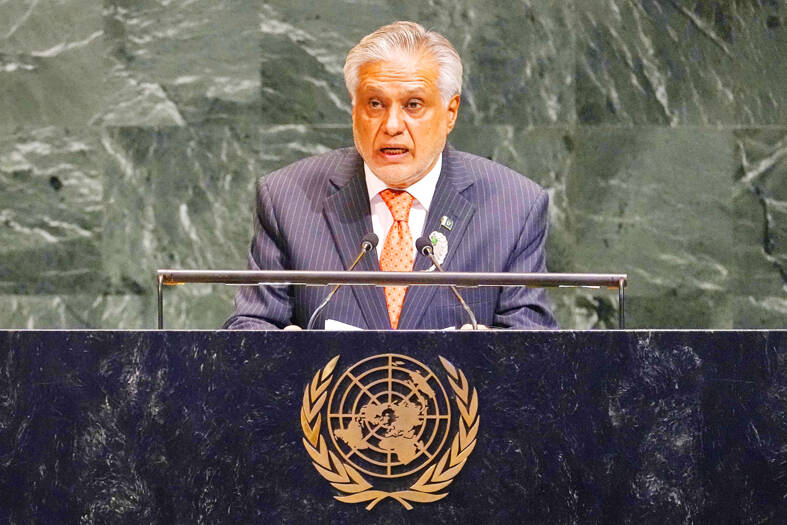
Pakistan minister makes landmark Bangladesh visit - Taipei Times
Bringing Taiwan to the World and the World to Taiwan
 www.taipeitimes.com
Pakistan’s minister of foreign affairs flew to Bangladesh yesterday, as the nations, once bitter enemies after they split in 1971, seek to rebuild ties.
Pakistani Minister of Foreign Affairs Ishaq Dar is the most senior Pakistani official to visit Dhaka since 2012, with Islamabad calling it a “significant milestone in Pakistan-Bangladesh relations.”