
News Japan To Invest 10 Trillion Yen In India Over Next Decade

Anari

Member
Nov 2, 2025
11
19
India
Japan To Invest 10 Trillion Yen In India Over Next Decade

Narendra Modi and Shigeru Ishiba shared their serious concern over the militarisation of disputed features.

Press Trust of India
India News
Aug 29, 2025 23:54 pm IST
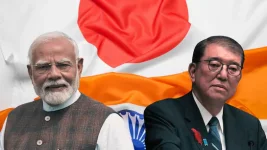
qncl4a_pm-modi_625x300_28_August_25.webp
New measures to further expand India-Japan special strategic partnership were unveiled following summit.

Tokyo: Japan on Friday set an investment target of 10 trillion yen (approx Rs 60,000 cr) in India over a decade and the two sides sealed a raft of big-ticket pacts, including a framework for defence ties and a 10-year roadmap to largely boost economic partnership -- decisions that came amid turbulence triggered by Washington's trade policies.

The new measures to further expand India-Japan special strategic and global partnership were unveiled following summit talks between Prime Minister Narendra Modi and his Japanese counterpart, Shigeru Ishiba.

The two sides firmed up 13 key pacts and documents and announced the launch of several transformative initiatives, including an economic security architecture to promote supply chain resilience in strategic sectors such as semiconductors, clean energy, telecom, pharmaceuticals, critical minerals and new and emerging technologies.

"We both agree that as two major economies and vibrant democracies, our partnership is very important not only for our two countries, but also for global peace and stability. Strong democracies are natural partners in shaping a better world," Modi, flanked by Ishiba, said.

"Today, we have laid a strong foundation for a new and golden chapter in our Special Strategic and Global Partnership. We have set a roadmap for the next decade." "We have set a target of 10 trillion yen investment from Japan in India over the next ten years," Modi said.

Of the agreements, one relates to promoting mobility of 50,000 skilled and semi-skilled personnel from India to Japan in the next five years, while another agreement will advance collaboration in digital public infrastructure.

The 10-year roadmap features several key pillars such as economic security, mobility, ecological sustainability, technology and innovation, health, people-to-people exchanges and engagements between Indian states and Japanese prefectures.

Another key pact was to advance cooperation in supply chain resilience for critical minerals, including through the development of processing technologies, joint investments for exploration and mining and efforts for stockpiling critical minerals. A separate declaration was sealed for promoting projects on hydrogen and ammonia.

The pacts signed also featured one on a joint crediting mechanism and another on cooperation between the Indian Space Research Organisation and Japan Aerospace Exploration Agency for a joint lunar-polar exploration mission.

The document defines terms and conditions for cooperation between India and Japan on the Chandrayaan-5 mission, giving practical shape to a "landmark" collaboration.

 
US had asked then PM Manmohan Singh to not encourage Japan PM on Quad: Ex-foreign secretary Shyam Saran

PTI / Updated: Feb 4, 2024, 21:01 IST

JAIPUR: Former foreign secretary Shyam Saran said the US, which persuaded India on the formation of the Quad alliance, had wanted the then prime minister Manmohan Singh to ask his Japanese counterpart to "not encourage" the diplomatic alliance focussed on the Indo-Pacific region.

Speaking here at the 17th edition of the Jaipur Literature Festival (JLF) on Saturday, Saran said the US explained its position on the Quad saying it needed to have China on its side on the issue of Iran and North Korea's nuclear programmes and had argued that "neither the Chinese nor the Russians were very happy with the Quad".

The Quad, a diplomatic partnership between four countries - Australia, India, Japan, and the United States - went into cold storage after protests from China.

It was reinstated in 2017, after a gap of 10 years, in the face of China's growing assertiveness in world affairs.

"What happened was before our PM Dr Manmohan Singh's visit to Tokyo for an official visit, I was contacted by our American friends and we were told, 'Please tell your PM not to encourage Abe (the then Japanese PM) on the Quad. He would like to push this forward. This is not the time we should be doing this'," Saran said.

Saran, who was the foreign secretary between 2004 and 2006, made the remarks during a session titled 'Heart of the Matter: Quad and the new Indo-Pacific Vision' at the JLF on Saturday.

Surprised by the US stance, Saran said he asked two things to the US official: "'Japan is your ally, why don't you talk to them yourself?' and 'You are the ones who persuaded us that this was a great platform to be on, why are you now trying to step back'".

Saran said the US official replied: "'We need the Chinese today because we have the Iran nuclear issue before the UNSC. Wealso have the North Korea six-party talks that we are trying to revive... It is not that we are stepping back but for the time being let us wait."

To which Saran said he replied, "It was your (US) initiative. You don't think it is convenient at this point of time, so be it."

The origins of the Quad lie in the devastating 2004 Indian Ocean tsunami, when the four countries formed the 'Tsunami Core Group' to coordinate the emergency response and humanitarian assistance.

In subsequent years, there were efforts to institutionalise it into the Quad alliance, which was led by late Shinzo Abe during his first term as prime minister of Japan from 2006 to 2007.

The US Ambassador to India Eric Garcetti, who was among the panellists discussing the topic, did not directly respond to Saran's remarks but said "the present and the history we are writing" is more important to him than past events.

"My president whose first engagement of all the countries, of all the institutions - bilateral, trilateral, quadrilateral - he engaged in was the Quad in Washington DC where he hosted the three national leaders (from India, Japan, Australia).

And that was a very powerful turn for us. So history is interesting to me but not that interesting to me... the history we are writing is not only fascinating, it is deep," he added.

Saran said he had no doubt that China was the "cement" which holds the Quad alliance together, and added that Beijing, which first called the Quad "some fluff on the ocean wave", won't call it the same anymore as the group today has acquired "substance".

"Maybe it is not against China, but it has certainly been made more crystallised as a result of a common sense amongst all our partners that the balance of power in the - what we call the Indo-Pacific - has been changing against us. And therefore if we do not work together this balance is going to get worse," the 78-year-old career diplomat said.

 
  • Informative
Reactions: Subgradewalker
US had asked then PM Manmohan Singh to not encourage Japan PM on Quad: Ex-foreign secretary Shyam Saran

PTI / Updated: Feb 4, 2024, 21:01 IST

JAIPUR: Former foreign secretary Shyam Saran said the US, which persuaded India on the formation of the Quad alliance, had wanted the then prime minister Manmohan Singh to ask his Japanese counterpart to "not encourage" the diplomatic alliance focussed on the Indo-Pacific region.

Speaking here at the 17th edition of the Jaipur Literature Festival (JLF) on Saturday, Saran said the US explained its position on the Quad saying it needed to have China on its side on the issue of Iran and North Korea's nuclear programmes and had argued that "neither the Chinese nor the Russians were very happy with the Quad".

The Quad, a diplomatic partnership between four countries - Australia, India, Japan, and the United States - went into cold storage after protests from China.

It was reinstated in 2017, after a gap of 10 years, in the face of China's growing assertiveness in world affairs.

"What happened was before our PM Dr Manmohan Singh's visit to Tokyo for an official visit, I was contacted by our American friends and we were told, 'Please tell your PM not to encourage Abe (the then Japanese PM) on the Quad. He would like to push this forward. This is not the time we should be doing this'," Saran said.

Saran, who was the foreign secretary between 2004 and 2006, made the remarks during a session titled 'Heart of the Matter: Quad and the new Indo-Pacific Vision' at the JLF on Saturday.

Surprised by the US stance, Saran said he asked two things to the US official: "'Japan is your ally, why don't you talk to them yourself?' and 'You are the ones who persuaded us that this was a great platform to be on, why are you now trying to step back'".

Saran said the US official replied: "'We need the Chinese today because we have the Iran nuclear issue before the UNSC. Wealso have the North Korea six-party talks that we are trying to revive... It is not that we are stepping back but for the time being let us wait."

To which Saran said he replied, "It was your (US) initiative. You don't think it is convenient at this point of time, so be it."

The origins of the Quad lie in the devastating 2004 Indian Ocean tsunami, when the four countries formed the 'Tsunami Core Group' to coordinate the emergency response and humanitarian assistance.

In subsequent years, there were efforts to institutionalise it into the Quad alliance, which was led by late Shinzo Abe during his first term as prime minister of Japan from 2006 to 2007.

The US Ambassador to India Eric Garcetti, who was among the panellists discussing the topic, did not directly respond to Saran's remarks but said "the present and the history we are writing" is more important to him than past events.

"My president whose first engagement of all the countries, of all the institutions - bilateral, trilateral, quadrilateral - he engaged in was the Quad in Washington DC where he hosted the three national leaders (from India, Japan, Australia).

And that was a very powerful turn for us. So history is interesting to me but not that interesting to me... the history we are writing is not only fascinating, it is deep," he added.

Saran said he had no doubt that China was the "cement" which holds the Quad alliance together, and added that Beijing, which first called the Quad "some fluff on the ocean wave", won't call it the same anymore as the group today has acquired "substance".

"Maybe it is not against China, but it has certainly been made more crystallised as a result of a common sense amongst all our partners that the balance of power in the - what we call the Indo-Pacific - has been changing against us. And therefore if we do not work together this balance is going to get worse," the 78-year-old career diplomat said.

US interference in internal affairs of other countries

US regularly interferes in internal affairs of other countries. Examples: Iran's nuclear programme, Use of nuclear energy in India, Japanese economic investments in other countries, etc. How do some countries successfully deal with this US interference and move on to complete their projects? What's their methodology?

Interference in internal affairs of other countries takes a lot of hardwork. The process detail is out of scope of this thread. It would suffice to say that it involves a lot of hardwork and after a few days it becomes tedious. So the strategy is to tire them out. Wait for days till Americans become fatigued and they lose interest in the issue. This is a time-tested method that works everytime. What seems like a great challenge at one point lasts for a while and then tapers off.
 
US interference in internal affairs of other countries

US regularly interferes in internal affairs of other countries. Examples: Iran's nuclear programme, Use of nuclear energy in India, Japanese economic investments in other countries, etc. How do some countries successfully deal with this US interference and move on to complete their projects? What's their methodology?

Interference in internal affairs of other countries takes a lot of hardwork. The process detail is out of scope of this thread. It would suffice to say that it involves a lot of hardwork and after a few days it becomes tedious. So the strategy is to tire them out. Wait for days till Americans become fatigued and they lose interest in the issue. This is a time-tested method that works everytime. What seems like a great challenge at one point lasts for a while and then tapers off.
Most posters are discussing US interference. Very few have noticed how some countries deal successfully with this interference and move on.

Excerpt from an article gives an example:

In the book The Kaoboys of R&AW -- Down the Memory Lane that is yet to be published, he said the US interest in Punjab militancy "continued for a little more than a decade and tapered off after.. "