India’s Dream to Build a Thousand Ships
The southern state has edged out Gujarat and Andhra Pradesh in Modi’s industrial ambitions.
By Menaka Doshi
February 12, 2026, at 12:50 PM GMT+5:30
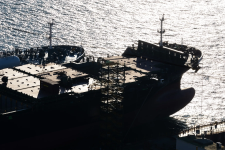 A ship under construction at a Hyundai Mipo Dockyard shipyard in Ulsan, South Korea.Photographer: SeongJoon Cho/Bloomberg.
The New Ulsan
A bona fide Korean meal and a trip to a Korean supermarket may have helped clinch India’s biggest commercial shipyard deal ever.
On a visit to the port town of Thoothukudi (Tuticorin) in March last year, executives of South Korean shipping major HD Hyundai stopped for lunch. Their hosts, Tamil Nadu state government officials, had picked a Korean restaurant owned and staffed by expats.
“They were really surprised to find Korean food four hours outside Chennai,” Darez Ahamed, CEO of the state’s investment promotion agency Guidance, told me.
Earlier in the trip the group visited a Korean supermarket that supplies some 5,000 expats working at the over 110 South Korean companies invested in the south Indian state, including Hyundai’s large automobile manufacturing factory.
This soft diplomacy, backed by an optimal location, a strong industrialization record and significant land and capital subsidies, put Tamil Nadu ahead of Gujarat and Andhra Pradesh in India’s race to build a fleet of over 1,000 flag carriers in the next 10 years.
“The Hyundai team’s first response after seeing Thootukudi was that it reminded them of Ulsan from 30 years ago,” Ahamed said. Ulsan is where HD Hyundai began shipbuilding in the early 1970s; last year it delivered its 5,000th vessel.
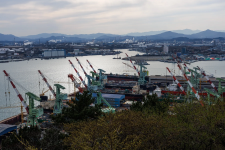 The HD Hyundai shipyard in Ulsan, South Korea, is the world’s largest.Photographer: SeongJoon Cho/Bloomberg.
China has displaced South Korea as the world’s largest shipmaker, raising national security concerns for countries like India and the US.
India owns just over 1,500 ships, about 1.2% of the global shipping fleet. It spends an estimated $90 billion a year on freight, moved mostly by foreign vessels, according to a report from credit rating agency ICRA. To cut that reliance and dollar outflow, Prime Minister Narendra Modi’s government has reworked policies and earmarked close to 700 billion rupees ($7.71 billion) in shipbuilding incentives over the next decade.
It will take much more such support as India produces less than 1% of the world’s commercial ships. The few shipyards in the country are largely government-owned and build mostly naval vessels, orders for which have spiked in recent years. The challenge is to develop a commercial ship building industry at competitive scale in the face of overcapacity in China and US revival efforts.
China-Made Ships Account for More Than a Third of the Global Fleet
Three Asian nations have built the vast majority of ships that are currently on the water
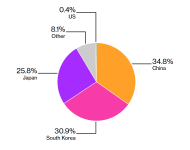 Source: Clarksons Research
Note: Data as of the end of June. Calculated based on deadweight tonnage of ships currently on water.
Source: Clarksons Research
Note: Data as of the end of June. Calculated based on deadweight tonnage of ships currently on water.
In Kattupalli in Tamil Nadu, things are finally looking up. The shipyard run by Larsen & Toubro, a private sector engineering and construction giant, began operations in 2013 with the intent of building commercial vessels, but has supplied mostly to the Navy and Coast Guard.
Production costs in India are up to 20% higher than in east Asia due to imported steel, marine engines and other equipment. Productivity is lower and build times are twice as long, Arun Ramchandani, senior vice president and head of L&T Precision Engineering & Systems, tells me. The ancillary ecosystem is fragmented and underdeveloped, and cheap, patient financing is scarce. There are also a multitude of tax, insurance and other hurdles. “These factors make Indian yards uncompetitive, but a turnaround is increasingly visible,” he said.
Alongside efforts to subsidize the cost gap and augment supply, the government is also stepping up demand. Earlier this month, several public sector companies signed an agreement to establish the Bharat Container Shipping Line. It will receive funding to buy ships from a new 100 billion rupee scheme announced in this month’s federal budget.
I must emphasize these supply and demand plans are yet in early stages.
“The direction of travel is positive; what’s needed now is scale, predictability of demand and a deeper supply chain for an industry-wide step change,” Ramchandani said.
In Thoothukudi, the federal and state governments (run by opposing political parties) are working in tandem to make that happen. A joint venture between them will build breakwaters, dry docks and other supporting facilities so that Hyundai can focus on
setting up the yard speedily. Two federally owned shipbuilders, Cochin Shipyard and Mazagon Dock Shipbuilders, are also exploring new yards in the state. Component makers and other ancillary manufacturers are planning expansions.
For every job created inside a shipyard, more than six jobs are created outside, Guidance CEO Darez said. “This high a multiplier effect is rare in any other industry. No country has become great without a strong shipbuilding presence.”
https://www.bloomberg.com/news/news...business&utm_medium=social&utm_source=twitter



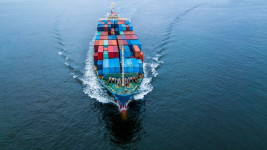

 HD Hyundai to go solo for it's $4 Billion shipbuilding plant


