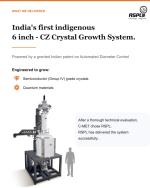

I will lose my mind if we get a semi-conductor fab equipment startup from a college hackathon:
Ministry of Defence
DRDO & IIT Delhi demonstrate Quantum Entanglement-Based Free-Space Quantum Secure Communication over more than 1 km distance
Paves way for development in quantum cyber security, quantum networks & future quantum internet
India has entered into a new quantum era of secure communication which will be a game changer in future warfare: Raksha Mantri
Posted On: 16 JUN 2025 5:18PM by PIB Delhi
View attachment 44518
India has entered into a new quantum era by successfully demonstrating an experimental advancement through DRDO-Industry-Academia Centre of Excellence (DIA-CoE), IIT Delhi. The free-space quantum secure communication using quantum entanglement over a distance of more than one km was achieved via a free-space optical link established on the IIT Delhi campus.
The experiment attained a secure key rate of nearly 240 bits per second with a quantum bit error rate of less than 7%. This entanglement-assisted quantum secure communication paves the way for real-time applications in quantum cyber security, including long-distance Quantum Key Distribution (QKD), the development of quantum networks, and the future quantum internet. These efforts align with India’s broader objectives to advance quantum technologies for national development.
Under the project ‘Design and development of photonic technologies for free space QKD’, sanctioned by Directorate of Futuristic Technology Management (DFTM), DRDO, the demonstration was given by Prof Bhaskar Kanseri’s research group in the presence of several dignitaries, including the DRDO DG (MED, COS & CS), Director SAG, Director DFTM, Dean (R&D) IIT Delhi, Director (DIA-CoE) and DRDO laboratory scientists.
Quantum entanglement-based QKD offers several significant advantages over the traditional prepare-and-measure method by enhancing both security and functionality. Even if devices are compromised or imperfect, the use of quantum entanglement ensures the security of key distribution. Any attempt to measure or intercept the entangled photons disturbs the quantum state, allowing authorised users to detect the presence of an eavesdropper.
Quantum communication provides fundamentally unbreakable encryption, making it a dual-use technology with applications in securing data in strategic sectors such as defence, finance, and telecommunications, as well as in protecting national security-related communications. Free-space QKD eliminates the need to lay optical fibers, which can be both disruptive and expensive, especially in challenging terrains and dense urban environments.
Earlier, India’s first intercity quantum communication link between Vindhyachal and Prayagraj in 2022, using commercial-grade underground dark optical fiber was demonstrated by DRDO scientists along with Prof Bhaskar’s team. More recently, in 2024, the team successfully distributed quantum keys using entanglement over a 100 km spool of telecom-grade optical fiber in another DRDO-supported project.
These technologies are being developed through DRDO-Industry-Academia – Centres of Excellence (DIA-CoEs) – an initiative of DRDO, where 15 Centres of Excellence have been established at premier academic institutes like IITs, IISc & Universities for development of cutting-edge defence technologies.
Raksha Mantri Shri Rajnath Singh has congratulated DRDO & IIT Delhi for this landmark achievement, stating that India entered into a new quantum era of secure communication which will be a game changer in future warfare.
Secretary Department of Defence R&D and Chairman DRDO Dr Samir V Kamat and Director, IIT Delhi Prof Rangan Banerjee congratulated the team for these key achievements.
https://www.pib.gov.in/PressReleasePage.aspx?PRID=2136702



India’s semiconductor ambitions got a fresh boost with the signing of a tripartite memorandum of understanding between the Odisha government, Intel Corporation and US-based 3D Glass Solutions Inc (3DGS) on May 29 to establish an advanced packaging glass core substrate manufacturing facility in the state.
The development comes as India sharpens its focus on strategic technologies, including semiconductors, artificial intelligence and electronics manufacturing, amid rising geopolitical competition and growing demand for resilient global supply chains.
The proposed project, to be located in the Bhubaneswar-Khurda region, entails an estimated investment of about $3.3 billion, making it among the country’s largest investments in high-technology manufacturing.
The agreement was signed in the presence of Electronics and IT minister Ashwini Vaishnaw, Odisha Chief Minister Mohan Charan Majhi, Intel chief executive Lip-Bu Tan and senior industry executives.
Officials said the facility would manufacture advanced packaging glass core substrates, high-density interconnect substrates and related semiconductor components, with Intel expected to provide technology expertise and process support.
Vaishnaw said the agreement aligned with the Centre’s broader strategy of developing a complete semiconductor manufacturing ecosystem in the country. He said the participation of global technology firms reflected growing industry confidence in India’s semiconductor push under the India Semiconductor Mission.
The minister cited recent investments and partnerships involving global semiconductor equipment and materials companies such as Applied Materials, Lam Research, Tokyo Electron and Merck, along with Tata Electronics’ collaboration with Dutch chip equipment maker ASML, as evidence of rising momentum in the sector.
India has intensified efforts to build domestic semiconductor capabilities through incentives covering chip fabrication, packaging, display manufacturing and compound semiconductors. The government has approved multiple semiconductor and electronics manufacturing proposals over the past two years as part of its plan to reduce import dependence and position India as an alternative global manufacturing hub.
Industry executives said advanced packaging technologies are becoming increasingly critical as chipmakers seek higher performance and energy efficiency. Glass core substrates are seen as a next-generation technology for semiconductor packaging due to their superior thermal and electrical properties compared with conventional organic substrates.
The Odisha project is proposed to be implemented in phases over five to six years. Once operational, it is expected to generate more than 1,800 direct high-skilled jobs while also creating indirect employment opportunities across the electronics manufacturing and semiconductor supply chain ecosystem.
State government officials said the project would help Odisha emerge as a key destination for semiconductor and electronics investments, supported by infrastructure development and policy incentives aimed at attracting high-technology industries.
The proposed facility is also expected to support export-oriented manufacturing and strengthen India’s participation in global semiconductor supply chains at a time when countries worldwide are seeking to diversify chip production networks beyond traditional manufacturing centres.
@Gautam Could tata perhaps partner wit intel for their advanced nodes like intel 3 or intel 18a, intel seems pretty eager to expand their IFS and Tata has the money to do this while India has both the current and future demand.
Too early to say.@Gautam Could tata perhaps partner wit intel for their advanced nodes like intel 3 or intel 18a, intel seems pretty eager to expand their IFS and Tata has the money to do this while India has both the current and future demand.
TATA was hit hard in the recent chip shortage
View attachment 51915
View attachment 51914
Too early to say.
TATA's roadmap, as I understand, is to start with 28nm node, commercialize, scale up, then move up to 14nm. These two-node fabs will be done in co-operation with PSMC, Taiwan. The chips produced here will mostly cater to power management, consumer electronics, automotive, aerospace, telecom etc. In these areas TATA Group's other companies can be customers.
There are some Linkedin posts that suggested that TATA might move to 7nm for RAM, CPU/GPU, camera SoCs, edge computing ASICs, etc. They have to establish themselves as a high volume/quality supplier to other global companies to build up a solid clientele before they can move to high end chips.
TATA has the financial firepower to build high end fabs, but that alone isn't enough. To make business sense they need to establish themselves in the fab business with the 28-14nm nodes.

 www.bbc.com
sure But India has a stated ambition for lower nm nodes. Tata and PSMC have alr sent a proposal to the gov to upgrade the current fab being built to go down to 14nm.Too early to say.
TATA's roadmap, as I understand, is to start with 28nm node, commercialize, scale up, then move up to 14nm. These two-node fabs will be done in co-operation with PSMC, Taiwan. The chips produced here will mostly cater to power management, consumer electronics, automotive, aerospace, telecom etc. In these areas TATA Group's other companies can be customers.
There are some Linkedin posts that suggested that TATA might move to 7nm for RAM, CPU/GPU, camera SoCs, edge computing ASICs, etc. They have to establish themselves as a high volume/quality supplier to other global companies to build up a solid clientele before they can move to high end chips.
TATA has the financial firepower to build high end fabs, but that alone isn't enough. To make business sense they need to establish themselves in the fab business with the 28-14nm nodes.