Sukhoi Su-30MKI

out of his dreams lmao, the astra mk3 is rated 340km at a 20km altitude(very high altitude, like mig 31 level). even if we assume a 30% range boost(absurd to the say the least) it would be around 450 kms. Nowhere near the fking 600kms stated lmao. He's waffling like he always does.

R-37M is 350 km when fired from a Flanker. 30% boost from here is 450 km.
Mig-31/J-36 can push the envelope to maybe 400 km, operating envelop expected to be 25 km. 30% boost is 500+ km.

And this is for the R-37M. Non-AESA, boost-sustain motor.

For the PL-17, even if we assume the standard advertised range is 450 km for a Flanker shot, we get ~600 km when launched from the J-36 with the 30% boost.
If we take the higher advertised range, it's still 500 km. 30% boost is 650 km.
 
PL-17's max range is 700+ km.

The only equivalent of the PL-17 right now is the AIM-174B, which is also likely to fall in the 800 km category.

It's unclear if R-37M can match that performance. We are buying it to keep up with any potential purchase of PL-17 by the PAF for J-10 and J-35.

We are developing Brahmos-M as our main capability for anti-AWACS.
Indian militry lacks vision.

They demand equipment with present requirements , and as it take time to develope, the developed tech is already outdated

Insted indian militry should have a unit , entirely focused on how future warfare will evolve and what types of technological advancement needed and then out the requirements of future

Till now, we are not developing any extreme long range a2a.

We should have been working on over 600+km range missile utilizing 3 or more pulse(or sfdr)

I suggest that indian militry should full up their present requirement with imports while double dowing on future requirement for indigenous

But nooo, we are looking for a partner i 6th gen fighter aircraft where we won't be lead partner

-> i will ask to develope what i require now(insted of a decade later)

-> after a decade the product will be outdated

-> i will cry that we need to import to have gold plated technology

-> repeat
 
You are repeating what I said using the opposite words.

The X band is a 3cm wave, S band is 12 cm. To achieve the same beamwidth, you need an S band array that's 4 times the size of the X band.

That's why a 4x4m S band array performs the same as a 1x1m X band.

Beamwidth = k x wavelength / side of square
At k= 50,
For 4x4 S band, you get 1.5 degrees.
For 1x1 X band, you get 1.5 degrees.

So this proves that you need an S band radar 4x the size of X band to have the same features.

For 8x1 S band, you get 0.86 deg and 6.9 deg. The formula here is (180xwavelength)/(3.14xd). d=length or breadth.

So you get superior bearing and inferior altitude on AWACS compared to fighter.

For L band, Netra Mk1, same numbers, you get 1.61 deg and 12.9 deg at 1.5 GHz. Which is double that of S band. To get the same performance as Netra Mk1A, Netra Mk2 needs to be 16x2m because the wavelength difference is 2x.

It's a simple rule of thumb. X band to S band is 4x difference. S band to L band is 2x. L band to X band is 8x. You need an 8x8m L band array to match 1x1m X band.

As for gain, Virupaksha has significantly higher gain. It has 2500 TRMs vs Netra Mk1A's 1280. We don't know the gain of each TRM, but we can assume taper efficiency is superior on Virupaksha due to it beign X band. So double TRM, higher taper efficiency, it's obvious the radar gain is significantly superior, by at least 2 times.
That gain advantage is all undone when you factor in sheer difference in the power each TRM (10W) compared to 50W each Netra TRM ( 400W each TRMM) puts out (this actually goes even higher when the radar operates in high power mode).
That puts Virupaksha, even with 1.5x more efficient GaN TRM, at a serious power disadvantage (20KW+ vs 64 KW+). Netra can actually switch off one array and use the active one to put out even more power than normal.

Now factor in atmospheric attenuation which gets far far worse if there are clouds and high humidity, even as high as 8 times compared to S-band.

There's a reason why all long range radars where you need some sort of accuracy while preserving long range performance, are all S-band. This only gets compounded for each km the beam has to travel. They make up for inferior angular resolution by making the radar larger.

ALSO, Netra uses slotted planar antenna array whereas Virupaksha uses TSA antenna, which can puts Virupaksha at a disadvantage in terms of power output because SPA provides higher efficiency and ERP. TSA do provide superior bandwidth performance and frequency agility.

So no, no level of menta gymnastics would put Virupaksha in the same level of RANGE performance as Netra when even physics doesn't support it. These random figures like 300km for 1 SQM, 400km for 1 SQM are just thrown out with no actual basis.
Oh ya, I'm not even talking about Netra MK1A which has new GaN-based TRMs but the MK1 variant.

1779425388040.jpeg
 
Last edited:
That gain advantage is all undone when you factor in sheer difference in the power each TRM (10W) compared to 50W each Netra TRM ( 400W each TRMM) puts out (this actually goes even higher when the radar operates in high power mode).
That puts Virupaksha, even with 1.5x more efficient GaN TRM, at a serious power disadvantage (20KW+ vs 64 KW+). Netra can actually switch off one array and use the active one to put out even more power than normal.

Now factor in atmospheric attenuation which gets far far worse if there are clouds and high humidity, even as high as 8 times compared to S-band.

There's a reason why all long range radars where you need some sort of accuracy while preserving long range performance, are all S-band. This only gets compounded for each km the beam has to travel. They make up for inferior angular resolution by making the radar larger.

ALSO, Netra uses slotted planar antenna array whereas Virupaksha uses TSA antenna, which can puts Virupaksha at a disadvantage in terms of power output because SPA provides higher efficiency and ERP. TSA do provide superior bandwidth performance and frequency agility.

So no, no level of menta gymnastics would put Virupaksha in the same level of RANGE performance as Netra when even physics doesn't support it. These random figures like 300km for 1 SQM, 400km for 1 SQM are just thrown out with no actual basis.
Oh ya, I'm not even talking about Netra MK1A which has new GaN-based TRMs but the MK1 variant.

View attachment 51763

You need 16 times power just to double range.

Plus the TRM numbers are too low. If your TRM numbers are too low, your gain is less, then your resolution will also be low. It means your radar will be powerful but it will see nothing beyond a certain range due to RCS limitations of the array. What it simply means is the signal will travel much farther than Virupaksha, but it will be pointless because it will receive less due to its lower gain.

That's why Uttam Mk2 can match/exceed Irbis-E in performance even though it is two times smaller and two times less powerful.

The best analogy is a television. A 55" 1080p TV gives a less clearer image than a 21" 4K TV. But from a distance the 55" TV is much more visible to our eyes. But Netra is like a 21" 1080p TV and Virupaksha is like a 55" 4K TV, the only thing Netra does is transmit more power but the image quality on Virupaksha is far superior. Power doesn't help beyond a point.

It's pretty much why Virupaksha will comfortably outrange Netra Mk1A at standard operations.

Netra's designed to outrange smaller radars and provide the best bearing, ie highest angle resolution, while Virupaksha provides the better range resolution. They are complementary. MKI will then combine the two to generate a higher resolution for fire control.

Attenuation is not sufficient to bridge the gap. You can see in your graph that the increase is not much between 2 Ghz and 10 Ghz. And most military use cases end at 20 GHz. Between S and X band it's just 0.01-0.03 dB/km, essentially a rounding error. It can become a problem during rains.

Rain fade on X band is compensated by frequency hopping to a frequency that's not affected by the rain drops. You also increase processor gain using pulse compression and increase power within a narrow sector through burst transmission. Another way is to use dual polarization techniques to figure out the intensity of the rain and subtract out the clutter. So there are ways to mitigate it. Modern algorithms and advanced processing are the reasons why MMW and terahertz are becoming viable for military use even after being limited by rain and clouds.

And no, 300 or 400 km against a 1m2 target are not random figures. You can design a radar for it and test it to get those figures. You can manipulate the beam at that point to get even higher ranges, so it's not a fixed number.
 
  • Like
Reactions: Rajput Lion
You need 16 times power just to double range.

Plus the TRM numbers are too low. If your TRM numbers are too low, your gain is less, then your resolution will also be low. It means your radar will be powerful but it will see nothing beyond a certain range due to RCS limitations of the array. What it simply means is the signal will travel much farther than Virupaksha, but it will be pointless because it will receive less due to its lower gain.

That's why Uttam Mk2 can match/exceed Irbis-E in performance even though it is two times smaller and two times less powerful.

The best analogy is a television. A 55" 1080p TV gives a less clearer image than a 21" 4K TV. But from a distance the 55" TV is much more visible to our eyes. But Netra is like a 21" 1080p TV and Virupaksha is like a 55" 4K TV, the only thing Netra does is transmit more power but the image quality on Virupaksha is far superior. Power doesn't help beyond a point.

It's pretty much why Virupaksha will comfortably outrange Netra Mk1A at standard operations.

Netra's designed to outrange smaller radars and provide the best bearing, ie highest angle resolution, while Virupaksha provides the better range resolution. They are complementary. MKI will then combine the two to generate a higher resolution for fire control.

Attenuation is not sufficient to bridge the gap. You can see in your graph that the increase is not much between 2 Ghz and 10 Ghz. And most military use cases end at 20 GHz. Between S and X band it's just 0.01-0.03 dB/km, essentially a rounding error. It can become a problem during rains.

Rain fade on X band is compensated by frequency hopping to a frequency that's not affected by the rain drops. You also increase processor gain using pulse compression and increase power within a narrow sector through burst transmission. Another way is to use dual polarization techniques to figure out the intensity of the rain and subtract out the clutter. So there are ways to mitigate it. Modern algorithms and advanced processing are the reasons why MMW and terahertz are becoming viable for military use even after being limited by rain and clouds.

And no, 300 or 400 km against a 1m2 target are not random figures. You can design a radar for it and test it to get those figures. You can manipulate the beam at that point to get even higher ranges, so it's not a fixed number.
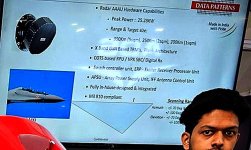
You are actually underestimating Virupaksha range. It's designed to "track" -20dBsm target from 200kms away. That's its design goal. 1m^2 target would be detected & tracked much beyond 400kms.(I heard someone very informative claim 600kms for 1m2 target but just leave it at that;) ).
 
You are actually underestimating Virupaksha range. It's designed to "track" -20dBsm target from 200kms away. That's its design goal. 1m^2 target would be detected & tracked much beyond 400kms.(I heard someone very informative claim 600kms for 1m2 target but just leave it at that;) ).
Extraordinary claims require Extraordinary evidence to back them up.
 
You are actually underestimating Virupaksha range. It's designed to "track" -20dBsm target from 200kms away. That's its design goal. 1m^2 target would be detected & tracked much beyond 400kms.(I heard someone very informative claim 600kms for 1m2 target but just leave it at that;) ).

200 km against -20 dBsm would give 632 km against 1m2.
 
  • Agree
Reactions: Rajput Lion
You are actually underestimating Virupaksha range. It's designed to "track" -20dBsm target from 200kms away. That's its design goal. 1m^2 target would be detected & tracked much beyond 400kms.(I heard someone very informative claim 600kms for 1m2 target but just leave it at that;) ).
Pretty much all information in public clearly states detection for that particular bit of information, not "track". And even that is doing is a pretty heavy lifting. Detection in what mode? A small sector searching with high power narrow beams?

600kms for 1m2, hmmmmm, ah man rejoice. We have wasted $1.5 billion buying a pair of EL/M-2090 ULTRA and SPECTRA radars. I guess we could've skipped Spectra radar and used Virupaksha for discrimination roles since you are approaching Spectra level of performance with a 0.9m diameter radar.
 
  • Like
Reactions: PhotonVish
Pretty much all information in public clearly states detection for that particular bit of information, not "track". And even that is doing is a pretty heavy lifting. Detection in what mode? A small sector searching with high power narrow beams?

600kms for 1m2, hmmmmm, ah man rejoice. We have wasted $1.5 billion buying a pair of EL/M-2090 ULTRA and SPECTRA radars. I guess we could've skipped Spectra radar and used Virupaksha for discrimination roles since you are approaching Spectra level of performance with a 0.9m diameter radar.

Yeah, you'd generally find unitary figures only for detection range 'cause you can get higher tracking range via adaptive techniques and it's largely irrelevant for ESAs, especially the ones with subarrays or lower.

The TERRA series are capable of far higher performance than that and meant for high speed, multi-target operations. For example, Swordfish can detect a cricket ball (0.1m2) from 1500 km. TERRA will do even more. Generally 2000-4000 km against 0.1m2.

The reason why it claims 500 km for fighter type targets has more to do with the angle and shape of the beam than actual radar performance. These radars point up higher at the sky, so a fighter only enters the beam of the radar at a distance of 500 km. Until that point the fighter is below the radar's horizon. That's why we have low-level and medium-level radars to compensate, and that's how we get layered air defenses.
 
Extraordinary claims require Extraordinary evidence to back them up.
Extraordinary? Not at all. It is Virupaksha design goal to track J-20 head-on from 200kms away in heavy EM clutter. Thanks to powerful-array, AI-backed algorithms, digital signal processing and digital beam forming along with very high level of sensor fusion between Virupaksha, BEL Dual-Band IRST & RWR-NG, it is going to be possible. Defeating and fighting Chinese 5th gen fighters behind our IADS cover is the prime goal and objective of MKI UPG. program.

Extraordinary claim would be Virupaksha able to track J-20 from 500kms away, which it won't. 200kms for both Virupaksha and BEL dual-band IRST is actually their design goal.
 
Extraordinary? Not at all. It is Virupaksha design goal to track J-20 head-on from 200kms away in heavy EM clutter. Thanks to powerful-array, AI-backed algorithms, digital signal processing and digital beam forming along with very high level of sensor fusion between Virupaksha, BEL Dual-Band IRST & RWR-NG, it is going to be possible. Defeating and fighting Chinese 5th gen fighters behind our IADS cover is the prime goal and objective of MKI UPG. program.

Extraordinary claim would be Virupaksha able to track J-20 from 500kms away, which it won't. 200kms for both Virupaksha and BEL dual-band IRST is actually their design goal.
I don't know about u, but in general terms a radar the size of Virupaksha being able to track -20dbsm target from 200km away is considered extraordinary and unless extraordinary evidence is presented i consider your point in the league of fantasy la-la land.
 
  • Like
Reactions: PhotonVish
I don't know about u, but in general terms a radar the size of Virupaksha being able to track -20dbsm target from 200km away is considered extraordinary and unless extraordinary evidence is presented i consider your point in the league of fantasy la-la land.

Gotta think logically here.

Irbis-E has a detection range of 250 km against a 1 m2 target which improves to 350 km using narrow search at 20x20 deg. Kopp published his research for a 0.01 m2 target at 90 km using the narrow search range at 300-350 km. This is essentially matched by Uttam Mk2.

Virupaksha with more than 2.5 times the TRM density of Uttam Mk2 while being much larger than Irbis-E should easily provide 2-3 times the performance boost compared to Uttam Mk2/Irbis-E even when using GaAs.

The detection range of the F-15C with APG-63v1 used to be 100 km. That almost tripled on the F-22. Now we are looking at a doubling of that.

AAMs too are increasing in capability to match the radar. So ranges have doubled and then doubled again. BVRAAM ranges have almost octupled since AIM-120A/B.

In fact, Virupaksha is power constrained due to the limits of the AL-31FP's electricity capacity so it's stuck with a 9W TRM instead of the standard 15-25W TRMs meant for GaN. So this range is still at the lower end of what such a radar should be able to do.

The logic train follows.
 
I don't know about u, but in general terms a radar the size of Virupaksha being able to track -20dbsm target from 200km away is considered extraordinary and unless extraordinary evidence is presented i consider your point in the league of fantasy la-la land.
Sure👍. But that's Virupaksha design goal. You are free to think otherwise.
Gotta think logically here.

Irbis-E has a detection range of 250 km against a 1 m2 target which improves to 350 km using narrow search at 20x20 deg. Kopp published his research for a 0.01 m2 target at 90 km using the narrow search range at 300-350 km. This is essentially matched by Uttam Mk2.

Virupaksha with more than 2.5 times the TRM density of Uttam Mk2 while being much larger than Irbis-E should easily provide 2-3 times the performance boost compared to Uttam Mk2/Irbis-E even when using GaAs.

The detection range of the F-15C with APG-63v1 used to be 100 km. That almost tripled on the F-22. Now we are looking at a doubling of that.

AAMs too are increasing in capability to match the radar. So ranges have doubled and then doubled again. BVRAAM ranges have almost octupled since AIM-120A/B.

In fact, Virupaksha is power constrained due to the limits of the AL-31FP's electricity capacity so it's stuck with a 9W TRM instead of the standard 15-25W TRMs meant for GaN. So this range is still at the lower end of what such a radar should be able to do.

The logic train follows.
Final Virupaksha production version will have more than 10W TRM.
 
Gotta think logically here.

Irbis-E has a detection range of 250 km against a 1 m2 target which improves to 350 km using narrow search at 20x20 deg. Kopp published his research for a 0.01 m2 target at 90 km using the narrow search range at 300-350 km. This is essentially matched by Uttam Mk2.

Virupaksha with more than 2.5 times the TRM density of Uttam Mk2 while being much larger than Irbis-E should easily provide 2-3 times the performance boost compared to Uttam Mk2/Irbis-E even when using GaAs.

The detection range of the F-15C with APG-63v1 used to be 100 km. That almost tripled on the F-22. Now we are looking at a doubling of that.

AAMs too are increasing in capability to match the radar. So ranges have doubled and then doubled again. BVRAAM ranges have almost octupled since AIM-120A/B.

In fact, Virupaksha is power constrained due to the limits of the AL-31FP's electricity capacity so it's stuck with a 9W TRM instead of the standard 15-25W TRMs meant for GaN. So this range is still at the lower end of what such a radar should be able to do.

The logic train follows.
Hawk i 2700 gan have detection range of only 200km for 1msq

And i assume that its non ew scenario(at private player wont downplay its range by putting it in bad scenrio)

So that means virupaksha should be similar or less.

That puts that its detection for j20 will be less than 100km in any ew scenario.

A stealth jet is best bet against another stealth jet paired with s/l band radar so that x band fcr only see in that direction
 

Attachments

  • hawk i 2700.jpg
    hawk i 2700.jpg
    108.7 KB · Views: 5
Hawk i 2700 gan have detection range of only 200km for 1msq

And i assume that its non ew scenario(at private player wont downplay its range by putting it in bad scenrio)

So that means virupaksha should be similar or less.

That puts that its detection for j20 will be less than 100km in any ew scenario.

A stealth jet is best bet against another stealth jet paired with s/l band radar so that x band fcr only see in that direction

This is when heavy ew situation exist.

No wonder even usa is trting to use irst on even f22, now it all make sense
 
Hawk i 2700 gan have detection range of only 200km for 1msq

And i assume that its non ew scenario(at private player wont downplay its range by putting it in bad scenrio)

So that means virupaksha should be similar or less.

That puts that its detection for j20 will be less than 100km in any ew scenario.

A stealth jet is best bet against another stealth jet paired with s/l band radar so that x band fcr only see in that direction

Many times OEMs report the design goal of a system rather than actual performance.

200-250 km against 1-3 sqm is Rafale AESA's performance. So the Rafale is the IAF's benchmark for MKI's radar.

Both DRDO and Data Patterns would have significantly exceeded those numbers because Rafale's radar is 3 times smaller and does not use GaN.
 
Gotta think logically here.

Irbis-E has a detection range of 250 km against a 1 m2 target which improves to 350 km using narrow search at 20x20 deg. Kopp published his research for a 0.01 m2 target at 90 km using the narrow search range at 300-350 km. This is essentially matched by Uttam Mk2.

Virupaksha with more than 2.5 times the TRM density of Uttam Mk2 while being much larger than Irbis-E should easily provide 2-3 times the performance boost compared to Uttam Mk2/Irbis-E even when using GaAs.

The detection range of the F-15C with APG-63v1 used to be 100 km. That almost tripled on the F-22. Now we are looking at a doubling of that.

AAMs too are increasing in capability to match the radar. So ranges have doubled and then doubled again. BVRAAM ranges have almost octupled since AIM-120A/B.

In fact, Virupaksha is power constrained due to the limits of the AL-31FP's electricity capacity so it's stuck with a 9W TRM instead of the standard 15-25W TRMs meant for GaN. So this range is still at the lower end of what such a radar should be able to do.

The logic train follows.
Your logic most of the times are based on selective information & misinformation along with conformation bias.

Many times OEMs report the design goal of a system rather than actual performance.
Another example.
What proof do u have for this?
But that's Virupaksha design goal.
Design goal by whom?
What's your source?
 
Many times OEMs report the design goal of a system rather than actual performance.

200-250 km against 1-3 sqm is Rafale AESA's performance. So the Rafale is the IAF's benchmark for MKI's radar.

Both DRDO and Data Patterns would have significantly exceeded those numbers because Rafale's radar is 3 times smaller and does not use GaN.
If this is true, then thats great, hopefully we also develop extremely long range awacs killer (6m×0.3 m sfdr based astra mk4) to knock out chinease awacs