

Why do we need the F15 when the Su30MkI is a better jet, the super sukhoi upgrade will also nullify the few advantages the EX variant of f15 has anyway.As an outsider, seeing that the F-15EX wasn't chosen in the end, and that even the MiG-35 was passed over, left me utterly stunned—I completely fail to comprehend it. To make matters worse, the Rafale won by an absolute landslide...
MMRCA 2.0 - Updates and Discussions
- Thread starter Picdelamirand-oil
- Start date
You are using an out of date browser. It may not display this or other websites correctly.
You should upgrade or use an alternative browser.
You should upgrade or use an alternative browser.

Since I noticed that the Su-30MKI was completely missing as an option in the voting selection, if it were entirely up to my own volition, the choices would be:Why do we need the F15 when the Su30MkI is a better jet, the super sukhoi upgrade will also nullify the few advantages the EX variant of f15 has anyway.
Upgrade the existing Su-30MKI fleet.
Procure new Su-35S(I) variants with customized avionics interfaces to ensure compatibility with India's required weapon systems.
In terms of meeting the light fighter requirement within the necessary timeframe, the only viable options are the F-16 and the Gripen. However, considering the F-16 is American, if one absolutely insists on buying an import, it would have to be the Gripen. But if that's the case, it would be far better to just properly focus on developing our own domestic Tejas.
I'll say proper focus on Super Sukhoi will be much better than acquiring the Su35.Since I noticed that the Su-30MKI was completely missing as an option in the voting selection, if it were entirely up to my own volition, the choices would be:
Upgrade the existing Su-30MKI fleet.
Procure new Su-35S(I) variants with customized avionics interfaces to ensure compatibility with India's required weapon systems.
Tejas MK2 being in development nullifies the need for Gripen as you said, I just hope we can develop the jet fast enough and america won't delay supplying the GE F414 like they did with the F404, I don't like that America can completely hinder our Tejas MK1, Mk1A, MK2, TEDBF and AMCA programs like what happened with the Marut, We need to speed up with the Kaveri, Indo-French Engine and maybe even redesign the Tejas MK2 with different russian core if necessary to derisk the entire program.In terms of meeting the light fighter requirement within the necessary timeframe, the only viable options are the F-16 and the Gripen. However, considering the F-16 is American, if one absolutely insists on buying an import, it would have to be the Gripen. But if that's the case, it would be far better to just properly focus on developing our own domestic Tejas.

The MiG-35 and the Rafale have internal fuel capacities of 4,800 kg and 4,700 kg, respectively. Under intermediate thrust conditions (military power), the specific fuel consumption (SFC) rates for the RD-33MK and the M88-2 are 0.77 \text{ kg}/(\text{N}\cdot\text{h}) and 0.80 \text{ kg}/(\text{N}\cdot\text{h}), respectively. Therefore, when executing similar profile missions, there won't be a significant disparity in their operational range. Furthermore, under clean configurations, the MiG-35’s thrust-to-weight ratio far exceeds that of the Rafale.
The Su-57E features a stated combat radius of 1,250 kilometers and a designated one-way ferry range of 4,000 kilometers. Meanwhile, the Su-75 lists a maximum range of 2,600 to 2,800 kilometers. From these figures, it becomes glaringly obvious just how inflated the advertised ranges of the Rafale and Typhoon—which boast figures ranging from 2,000+ to over 4,000 kilometers—actually are.

This is verified combat radius. 920 nm with A2A. For A2G it drops below that.
Rather than quantity of fuel, calculating fuel fraction is better. With full internal fuel and empty weight, we get 28% for Mig-29M, 31.6% for the SH, and 33% for Rafale. F-35 and Su-57 should give us close to 40%.
There's also the enhancement in lift through airframe design. The canards provide an additional 20-25% lift on Rafale, so the thrust requirement is lower, hence less powerful engines. It's an efficiency-focused design while Mig-29, SH, and Su-57 are power-focused designs. They use thrust to make up for lower lift.
Mig-29 is a powerful aircraft, but it's still inferior and its only combat relevant equivalence with Rafale ends there. Pretty much everything else favors the Rafale. With the new 90 kN engines, the Rafale's performance will come very close to the F-22, including a mach 1.5+ supercruise.
Furthermore, consider the MiG-29s delivered to the East German Air Force in 1988, which later made their way to Poland and are still actively flying in the war in Ukraine today. With an actual airframe age exceeding 38 years, the officially stated service life of just over 1,000 hours is likewise an impossibility.
Limited flying time and SLEP. The Germans barely flew their jet and the Polish continued that tradition.
The Indian Mig-29S came with 2500 hours, was extended to 3500 hours, and will soon be extended by another 1000 hours. The original RD-33 came with a life of 1500 hours, extendable to 2500 hours, to match the airframe's life. It's since been replaced.
The Mig-29M comes with a 4000 hours airframe and a new 4000-hour engine. Both IAF and IN Mig-29s come with new engines.
Take the Su-27SKs that Russia exported to China. Their official specifications stated a service life of 2,000 flight hours and a calendar life of 20 years. Yet, here we are in 2026, and quite a few of those original, imported Su-27SK/UBKs are still in the active order of battle and undergoing high-intensity flight operations—their actual operational service life has long surpassed 8,000 hours. This airframe longevity even outlasts that of the later domestic copies, the J-11B, despite China officially rating the J-11B's service life at well over 6,000 hours.
The Su-27s came with 4000 hours and can be extended by another 2000 hours. The MKIs come with 6000 hours and will likely be extended by another 4000+ hours.
Due to its strategic doctrine of large-scale attrition warfare, the Soviet Union applied incredibly conservative estimates to weapon service life. A vast number of highly capable weapons were forcibly retired and sent directly to rear-area storage simply to clear space for newly manufactured hardware. For example, massive fleets of T-80 tanks were mothballed and retired before the older IS-4 tanks had even fully completed their decommissioning process. Similarly, the T-90s supplied to Syria a few years back were actually pristine units produced in the 1990s that had seen less than a decade of active use before being mothballed.
In other words, you cannot generalize across the board; these weapons have entirely different strategic roles, testing standards, and operational parameters. The unit cost of a single European weapon alone is enough to buy several MiGs.
Abandoning jets before their time is quite common. RAF is getting rid of their Tranche 1 Typhoons at just 2500 hours.
But India is extending the life of the army's T-72s by 20 more years.
Anyway, Rafale was selected over the Mig-35 for being a generation ahead in airframe, engine, and avionics. It's also cheaper to maintain and operate, even if the Russian market is cheaper than French. The cost difference is compensated by Rafale's higher quality. And the capability boost is immense. As per the IAF, the Rafale is 200% superior to the MKI, which is in turn just 25-30% superior to the Mig-29M.

Rafale’s range is 2.5 times more than a Sukhoi: Top IAF sources
At a time when critics are questioning the operational capabilities of the Rafale combat aircraft, top IAF sources said the range of the French-origin aircraft is 2.5 more than that of the Russian …
 defenceupdate.in
“The Sukhoi-30, MiG-29 and Mirage-2000 are not MMRCA… None of these meet the Air Staff Qualitative Requirements of the Indian Air Force specified for MMRCA in 2007 for its requirements of 126 combat jets,” the sources said.
Rafale F4 basically gives the IAF F-15EX class avionics, lower than F-16 class costs, and F-15C++ performance. And F5 will give the IAF F-22-class performance with F-35-class avionics without significant increase in operational costs.
F22 class sperformance? Its not going to give anywhere close to that lmao. for that you need stealth and F22 class kinematics which the rafale does not have. avionics maybe for everyhting else no. Its probably going to be top 4 in terms of 4.5 gen alongside the j16 and f15EX and maybe the UPG su30mki but thats about its limit. it fulfills a different operational requirement and is the best in its class but doesnt really compare well with the heavyweightsView attachment 51944
This is verified combat radius. 920 nm with A2A. For A2G it drops below that.
Rather than quantity of fuel, calculating fuel fraction is better. With full internal fuel and empty weight, we get 28% for Mig-29M, 31.6% for the SH, and 33% for Rafale. F-35 and Su-57 should give us close to 40%.
There's also the enhancement in lift through airframe design. The canards provide an additional 20-25% lift on Rafale, so the thrust requirement is lower, hence less powerful engines. It's an efficiency-focused design while Mig-29, SH, and Su-57 are power-focused designs. They use thrust to make up for lower lift.
Mig-29 is a powerful aircraft, but it's still inferior and its only combat relevant equivalence with Rafale ends there. Pretty much everything else favors the Rafale. With the new 90 kN engines, the Rafale's performance will come very close to the F-22, including a mach 1.5+ supercruise.
Limited flying time and SLEP. The Germans barely flew their jet and the Polish continued that tradition.
The Indian Mig-29S came with 2500 hours, was extended to 3500 hours, and will soon be extended by another 1000 hours. The original RD-33 came with a life of 1500 hours, extendable to 2500 hours, to match the airframe's life. It's since been replaced.
The Mig-29M comes with a 4000 hours airframe and a new 4000-hour engine. Both IAF and IN Mig-29s come with new engines.
The Su-27s came with 4000 hours and can be extended by another 2000 hours. The MKIs come with 6000 hours and will likely be extended by another 4000+ hours.
Abandoning jets before their time is quite common. RAF is getting rid of their Tranche 1 Typhoons at just 2500 hours.
But India is extending the life of the army's T-72s by 20 more years.
Anyway, Rafale was selected over the Mig-35 for being a generation ahead in airframe, engine, and avionics. It's also cheaper to maintain and operate, even if the Russian market is cheaper than French. The cost difference is compensated by Rafale's higher quality. And the capability boost is immense. As per the IAF, the Rafale is 200% superior to the MKI, which is in turn just 25-30% superior to the Mig-29M.
“The operational capabilities of the Sukhoi-30 in terms of capability and range are far superior than that of the MiG-29 while the range of the Rafale is 2.5 times that of the Su-30MKI in the same role,” top IAF sources told ANI here.Rafale’s range is 2.5 times more than a Sukhoi: Top IAF sources
At a time when critics are questioning the operational capabilities of the Rafale combat aircraft, top IAF sources said the range of the French-origin aircraft is 2.5 more than that of the Russian …
“The Sukhoi-30, MiG-29 and Mirage-2000 are not MMRCA… None of these meet the Air Staff Qualitative Requirements of the Indian Air Force specified for MMRCA in 2007 for its requirements of 126 combat jets,” the sources said.
Rafale F4 basically gives the IAF F-15EX class avionics, lower than F-16 class costs, and F-15C++ performance. And F5 will give the IAF F-22-class performance with F-35-class avionics without significant increase in operational costs.

From my perspective, the very existence of the "medium fighter" classification is quite bizarre.I'll say proper focus on Super Sukhoi will be much better than acquiring the Su35.
Tejas MK2 being in development nullifies the need for Gripen as you said, I just hope we can develop the jet fast enough and america won't delay supplying the GE F414 like they did with the F404, I don't like that America can completely hinder our Tejas MK1, Mk1A, MK2, TEDBF and AMCA programs like what happened with the Marut, We need to speed up with the Kaveri, Indo-French Engine and maybe even redesign the Tejas MK2 with different russian core if necessary to derisk the entire program.
For major global powers, a "heavy-and-light" high-low mix is the most rational approach. Heavy fighters are characterized by twin engines, while single-engine light fighters serve as auxiliary assets to expand fleet size and reduce operational costs. Crucially, both types must share a common engine core—the only difference being the number of engines installed. The most textbook example of this doctrine is the F-15 and F-16 pairing.
For smaller nations, however, only a heavy fighter possesses the multi-role capability required to handle all mission types, making a pure heavy fighter fleet the most rational choice. Currently, the optimal solution lies in platforms like the Su-30SM or modernized variants of the F-15E (such as the F-15K), which are capable of undertaking everything from training, patrolling, and air-to-ground strikes to air defense, interception, and anti-ship operations. In short, the emphasis here is purely on multi-role versatility.
So, coming back to the main topic, where exactly did the so-called "medium fighter" come from?
The answer is simple: the earliest examples were the Rafale and the Eurofighter Typhoon. Medium-sized European nations like the UK and France initially sought a daily multi-role fighter that could execute every single mission required by a mid-sized power. Why did it turn out to be a medium fighter instead of a heavy one? The reality is that Europe at the time lacked both the capability and the engineering experience to develop large, Low-bypass-ratio, high-thrust turbofan engines. Therefore, these aircraft were designed strictly to satisfy their basic homeland defense requirements.
However, two exceptions—the F/A-18 and the MiG-29—need to be analyzed separately. These two are entirely different animals compared to Europe's Rafale and Typhoon; in fact, from the very beginning, they were never part of a standard "light vs. heavy" classification.
First, consider the MiG-29. It was designed as a frontline tactical fighter for the Soviet Air Force (VVS). Meanwhile, the Su-27 was developed as a long-range interceptor and escort fighter for the Soviet Air Defense Forces (PVO). The Soviet aerospace branches operated under highly distinct divisions of labor. The MiG-29, much like the F-15A or Europe's Rafale and Typhoon, was designed to contest air superiority in localized theaters on the Cold War frontlines—essentially tailored to the geographical dimensions of European nations.
Conversely, the Su-27 was engineered around the mission parameters of the PVO. Its original purpose was to defend the vast, sparsely populated expanses of the Soviet homeland and provide long-range escort for strategic bombers. Although people today frequently compare the Su-27 directly to the F-15, the truth is that the Su-27 is nearly 25% larger in overall dimensions, and its engine thrust belongs to an entirely different class. Similarly, the physical footprint of a MiG-29 is significantly larger than that of an F-16. Thus, the MiG-29 just happened to be sized perfectly for localized European warfare, which naturally made it a full size smaller than the PVO's massive Su-27. The two were never intended to form a "light-heavy mix" to reduce logistical pressure via engine commonality; their divergence was purely a reflection of the doctrinal division between Soviet frontline tactical aviation and homeland strategic air defense.
Next, look at the F/A-18. Although it started as a competitor to the F-16 in the Lightweight Fighter (LWF) program, it lost. However, it caught the eye of the US Navy, which resurrected it as a carrier-borne strike fighter. When the program restarted, the F/A-18's airframe was significantly enlarged. Yet, this scaling up was not done to meet some arbitrary "medium fighter" threshold; the Navy simply demanded greater range and ordnance payload, which required a larger fuselage. To achieve this, they severely sacrificed the exceptional maneuverability and supersonic performance that the original prototype prided itself on. Its relationship with the F-14 Tomcat was that of a strike bomber to a fleet defender—completely different operational responsibilities, rather than a medium-to-heavy mix.
Therefore, for a major power like India, I see absolutely no practical value in specifically choosing the Typhoon or the Rafale. Such a move saves no money and only introduces massive logistical nightmares. It would be far more rational to position the Su-30MKI as the core of the air force, and then utilize its AL-31 series engine core to power an Indian-built light fighter.
This mirrors the logical pairings we see today: the Su-57 and Su-75, the J-20 and J-10, or the F-15 and F-16.
Last edited:
F22 class sperformance? Its not going to give anywhere close to that lmao. for that you need stealth and F22 class kinematics which the rafale does not have. avionics maybe for everyhting else no. Its probably going to be top 4 in terms of 4.5 gen alongside the j16 and f15EX and maybe the UPG su30mki but thats about its limit. it fulfills a different operational requirement and is the best in its class but doesnt really compare well with the heavyweights
Wasn't talking about stealth there. Whether Rafale achieves that level of stealth or not with ACT is unknown. Plus it's not gonna be all-aspect. IR and visual stealth for sure favor Rafale.
But in term of kinematics, yes, it will.
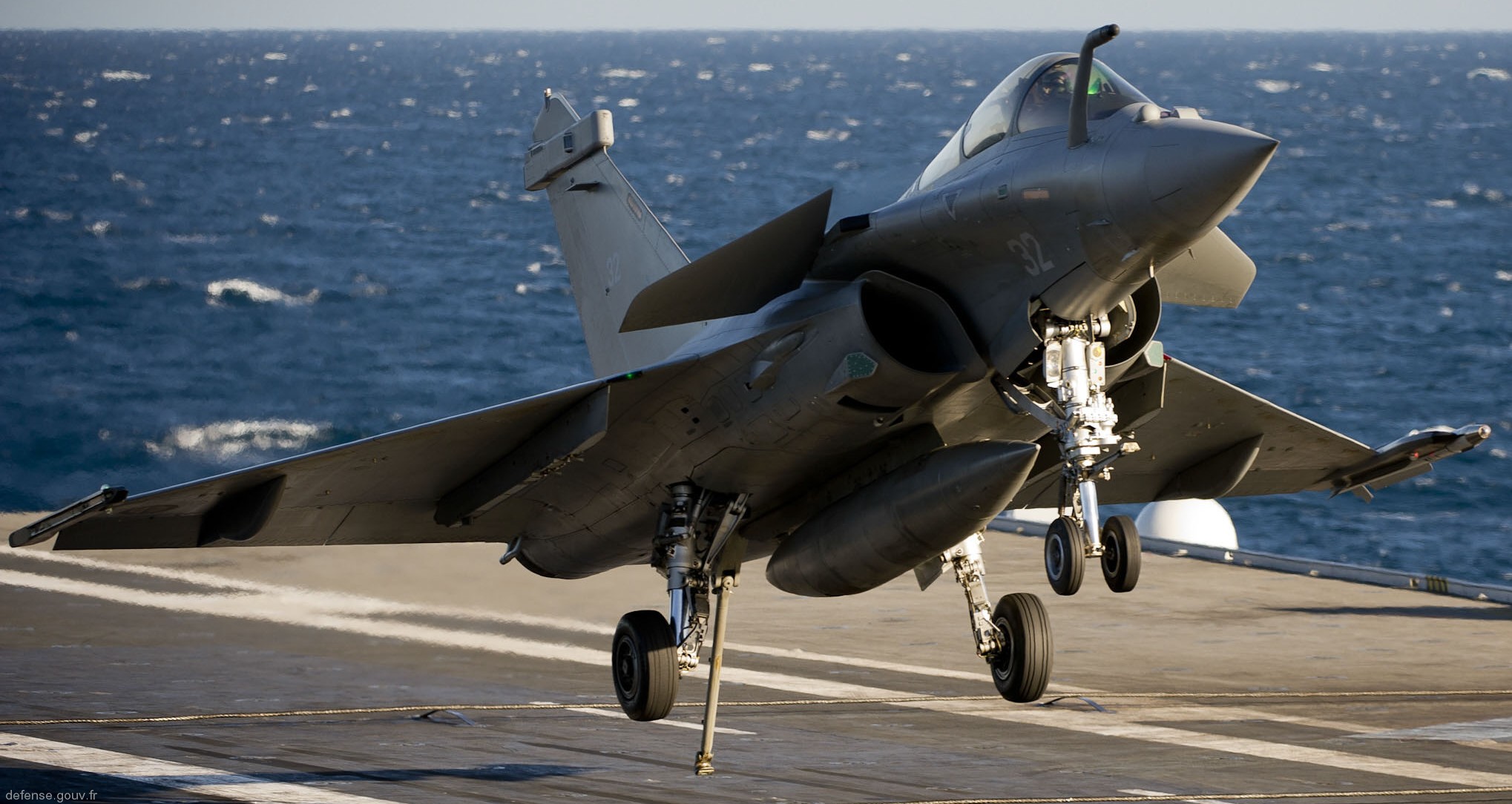
Flying & fighting in the Dassault Rafale: Interview with a Rafale combat veteran
From the perilous deck of an aircraft carrier, Pierre-Henri ‘Até’ Chuet took the Dassault Rafale M into combat in Iraq. We spoke to him to find out more about the Rafale, a remarkable …
 hushkit.net
Rafale climb performance:
“The acceleration is insane! Climb rate is firm – to give you an idea: if we’re at 500 knots & 500 feet… put the afterburner on — wait for the afterburner to kick in — then put the nose up at 60 degrees so you’re feeling like you’re vertical because of the angle of the seat (that’s 30 degrees) and at some point you have to throttle back in the afterburner to make sure it doesn’t go supersonic…in the climb 60 degree nose up! So that’s for the climb rate.”
Rafale vs Typhoon in BVR.
“I don’t know why they’re compared so often – it’s really not the same design, ideas or philosophy. We’re a truly omnirole platform. Typhoons are great, they like to use their big engines at 40,000 feet. I can’t count how many times I’ve shot down Typhoons at 45,000 feet in the contrails. And my radar off, everything off, I was coming from 100 feet below, supersonic in the climb from below. Absolutely undetected. So I have absolutely no fear of the Typhoons. Both the tactics used by the Typhoons, the agility and the cockpit of the aircraft make it easier for us to take the advantage — basically we have better fusion of the sensors — so we can be way more aggressive in terms of tactics. It’s a great aircraft at high level, but we’re not dumb enough to try to fight Typhoons at 50,000 feet or 45,000 feet. We’re going to put them outside their comfort zone. Against devious tactics. Now if you want to rate a Typhoon with AMRAAMs against a Rafale at 50,000 ft, then, yeah, Typhoon is going to have better performances for sure. But as a Rafale pilot, I’m stupid if I take him on like that, so I’m going to move the combat a bit. I’ll fake a combat at 50,000 feet and I’m going to send a guy sneakily low level to surprise the Typhoon, it’s more easy than you think!”
Rafale vs F-22 in WVR.
“Obviously you have seen videos (see above). Is it going to be guns only? Is it going to be Sidewinders? If it’s gun only I don’t have any issue – if it’s Sidewinders — and he has his helmet-mounted stuff* and 9X then I’m going to be careful — I would be concerned. I definitely don’t have no concerns otherwise: it would be tougher for me because he has his 9X and mounted vizor. If I play my cards correctly there’s no reason why it shouldn’t be OK. I have questions, like what is the set-up? Is it going to be ‘Butterfly’ with one close to the other one? It really depends on these situation. But guns only? Honestly, no concern. And it’s a big aircraft so it’s easy to shoot at.”
So the Rafale has climb performance already. Since we know it can supercruise, it has the acceleration as well.
The Rafale has superiority over the F-22 in WVR even with current engines. The only thing missing is helmet and our jets have it. Newer French jets now do too. Smaller jets like Rafale and AMCA are expected to retain superiority over larger jets like F-22 and Su-57 at low altitudes due to their efficiency-focused designs.
He identifies high altitude as a problem for the Rafale when up against the Typhoon. It's primarily due to low TWR, "small engines."
So the only problem is engine. The Typhoon pilots claim competitive performance with the F-22. For example, it supercruises at mach 1.5 and can perform 6G maneuvers like the F-22 can (up to 7G at mach 1.6). And Rafale F5's gonna get 90 kN engines on a lighter airframe than the Typhoon. So it's gonna exceed the Typhoon with its new engine. Which means it's effectively gonna have near-F-22-class performance in the supersonic regime.
Normally, this shouldn't have happened. While the French are pushing the boundaries with Rafale, the F-22 has stagnated. It's not seen any serious upgrades since 2005 while the Rafale has seen two sets of upgrades within the same time and is on its third big one. The Americans need to get upgraded hot core parts for the next overhaul if they are to keep up with the Su-57 and J-20, or replace the jet entirely.
From my perspective, the very existence of the "medium fighter" classification is quite bizarre.
For major global powers, a "heavy-and-light" high-low mix is the most rational approach. Heavy fighters are characterized by twin engines, while single-engine light fighters serve as auxiliary assets to expand fleet size and reduce operational costs. Crucially, both types must share a common engine core—the only difference being the number of engines installed. The most textbook example of this doctrine is the F-15 and F-16 pairing.
For smaller nations, however, only a heavy fighter possesses the multi-role capability required to handle all mission types, making a pure heavy fighter fleet the most rational choice. Currently, the optimal solution lies in platforms like the Su-30SM or modernized variants of the F-15E (such as the F-15K), which are capable of undertaking everything from training, patrolling, and air-to-ground strikes to air defense, interception, and anti-ship operations. In short, the emphasis here is purely on multi-role versatility.
So, coming back to the main topic, where exactly did the so-called "medium fighter" come from?
The answer is simple: the earliest examples were the Rafale and the Eurofighter Typhoon. Medium-sized European nations like the UK and France initially sought a daily multi-role fighter that could execute every single mission required by a mid-sized power. Why did it turn out to be a medium fighter instead of a heavy one? The reality is that Europe at the time lacked both the capability and the engineering experience to develop large, Low-bypass-ratio, high-thrust turbofan engines. Therefore, these aircraft were designed strictly to satisfy their basic homeland defense requirements.
However, two exceptions—the F/A-18 and the MiG-29—need to be analyzed separately. These two are entirely different animals compared to Europe's Rafale and Typhoon; in fact, from the very beginning, they were never part of a standard "light vs. heavy" classification.
First, consider the MiG-29. It was designed as a frontline tactical fighter for the Soviet Air Force (VVS). Meanwhile, the Su-27 was developed as a long-range interceptor and escort fighter for the Soviet Air Defense Forces (PVO). The Soviet aerospace branches operated under highly distinct divisions of labor. The MiG-29, much like the F-15A or Europe's Rafale and Typhoon, was designed to contest air superiority in localized theaters on the Cold War frontlines—essentially tailored to the geographical dimensions of European nations.
Conversely, the Su-27 was engineered around the mission parameters of the PVO. Its original purpose was to defend the vast, sparsely populated expanses of the Soviet homeland and provide long-range escort for strategic bombers. Although people today frequently compare the Su-27 directly to the F-15, the truth is that the Su-27 is nearly 25% larger in overall dimensions, and its engine thrust belongs to an entirely different class. Similarly, the physical footprint of a MiG-29 is significantly larger than that of an F-16. Thus, the MiG-29 just happened to be sized perfectly for localized European warfare, which naturally made it a full size smaller than the PVO's massive Su-27. The two were never intended to form a "light-heavy mix" to reduce logistical pressure via engine commonality; their divergence was purely a reflection of the doctrinal division between Soviet frontline tactical aviation and homeland strategic air defense.
Next, look at the F/A-18. Although it started as a competitor to the F-16 in the Lightweight Fighter (LWF) program, it lost. However, it caught the eye of the US Navy, which resurrected it as a carrier-borne strike fighter. When the program restarted, the F/A-18's airframe was significantly enlarged. Yet, this scaling up was not done to meet some arbitrary "medium fighter" threshold; the Navy simply demanded greater range and ordnance payload, which required a larger fuselage. To achieve this, they severely sacrificed the exceptional maneuverability and supersonic performance that the original prototype prided itself on. Its relationship with the F-14 Tomcat was that of a strike bomber to a fleet defender—completely different operational responsibilities, rather than a medium-to-heavy mix.
Therefore, for a major power like India, I see absolutely no practical value in specifically choosing the Typhoon or the Rafale. Such a move saves no money and only introduces massive logistical nightmares. It would be far more rational to position the Su-30MKI as the core of the air force, and then utilize its AL-31 series engine core to power an Indian-built light fighter.
This mirrors the logical pairings we see today: the Su-57 and Su-75, the J-20 and J-10, or the F-15 and F-16.
Medium is now largely just a marketing term to engineer procurement towards mission-specific goals without having to deal with the heavy aircraft OEMs and light domestic rivals.
Back then the classifications existed. For example, light is in the context of F-5, a quick reaction interceptor that's cheap to operate and acts as the first point of contact due to its quick reaction time. Medium (F-16) is to save money that cannot be saved from heavy jets (F-15).
The Su-57/75, J-20/35, F-15/16, and F-22/35 are in reality heavy and medium jets. The F-5 and F-20 would qualify as light, but has since been eliminated. This category wasn't necessary for other air forces due to the size of airspaces and relative capabilities of adversaries in relation to each other. India has soft borders with enemies, the Americans and Russians don't, hence the need for faster reaction time.
Today, the light, medium, and heavy classifications are mainly about balancing capabilities with operations costs. Light and medium are essentially the same class while heavy is different.
India, S Korea, and Taiwan operate light jets in the F-5/20 class in order to support the domestic industry.
And yes, you are right about India not having needed a Rafale/Typhoon class fighter. The MKIs were supposed to be sufficient. Had we actually owned the MKI ourselves, we never would have started the MMRCA program, we would have just continued building more MKIs.
Here's the chief architect of MMRCA explaining the reason.

Video: Vayu-StratPost Air Power Roundtable II
In the second session, moderator Inderjit Badhwar initiated the discussion deconstructing the evolution and process of the Indian Air Force (IAF) competition for 126 Medium Multi Role Combat Aircraft (MMRCA).
 www.stratpost.com
What surprises me – since you’re the author of that RFP (MMRCA) – is that what is the significance of the term medium? Is it weight, is it performance, is it range, is it endurance? A. And B – how did you end up with a bunch of aircraft from single-engined to twin-engined, from 17 tons to 30 tons – I mean why did you stand for it? Make up your mind what you want. Whether it is performance, whether it is weight. So I think this mess, in which we are today has been self-inflicted.” – Admiral (retd.) Arun Prakash
“It’s about operational requirements – you know, meeting a certain spectrum of operational utility. You had to have a mix of both – I’m defending that. And I’m defending it very strongly. We had to actually bring in this Medium Multi Role Combat – because it was originally MRCA – primarily because you had to – although I’d said that weight consideration is no more a relevant issue – to categorize aircraft by weight limitations – we had to keep the Su-30 out because otherwise the Su-30 would have come into the competition, as well. And the question would have been raised, ‘Why can’t you buy more of the Su-30s’. Now you can’t put all your eggs in one basket – strategically, it’s unwise. That’s one of the primary reasons. And therefore you created this Medium Multi role Combat Aircraft (competition) which is 30 tons and below. Okay, so the Su-30 is 34 tons and above – 34 tons category. So the heaviest aircraft in this entire category was the F/A-18, which is 29 tons. The costliest aircraft was the Eurofighter, as per our estimation at that point of time. The cheapest aircraft was – and the lightest aircraft was the Gripen. The F-16 would have been the cheapest. But the point is, you had the original contenders who were there in the fray – you couldn’t have removed them because that process had started off. But you had the new technologies – 4 and half generation aircraft and you also had a spectrum of cost differentials from one end -I would say, averaging about 40 million dollars to almost 100 million dollars – or 85 million dollars.” – Air Marshal (retd) M Matheswaran
The RD-33 (1981) outperforms the M88-2 (1990). As shown in the chart, the red lines represent the thrust curves of the RD-33 at various altitudes, while the blue lines represent those of the M88-2. Even when accounting for differences in data criteria (for instance, the M88-2 curves all originate at $X=0$, meaning zero velocity, and terminate right at the edge of the chart, indicating they are fitted curves, whereas the RD-33 curves represent actual installed test data) — the RD-33 demonstrates a clear advantage across all altitudes, with a particularly massive superiority below 8,000 meters. Consequently, even upgraded variants of the M88-2 may not necessarily best the RD-33MK or other advanced iterations, which similarly boast 9 tons of sea-level static thrustView attachment 51944
This is verified combat radius. 920 nm with A2A. For A2G it drops below that.
Rather than quantity of fuel, calculating fuel fraction is better. With full internal fuel and empty weight, we get 28% for Mig-29M, 31.6% for the SH, and 33% for Rafale. F-35 and Su-57 should give us close to 40%.
There's also the enhancement in lift through airframe design. The canards provide an additional 20-25% lift on Rafale, so the thrust requirement is lower, hence less powerful engines. It's an efficiency-focused design while Mig-29, SH, and Su-57 are power-focused designs. They use thrust to make up for lower lift.
Mig-29 is a powerful aircraft, but it's still inferior and its only combat relevant equivalence with Rafale ends there. Pretty much everything else favors the Rafale. With the new 90 kN engines, the Rafale's performance will come very close to the F-22, including a mach 1.5+ supercruise.
Limited flying time and SLEP. The Germans barely flew their jet and the Polish continued that tradition.
The Indian Mig-29S came with 2500 hours, was extended to 3500 hours, and will soon be extended by another 1000 hours. The original RD-33 came with a life of 1500 hours, extendable to 2500 hours, to match the airframe's life. It's since been replaced.
The Mig-29M comes with a 4000 hours airframe and a new 4000-hour engine. Both IAF and IN Mig-29s come with new engines.
The Su-27s came with 4000 hours and can be extended by another 2000 hours. The MKIs come with 6000 hours and will likely be extended by another 4000+ hours.
Abandoning jets before their time is quite common. RAF is getting rid of their Tranche 1 Typhoons at just 2500 hours.
But India is extending the life of the army's T-72s by 20 more years.
Anyway, Rafale was selected over the Mig-35 for being a generation ahead in airframe, engine, and avionics. It's also cheaper to maintain and operate, even if the Russian market is cheaper than French. The cost difference is compensated by Rafale's higher quality. And the capability boost is immense. As per the IAF, the Rafale is 200% superior to the MKI, which is in turn just 25-30% superior to the Mig-29M.
“The operational capabilities of the Sukhoi-30 in terms of capability and range are far superior than that of the MiG-29 while the range of the Rafale is 2.5 times that of the Su-30MKI in the same role,” top IAF sources told ANI here.Rafale’s range is 2.5 times more than a Sukhoi: Top IAF sources
At a time when critics are questioning the operational capabilities of the Rafale combat aircraft, top IAF sources said the range of the French-origin aircraft is 2.5 more than that of the Russian …
“The Sukhoi-30, MiG-29 and Mirage-2000 are not MMRCA… None of these meet the Air Staff Qualitative Requirements of the Indian Air Force specified for MMRCA in 2007 for its requirements of 126 combat jets,” the sources said.
Rafale F4 basically gives the IAF F-15EX class avionics, lower than F-16 class costs, and F-15C++ performance. And F5 will give the IAF F-22-class performance with F-35-class avionics without significant increase in operational costs.
Attachments
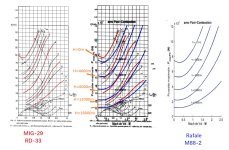

The M88-2 is smaller in size and weight and requires less air than the RD-33; a longer length increases the aircraft’s weight, while the greater air requirement increases the size of the air intakes, which is detrimental to drag and stealth, and the RD-33’s nearly 30% larger diameter significantly increases the aircraft’s drag. The M88 compensates for all these drawbacks with superior technology, as evidenced by the turbine inlet temperature: 1,850 K (1,577 °C) for the M88-2 and 1,680 K (1,407 °C) for the RD-33. The M88 T-REX will provide 20% more thrust with the same dimensions by replacing three modules; it is designed to be installed natively on the Rafale F5 but can be retrofitted to other Rafale models without changing the air intakes, though the air duct feeding the engine must be replaced.The RD-33 (1981) outperforms the M88-2 (1990). As shown in the chart, the red lines represent the thrust curves of the RD-33 at various altitudes, while the blue lines represent those of the M88-2. Even when accounting for differences in data criteria (for instance, the M88-2 curves all originate at $X=0$, meaning zero velocity, and terminate right at the edge of the chart, indicating they are fitted curves, whereas the RD-33 curves represent actual installed test data) — the RD-33 demonstrates a clear advantage across all altitudes, with a particularly massive superiority below 8,000 meters. Consequently, even upgraded variants of the M88-2 may not necessarily best the RD-33MK or other advanced iterations, which similarly boast 9 tons of sea-level static thrust
The engine currently installed on the Rafale is not the M88-2 but the M88-4E

My personal engineering philosophy is this: to achieve the same level of performance, the more common the materials, the lower the operating temperatures, and the simpler the methods employed, the better the overall system design. In Soviet textbooks, this is the essence of 'Systems Engineering.' The RD-33, for instance, actually carries an onboard oxygen bottle to facilitate an in-flight airstart (re-light) if the engine flameouts after ingesting cannon exhaust—an incredibly ingenious solution. Furthermore, the AL-31F utilizes riveting for blade attachment. Despite these seemingly 'rudimentary' methods, they produced a world-class engine. China spent 30 years struggling with a vast array of expensive single-crystal superalloys, yet the results still fell short of the original Russian versions. Additionally, I’ve found it impossible to locate a performance curve chart for the M88-4E.The M88-2 is smaller in size and weight and requires less air than the RD-33; a longer length increases the aircraft’s weight, while the greater air requirement increases the size of the air intakes, which is detrimental to drag and stealth, and the RD-33’s nearly 30% larger diameter significantly increases the aircraft’s drag. The M88 compensates for all these drawbacks with superior technology, as evidenced by the turbine inlet temperature: 1,850 K (1,577 °C) for the M88-2 and 1,680 K (1,407 °C) for the RD-33. The M88 T-REX will provide 20% more thrust with the same dimensions by replacing three modules; it is designed to be installed natively on the Rafale F5 but can be retrofitted to other Rafale models without changing the air intakes, though the air duct feeding the engine must be replaced.
The engine currently installed on the Rafale is not the M88-2 but the M88-4E
Yes, using high-tech components effectively in an engine isn't science, it's an art. The people here who can do it are called wizards.My personal engineering philosophy is this: to achieve the same level of performance, the more common the materials, the lower the operating temperatures, and the simpler the methods employed, the better the overall system design. In Soviet textbooks, this is the essence of 'Systems Engineering.' The RD-33, for instance, actually carries an onboard oxygen bottle to facilitate an in-flight airstart (re-light) if the engine flameouts after ingesting cannon exhaust—an incredibly ingenious solution. Furthermore, the AL-31F utilizes riveting for blade attachment. Despite these seemingly 'rudimentary' methods, they produced a world-class engine. China spent 30 years struggling with a vast array of expensive single-crystal superalloys, yet the results still fell short of the original Russian versions. Additionally, I’ve found it impossible to locate a performance curve chart for the M88-4E.

While Western engineers go completely wild with R&D, pouring massive amounts of money into improving engine reliability, preventing flameouts, boosting machining precision, upgrading to digital electronic controls, and developing advanced materials—the Russians simply pack an onboard bottle of pure oxygen and a splash of gasoline to execute a brute-force mid-air re-light.Yes, using high-tech components effectively in an engine isn't science, it's an art. The people here who can do it are called wizards.
When Westerners find that the pneumatic pressure from their Auxiliary Power Unit (APU) is insufficient and start obsessing over increasing compressor pressure ratios, the Russians just use a gunpowder cartridge (pyrotechnic starter) to blast the turbine directly.
When Westerners tortuously engineer high-precision machining methods to combat thermal stress and expansion, the Russians just secure the disk and shroud with simple dowel pins. If you ask them how they resolve the thermal stress, the Russians tell you they just drilled a few basic cooling holes. If you ask them how on earth you are supposed to remove those pins during maintenance and overhaul, the Russians instruct you to take a drill bit one size larger, drill out the old pin entirely, and just drive in a bigger pin next time.
And you expect me to admire that?While Western engineers go completely wild with R&D, pouring massive amounts of money into improving engine reliability, preventing flameouts, boosting machining precision, upgrading to digital electronic controls, and developing advanced materials—the Russians simply pack an onboard bottle of pure oxygen and a splash of gasoline to execute a brute-force mid-air re-light.
When Westerners find that the pneumatic pressure from their Auxiliary Power Unit (APU) is insufficient and start obsessing over increasing compressor pressure ratios, the Russians just use a gunpowder cartridge (pyrotechnic starter) to blast the turbine directly.
When Westerners tortuously engineer high-precision machining methods to combat thermal stress and expansion, the Russians just secure the disk and shroud with simple dowel pins. If you ask them how they resolve the thermal stress, the Russians tell you they just drilled a few basic cooling holes. If you ask them how on earth you are supposed to remove those pins during maintenance and overhaul, the Russians instruct you to take a drill bit one size larger, drill out the old pin entirely, and just drive in a bigger pin next time.

Will you ever share this with us if price is rightYes, using high-tech components effectively in an engine isn't science, it's an art. The people here who can do it are called wizards.

Personally, I highly admire this philosophy. At the end of the day, you wage a war to win, and in warfare, efficiency is the ultimate path to victory.And you expect me to admire that?
Keep and expand what is useful, discard the secondary, and eliminate the unnecessary. In Elon Musk's current terminology, this is exactly what is known as 'First Principles' thinking
He is literally out there in rural American sheds, nestled deep within mountain valleys, using ugly excavators to build rockets
We don't know how wizards are made; the problem with engines is that we have the equations to verify whether a configuration works or not, but we don't have the equations to directly calculate the optimal configuration. Only a few people with extensive experience can find the right configuration through trial and error. But they are the product of an entire industry: it’s because they’ve been intimately familiar with engines for years that they’re able to do this, and even they don’t know why. These people are insiders, not scientists; it’s a kind of knowledge that can’t be easily passed on.Will you ever share this with us if price is right
That’s not how you’ll achieve a level of operational readiness comparable to that of the Rafale.Personally, I highly admire this philosophy. At the end of the day, you wage a war to win, and in warfare, efficiency is the ultimate path to victory.
Keep and expand what is useful, discard the secondary, and eliminate the unnecessary. In Elon Musk's current terminology, this is exactly what is known as 'First Principles' thinking
He is literally out there in rural American sheds, nestled deep within mountain valleys, using ugly excavators to build rockets
While Western engineers go completely wild with R&D, pouring massive amounts of money into improving engine reliability, preventing flameouts, boosting machining precision, upgrading to digital electronic controls, and developing advanced materials—the Russians simply pack an onboard bottle of pure oxygen and a splash of gasoline to execute a brute-force mid-air re-light.
When Westerners find that the pneumatic pressure from their Auxiliary Power Unit (APU) is insufficient and start obsessing over increasing compressor pressure ratios, the Russians just use a gunpowder cartridge (pyrotechnic starter) to blast the turbine directly.
When Westerners tortuously engineer high-precision machining methods to combat thermal stress and expansion, the Russians just secure the disk and shroud with simple dowel pins. If you ask them how they resolve the thermal stress, the Russians tell you they just drilled a few basic cooling holes. If you ask them how on earth you are supposed to remove those pins during maintenance and overhaul, the Russians instruct you to take a drill bit one size larger, drill out the old pin entirely, and just drive in a bigger pin next time.
Frugal engineering is just an unconventional way to solve problems. But this comes at the sacrifice of quality.
I'd rather find a proper solution to drones for example than taking a barn into battle.

There is no second solution in this world; this is the only viable path, and the real world will not alter its course to accommodate personal preferences. Prolonged peacetime merely breeds corruption and useless over-engineering—such as engines designed with thousands of hours of service life or warships built to last for decades. The very existence of these things is what is truly abnormal.Frugal engineering is just an unconventional way to solve problems. But this comes at the sacrifice of quality.
I'd rather find a proper solution to drones for example than taking a barn into battle.
For instance, tank designs shaped like barns have completely phased out the M1A2 or Leopard 2 models popularized by Hollywood and video game aesthetics, while FPV drones have replaced once-formidable attack helicopters and frontline close-air support aircraft. If events unfolding in the physical world clash with personal preferences, it is never the material world that is in error; one must simply correct their own perspective. This is the essence of materialism.
Before World War II, air forces around the world wagered heavily on high-altitude fighters, only to realize once the fighting started that the decisive dogfights all took place at low altitudes below 3,000 meters. Similarly, prior to World War II, everyone was obsessively building battleships, only to discover once the war erupted that they were nothing more than floating targets.
In fact, from my point of view, as the war in Ukraine progresses, it is not just the Eurofighter Typhoon or Dassault Rafale that have become obsolete—even the Su-57 is no longer suited for future warfare. Future combat aircraft will likely abandon the so-called 'stealth features' entirely and return to the path of high-altitude, high-speed, and heavyweight configurations.