

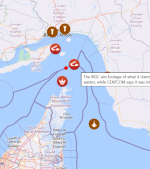
The United States targeted several sites in Bandar Abbas and Sirik Island at dawn today, believed to be linked to infrastructure belonging to the Iranian Revolutionary Guard's Air Force.
Last edited:
The United States targeted several sites in Bandar Abbas and Sirik Island at dawn today, believed to be linked to infrastructure belonging to the Iranian Revolutionary Guard's Air Force.
"In response to the flagrant aggression committed by US terrorist forces against the national sovereignty of the Islamic Republic of Iran on Qeshm Island, the IRGC Aerospace Force struck US military occupation bases in Kuwait with precise and intensive missile strikes, successfully destroying their targets and setting the aggressors' fortifications ablaze.The IRGC issues this as an initial response and delivers a severe warning to the US administration and any party permitting their territory or airspace to be used as a launchpad for aggression against Iran:Any new act of aggression, or any move against a single inch of our borders and sovereignty, will be met with a seismic, crushing, and decisive response that goes beyond existing boundaries. Our forces will not hesitate to turn all enemy positions and interests in the region to ash."

So they've now attacked an international airport at what looks like either the departure or arrivals lounge, which is no better than simply shooting down civilian airliners.
Time to take out Iran's entire power grid, all their refineries, metal/steel industries, plastics production and bridges... and keep it taken out. Blow up anyone who tries fix them too.
Although the House has approved the measure, it must still clear several substantial hurdles before it can compel any change in US military policy.
The first challenge lies in the Senate. A similar war powers resolution has already advanced through a procedural stage in the upper chamber.
Last month, a small group of Republican senators joined Democrats in helping move the proposal forward after seven previous attempts had failed. However, Senate leaders have not yet scheduled a final vote on the measure, leaving its future uncertain.
Even if the Senate eventually approves its version of the resolution, another obstacle awaits. Trump is widely expected to veto any legislation designed to restrict his authority as commander-in-chief.
The administration has consistently defended the military campaign and has questioned the constitutionality of congressional attempts to curtail presidential war-making powers through the War Powers Act.
A presidential veto would force opponents of the war to seek a two-thirds supermajority in both chambers of Congress to override the president’s decision.

So what's your assessment Paddy ? You think the war'd go on & oil prices will reach 150 USD /barrel ? In which case what'd little britain do in winter ?

 www.twz.com
For the first time since the April ceasefire, Israel and Iran have attacked each other. Israel carried out strikes on western and central Iran including the Iranian capital Tehran.
Someone in the ministry ought to be studying these tweets.


