
Off-Topic Chit-Chat
- Thread starter BMD
- Start date
You are using an out of date browser. It may not display this or other websites correctly.
You should upgrade or use an alternative browser.
You should upgrade or use an alternative browser.

I read something interesting in reddit, who read it from somewhere else. Would like your take on it.
During the time of the Galwan standoff, someone had posted the following insightful analysis of China on an online forum:
China
What are they up to in Ladakh? What are they fighting for? Why now?
How the Chinese see us Indians:
[Popular histories] usually include a reference to the slang term by which the Sikhs were known among Chinese, hongtou asan,
- Inferior: There is absolutely no question about this. If anyone talks about how they consider India as the origin of Buddhism, or ancient civilisation, then it's garbage. China doesn't give a damn about all that. There might be a reluctant admission that India has an ancient history but for them that history ended with the arrival of the British. The cultural revolution also pretty much cut off the contact of China with their own heritage, so they don't value culture too highly. Japan makes them insecure, USA makes them very insecure but India is inferior and not really to be taken seriously. Also India is poor and dirty.
- Arrogant: This is a very bad thing in Chinese eyes. Humility is a virtue, arrogance is a sin. Arrogance for them means that India does not know its place. This started from the time of Nehru who tried to pretend that he was a leader of Asia. All the stuff about the UN seat for China and all that, that was China's right, Nehru was doing his duty, that's all. That's why they like Pakistan. It is servile, flatters the leaders and knows its place. (This is not a new thing, even declassified cables from the 1950s show the Pakistanis were being chamchas and undermining India).
- Tools of powerful countries: The first time the Chinese had contact with Indians in modern times was with Sikh policemen in service of the British. This shapes their perception of Indians till today. I'll quote some academic research by Isabella Jackson about this:
which has been translated variously as ‘red-headed monkeys’, ‘red-headed rascals’, or ‘turbaned number threes’. All reflect their status in Chinese eyes as the vicious lackeys of their British masters. Hongtou is a reference to the red turbans that formed part of the police uniform for the Sikhs, while asan is thought to derive from the Sikhs’ third-
class social position in Shanghai, or from a transliteration of either the British exclamation ‘I say’ or ‘ah, sir’, as Shanghai’s Chinese addressed the Sikhs. Popular racist perceptions of Sikhs [see them as] ‘black devils’ (heigui), the Indian troops of the
British in nineteenth-century China.
All current social media discussion of the India-China conflict uses the term hongtou 紅頭 (red turbans) or asan 阿三 (number threes) or heigui 黑鬼 (black devils) to describe us. Most of their racist caricatures also show the Indian Army as composed of Sikhs. Indians oppressed the Chinese for the British, later they served the interest of the Soviets and now they want to serve the interests of the USA. They thought the entire idea of NAM was a self-serving lie by Nehru to fool Asian countries while serving the interests of white masters. That's pretty much what they think of India today. "Strategic autonomy" for them is again a fake front that India puts up (in fear of China) while it secretly serves the interests of the USA against China.
4. Duplicitous: They have always thought of Indians in this way, partly self-projection. Partly because they see the adversary in their own image. The idea of honor is completely alien to Chinese thought. Which means all this talk of India about honor or keeping its word must be a lie. Which means they are hiding something else. Sometimes, China is smart enough to see through India (and see whatever they wanted to see). Being honest is not something anyone places too much value on. In China it is every man for himself. They wouldn't think twice about cheating anyone and corruption (also within the PLA) is expected and only punished as part of a package deal, if someone also commits another crime like disloyalty to the party.
5. Divided: Since we are a democracy, all our internal differences are all out there for the entire world to see. The Chinese differences are not visible, not even to the Chinese themselves. So they can comment about Racism in USA without bothering to give a second thought to their prison camps (which anyway only have the second class Uyghurs). They see India divided between rich and poor, castes and naturally all sorts of political parties.
These are all the comfortable opinions China holds but there are some things that make them uneasy or slightly challenge their picture of India. The space programme makes them very insecure (not just them actually). The nuclear programme makes them angry, India has no right to do such things. The CCP also fears to some extent that a successful democracy might give the people the wrong ideas. Hong Kong is an ideological threat. Taiwan too, that's why they love sharing videos of fist-fights in the Taiwanese Parliament. The Indian IT thing made them uncomfortable earlier but they then decided Indians were good at doing stupid repetitive stuff.
How the Chinese see their neighbours:
Simply put as vassals. There is a periphery which needs to be periodically pacified. China is the centre of the world, if any of the small countries at its periphery gets uppity then it must periodically be taught a lesson. A peaceful periphery is especially important when the Kingdom is facing challenges. Xinjiang quite literally means "new frontier". Tibet is also part of the same strategy. Having a frontier area outside the main heartland is part of the Chinese tradition (also inner Mongolia, outer Mongolia is another story). These regions usually faced benign neglect and occasional severe repression and they were just kept around as an insulation of the heartland, extracting resources and all was secondary. So we have the heartland, directly ruled barbarians (Tibet, Xinjiang), and tributaries (Laos, Mongolia but also uppity ones like Vietnam) outside that. The tributaries should send gifts to the emperor and recognise his authority and they'll be left alone.
How China sees itself:
- China is not a Communist country: It is a country ruled by a communist party, that's the extent of its communism. In some ways it is like Post-Soviet republics of the USSR with a hyper-capitalist, robber baron, crony capitalist oligarchy.
- It is a Han nation. All other minorities get to wear regional costumes like dressed up monkeys when the attend a few congresses in Beijing, but they are second class. This is seen in their repression of Tibetans and Uyghurs. Partly, they want to cilvilise (or make Han) these barbarians practicing strange religions, and stuck in the past.
- China is a modern civilised country (almost western). Think Meiji restoration Japan, think Singapore. See the CCP functionaries wearing western suits, with CCP badges.
- China is on its way to restoring its place as the centre of the world. The USA is an obstacle it will need to overcome for this.
- The CCP has the mandate of heaven. All Chinese emperors needed to have this, otherwise someone with the mandate would usurp their place. CCP is the current dynasty and Xi is the current emperor (for life). Everything becomes a lot clearer when China is seen in its imperial tradition.
- China is orderly and stable. At the moment. The typical condition of China over the past 200 years has been of disorder. The Taiping rebellion, civil war, cultural revolution, etc. So finally the CCP has brought order. Order is way more important than "freedom". Freedom is something they know from Hollywood, not really for China but maybe its worth visiting Disneyworld to see what it's like.
- China is corrupt to the core and the CCP is the heart of this corruption. This is something most people find terrible and all the protests and opposition are inevitably protests against corrupt petty functionaries. But to get rid of corruption, you have to get rid of the CCP and if you get rid of the CCP, China wouldn't function. At the moment corruption is not as ostentatious as before. People are keeping their heads down because Xi was collecting heads to stabilise his rule. Since everyone is corrupt, everyone was afraid of his anti-corruption drive.
- China is a merchant empire. The CCP to sustain its corruption needs heavy trade. If the size of the pie shrinks, there will be infighting. Which will weaken its hold.
- CCP has two enemies: The Chinese People and the USA. The fall of the USSR has been the biggest nightmare of the CCP, and both these factors are thought to have played a role. The CCP spends a very substantial amount on internal security, according to some accounts as much as on external security.
- China has 3 classes: Peasants (the majority, who nowadays are usually migrant workers); the nouveau riche and the rulers CCP. All three are afraid of each other. The newly rich are happy, obedient and scared to lose what they have, send their children to study abroad and hope to migrate to USA; the worker/peasants are the ones who cause disturbances and are in terrible shape. The rulers are insanely rich, insanely corrupt and insanely paranoid, everyone has at least 2 different passports for their children, apart from the chinese one.
What is China doing in Ladakh?
Based on what I have written so far I think this is a mission to subdue the periphery. The army is on an expedition to pacify the frontier and punish the uppity kingdom on the periphery, India. Show them who's the boss and then return to the heartland.
This is also about warning India not to join an alliance with the USA. For us, this might sound ridiculous but when you read how the Chinese see us, it makes perfect sense that we will not ally ourselves with the USA after receiving this warning. Ideas like humiliation being bad for relations are alien to them (humility is a virtue, they are simply showing India its place). That we might have self-respect or might actually care about strategic autonomy or be protecting our own interests are simply incomprehensible and completely out of sync with how they see us.
Several people have tried to think of the current situation in terms of military strategy. That makes absolutely no sense. It is almost certainly not about protecting the Aksai Chin highway. Firstly the PLA is not too bright in terms of military tactics, for example having 200 trucks inside a gorge seems foolish even to a civilian like me. Secondly, the empire never expects trouble or attack inside its borders. I think maybe one or two junior officers in the PLA might entertain the thought of an Indian armored attack and prepare a report on that but I think that's inconceivable for the majority. Also practically, China has enough heavy lift capability and construction skills to have a replacement highway running very quickly.
For those suggesting more fantastic ideas like a shortcut to PoK over the Karakoram pass. The Karakoram Pass is the one point on the boundary that there is no conflict about. Secondly, the Karakoram Highway has nothing to do with the Karakoram Pass. The geography of the area makes it impossible to build a road. Thirdly even the KKH is more or less a gesture for Pakistan, nothing seriously economic about it. it is far away from the economic and population heartland of China. Pakistan is a model tributary state, so it is rewarded with favors like the CPEC. From at least 2013, I have been telling anyone who would listen that it's a big joke. Some Chinese companies will get to build stuff and make a lot of money, which will be shared through the hierarchy but trade with Pakistan over the KKH makes utterly, absolutely no sense.
@Hyperactive ADD
The current conflict is for the average Chinese, out there in Timbuktu. Tibet is already like Antarctica inhabited by the savages for the majority of them. And then there is some fight with India, a country they have heard of. It's quite an exotic place, people dance all the time, they've seen Bollywood movies. That's why I think the idea of domestic messaging doesn't quite fly. Hong Kong is easy to crush, also sends out a message about the supremacy of the CCP and the futility of democracy protests, but Tibet, as far away as it can get? With a third rate country like India? They have a vague idea that it's full of poor people who dance but is there really glory in defeating their army? That's only to be expected surely. This has also created a headache for the CCP, did high-tech Han warriors actually get slaughtered by dirty Red Turbans? [This is currently a very popular question on Chinese social media, which is being asked indirectly in many different ways].
Lessons for India:
- Conflict with China is inevitable. So we must make sure we find the right time and place for it. It will not be a total war. Total war is too unpredictable and might cut into the CCPs earnings.
- Localised conflict is feasible and manageable Tibet is not worth much to the CCP. Of course a dynasty never allows its size to be reduced, but if Lhasa or Amdo or any city in Tibet or Xinjiang were destroyed, the CCP wouldn't even blink. But the CCP will at no costs see even the smallest threat to the heartland (south-west China). So escalation won't proceed beyond a certain step on the ladder
- Any war will be about temporary deterrence and not permanent victory. When we give them a bloody nose, they'll leave us alone for 30 years. But then we'll have to fight them again
- Diplomacy is about delay and obfuscation, not resolution. Talking helps pass the time until its time for military conflict. Any promises aren't worth the toilet paper they are written on. A loophole will be found as and when necessary.
- It's not Sun Tzu (Sun Zi) who's relevant to Chinese military strategy but Weiqi. I find it a bit ridiculous because The Art of War is quite elliptical and can be interpreted as one wishes. I haven't read it myself and I'm convinced most people who quote it haven't either. What Chinese Generals were also mesmerised by was the Gulf War 1. That and RMA have very much shaped their understanding of how the next war (with USA) will be fought.
- They will be hopeless at mountain warfare. From everything I read, their strategy seems to be one of overwhelming the enemy. Send 2000 soldiers, 200 tanks, 500 trucks and 20 bulldozers to scare 200 enemy soldiers. This strategy might work on Tiananmen Square (as it indeed did) but not in the mountains. I don't know anything about weapons systems but I have a suspicion networked warfare is not really the best way to fight in the mountains. Massed forces are also probably not the best idea in Ladakh (perhaps with the exception of Depsang)
- This might make me sound like a Pakistani, but the Chinese have nothing to even remotely match the Indian soldier's spirit. I just tried to think of how many of my Chinese acquaintances might be willing to die for their country and I honestly can't think of a single one. In case of India obviously I have family, friends, neighbors, one doesn't need more than 5 seconds to think of 10 people. The Chinese spirit comes from Han superiority and fear of their officers, especially the political officers. This means they are ripe for desertion, and if there are non-Han soldiers they can probably be used to create disorder within their armies. The han superiority also makes them afraid of barbarians. They are always scared by people with heavy beards and scary mustaches.
- Their lack of democracy means they are very brittle against information warfare. I had posted earlier how Chinese social media was relying on the messaging of the new Baba Banaras twitter account. All their news came from Indian media. If we can spread some fake videos or pics of mutilated Chinese soldiers, that will not enrage but scare them. It will perfectly fit their image of savage barbarians and the modern Chinese population is all up for CGI warfare but not to see skulls crushed with rocks.
- The planning is done by Generals, approved by Beijing, and then flows down to the soldiers. This system lacks innovation and probably won't be very flexible on the ground. Though it may very well lead to brilliant strategy in the case of experienced generals, the tactics will probably be shoddy and predictable.
- We should try to understand them and how they see us and take advantage of it. We must also be willing to adapt to their working style, which might mean giving up on values like honour and truth. We always feel betrayed by them because they act differently to our expectations. When we understand their worldview, we will be the ones taking advantage of them.
- What CCP does not want is a widespread front and protracted warfare. Traditionally such pacification exercises (Ladakh, but also Xinjiang and Tibet) were conducted in order to free the empire for more important work (like confronting the USA). We will know we have won this round when General Zhao is recalled to Beijing.
1. How Chinese People View Indians
---① To answer this question, one must first answer: What is the ideology of the Chinese people like?China is a highly backward nation in terms of civilization. As an ancient country, its accumulation of spiritual culture lags far behind that of India, and it lacks basic modern morals and values. The modernization of these fundamental ideological concepts was first brought over from Japan by international students during the Qing Dynasty, performing an "enlightenment" in China. This was subsequently followed by the Russian Bolsheviks, who brought genuine spiritual modernization to China. In one fell swoop, they elevated the Qing Dynasty serfs from semi-slave, semi-feudal subjects into true citizens. Within a few decades, China traversed a path that took Western society 500 years to complete.
However, because this set of thinking patterns entered China too recently, it remains akin to a "factory-farmed, chemically ripened chicken" and lacks a basic intellectual foundation among the general populace. Consequently, after 1978, China plummeted back into what is, in a certain sense, a semi-feudal and semi-civilized society.
The Chinese people possess an extremely strong slave mentality, yet they are incredibly cowardly. They loathe officials and the government, yet they maintain an extremely restrained and humble obedience—this is the result of 3,000 years of domestication by feudal lords. The Bolsheviks wanted to teach them hand-in-hand how to be "citizens," but the people lacked the capacity for it. They can only exist as the domestic slaves of their rulers. Because they fear sticking their necks out, displaying unconditional obedience to the government is an action hardcoded into their genes.
Having said all that, what is the ideology of the Chinese people like? To alleviate the pain generated by the core problem I described above, the Chinese public possesses an intensely self-deceiving nature (a trait similar to Indians). The core of this is mocking the poor but not the prostitute, characterized by self-contradictory double standards.
What is the most sinister aspect of Chinese culture?Do you think that after suffering oppression, they would want a country free of oppression?No. They are simply poor right now. Once these people at the bottom become wealthy, they too will ruthlessly and unthinkingly turn around to oppress other underclasses.Because "knowing how to obey" is merely a low-level form of slave mentality; "believing in the law of the jungle and slavery itself" is the ultimate skill that makes Chinese slaves the crown jewels among global slaves.
Furthermore, due to immense survival pressures and an empty core within their traditional culture, Chinese people require highly potent spiritual placebos to soothe the agony of their real lives—and they must evade the core factor of their own cowardice in this process.
Political topics are perennially popular in China. Perhaps no other country's citizens possess such a high level of interest in politics—particularly international politics—as Chinese citizens do. This serves as a powerful placebo.
Because discussing domestic topics will get you severely beaten by the public security bureau. Only discussing international politics is safe.Only by expressing the alleged greatness of their own country and despising all Western nations as barbarians can they achieve satisfaction.
And the official authorities are more than happy to use this channel to provide the slaves at the bottom with an outlet for emotional release. Therefore, the official apparatus itself actively supports chauvinism and racism. In fact, Chinese people view the world exactly according to skin color; here, I have constructed a baseline logical map of how ordinary Chinese citizens view various nations.
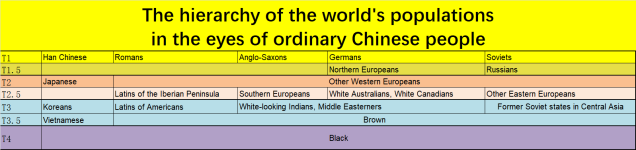
↑Based on this chart, you can understand the worldview and logic held by the majority of ordinary Chinese people:
Rome has already Die,
The Soviet Union has already collapsed,
Germany is left with a mere few tens of millions and is of no consequence,
The Anglo-Saxons' only hope—the United States—is on the verge of being defeated by Black, Latino, and Brown populations,
Therefore, only the Han people are invincible.
Only by grasping this fundamental line of reasoning can you understand the mindset regarding foreign affairs shared by the majority of Chinese people—
and I believe I am the only one who can explain it.
② Therefore, how do Chinese people view Indians?
As I have already stated above, when Chinese people "view" international politics, they do so with the target KPI of searching for a spiritual placebo. By asking this, you are in fact asking: "How do Chinese people 'win' by comparing themselves to India?"
-------1. Dirty: Dirtiness is a characteristic of poverty, so first and foremost, they look down on Indians for being poor.
-------2. Stupid: Because of the previous point, because they are poor, they are stupid; and this stupidity, in turn, reproduces poverty.
-------3. Dark-skinned, therefore inferior: (Yes, this point was copied and brought over from the West. However, for the sake of political correctness, Westerners no longer dare to say it publicly now, but the Chinese dare. This is because, deep down in their bones, the Chinese feel that the only people on Earth who can compete with them for status are the Anglo-Saxons—because they have money). Because their skin is dark, it further reinforces the first two points.
-------4. Regarding the matter of "belonging to an ancient civilization just like China," it goes like this: Reddit is a community for foreigners. Ordinary Chinese (mainlanders) cannot access it, or those who can come here do so for propaganda purposes. In many aspects, they cannot speak as piercingly to the truth as a real Chinese person like me. In the worldview of the Chinese people, out of the so-called "Four Great Ancient Civilizations" (a self-invented concept from the 1900s, an era when nationalists were overthrowing the Qing Dynasty, based on the Western historical view at the time of the "Five Great Cradles of Civilization"—Babylonia, Egypt, Greece, India, and China—which they self-invented by removing Greece, the root of Western civilization. This was a form of Ah Q-style spiritual victory to deny Western history because the Qing Dynasty was being invaded and crushed by the West back then, and the Chinese found it difficult to accept reality), China is the only surviving spark—all other civilizations have already "died out," and only China is the oldest, most powerful historically continuous powerhouse in the world (in reality, more than half of China's dynasties were complete conquests of the southern Chinese by northern nomadic races like the Mongols and Mongol-analogs). The other three, including India, are just there to make up the numbers—this is the consistent propaganda and educational baseline of the Chinese authorities, and in fact, it is simply another way of phrasing the theory of Chinese racial supremacy.
③, I can also give you the templates for how Chinese people assess other major countries,
Or you could call them the standard formulaic stories of "How Chinese people 'win' by comparing themselves to Country XXX."Russia
------1. Only knows how to fight, has no culture.------2. Doesn't understand that Western politics and economics are the true path. They belong to the category of barbarians wandering outside the civilized world, far inferior to the Chinese, who stand higher and see further.
------3. A mixed breed of Mongols and whites, therefore inferior. (As previously stated, the Chinese firmly believe in the skin color theories invented by the West, except the Chinese believe that the "Chinese breed" is at least as high-grade as the "most authentic" white race, while all other ethnicities are inferior. In their eyes, Russians, Eastern Europeans, and Latinos are half a tier lower than the Anglo-Saxons.)
Japan
------1. Merely a knockoff of China. If it weren't for the sea separating them, China would have crushed them long ago.------2. Losing to Japan was just an accident. The Chinese just lacked internal magical power back then and didn't unleash their "Five-Step Lightning Whip." (Note: A notorious Chinese internet meme mocking fake kung fu masters—used here to ridicule the absurd coping excuse that China lost only because it didn't use fictional, magical martial arts).
All Western European Countries
------1. Only Rome is worthy of standing on equal footing with China. The European countries that followed are already finished; they are all insignificant micro-states. When their leaders visit China, they should only be given the reception treatment of a municipal mayor.------2. Losing to the Eight-Nation Alliance was just an accident. The Chinese just lacked internal magical power back then and didn't unleash their "Five-Step Lightning Whip."
Eastern European Countries
------1. Whores.------2. Whores.
------3. Whores.
United States
------1. The only country capable of rivaling the Celestial Empire right now. However, its days are numbered, and defeating the US is purely a matter of time.------2. Because the white race (excluding Eastern Europeans and Latinos here) is already in decline, it further reinforces the previous point.
------3. Because it lacks the ancient history of China, it is fundamentally incapable of competing with an ancient civilization like China.
======================
"The other points are spot on, including how Chinese people project themselves onto Indians, imagining them as reflections of themselves, and then further attacking the very flaws within themselves that they refuse to admit.
The derogatory term 'Ah San' (阿三) is also highly accurate in this context. It originated from Indian colonial police officers under British rule; the pronunciation is actually identical to how they mispronounced 'Ah Sir'."
======================
2.Regarding How Chinese People View Themselves
①High-level intellectuals understand that China is actually practicing the predatory, monopolistic capitalism of the 1900s West. These high-level intellectuals are basically split into 3 categories.----The first category worries about survival, deeply anxious over how rapidly this system is overdrawing the society’s future potential.
----The second category consists of the vested-interest capitalist class. They believe that keeping the current system going for as long as possible is the best-case scenario because it allows them to milk more money out of it (as their actual abilities would never yield them this kind of success anywhere else on Earth). To them, it doesn't matter as long as this game of hot potato doesn't explode in their own hands—after all, they can always just immigrate to the United States when the time comes. This type accounts for nearly half of the high-level intellectual population.
----Then there is a third category: those in power, who honestly have no idea what to do about the future either.
②Meanwhile, the middle class, lower class, and the vast majority (at least 80%) of Chinese people believe that "China is just China," and that it has run this way for thousands of years—meaning all its irrationalities and dark sides are deemed "normal." They take their high-pressure existence entirely for granted and assume that every other country operates exactly the same way. For instance, they genuinely believe that the Soviet Union used to run like this, that the United States runs like this now, and India too. Therefore, when they hear in the news that Indian workers dare to revolt against Samsung's tyranny to demand an 8-hour workday, most of these Chinese people find it mind-boggling and begin to mock them. Likewise, when they see death-defying Russians or North Koreans strapping on bombs to launch suicide attacks against Americans and their Western proxies, they similarly find it incomprehensible and ridicule it. This is because they cannot accept that while they claim to be "the most superior race in the world," other races are actually doing things in reality that the Chinese themselves cannot achieve (or can only be done by those mechanical, cookie-cutter characters in Chinese propaganda films). This only further highlights the inherent weakness of their dominant ethnic group.
--------------Struggling to accept the reality of having inherited mediocrity and incompetence.
3.As for How China’s High Command Views China
Maintaining social stability is absolutely Priority Number One. If the government possesses 100 units of power, it will expend 65 points on this front, whereas countering the United States accounts for a mere 10 points. China's corruption stems from the commoners' genetic dread of raw power. During the recent pandemic, China maintained high-pressure lockdown measures for three years. The moment a single positive case popped up in a village, town, or a residential compound with a population of tens of thousands, it would be forcibly locked down immediately, halting all work and business. Often, simply hiring 30 temporary security guards, putting red armbands on them, and giving them a few packs of cotton swabs was enough to lock down and police a residential area of tens of thousands—and no one dared to cross the line or resist. To use an old Chinese proverb, it is a mindset of "Starving to death is a small matter, but losing one's integrity [to the master] is a grave matter."------The phrase 'Starving to death is a small matter, but losing one's integrity is a grave matter' --------------originally meant that traditional Chinese women had to guard their 'purity' at all costs; even in a brutal famine, they wouldn't accept a piece of bread from a neighbor's husband, choosing starvation instead.
What makes it far more cynical today is how the current moral fabric forces the absolute bottom of society to sign away all dignity and fundamental human rights. As mere peasants, they are expected to perform the duties of state officials, willingly and proactively acting as the unpaid guardians of government dictates.
Including folks like you, outsiders have an utterly inadequate understanding of China. Trying to comprehend Chinese "beasts of burden" (Niuma) using the psychological frameworks of foreigners is completely unscientific.
Furthermore, on the topic of corruption: the corruption of the Communist Party actually qualifies as excellent and restrained when compared to any of the major Chinese dynasties in recent history. Swapping in any other government, political party, or system wouldn’t change a thing. It is the exact same reason why Chinese "Chinatowns" in the United States remain an absolute shambles.
This is a fundamental flaw in the HAN national character.


4.As for Ladakh
Not a single Chinese person gives a damn about these things. It is merely a seasoning for their high-pressure lives, serving as idle gossip over tea and meals, and a tool used by the purged military brass to flash their toughness to the central leadership. Nor does anyone actually believe in something like The Art of War—it is just a talking point, a piece of proverbial folklore akin to Ali Baba and the Forty Thieves. The whole thing is baffling and utterly nonsensical.Back in history, a mere 20,000 Manchu cavalrymen, joined by an allied force of 8,000 Mongols and roughly 20,000 additional Han puppet troops—making a total Eight Banners alliance of just 50,000—completely annihilated a Han dynasty(Ming dynasty) boasting a population of at least 60 million and "an army of hundreds of thousands."
Yet, in the exact same era, during the Second Battle of Albazin (1686), a 3,000-strong Manchu force faced a ragtag group of 826 Russian merchants, hunters, peasants, and frontiersmen, and ended up losing over 500 of their own. Even worse was the Battle of Achansk (乌扎拉之战) in 1652, where 1,225 Qing soldiers equipped with 6 cannons went to wipe out a Russian force of a mere 207 men, only to be counter-slaughtered, losing 676 men.
The Japanese ran through China like a knife through butter (Kangua Qieca). A few thousand Japanese troops could chase tens of thousands of Chinese soldiers all over the place, sweeping all the way from the Greater Khingan Mountains to the shores of the South China Sea like absolute gods of war. By contrast, the elite of the Japanese military—the 700,000-strong Kwantung Army—couldn't even hold out for 15 days under the onslaught of just two fronts of the Soviet Red Army.
Last edited:

thanks, that was really informative.1. How Chinese People View Indians
---① To answer this question, one must first answer: What is the ideology of the Chinese people like?
China is a highly backward nation in terms of civilization. As an ancient country, its accumulation of spiritual culture lags far behind that of India, and it lacks basic modern morals and values. The modernization of these fundamental ideological concepts was first brought over from Japan by international students during the Qing Dynasty, performing an "enlightenment" in China. This was subsequently followed by the Russian Bolsheviks, who brought genuine spiritual modernization to China. In one fell swoop, they elevated the Qing Dynasty serfs from semi-slave, semi-feudal subjects into true citizens. Within a few decades, China traversed a path that took Western society 500 years to complete.
However, because this set of thinking patterns entered China too recently, it remains akin to a "factory-farmed, chemically ripened chicken" and lacks a basic intellectual foundation among the general populace. Consequently, after 1978, China plummeted back into what is, in a certain sense, a semi-feudal and semi-civilized society.
The Chinese people possess an extremely strong slave mentality, yet they are incredibly cowardly. They loathe officials and the government, yet they maintain an extremely restrained and humble obedience—this is the result of 3,000 years of domestication by feudal lords. The Bolsheviks wanted to teach them hand-in-hand how to be "citizens," but the people lacked the capacity for it. They can only exist as the domestic slaves of their rulers. Because they fear sticking their necks out, displaying unconditional obedience to the government is an action hardcoded into their genes.
Having said all that, what is the ideology of the Chinese people like? To alleviate the pain generated by the core problem I described above, the Chinese public possesses an intensely self-deceiving nature (a trait similar to Indians). The core of this is mocking the poor but not the prostitute, characterized by self-contradictory double standards.
What is the most sinister aspect of Chinese culture?Do you think that after suffering oppression, they would want a country free of oppression?No. They are simply poor right now. Once these people at the bottom become wealthy, they too will ruthlessly and unthinkingly turn around to oppress other underclasses.Because "knowing how to obey" is merely a low-level form of slave mentality; "believing in the law of the jungle and slavery itself" is the ultimate skill that makes Chinese slaves the crown jewels among global slaves.
Furthermore, due to immense survival pressures and an empty core within their traditional culture, Chinese people require highly potent spiritual placebos to soothe the agony of their real lives—and they must evade the core factor of their own cowardice in this process.
Political topics are perennially popular in China. Perhaps no other country's citizens possess such a high level of interest in politics—particularly international politics—as Chinese citizens do. This serves as a powerful placebo.
Because discussing domestic topics will get you severely beaten by the public security bureau. Only discussing international politics is safe.Only by expressing the alleged greatness of their own country and despising all Western nations as barbarians can they achieve satisfaction.
And the official authorities are more than happy to use this channel to provide the slaves at the bottom with an outlet for emotional release. Therefore, the official apparatus itself actively supports chauvinism and racism. In fact, Chinese people view the world exactly according to skin color; here, I have constructed a baseline logical map of how ordinary Chinese citizens view various nations.
View attachment 52733
↑Based on this chart, you can understand the worldview and logic held by the majority of ordinary Chinese people:
Rome has already Die,
The Soviet Union has already collapsed,
Germany is left with a mere few tens of millions and is of no consequence,
The Anglo-Saxons' only hope—the United States—is on the verge of being defeated by Black, Latino, and Brown populations,
Therefore, only the Han people are invincible.
Only by grasping this fundamental line of reasoning can you understand the mindset regarding foreign affairs shared by the majority of Chinese people—
and I believe I am the only one who can explain it.
② Therefore, how do Chinese people view Indians?
As I have already stated above, when Chinese people "view" international politics, they do so with the target KPI of searching for a spiritual placebo. By asking this, you are in fact asking: "How do Chinese people 'win' by comparing themselves to India?"
-------1. Dirty: Dirtiness is a characteristic of poverty, so first and foremost, they look down on Indians for being poor.
-------2. Stupid: Because of the previous point, because they are poor, they are stupid; and this stupidity, in turn, reproduces poverty.
-------3. Dark-skinned, therefore inferior: (Yes, this point was copied and brought over from the West. However, for the sake of political correctness, Westerners no longer dare to say it publicly now, but the Chinese dare. This is because, deep down in their bones, the Chinese feel that the only people on Earth who can compete with them for status are the Anglo-Saxons—because they have money). Because their skin is dark, it further reinforces the first two points.
-------4. Regarding the matter of "belonging to an ancient civilization just like China," it goes like this: Reddit is a community for foreigners. Ordinary Chinese (mainlanders) cannot access it, or those who can come here do so for propaganda purposes. In many aspects, they cannot speak as piercingly to the truth as a real Chinese person like me. In the worldview of the Chinese people, out of the so-called "Four Great Ancient Civilizations" (a self-invented concept from the 1900s, an era when nationalists were overthrowing the Qing Dynasty, based on the Western historical view at the time of the "Five Great Cradles of Civilization"—Babylonia, Egypt, Greece, India, and China—which they self-invented by removing Greece, the root of Western civilization. This was a form of Ah Q-style spiritual victory to deny Western history because the Qing Dynasty was being invaded and crushed by the West back then, and the Chinese found it difficult to accept reality), China is the only surviving spark—all other civilizations have already "died out," and only China is the oldest, most powerful historically continuous powerhouse in the world (in reality, more than half of China's dynasties were complete conquests of the southern Chinese by northern nomadic races like the Mongols and Mongol-analogs). The other three, including India, are just there to make up the numbers—this is the consistent propaganda and educational baseline of the Chinese authorities, and in fact, it is simply another way of phrasing the theory of Chinese racial supremacy.
③, I can also give you the templates for how Chinese people assess other major countries,
Or you could call them the standard formulaic stories of "How Chinese people 'win' by comparing themselves to Country XXX."
Russia
------1. Only knows how to fight, has no culture.
------2. Doesn't understand that Western politics and economics are the true path. They belong to the category of barbarians wandering outside the civilized world, far inferior to the Chinese, who stand higher and see further.
------3. A mixed breed of Mongols and whites, therefore inferior. (As previously stated, the Chinese firmly believe in the skin color theories invented by the West, except the Chinese believe that the "Chinese breed" is at least as high-grade as the "most authentic" white race, while all other ethnicities are inferior. In their eyes, Russians, Eastern Europeans, and Latinos are half a tier lower than the Anglo-Saxons.)
Japan
------1. Merely a knockoff of China. If it weren't for the sea separating them, China would have crushed them long ago.
------2. Losing to Japan was just an accident. The Chinese just lacked internal magical power back then and didn't unleash their "Five-Step Lightning Whip." (Note: A notorious Chinese internet meme mocking fake kung fu masters—used here to ridicule the absurd coping excuse that China lost only because it didn't use fictional, magical martial arts).
All Western European Countries
------1. Only Rome is worthy of standing on equal footing with China. The European countries that followed are already finished; they are all insignificant micro-states. When their leaders visit China, they should only be given the reception treatment of a municipal mayor.
------2. Losing to the Eight-Nation Alliance was just an accident. The Chinese just lacked internal magical power back then and didn't unleash their "Five-Step Lightning Whip."
Eastern European Countries
------1. Whores.
------2. Whores.
------3. Whores.
United States
------1. The only country capable of rivaling the Celestial Empire right now. However, its days are numbered, and defeating the US is purely a matter of time.
------2. Because the white race (excluding Eastern Europeans and Latinos here) is already in decline, it further reinforces the previous point.
------3. Because it lacks the ancient history of China, it is fundamentally incapable of competing with an ancient civilization like China.
======================
"The other points are spot on, including how Chinese people project themselves onto Indians, imagining them as reflections of themselves, and then further attacking the very flaws within themselves that they refuse to admit.
The derogatory term 'Ah San' (阿三) is also highly accurate in this context. It originated from Indian colonial police officers under British rule; the pronunciation is actually identical to how they mispronounced 'Ah Sir'."
======================
2.Regarding How Chinese People View Themselves
①High-level intellectuals understand that China is actually practicing the predatory, monopolistic capitalism of the 1900s West. These high-level intellectuals are basically split into 3 categories.
----The first category worries about survival, deeply anxious over how rapidly this system is overdrawing the society’s future potential.
----The second category consists of the vested-interest capitalist class. They believe that keeping the current system going for as long as possible is the best-case scenario because it allows them to milk more money out of it (as their actual abilities would never yield them this kind of success anywhere else on Earth). To them, it doesn't matter as long as this game of hot potato doesn't explode in their own hands—after all, they can always just immigrate to the United States when the time comes. This type accounts for nearly half of the high-level intellectual population.
----Then there is a third category: those in power, who honestly have no idea what to do about the future either.
②Meanwhile, the middle class, lower class, and the vast majority (at least 80%) of Chinese people believe that "China is just China," and that it has run this way for thousands of years—meaning all its irrationalities and dark sides are deemed "normal." They take their high-pressure existence entirely for granted and assume that every other country operates exactly the same way. For instance, they genuinely believe that the Soviet Union used to run like this, that the United States runs like this now, and India too. Therefore, when they hear in the news that Indian workers dare to revolt against Samsung's tyranny to demand an 8-hour workday, most of these Chinese people find it mind-boggling and begin to mock them. Likewise, when they see death-defying Russians or North Koreans strapping on bombs to launch suicide attacks against Americans and their Western proxies, they similarly find it incomprehensible and ridicule it. This is because they cannot accept that while they claim to be "the most superior race in the world," other races are actually doing things in reality that the Chinese themselves cannot achieve (or can only be done by those mechanical, cookie-cutter characters in Chinese propaganda films). This only further highlights the inherent weakness of their dominant ethnic group.
--------------Struggling to accept the reality of having inherited mediocrity and incompetence.
3.As for How China’s High Command Views China
Maintaining social stability is absolutely Priority Number One. If the government possesses 100 units of power, it will expend 65 points on this front, whereas countering the United States accounts for a mere 10 points. China's corruption stems from the commoners' genetic dread of raw power. During the recent pandemic, China maintained high-pressure lockdown measures for three years. The moment a single positive case popped up in a village, town, or a residential compound with a population of tens of thousands, it would be forcibly locked down immediately, halting all work and business. Often, simply hiring 30 temporary security guards, putting red armbands on them, and giving them a few packs of cotton swabs was enough to lock down and police a residential area of tens of thousands—and no one dared to cross the line or resist. To use an old Chinese proverb, it is a mindset of "Starving to death is a small matter, but losing one's integrity [to the master] is a grave matter."
------The phrase 'Starving to death is a small matter, but losing one's integrity is a grave matter' --------------originally meant that traditional Chinese women had to guard their 'purity' at all costs; even in a brutal famine, they wouldn't accept a piece of bread from a neighbor's husband, choosing starvation instead.
What makes it far more cynical today is how the current moral fabric forces the absolute bottom of society to sign away all dignity and fundamental human rights. As mere peasants, they are expected to perform the duties of state officials, willingly and proactively acting as the unpaid guardians of government dictates.
Including folks like you, outsiders have an utterly inadequate understanding of China. Trying to comprehend Chinese "beasts of burden" (Niuma) using the psychological frameworks of foreigners is completely unscientific.
Furthermore, on the topic of corruption: the corruption of the Communist Party actually qualifies as excellent and restrained when compared to any of the major Chinese dynasties in recent history. Swapping in any other government, political party, or system wouldn’t change a thing. It is the exact same reason why Chinese "Chinatowns" in the United States remain an absolute shambles.
This is a fundamental flaw in the HAN national character.
View attachment 52735View attachment 52734View attachment 52736
4.As for Ladakh
Not a single Chinese person gives a damn about these things. It is merely a seasoning for their high-pressure lives, serving as idle gossip over tea and meals, and a tool used by the purged military brass to flash their toughness to the central leadership. Nor does anyone actually believe in something like The Art of War—it is just a talking point, a piece of proverbial folklore akin to Ali Baba and the Forty Thieves. The whole thing is baffling and utterly nonsensical.
Back in history, a mere 20,000 Manchu cavalrymen, joined by an allied force of 8,000 Mongols and roughly 20,000 additional Han puppet troops—making a total Eight Banners alliance of just 50,000—completely annihilated a Han dynasty(Ming dynasty) boasting a population of at least 60 million and "an army of hundreds of thousands."
Yet, in the exact same era, during the Second Battle of Albazin (1686), a 3,000-strong Manchu force faced a ragtag group of 826 Russian merchants, hunters, peasants, and frontiersmen, and ended up losing over 500 of their own. Even worse was the Battle of Achansk (乌扎拉之战) in 1652, where 1,225 Qing soldiers equipped with 6 cannons went to wipe out a Russian force of a mere 207 men, only to be counter-slaughtered, losing 676 men.
The Japanese ran through China like a knife through butter (Kangua Qieca). A few thousand Japanese troops could chase tens of thousands of Chinese soldiers all over the place, sweeping all the way from the Greater Khingan Mountains to the shores of the South China Sea like absolute gods of war. By contrast, the elite of the Japanese military—the 700,000-strong Kwantung Army—couldn't even hold out for 15 days under the onslaught of just two fronts of the Soviet Red Army.
China’s Hidden Racial Hierarchy and Ethnic Paradoxthanks, that was really informative.
China is a thoroughly racist country, particularly in how it views the rest of the world through the lens of skin color.
Furthermore, this worldview and value system are fundamentally institutionalized and pushed by the education system. Although these educational methods are subtle and covert—never explicitly stating that Black or brown people are "dirty," but rather using a variety of sophisticated tropes to instill the same message—the desired effect is fully achieved. Because China’s internet environment is closed off, most people on the outside do not actually understand the depth of this issue. In contemporary Western societies, very few people dare to openly and candidly express racial discrimination, as it violates "political correctness." In China, however, no such political correctness exists.
The Paradox of Ethnic Group Status
This reality manifests in a deeply contradictory set of relationships. If a Manchu person today dared to walk down the street keeping a traditional queue (braid), they would be physically assaulted by a mob, regardless of whether keeping a queue is part of their ethnic heritage or not. For the vast majority of minority groups, they occupy the weakest and most marginalized positions.
Yet, if you are a Hui (Muslim), Uyghur (Muslim), or Tibetan, you are accorded what amounts to aristocratic treatment in China. This is because the government bullies the weak but fears the strong; they only fear ethnic groups that are capable of rising up, rioting, and causing severe political consequences. In front of these groups, the Han majority instantly subverts itself into a servile status. In fact, prior to the 2000s, Tibetans legally and openly carried long swords and primitive firearms; if a Tibetan killed a Han person, under normal circumstances they would not be sentenced to death. ...without even facing prison timeThe courts would invariably chalk everything up to a "matter of ethnic sentiments."
Therefore, despite China claiming to have 56 ethnic minorities:
The Muslims, Tibetans, and the Yi people in certain regions enjoy absolute aristocratic status. At the end of the day, it is simply because they are fierce and unyielding. Meanwhile, other populous minorities—such as the Zhuang and Miao—receive treatment indistinguishable from the Han, while the remaining smaller minorities are treated as mere window dressing.
So even though the values the Chinese government teaches their people are things like being obedient and show servitude to their government, it's people who have the opposite of these values like being strong and rebellious that they fear and respect the most.China’s Hidden Racial Hierarchy and Ethnic Paradox
China is a thoroughly racist country, particularly in how it views the rest of the world through the lens of skin color.
Furthermore, this worldview and value system are fundamentally institutionalized and pushed by the education system. Although these educational methods are subtle and covert—never explicitly stating that Black or brown people are "dirty," but rather using a variety of sophisticated tropes to instill the same message—the desired effect is fully achieved. Because China’s internet environment is closed off, most people on the outside do not actually understand the depth of this issue. In contemporary Western societies, very few people dare to openly and candidly express racial discrimination, as it violates "political correctness." In China, however, no such political correctness exists.
The Paradox of Ethnic Group Status
This reality manifests in a deeply contradictory set of relationships. If a Manchu person today dared to walk down the street keeping a traditional queue (braid), they would be physically assaulted by a mob, regardless of whether keeping a queue is part of their ethnic heritage or not. For the vast majority of minority groups, they occupy the weakest and most marginalized positions.
Yet, if you are a Hui (Muslim), Uyghur (Muslim), or Tibetan, you are accorded what amounts to aristocratic treatment in China. This is because the government bullies the weak but fears the strong; they only fear ethnic groups that are capable of rising up, rioting, and causing severe political consequences. In front of these groups, the Han majority instantly subverts itself into a servile status. In fact, prior to the 2000s, Tibetans legally and openly carried long swords and primitive firearms; if a Tibetan killed a Han person, under normal circumstances they would not be sentenced to death. ...without even facing prison timeThe courts would invariably chalk everything up to a "matter of ethnic sentiments."
Therefore, despite China claiming to have 56 ethnic minorities:
The Muslims, Tibetans, and the Yi people in certain regions enjoy absolute aristocratic status. At the end of the day, it is simply because they are fierce and unyielding. Meanwhile, other populous minorities—such as the Zhuang and Miao—receive treatment indistinguishable from the Han, while the remaining smaller minorities are treated as mere window dressing.
Also, what makes the Han Chinese people consider themselves as racially superior than the rest? Is it because of their long ancient history and heritage? Then by those same standards, countries like India has an even older history and heritage. Is it because they consider themselves as intellectually superior than the rest? Then Indian's with a similar level of upbringing have an equally good intellect atleast. Is it because of their skin colour? Then europeans and other races should be superior to them? Is it because of their body built? Then for most of our history until recently, the average Indian was bigger and stronger than the average Chinese. Is it because of their moral values? Here I consider the Indian's to be leagues ahead of the Chinese and wouldn't even compare it. So my question boils down to, what's the basis of these Han Chinese people to have an inflated sense of self worth?
I'm generally not racist but have to be extra careful when it comes to pakistan, what is your purpose here?China is jumping the boat from the hump deisgn to streamline ones like the western subs , Most of the S5 designs are like Hump based or kinda looks like the british subs..
Why are yall so worried when a Pakistani comes here? Im just here for some updates and hearing nice discussions .I'm generally not racist but have to be extra careful when it comes to pakistan, what is your purpose here?
If that's true, can you swear on Wallahi (وَاللّٰهِ) that you're not here on behalf of Pakistan, any agency, or anyone else to spy, spread propaganda, lie, troll, manipulate discussions, or otherwise participate in bad faith? If you're genuinely here just for respectful conversation, that should be an easy thing to say.Why are yall so worried when a Pakistani comes here? Im just here for some updates and hearing nice discussions .

Broo this was so funny to read , Ans yes i swear i aint here to do propaganda and stuff , just healthy convos and to know stuff.If that's true, can you swear on Wallahi (وَاللّٰهِ) that you're not here on behalf of Pakistan, any agency, or anyone else to spy, spread propaganda, lie, troll, manipulate discussions, or otherwise participate in bad faith? If you're genuinely here just for respectful conversation, that should be an easy thing to say.
And do you actually think 'Agenices" will be sending people to forums lol I bet they can just honey trap some scientist to get latest info . Kher Thats a convo for another time
As long as you Wallahi that you won't be spying or collecting information for the government, military or any agency, it's fine I guess.Broo this was so funny to read , Ans yes i swear i aint here to do propaganda and stuff , just healthy convos and to know stuff.
why notAnd do you actually think 'Agenices" will be sending people to forums lol
I'm sad that this is true.I bet they can just honey trap some scientist to get latest info . Kher Thats a convo for another time
My advice is probably that on open forums like these the people who "know" wont be telling anything , even if they do . High chance its mixed with fake info. Also you dont need people to log into forums , Agencies tend to have bots or programs that fish out words and pictures from these sites , eg is CIAAs long as you Wallahi that you won't be spying or collecting information for Pakistan, it's fine I guess.
why not
I'm sad that this is true.
The intelligence gathering capability of America is scary af, they have organisations even more capable than CIA for intelligence gathering, the CIA have tools to spy you from the TV at your home, malware to hack windows, android, ios etcMy advice is probably that on open forums like these the people who "know" wont be telling anything , even if they do . High chance its mixed with fake info. Also you dont need people to log into forums , Agencies tend to have bots or programs that fish out words and pictures from these sites , eg is CIA
@Kimjongun you can tell me whats weapon used by pak during op sindoor.
I know about fatah 1 and fatah 2 ? But how much nunber ? And was shaheen used ? And why babur or raad not used ??
Saafiz used to say that Raad is of conventional use when it was tested in 2020, so why not use it ??
And was only fatah1 and 2 used or any other ? Quantity ?
And for pak rocket force, whats the inventory size goal ? Like for indian tri-service, its around 1000-1500 for brahmos only.
So what's inventory target for fatah 1/2/3/4/5 ?
I know about fatah 1 and fatah 2 ? But how much nunber ? And was shaheen used ? And why babur or raad not used ??
Saafiz used to say that Raad is of conventional use when it was tested in 2020, so why not use it ??
And was only fatah1 and 2 used or any other ? Quantity ?
And for pak rocket force, whats the inventory size goal ? Like for indian tri-service, its around 1000-1500 for brahmos only.
So what's inventory target for fatah 1/2/3/4/5 ?
First of all exact numbers aren't known , maybe you can do some counting by OSINT but its still debatable..@Kimjongun you can tell me whats weapon used by pak during op sindoor.
I know about fatah 1 and fatah 2 ? But how much nunber ? And was shaheen used ? And why babur or raad not used ??
Saafiz used to say that Raad is of conventional use when it was tested in 2020, so why not use it ??
And was only fatah1 and 2 used or any other ? Quantity ?
And for pak rocket force, whats the inventory size goal ? Like for indian tri-service, its around 1000-1500 for brahmos only.
So what's inventory target for fatah 1/2/3/4/5 ?
F1 was used and CM400akg , Not sure about F2 as all evidence pointing to f2 usage turned out to be S125 parts. If you have any pictures of F2 use plz share otherwise its just BS tbh ,
No type of Shaheen was used , its all Lies . The Shaheen series are purely strategic like the Agni's .
Raad is also a strategic weapon , same with babur but that doesn't mean in a nuclear exchange they wont be used with conventional warheads .
This was the reason that ARFC was made , and now conventional munitions are being made. Taimoor was unveiled recently and is a conventional ALCM.
Idk about the quantity of ARFC or how much is planned , cuz babus tend to hide even the smallest of things...
@Kimjongun and whats about interception , specially brahmos.
Like credible, and not "many brahmos intercepted" type statement. Any pics or proof.
And what's the actual interception rate ?
Was there any SAM kill ? From what i know, Rafale kill was SAM, and PL-15 killed mirage 2000 and Mig-29 (total 3 down from my research).
I am not here to debate how many kills(but i will appreciate you if you have undeniable proof to any other mamned fightet shot down) , i am just here to know is only PL-15 scores kill from your info ?
Like credible, and not "many brahmos intercepted" type statement. Any pics or proof.
And what's the actual interception rate ?
Was there any SAM kill ? From what i know, Rafale kill was SAM, and PL-15 killed mirage 2000 and Mig-29 (total 3 down from my research).
I am not here to debate how many kills(but i will appreciate you if you have undeniable proof to any other mamned fightet shot down) , i am just here to know is only PL-15 scores kill from your info ?
There was a ballistic missile interception at sirsa, Haryana(it border indian punjab), and i don't think it was CM400 as if it were then indian OSINT would not label it as Fatah-2 (Fatah-1 can not reach that much), as CM400 is much bigger interception.First of all exact numbers aren't known , maybe you can do some counting by OSINT but its still debatable..
F1 was used and CM400akg , Not sure about F2 as all evidence pointing to f2 usage turned out to be S125 parts. If you have any pictures of F2 use plz share otherwise its just BS tbh ,
From my understanding and research,No type of Shaheen was used , its all Lies . The Shaheen series are purely strategic like the Agni's .
Raad is also a strategic weapon , same with babur but that doesn't mean in a nuclear exchange they wont be used with conventional warheads .
This was the reason that ARFC was made , and now conventional munitions are being made. Taimoor was unveiled recently and is a conventional ALCM.
Idk about the quantity of ARFC or how much is planned , cuz babus tend to hide even the smallest of things...
Fatah-2: target inventory will try to match that of indian brahmos(atleast 1000) in long term
Fatah 1: thousands, its just GMRLS
Fatah 4: 500 < ▪︎ <1000
Fatah 3: No idea at all
It's just guesstimate based on total target on indian side.
You people don't do such guesstimate ? PDF feels like circle jerk reddit and not actaul forum.
But if any if the Memebers on PDF has dones any guesstimate them i would love to read it.
All A2A killes were PL15s acc to respected individuals , No SAM hit - thos some say the mirage 200 was a SAM kill but i doubt it .@Kimjongun and whats about interception , specially brahmos.
Like credible, and not "many brahmos intercepted" type statement. Any pics or proof.
And what's the actual interception rate ?
Was there any SAM kill ? From what i know, Rafale kill was SAM, and PL-15 killed mirage 2000 and Mig-29 (total 3 down from my research).
I am not here to debate how many kills(but i will appreciate you if you have undeniable proof to any other mamned fightet shot down) , i am just here to know is only PL-15 scores kill from your info ?
HQ9 and other sams were active during the A2A battle .
I still go by the PAF's claim of 6 jets out of which 4 have been confirmed Rafale in bhatinda , Mirage 2000 in Pampore , Mig29 in Ramban and SU30 in Akhnoor (for which you might come at me ) .
Throughout The conflict SAMs from our side were fired against projectiles , and their were interceptions .
Brahmos were in more number then people tend to say , Let me create a file or "proof" for evry interception then share it with you ok
Acc to indians there was and their is a video too , idk what was hit or intercepted .There was a ballistic missile interception at sirsa, Haryana(it border indian punjab), and i don't think it was CM400 as if it were then indian OSINT would not label it as Fatah-2 (Fatah-1 can not reach that much), as CM400 is much bigger interception.
From my understanding and research,
Fatah-2: target inventory will try to match that of indian brahmos(atleast 1000) in long term
Fatah 1: thousands, its just GMRLS
Fatah 4: 500 < ▪︎ <1000
Fatah 3: No idea at all
It's just guesstimate based on total target on indian side.
You people don't do such guesstimate ? PDF feels like circle jerk reddit and not actaul forum.
But if any if the Memebers on PDF has dones any guesstimate them i would love to read it.
Guesstimates are guesstimates so we cant say much.
Pdf is actually a circle jerk reddit , thats why i dont use it much .
Its like if you replace the teenagers at r/IndianDefence with 40+ year old booomers , you will get PDF.
@Photon Vish
Intercepted Brahmos wreckage in jacocabad city , The seeker is not crushed meaning it was an interception rathern then a hit
That does not mean all missiles were intercepted , this one was

Intercepted Brahmos wreckage in jacocabad city , The seeker is not crushed meaning it was an interception rathern then a hit
That does not mean all missiles were intercepted , this one was

And here , you can see hhat there is some thing 80% length of the tail, and on ground, tehre is some horizontal thing.Are you talking about this ?
But its vertical tail is not even 1.5x if thst green cloth person who himself is little bent little.

It all proves thatbits heron drone.
if you have any other crash pic of alleged Su-30 mki them feel free to share.