

Iran was secular, Afghan was secular & FYI Pakistan was secular.Yup, but as i already mentioned, theur govt is mostly secular when it comes to geopolitics.
Having an military dependent Indonesia on india is far better them being dependent on china or pakistan.
Astra Series Air to Air Missiles
- Thread starter Fatalis
- Start date
You are using an out of date browser. It may not display this or other websites correctly.
You should upgrade or use an alternative browser.
You should upgrade or use an alternative browser.
Export is export, its important to keep production line active. IA and IAF anyways aren't going to order any more brahmos till brahmos ng comes online in 2030.Iran was secular, Afghan was secular & FYI Pakistan was secular.
Other important thing, finally we are developing capacity to respond to China arming Pakistan, something that was missing till now.


Yeah thats true.Iran was secular, Afghan was secular & FYI Pakistan was secular.
Lets examine in more structured way.
-> two possibility for Indonesia
A) remain secular
B) become islamist
-> For option A, we have two option:
A) sell weapon: will make Indonesia dependent on us, hence can not go against us
B) dependent on china/pak: may go against india
-> option B:
They will disgust us and hate us , so anti india in both case, if we already have sold weapon, then our secrets and tech will go to china/pak.
Islamism is growing in Indonesia, but possibility that it will take over Indonesia is not very high
So it means we need to sell them weapon, but not the top of the class, but atleast what chinease will sell them.
As Indonesia too can not become pro china directly (they can become pro pakistan definitely ) as they hate ethnic chinease and on top of that, ethnic chinease are Christians.
And in past, there was a massive anti-chinease genocide by Indonesians, and islamist hate ethnic Christian chinease alot(it their local ethno-religious issue).
Yup, exporting export grade, second class indian weapon to them is fine.Export is export, its important to keep production line active. IA and IAF anyways aren't going to order any more brahmos till brahmos ng comes online in 2030.
Other important thing, finally we are developing capacity to respond to China arming Pakistan, something that was missing till now.
Like Astra mk1, Rudram 1, Akash-NG(we will have kusha ), QR-SAM, BrahMos, NASM-MR.
just downgrade them software wise and use less.
Anyways, Indonesia is far better than Malayasia(which HAL trying to sell Tejas) which has some islamist govt.

Hope the finished missile looks like this, I like it's paint and finish quality.

Big wing, big lift, more range with lower weight.does someone know why the Astra has those big Central fins? Why didnt drdo went with something more streamline and compact?

Doubtful.Is it true that the range enhancement of the astra missile might have relation to the tech discovered in the Pl-15 during operation sindoor against pakistan?
HEMRL has been working on boron infused HTPB & stabilizing/de-sensitizing CL-20 based rocket fuel for many years. They have had some success with CL-20 based propellant recently. DRDO has moved to commercial production of CL-20 based propellant with Solar Industries/PEL. The range enhancement is probably a by-product of this research work.
I'd also add high G manoeuvrability and high AoA without stalling
Body Lift is another method
'The ASRAAM instead of relying entirely on traditional large wings, it is designed with a very clean, low-drag body that relies heavily on body lift—along with tail controls—to achieve its exceptional maneuverability (up to 50 g)'
Body Lift is another method
'The ASRAAM instead of relying entirely on traditional large wings, it is designed with a very clean, low-drag body that relies heavily on body lift—along with tail controls—to achieve its exceptional maneuverability (up to 50 g)'
Last edited:
Isn't bigger fins means more drag hence much higher energy bleed during any manures ?I'd also add high G manoeuvrability and high AoA without stalling
Body Lift is another method
'The ASRAAM instead of relying entirely on traditional large wings, it is designed with a very clean, low-drag body that relies heavily on body lift—along with tail controls—to achieve its exceptional maneuverability (up to 50 g)'
And how (in case of ASRAAM) , a cylinder body is able to generate enough lift ?
And do you know the advantage and disadvantage of fins like in Astra, Mica(or SM 3/6), Aim 120 and no fins llke Aim 260.
Like all 3 have very different fins, which is better in which case ?
And do you think/know that , Aim 260 will be menurable enough to take on fighter jet with target >200km ?
And how you see Astra Mk3, Aim 260 and PL-16 ? Like which one will be better at long distances against fighter jet ?
And is the air intake of Astra Mk3 or meteor has any nagative effect except for extra weight ? Like reduced menurabality ? Or reduced effect at less altitude ?
(I know very little about air to air missiles, that's why i asked, and if you have any good materials/videos on BVR A2A missiles and combat that i would love to read that)
This is the answer i got from gemini for Astra Mk3 vs Aim 260 vs PL-16.Isn't bigger fins means more drag hence much higher energy bleed during any manures ?
And how (in case of ASRAAM) , a cylinder body is able to generate enough lift ?
And do you know the advantage and disadvantage of fins like in Astra, Mica(or SM 3/6), Aim 120 and no fins llke Aim 260.
Like all 3 have very different fins, which is better in which case ?
And do you think/know that , Aim 260 will be menurable enough to take on fighter jet with target >200km ?
And how you see Astra Mk3, Aim 260 and PL-16 ? Like which one will be better at long distances against fighter jet ?
And is the air intake of Astra Mk3 or meteor has any nagative effect except for extra weight ? Like reduced menurabality ? Or reduced effect at less altitude ?
(I know very little about air to air missiles, that's why i asked, and if you have any good materials/videos on BVR A2A missiles and combat that i would love to read that)
4. AIM-260 Maneuverability at >200km
At ranges exceeding 200 km, a heavily finned missile would arrive practically coasting, lacking the airflow over its wings to turn hard. The AIM-260, because it is essentially a low-drag dart, retains its kinetic energy. It arrives at the 200km mark flying significantly faster. At those extreme ranges, speed equals aerodynamic authority; because it is moving so fast during the end-game, its tail fins can still aggressively pitch the missile body to intercept a maneuvering target.
5. Astra Mk3 vs. AIM-260 vs. PL-16 at Long Distances
Astra Mk3 (and Meteor): These use Solid Fuel Ducted Ramjets (SFDR). Their biggest advantage is that the engine can be throttled and continues to burn fuel all the way to the target. This gives them exceptional "end-game" energy because they are actively accelerating when they reach the enemy fighter.
AIM-260 & PL-16: These likely use advanced, multi-pulse solid rocket motors rather than ramjets (primarily to keep them compact for internal stealth bays). A rocket motor eventually burns out, and the missile coasts the rest of the way.
The Verdict: Purely in terms of kinematics and the "no-escape zone" at extreme ranges, an active ramjet like the Astra Mk3 holds a theoretical edge because it doesn't run out of breath. However, the AIM-260 and PL-16 counter this with highly refined low-drag profiles and advanced seekers.
6. The Downside of Ramjet Air Intakes
While SFDR technology offers incredible range, strapping air intakes to a missile does come with penalties:
Weight & Drag: The scoops and internal air ducts add parasitic drag and structural weight compared to a clean, finless rocket tube.
Maneuverability Limits: Ramjets require a constant flow of supersonic air to keep the engine lit. If the missile pulls too high an Angle of Attack (AoA) or rolls violently, the missile's own body can block the airflow to the intakes (called blanking), which can stall the engine. Therefore, ramjet missiles often have to fly slightly less aggressive trajectories to keep their engines breathing.
Altitude Constraints: Ramjets are optimized for thin, high-altitude air. At lower altitudes (e.g., 8 km or below), the air is dense, causing massive friction and drag, which severely reduces the missile's range. For example, Astra Mk3's estimated range drops from ~340 km at 20 km altitude down to ~190 km at 8 km altitude.
So should DRDO also work on a tail fins only A2A missile ? Specially against chinease AWACS ? @Optimist
FYI, USA is working one 1000 miles(1600km) range BVR missile.
Doubtful.
HEMRL has been working on boron infused HTPB & stabilizing/de-sensitizing CL-20 based rocket fuel for many years. They have had some success with CL-20 based propellant recently. DRDO has moved to commercial production of CL-20 based propellant with Solar Industries/PEL. The range enhancement is probably a by-product of this research work.
I remember this video from months back and found it quite interesting to watch although I personally can't confirm the contents in it.
I will leave it to you to work out the designs of 'lifting body' a wing and wing size needed, There is a lot to itIsn't bigger fins means more drag hence much higher energy bleed during any manures ?
And how (in case of ASRAAM) , a cylinder body is able to generate enough lift ?
And do you know the advantage and disadvantage of fins like in Astra, Mica(or SM 3/6), Aim 120 and no fins llke Aim 260.
Like all 3 have very different fins, which is better in which case ?
And do you think/know that , Aim 260 will be menurable enough to take on fighter jet with target >200km ?
And how you see Astra Mk3, Aim 260 and PL-16 ? Like which one will be better at long distances against fighter jet ?
And is the air intake of Astra Mk3 or meteor has any nagative effect except for extra weight ? Like reduced menurabality ? Or reduced effect at less altitude ?
(I know very little about air to air missiles, that's why i asked, and if you have any good materials/videos on BVR A2A missiles and combat that i would love to read that)
The body lift asraam I gave as another method of control, was just for information on designs
The AIM-9X has wings
Ai
- Fuselage as a Wing: Instead of relying on large wings, the missile’s body is shaped to generate lift when flown at an angle of attack (tilted slightly relative to the oncoming air).
- Tail Control: ASRAAM relies on small control fins at the tail to pitch or yaw the missile. By adjusting these tail fins, the missile pivots its entire body into the airflow, allowing the main body to create massive amounts of aerodynamic lift.
- The missile is designed to be inherently unstable, meaning it naturally wants to pitch off-course. Its computer-controlled autopilot constantly adjusts the tail fins to maintain or alter the flight path, resulting in ultra-fast reaction times and extreme turn rates
Last edited:
Sounds like a fiction, best to avoid giving it traction
I remember this video from months back and found it quite interesting to watch although I personally can't confirm the contents in it.
You cant strip mutch from burnt away rocket propellent , Most of these missiles were without their warheads (cuz they exploded) , seeker also doesnt tell you much . Its a good war booty ig .
I remember this video from months back and found it quite interesting to watch although I personally can't confirm the contents in it.
Map reader guys is BS , Utterly wrong info posted with cheeky english to boast to his teenage audience . Same guy said Nurkhan had a deeply burried underground Node which is false , The Target were those two trucks and the above ground building not a non existent node. lol

The missile's failure will definitely cost pakistan, It will provided valuable intelligence at no cost. One more thing: if you compare the PL-15 wreckage with the AIM-120 wreckage, the PL-15 appears to have retained most of its overall structure. The PL-15 missile and its seeker are now with DRDO, they could be used for detailed analysis, including wind tunnel testing, evaluation of its design limitations, and trials using a dummy PL-15. Studying the seeker's operating frequency and other characteristics could help develop more effective countermeasures against missiles of the same production series.You cant strip mutch from burnt away rocket propellent , Most of these missiles were without their warheads (cuz they exploded) , seeker also doesnt tell you much . Its a good war booty ig .
Map reader guys is BS , Utterly wrong info posted with cheeky english to boast to his teenage audience . Same guy said Nurkhan had a deeply burried underground Node which is false , The Target were those two trucks and the above ground building not a non existent node. lol


Yes the youtube account is absolute bullcrap but there have been some seeker(s) recovered in somewhat decent condition.You cant strip mutch from burnt away rocket propellent , Most of these missiles were without their warheads (cuz they exploded) , seeker also doesnt tell you much . Its a good war booty ig .
Map reader guys is BS , Utterly wrong info posted with cheeky english to boast to his teenage audience . Same guy said Nurkhan had a deeply burried underground Node which is false , The Target were those two trucks and the above ground building not a non existent node. lol
As far as targets in Nur Khan goes, IAF has explicitly stated targets were underground C&C nodes so it's not his claim. And the fact that they were targetted with not one but 2x SCALP-EG missiles that carry the bunker-buster BROACH warhead instead of something conventional. You don't need two 450kg each bunker busting warheads for two trucks, that were at best collateral damage. Or if those trucks indeed were the real targets then it means they must've been extremely valuable an asset for IAF to have prioritised hitting them with 2x SCALPs over the multiple C-130s and Il-78s parked over the tarmac nearby.
Bhai , there was no "underground c&c node" in Nurkhan , none of the infra matches existent node architecture , The target priority were those two trucks and the missile was AFAIK brahmos and not scalps , Underground c&c nodes require ventilation and other stuff which isnt seen , The above ground building also took hits or maybe shocks of the missile which caused them to demolish and rebuild it .Yes the youtube account is absolute bullcrap but there have been some seeker(s) recovered in somewhat decent condition.
As far as targets in Nur Khan goes, IAF has explicitly stated targets were underground C&C nodes so it's not his claim. And the fact that they were targetted with not one but 2x SCALP-EG missiles that carry the bunker-buster BROACH warhead instead of something conventional. You don't need two 450kg each bunker busting warheads for two trucks, that were at best collateral damage. Or if those trucks indeed were the real targets then it means they must've been extremely valuable an asset for IAF to have prioritised hitting them with 2x SCALPs over the multiple C-130s and Il-78s parked over the tarmac nearby.
Those trucks were the main targets cuz they were rare expensive pieces of equipment under no cover . Somewhat hiding them in a garage or a building would have helped in not loosing them.
Do you have any links where the IAF explicitly said the target was underground nodes??
And please refrain from that yt channel , he saw pics of some TSTs maybe and called them drone operators coming from US to help us , let him be
Is this a complete intact seeker ?Yes the youtube account is absolute bullcrap but there have been some seeker(s) recovered in somewhat decent condition.
As far as targets in Nur Khan goes, IAF has explicitly stated targets were underground C&C nodes so it's not his claim. And the fact that they were targetted with not one but 2x SCALP-EG missiles that carry the bunker-buster BROACH warhead instead of something conventional. You don't need two 450kg each bunker busting warheads for two trucks, that were at best collateral damage. Or if those trucks indeed were the real targets then it means they must've been extremely valuable an asset for IAF to have prioritised hitting them with 2x SCALPs over the multiple C-130s and Il-78s parked over the tarmac nearby.
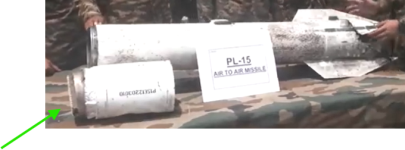

Why Pakistan-fired PL-15E missile’s debris in India is China’s worry
The remnants, while proving China’s role in the India-Pakistan conflict, open up reverse-engineering potential for New Delhi to bolster its own missile programmes
Amidst the three days of intense missile and drone exchanges between India and Pakistan, debris from a Chinese PL-15E missile, launched by a J-10C or JF-17 jet of the Pakistan air force, was found near Kamahi Devi village in Punjab’s Hoshiarpur district.
Significant portions of the missile, including its propulsion, data-link, inertial unit and advanced active electronically scanned array (AESA) seeker, were found to be intact. The debris find has drawn global attention, with the Five Eyes alliance (United States, United Kingdom, Canada, Australia and New Zealand), Japan and South Korea having requested access to study its dual-pulse motor and AESA technology. This reflects global concerns about China’s advancing military technology.
Indian defence scientists now possess this debris, leading to speculation about potential reverse-engineering to bolster India’s own beyond-visual-range missile programmes, such as the upgraded Astra missile, and to probably rule out technical glitches in its development.

Yes, seeker assembly with the antenna sheared offIs this a complete intact seeker ?
View attachment 52830
Why Pakistan-fired PL-15E missile’s debris in India is China’s worry
The remnants, while proving China’s role in the India-Pakistan conflict, open up reverse-engineering potential for New Delhi to bolster its own missile programmeswww.indiatoday.in
Amidst the three days of intense missile and drone exchanges between India and Pakistan, debris from a Chinese PL-15E missile, launched by a J-10C or JF-17 jet of the Pakistan air force, was found near Kamahi Devi village in Punjab’s Hoshiarpur district.
Significant portions of the missile, including its propulsion, data-link, inertial unit and advanced active electronically scanned array (AESA) seeker, were found to be intact. The debris find has drawn global attention, with the Five Eyes alliance (United States, United Kingdom, Canada, Australia and New Zealand), Japan and South Korea having requested access to study its dual-pulse motor and AESA technology. This reflects global concerns about China’s advancing military technology.
Indian defence scientists now possess this debris, leading to speculation about potential reverse-engineering to bolster India’s own beyond-visual-range missile programmes, such as the upgraded Astra missile, and to probably rule out technical glitches in its development.