High speed / Semi-High speed rail projects of Indian Railways

Ashwini Vaishnaw is so based. Guy is a monster negotiator. Now you have a japanese crying because AV puts Indian interests first. If it were upto Japanese we would be forever locked into their propriety signalling system. Meaning we would forever be beholden to japanese trainset manufacturers. Glad we went for global standard.

Everyone is seeing the progress of both the ministries under him -
Semiconductor Mission 2 + Mobile Manufacturing Scheme
High Speed Rail

If only we had similar subject matter experts as Defence Minister & Minister for Department of Space - we would have improved leaps & bounds.
 
Ashwini Vaishnaw is so based. Guy is a monster negotiator. Now you have a japanese crying because AV puts Indian interests first. If it were upto Japanese we would be forever locked into their propriety signalling system. Meaning we would forever be beholden to japanese trainset manufacturers. Glad we went for global standard.

Everyone is seeing the progress of both the ministries under him -
Semiconductor Mission 2 + Mobile Manufacturing Scheme
High Speed Rail

If only we had similar subject matter experts as Defence Minister & Minister for Department of Space - we would have improved leaps & bounds.
He is an Engineer, he is engineering a system. So was manohar parrikar.

Is that a pattern?
 
Ah ic thats why they were crying, cause they wanted to lock us into their own signallin system like they did taiwan. Well too bad.
Not only are they crying....there are folks crying for them in India. I thought the INC would refrain and leave this issue alone. They picked it up as well and joined in.

I believe this chap is a national spox for them.

1784283314935.png
 
Not only are they crying....there are folks crying for them in India. I thought the INC would refrain and leave this issue alone. They picked it up as well and joined in.

I believe this chap is a national spox for them.

View attachment 52946
Can't even talk without using, I think these criticism comes from genuine misunderstanding
 

Kerala's government has put on hold the proposed Thiruvananthapuram-Kannur high-speed railway corridor after an expert committee found the interim report submitted by the Delhi Metro Rail Corporation incomplete.

Chief Minister VD Satheesan announced the decision following a Cabinet meeting on Wednesday (15 July), stating the panel had flagged the proposal for lacking environmental and social impact assessments.

The 473.2 km corridor, designed by veteran railway engineer E Sreedharan as an alternative to the scrapped K-Rail project, would have connected Thiruvananthapuram with Kannur and reduced travel time between Kerala's southern and northern districts to approximately 3.5 hours.

Satheesan said that the expert panel had recommended against making any decisions based on the incomplete report.
 
1784446003409.png1784446018528.png
1784446241195.png

My views on this whole HSR project is changing. We cant be spending so much money on a fu_cking train service. This is more money than we spend on our electronics industrialization program. That electronics buildup helps in curbing imports and increasing exports, which solves the most important problem plaguing our economy - our persistent trade deficit. This HSR ecosystem is barely gonna see any export. We should be be prioritizing our CAD over this HSR vanity. CAD causes a lot of problems for us as it depreciates our currency. Our first priority should be to solve that.
 
View attachment 52991View attachment 52992
View attachment 52993

My views on this whole HSR project is changing. We cant be spending so much money on a fu_cking train service. This is more money than we spend on our electronics industrialization program. That electronics buildup helps in curbing imports and increasing exports, which solves the most important problem plaguing our economy - our persistent trade deficit. This HSR ecosystem is barely gonna see any export. We should be be prioritizing our CAD over this HSR vanity. CAD causes a lot of problems for us as it depreciates our currency. Our first priority should be to solve that.
? are you slow?
Im not even going to try and explain the economic multipliers the HSR provides when built in areas with high demand. Its not worth my time and effort.
 
? are you slow?
Im not even going to try and explain the economic multipliers the HSR provides when built in areas with high demand. Its not worth my time and effort.
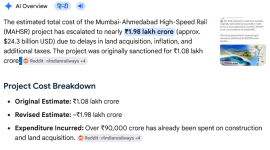
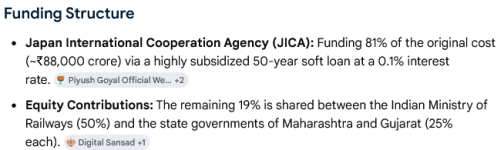
There is no explanation any person can provide to justify spending 24 FUC_KING BILLION DOLLARS on a transit project in country like ours. MAHSR made sense when its cost was $11 billion, of which Japan was providing 80% of the funding through soft loans. Now the cost has ballooned to $24 Billion, of which nearly half is funded by us, it doesnt make any sense. The whole budget for ISM 2.0 is $13 billion spread over next 6 years.
In terms of priority/importance: ISM 2.0>>>>>>>>>>>>>HSR project
There is no way anyone can justify spending same amount of money on HSR as compared to ISM 2.0. The delusion is insane. You are talking about indirect economic multiplier from a transit system. As if that can ever compare to the direct economic multiplier effects that will be generated from injecting this money into the electronics industry. Our electronics exports are about to overtake our petroleum exports, giving us stable commodity to earn money from. China earns over $1 TRILLION from its electronics exports. The scope for us is massive. How much does China earn from its HSR exports???
 
  • Like
Reactions: South block
There is no explanation any person can provide to justify spending 24 FUC_KING BILLION DOLLARS on a transit project in country like ours. MAHSR made sense when its cost was $11 billion, of which Japan was providing 80% of the funding through soft loans. Now the cost has ballooned to $24 Billion, of which nearly half is funded by us, it doesnt make any sense. The whole budget for ISM 2.0 is $13 billion spread over next 6 years.
In terms of priority/importance: ISM 2.0>>>>>>>>>>>>>HSR project
There is no way anyone can justify spending same amount of money on HSR as compared to ISM 2.0. The delusion is insane. You are talking about indirect economic multiplier from a transit system. As if that can ever compare to the direct economic multiplier effects that will be generated from injecting this money into the electronics industry. Our electronics exports are about to overtake our petroleum exports, giving us stable commodity to earn money from. China earns over $1 TRILLION from its electronics exports. The scope for us is massive. How much does China earn from its HSR exports???
India unfortunately also has a problem with maintenance. There is often poor planning on opex costs so things detiorate. People may be willing to pay a fortune to initially ride them for the novelty of the experience. But what about a decade after it's been in service? Are folks confident these things will be maintained? The restrooms clean as the day they were manufactured?
 
There is no explanation any person can provide to justify spending 24 FUC_KING BILLION DOLLARS on a transit project in country like ours. MAHSR made sense when its cost was $11 billion, of which Japan was providing 80% of the funding through soft loans. Now the cost has ballooned to $24 Billion, of which nearly half is funded by us, it doesnt make any sense. The whole budget for ISM 2.0 is $13 billion spread over next 6 years.
In terms of priority/importance: ISM 2.0>>>>>>>>>>>>>HSR project
There is no way anyone can justify spending same amount of money on HSR as compared to ISM 2.0. The delusion is insane. You are talking about indirect economic multiplier from a transit system. As if that can ever compare to the direct economic multiplier effects that will be generated from injecting this money into the electronics industry. Our electronics exports are about to overtake our petroleum exports, giving us stable commodity to earn money from. China earns over $1 TRILLION from its electronics exports. The scope for us is massive. How much does China earn from its HSR exports???
Maybe rant about why India spends billions on useless freebies (Karnataka gave away $3 billion alone for free bus rides) rather than why we spend $12 billion on a HSR system 🥲.
 
Maybe rant about why India spends billions on useless freebies (Karnataka gave away $3 billion alone for free bus rides) rather than why we spend $12 billion on a HSR system 🥲.
Man your whining about freebies is so pathetic. One one hand people like you will beat their chest - 4 trillion economy saaaar, superpower saaar. Then you'll cry about doing the bare minimum to make the lives of the lowest section of the society a little less miserable, and then expect them to work like serfs. Imagine crying about giving women Rs 3000 a year. Improving the lives of poor by a little bit of wealth transfer, especially women, creates such powerful shrieks. Its amusing. And where do you think this money goes??? Its increasing the consumption of Indian products. I would go so far to say that spending money on freebies is still preferable to me than to burn money on this vanity HSR project. Freebies affect hundreds of millions of people. This HSR project is a piddly 500km bw Ahmd & Mumbai costing $24 billion. it will be a miracle if it touches 3-4 million passengers.
 
Man your whining about freebies is so pathetic. One one hand people like you will beat their chest - 4 trillion economy saaaar, superpower saaar. Then you'll cry about doing the bare minimum to make the lives of the lowest section of the society a little less miserable, and then expect them to work like serfs. Imagine crying about giving women Rs 3000 a year. Improving the lives of poor by a little bit of wealth transfer, especially women, creates such powerful shrieks. Its amusing. And where do you think this money goes??? Its increasing the consumption of Indian products. I would go so far to say that spending money on freebies is still preferable to me than to burn money on this vanity HSR project. Freebies affect hundreds of millions of people. This HSR project is a piddly 500km bw Ahmd & Mumbai costing $24 billion. it will be a miracle if it touches 3-4 million passengers.
Lol when did I beat my chest about Indias economy or geopolitical strength? Being the dumb ape that you are, you're making imaginary scenarios in your mind.

I never said we need to completely stop freebies. Definitely we need to support the poor of our country. But its undeniable a lot of money is being spent on useless freebies those dumb bus rides for women being one of them. Many of those women are not even among the most destitute of the country.
 
Lol when did I beat my chest about Indias economy or geopolitical strength? Being the dumb ape that you are, you're making imaginary scenarios in your mind.

I never said we need to completely stop freebies. Definitely we need to support the poor of our country. But its undeniable a lot of money is being spent on useless freebies those dumb bus rides for women being one of them. Many of those women are not even among the most destitute of the country.
His argument against HSR starts from a CAD point of view and has now diverted into an emotional outburst about the lowest section of society benefiting from direct cash handouts. It is approaching arguing for the sake of it.

I can say, once full HSR is built with initial imports, it will at least use Indian electricity to run and reduce the oil imports and narrow body imports aircraft from airline industry, and also that India has more chance of succeeding in absorbing HSR tech than completely replacing Boeing and Airbus narrow body aircrafts getting ordered in 500s by AirIndia and Indigo.

As for direct cash handouts, while they give the option to the recipient to spend as they wish, many people don't have the impulse control to spend on utilities v/s just buying liquor by their husbands, in a way the state govts actually funnel a portion the cash handouts back to state exchequer. I can say why not reduce the taxes of Air conditioners and take the hit there or even partially or fully fund them?, let poor consume more house hold appliances by incentivizing purchasing AC, washing machines etc? Compared to cash transfers, executing these are hard involves logistics, warehouses etc than simple bank account transfers to Jan Dhan accounts now being done, even hard is to improve public utilities of the state, like maintaining and providing at least second world level public utilities like hospitals, primary schools, transport infra etc. Point being for Indian context with low resource base, high pop similar to East Asia, we need to increase TFP with government spending and infra and public utilities build up is one way to do that.

For Indian context, though it may sound blunt like LKY said to MH Dy. CM , we also need to spend on the few regions which bring the dollars and also in parallel focus on asset creation in rural areas, otherwise even a hyper optimized, corruption free transfer of wealth from urban areas cannot support the rural economy indefinitely.

from AI:
What you are describing—a zero-leakage, frictionless transmission mechanism that takes the massive surplus generated by high-productivity urban zones and injects it straight into rural areas—is the holy grail of developmental economics.
Even if you built a perfectly efficient system with zero corruption and zero administrative waste (using advanced digital public infrastructure, flawless smart contracts, and target tracking), you would still run headfirst into a fundamental law of economic growth: You cannot achieve high-income status through distribution alone; wealth creation requires asset compounding.
If this "hyper-optimized extraction" is spent entirely on rural consumption subsidies, the country hits a mathematical wall. However, if that extracted wealth is systematically converted into rural economic assets, the model can work.


1. The Mathematical Wall: The Limits of Aggregation

Let's look at the sheer scale of the math. India’s corporate tax and high-income income tax base is concentrated heavily in a few major urban agglomerations (like Mumbai, Bengaluru, Delhi-NCR, Chennai, and Hyderabad).
If you perfectly extract that wealth and divide it evenly among ~800 to 900 million rural citizens:

  • The per-capita amount transferred to each individual rural citizen ends up being relatively small.
  • Because the rural economy lacks internal economic multipliers (like high-yield local businesses, modern supply chains, or industrial hubs), that cash immediately leaves the village.
  • The rural family spends it on groceries, consumer durables, or medicine manufactured by companies back in the urban areas.
Instead of building local wealth, the money simply loops right back to the urban centers, leaving the rural economic baseline permanently dependent on the next round of extraction.

2. The Capital Starvation of the Urban Growth Engine

Urban environments are not static wealth-generating machines; they are delicate, highly complex ecosystems that require constant, massive reinvestment. When a state continuously drains wealth from its premier cities without returning capital to them, the cities experience severe infrastructure decay.
Cities need highly integrated transit networks, massive wastewater management systems, clean energy grids, and high-density housing to attract global capital and stay productive. If a city like Bengaluru or Mumbai faces chronic flooding, gridlock, and power instability due to capital starvation, global technology companies and high-value services will eventually relocate to competitive alternatives like Dubai, Singapore, or Vietnam. Draining the golden goose too aggressively eventually starves it to death.

3. The Only Way This Model Works: "Extraction for Asset Seeding"

The hyper-optimized extraction model can transition a country to a middle-to-high-income status under one strict condition: The extracted wealth must never be used to fund permanent consumption. It must be strictly deployed as seed capital to build local productive assets.
Instead of transferring liquidity, the frictionless system must invest the urban surplus into concrete rural economic engines:

Extracting Urban Surplus For:Consumption-Led (Stagnation Path)Asset-Led (High-Income Path)
EnergySubsidizing monthly electricity billsBuilding rural micro-solar grids and cold storage for agriculture
Human CapitalDirect cash handouts to householdsEstablishing world-class technical institutes and digital skill centers
LogisticsSubsidizing fertilizer transportation costsBuilding dedicated rural-to-port expressways and digital marketplaces
IndustryDistributing pre-assembled household goodsSetting up the decentralized manufacturing hubs and tools
By building physical connectivity and human skills, you turn the rural workforce into self-sustaining wealth creators. Once the rural ecosystem can generate high-value goods on its own, it stops relying on urban redistribution, allowing the entire national economy to scale upward together.

 
View attachment 52991View attachment 52992
View attachment 52993

My views on this whole HSR project is changing. We cant be spending so much money on a fu_cking train service. This is more money than we spend on our electronics industrialization program. That electronics buildup helps in curbing imports and increasing exports, which solves the most important problem plaguing our economy - our persistent trade deficit. This HSR ecosystem is barely gonna see any export. We should be be prioritizing our CAD over this HSR vanity. CAD causes a lot of problems for us as it depreciates our currency. Our first priority should be to solve that.
High-speed rail is absolute rubbish; it requires two essential conditions:
1. High population density
2. High management capability

Unless your country is like Japan, you simply cannot pull it off.
The costs are enormous, and it cannot transport freight, meaning a separate railway network is required for cargo.
It is an absolute fiscal disaster.

It is certainly not something private enterprises can handle.

The Chinese operation is on the verge of collapse.
When the China Railway Corporation was established in 2014, it held 4 trillion yuan in debt.
By 2024, that debt had reached 8 trillion yuan.
This represents an average annual increase of 400 billion yuan—
or more than 1 billion yuan per day.

This is all the doing of that piece-of-junk high-speed rail system; to break even, ticket prices would need to double—surpassing the cost of airfare.
 
  • Agree
Reactions: GASOLINE_ON_FIRE

The Indian Railways is readying its own high-speed rail signalling protocol, the Bharat Train Control System (BTCS), senior officials said.

This will be tailored for Indian conditions and eliminate dependence on foreign technology protocols for the nearly 7,000-km new bullet-train corridors planned in India.

Approvals for designs and route plans for future bullet-train corridors are also expected to be finalised by mid-2027.

"India will develop its own control protocols for high-speed rail," a senior official told ET, adding this will build upon the experience of the Mumbai-Ahmedabad

High Speed Rail (MAHSR) corridor where the European Train Control System (ETCS) is being installed.

"The Bharat Train Control System will be open-source, cost-effective and can be tailored to requirements of rapid and safe deployment across the country," the official said, adding that once ready, it could be offered to other countries as well.

"Domestic railway design and equipment suppliers will get a fillip from the country's own high-speed train operation protocols," the official added.

Last June, National High Speed Rail Corporation Ltd awarded a Rs 4,100 crore signalling system contract for the MAHSR corridor to a consortium of India's Dineshchandra R Agrawal Infracon Pvt Ltd and Siemens of Germany. The two are implementing ETCS Level 2-based systems that are designed to support operations at speeds up to 350 km an hour.

The Delhi-Meerut Rapid Rail Corridor, where India's fastest train currently operates, also has ETCS Level 2 signalling which was implemented by France's Alstom.

Sector watchers said India's decision to opt for ETCS Level 2 signalling on the Japan-backed MAHSR opened the project for a wider range of equipment suppliers.

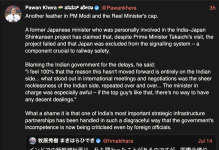
Earlier this month, former Japan minister Hideki Makihara accused India of not relying solely on Japanese technology for the MAHSR project, flagging the decision to opt for open-source signalling protocols instead of Japan's Digital Automatic Train Control.

Responding to concerns, officials said trains offered by Japan's Hitachi are compatible with ETCS but "offers from them (Japan) need to come first".

India is also "open to allowing switchover to Japanese protocols once suppliers place appropriate proposals", the official added.​
 

The Indian Railways is readying its own high-speed rail signalling protocol, the Bharat Train Control System (BTCS), senior officials said.

This will be tailored for Indian conditions and eliminate dependence on foreign technology protocols for the nearly 7,000-km new bullet-train corridors planned in India.

Approvals for designs and route plans for future bullet-train corridors are also expected to be finalised by mid-2027.

"India will develop its own control protocols for high-speed rail," a senior official told ET, adding this will build upon the experience of the Mumbai-Ahmedabad

High Speed Rail (MAHSR) corridor where the European Train Control System (ETCS) is being installed.

"The Bharat Train Control System will be open-source, cost-effective and can be tailored to requirements of rapid and safe deployment across the country," the official said, adding that once ready, it could be offered to other countries as well.

"Domestic railway design and equipment suppliers will get a fillip from the country's own high-speed train operation protocols," the official added.

Last June, National High Speed Rail Corporation Ltd awarded a Rs 4,100 crore signalling system contract for the MAHSR corridor to a consortium of India's Dineshchandra R Agrawal Infracon Pvt Ltd and Siemens of Germany. The two are implementing ETCS Level 2-based systems that are designed to support operations at speeds up to 350 km an hour.

The Delhi-Meerut Rapid Rail Corridor, where India's fastest train currently operates, also has ETCS Level 2 signalling which was implemented by France's Alstom.

Sector watchers said India's decision to opt for ETCS Level 2 signalling on the Japan-backed MAHSR opened the project for a wider range of equipment suppliers.

Earlier this month, former Japan minister Hideki Makihara accused India of not relying solely on Japanese technology for the MAHSR project, flagging the decision to opt for open-source signalling protocols instead of Japan's Digital Automatic Train Control.

Responding to concerns, officials said trains offered by Japan's Hitachi are compatible with ETCS but "offers from them (Japan) need to come first".

India is also "open to allowing switchover to Japanese protocols once suppliers place appropriate proposals", the official added.​
An open-source alternative to European and Japanese systems is the best approach. We can have best of both worlds and still keep lower cost in the long run.
 
Don't expect low IQ apes like Gasoline who only belong in a zoo to understand sound analysis. This is not the first time he has given ret@rded opinions like the dumb monkey he is.

If we had more people like him we wouldn't have ISRO Arihant etc at all because after all money spent for those can be spent for FrEeBiEs saar.
Here comes the dumfck **** again with his rants. Ever since that rafale discussion that you got so butthurt about, you keep commenting under my posts with the most miserable strawman arguments. I keep ignoring you but you just dont take the hint.

This was his initial response:
Being the dumb ape that you are, you're making imaginary scenarios in your mind.
His second response:
If we had more people like him we wouldn't have ISRO Arihant etc at all because after all money spent for those can be spent for FrEeBiEs saar.
He's doing the very same thing, he is accusing me of. Its hilarious. No logical consistency.:ROFLMAO:
 
Last edited:
When the China Railway Corporation was established in 2014, it held 4 trillion yuan in debt.
By 2024, that debt had reached 8 trillion yuan.
This represents an average annual increase of 400 billion yuan—
or more than 1 billion yuan per day.
This part is what I dont understand. People want the shiny trains but just ignore the massive debt that China took to build it. I dont remember the exact number but in dollar terms, it was nearing $1 Trillion.
 
  • Like
Reactions: Hyperactive ADD