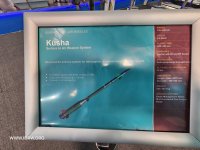
Project Kusha / Programme LRSAM / PGLRSAM

Plus, just because something has ~150 km max range doesn't mean it can't take care of targets at 100, 70 or 40 kms
Ofc I know that, but my point is can a missile with a booster shoot something down at less than 30 km,
MRSAM can do that because it's a single stage missile which gives it unmatched agility at all ranges but that wouldn't be the case with Kusha M1, thanks to it's booster it's minimum engagment range would be on the higher side (certainly more than MRSAM)


It's essentially the Barak-8 vs Kusha M1 story again. AD-1 basically does everything AAD can, but it can also do much more. So carrying AD-1 gives you more options than carrying AAD, while still being able to do everything AAD was needed for.
Money my friend, money, AAD will certainly be substantially cheaper than AD-1.
NVM it has already been tested from a ship and as such is farther along its developmental cycle
1784901784759.jpeg
 
Last edited:
Ofc I know that, but my point is can a missile with a booster shoot something down at less than 30 km,

Sure it can. If target is close, the booster is just ejected early.

MASAM can do that because it's a single stage missile which gives it unmatched agility at all ranges but that wouldn't be the case with Kusha M1, thanks to it's booster it's minimum engagment range would be on the higher side (certainly more than MRSAM)

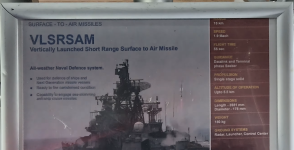
That's fine because of what I said above. Besides, VL-SRSAM has already got everything from 0.5 to about 40 or so km covered.

Most current British, French & Italian principle combatants use the Aster-15 (which has a booster) even for the point-defence role.

1000004419.jpg

Money my friend, money, AAD will certainly be substantially cheaper than AD-1.
NVM it has already been tested from a ship and as such is farther along its developmental cycle
View attachment 53168

The money argument makes sense when you have a very large fleet (60-70 destroyers) to equip, like US going for mix of SM-2 & SM-6 to save money.

But for our limited numbers (6-8 NGD at best), skimping out to save some change doesn't make the same kind of sense.

Regardless, we'll see what happens eventually.
 
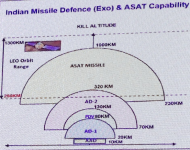
I believe the chart is from this very forum, IIRC @Fatalis made that chart


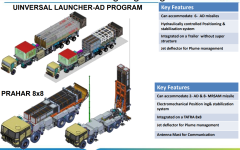
Isn't that a experimental VLS meant to be able to launch any and all type of missiles, that's why the 1m+ diameter

Most likely, but I wouldn't get my hopes high on a Naval AD-2 that thing is a monster, even at a conservative guesstimate it would be similar to pralay in size
I think P18 would carry these interceptors
• VLSRSAM (50/50)
• Barak 8 (100%)
• Kusha M1 (100%)
• Kusha M2 (100%)
• AAD (100%)
• AD-1 (50/50)
• A lightweight PDV replacement instead of AD-2 if I snort a f**k ton of hopium


Anvesh VLS is quite a bit larger than Brahmos VLS, I would say at least 50% bigger
PDV on a ship?

💀
 
1. Maybe you are right about Barak 8 (it will be a headache to integrate with LRMFR) But I don't think Navy will leave such a big gaping hole where your only choices are 15 km VLSRSAM or 150 km Kusha M1.
But who knows what will happen in the future, your argument makes sense too.

2. AAD and AD-1 are 2 completely different class of missile, I don't think they are comparable at all, if anything they complement each other.
AAD has a confirmed (by DRDO) max altitude of >25km
where as AD-1 has been repeatedly hailed as capable of both endo and low exo atmospheric interception (i.e max altitude - The Karman Line)
My guess would be a max altitude of 80 km.

AAD range - Indian Ballistic Missile Defence Programme - Updates and Discussions

3. I get the debilitating need of a Exo Atmospheric interceptor on P18 but AD-2 is most definitely not that interceptor, we will need a completely new PDV replacement.
I think a somewhat bigger THAAD / HQ-19 sized interceptor is the only real option
i.e a 500 - 600 mm diameter, 7-8 m length, IIR seeker 160 km altitude interceptor
I thought AD2 was exoatmospheric capable. Why can't we use that for P18?
 
Last edited:
AAD will certainly be substantially cheaper than AD-1.
NVM it has already been tested from a ship and as such is farther along its developmental cycle
AAD is not as effective as AD-1, it has a very small protected footprint and can only cover the lower end of separating body missiles. It'll force the ships to bunch together for overlapping coverage.

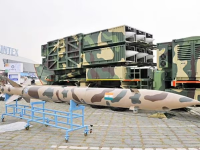
Further, it's a false assertion that AD-2 is similar in size to Pralay. It's likely based on that that launcher photo, which is btw is not of Phase-2 launchers. At the moment, there is no source of AD-2 scale (other than that Pralay photo falsely identified as AD-2)
 

Attachments

  • lusmOcr (1).png
    lusmOcr (1).png
    565.2 KB · Views: 22
I have been hearing time nd time again that Kusha will replace S-400..well this is fundamentally flawed logic... Guys are totally ignoring the actual engineering nd operational realities of how these SAM systems deploy on the ground.

First off, let's talk physics.. Kusha’s M2 nd M3 long range interceptors are quite lengthy for a SAM..measuring nearly 9.5 meters in length. When you look at the M1, M2 nd M3 variants, their lengths are completely different... Now compare that to the S-400. Whether it's the long range 40N6, the 48N6, or the smaller 9M96 interceptors, they all integrate perfectly into standard multi terrain TELs. Can we fit the vastly different lengths of Kusha's M1, M2, and M3 onto a single launch vehicle like as in the S-400 setup??


NOW, the biggest flex of the S-400 isn't just its 400km reach it’s the elite shoot nd scoot capability... where 8x8 multiterrain truck can halt.. launch a 40N6 pack up nd completely relocate within 5 minutes flat..

We literally saw this capability prove to our decisive edge in Operation Sindoor..The IAF completely shattered the PAF’s OODA loop. S-400s were taking shots and vanishing before the enemy could even track the launch point.. It left the PAF completely toothless.. They literally went missing from the battlefield, cowering in their bunkers while their most "secure" airbases got absolutely pummeled..
Imagine watching your prime assets get smoked and being too terrified to even scramble a jet..lmaoabsolutely pitiful..

So ask yourselves.. Can Kusha, with its varying interceptor lengths nd complex TEL integrations truly emulate that 5 minute off road shoot nd scoot agility of the S-400?

This is exactly why the IAF is pushing for additional S-400 squadrons.. The top brass knows the unique threat and pure deterrence the S-400 poses to our western adversary. The tactical setup is obvious..where S-400 squadrons will be forward deployed right near the border to choke the airspce while Kusha will sit in the rear providing supporting area defense...They are complementary to each other nd not replacment as few posters here are saying..
 
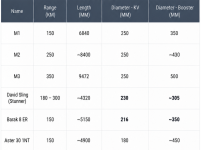
here I hv made a comparison table of Kusha's interceptors with Israeli nd European equivalents..

Note how long Kusha's interceptors are compared to israeli nd Europeans SAM.. like aster 30 nd David sling are significantly shorter, hv less diameter but are providing better range nd kinematics owing to their superior Composite propellant chemistry nd mix. IMG_20260726_091113.png
 
Numerous social media posts are comparing the system to the S-400, and similar platforms.

Modern SAMs are canisterised. A TEL carries sealed canisters, not bare missiles. Mixing canister sizes on a common launcher family is routine engineering. The S-400 itself does it (one 48N6 canister vs. four smaller 9M96 canisters per tube position), and so do Barak-8, HQ-9, and Patriot (PAC-2 vs. PAC-3 quad-packs).

Kusha's modular common core design was chosen specifically to reduce integration burden across M1/M2/M3
Even if M3 required a dedicated longer launcher...so what? The S-400's 40N6 effectively rides its own configuration too. Nothing about a 9.5 m missile prevents road mobile canister launch.

The 40N6's max intercept altitude and its dependence on the 91N6/92N6 radar chain means the radar and command post, not the TEL, are the real signature and the real vulnerability. A launcher relocating in 5 minutes achieves little if the big engagement radar which cannot relocate that fast....this why it gets targeted. Ukraine's repeated destruction of S 400 batteries in Ru-Uk war by ATACMS demonstrated exactly this weakness in the system's survivability model.

Also, I would add another aspect that has been ignored when it comes to certain claims that have been made repeatedly.

The 400 km figure applies only to the 40N6 against large, high-altitude, non-manoeuvring targets. Against low-flying aircraft, cruise missiles, and drones, engagement range collapses to the radar horizon...roughly 30 to 40 km for a ground-based radar regardless of the missile's paper range. So the 400 km grip or preventive range framing is marketing.

S-400 is a good ADS and has been combat tested by the forces. However, there is no need for repeated debates that revolve around a media headline that claim "replacement". Avoid this and you'll be helping yourselves.
 
Last edited:
here I hv made a comparison table of Kusha's interceptors with Israeli nd European equivalents..

Note how long Kusha's interceptors are compared to israeli nd Europeans SAM.. like aster 30 nd David sling are significantly shorter, hv less diameter but are providing better range nd kinematics owing to their superior Composite propellant chemistry nd mix. View attachment 53201
Apart from DAVID SLING , all other foreign SAMs are in proportional to their range similar to KUSHA.
 
Scientists associated with the classified programme say Kusha has been designed not merely to complement existing foreign-origin systems but eventually replace them as India’s primary long-range air defence architecture.

“Kusha features a three-tier interceptor architecture comprising M1, M2 and M3 missiles built around a common kill booster vehicle. The system is customised to meet the operational requirements of the Indian Air Force and the Indian Navy,”

“Everything is indigenous, including seekers, actuators and computing systems that earlier had to be imported,” the scientist said.

During the maiden flight trial conducted on July 23 from Dr A.P.J. Abdul Kalam Island off the Odisha coast, the M1 interceptor successfully destroyed an electronic aerial target. Although the planned engagement distance was 120 km, the interceptor achieved a successful kill beyond 142 km, validating the system’s performance envelope.

Unlike imported systems, Kusha has been designed around indigenous seekers, command-and-control software and mission computers, allowing future upgrades to be carried out entirely within the country. Defence scientists also point to its modern Gallium Nitride (GaN)-based Active Electronically Scanned Array (AESA) radar architecture and dual active radio frequency and imaging infrared seekers on longer-range interceptors, which are expected to improve performance against stealth aircraft, electronic jamming and complex aerial threats.

The Indian Air Force is expected to induct the system in phases between 2028 and 2030, making Project Kusha one of the country’s most significant indigenous air defence programmes after the Ballistic Missile Defence initiative.
 
1 ) I read on other forum @South block talking about speed 778m/s for total time of 200-450 s for 350km range.
Here the the term speed is wrong, the term is velocity, the direction parameter influences it. Missile going after a target will not follow straight path.

2 ) please take note that 350km range is a displacement (straight path) not distance. The missile follows distance(every curve it takes) not displacement while chasing a target.

3) to know the total speed you also have to take account of acceleration. Newtons second law.
d = vt + 0.5at²

4) since it is a rocket hence mass will reduce every second thus acceleration will increase


hence you can't get accurate on 778m/s.
 
1 ) I read on other forum @South block talking about speed 778m/s for total time of 200-450 s for 350km range.
Here the the term speed is wrong, the term is velocity, the direction parameter influences it. Missile going after a target will not follow straight path.

2 ) please take note that 350km range is a displacement (straight path) not distance. The missile follows distance(every curve it takes) not displacement while chasing a target.

3) to know the total speed you also have to take account of acceleration. Newtons second law.
d = vt + 0.5at²

4) since it is a rocket hence mass will reduce every second thus acceleration will increase


hence you can't get accurate on 778m/s.

20260203_072102 (1).jpg

You're making an assumption that the brochure's 350 km is purely displacement while simultaneously assuming you know the missile's actual flight path. The brochure doesn't provide the trajectory profile, loft angle, guidance law or total path length. It simply states engagement range is 350 km & flight time is 200–450 s.

Without the actual trajectory, neither you nor I can derive the true average flight speed. But the only published quantities available are engagement range & flight time, making a first order estimate the only defensible comparison. If you reject that estimate because the trajectory is curved, then you also need to provide the actual path length not just state that it's longer....Similar argument can also be applied to 48N6E & 40N6E Interceptors as well. They also flies in lofted trajectories with mid course guidance & terminal manoeuvres. Unless you have trajectory data for both missiles, claiming Kusha's average flight speed is substantially higher is pure speculation. You're replacing one published number with an unknown & then treating that unknown as evidence.
 
  • Like
Reactions: screambowl
You're making an assumption that the brochure's 350 km is purely displacement

Even if you consider it as a distance below point will clarify why the speed won't limit to just 750m/s.

The brochure doesn't provide the trajectory profile, loft angle, guidance law or total path length. It simply states engagement range is 350 km & flight time is 200–450 s.

In 99.999% cases the acceleration will increase as the missile fuel burns (delta M) which will further add to the velocity. F=Ma, acceleration is inversely proportional to the mass.

Without the actual trajectory, neither you nor I can derive the true average flight speed.

Whatever the trajectory is the acceleration will increase, except for very high G turns against the gravity that too for maximum 1-2 seconds in the terminal phase. Because you are reducing the mass per second.
 
  • Like
Reactions: Aniruddha
Sure it can. If target is close, the booster is just ejected early.
1. you can't just eject a burning booster (there's nothing called ejecting a booster early, its always ejected at the 1st possible chance anyways)
2. Kusha's booster fins suggest them being there for stability not maneuverability, and with the tvc alone you can not achieve the required maneuverability to shoot close range targets with such a big *censored* 6.8m long 650 kg missile
3. kusha won't be very maneuverabe in sub 40 km range if it follows a horizontal path with no high ascent phase and relies on its booster TVC (as explained above) and if it follows a vertical path with a high ascent phase it will still bleed quite a bit of horizontal range and in the end will miss quite a bit of sub 40 km area
4. As such unlike Kusha with its Moveable fins + TVC MRSAM would be more agile in this sub 40 km range
5. Can kusha M1 work in sub 40 km range absolutely, but will it be able to protect you from a supersonic AShM at those ranges absolutely not, you will need a MRSAM for that
Besides, VL-SRSAM has already got everything from 0.5 to about 40 or so km covered.
no, it will not it has a max range of 15 km and a fligh ceiling of 6 km
1785442316393.png

Most current British, French & Italian principle combatants use the Aster-15 (which has a booster) even for the point-defence role.
they use aster 15 along with Aster 30, they don't replace Aster 15 with Aster 30 and ask Aster 30 to take over its role, as you were suggesting with MRSAM and Kusha M1

As for the Aster 15 being used in point defence even though it has a booster, may I remind you Aster 15 is tiny at 4.2 m and is very lightweight, as such it can maneuver eaisly even with the booster thanks to the TVC not at all similar to 6.8m long 650 kg Kusha M1

The money argument makes sense when you have a very large fleet (60-70 destroyers) to equip, like US going for mix of SM-2 & SM-6 to save money.

But for our limited numbers (6-8 NGD at best), skimping out to save some change doesn't make the same kind of sense.
i would have agreed with you here if not for the fact that our armed forces and MoD baboons are absolute penny pinchers
But like you said we'll see what happens eventually.

PDV on a ship?
not PDV, I said PDV NG a replacement for PDV offering similar capabilities to PDV in a reduced footprint similar to THAAD or HQ 19 which can be deployed on a ship.
Also did you forgot the F**k ton of hopium that was recommended beforehand

I thought AD2 was exoatmospheric capable. Why can't we use that for P18?
because according to my guesstimate it is going to be huge (somewhat similar in size to Pralay)
 
AAD is not as effective as AD-1, it has a very small protected footprint and can only cover the lower end of separating body missiles. It'll force the ships to bunch together for overlapping coverage.
And Aster 15 is not as effective as Aster 30, doesn't mean you are going to just ditch Aster 15 and go all in on Aster 30
Raw capability is not the sole metric in determining what weapon will be fielded

Further, it's a false assertion that AD-2 is similar in size to Pralay. It's likely based on that that launcher photo, which is btw is not of Phase-2 launchers. At the moment, there is no source of AD-2 scale (other than that Pralay photo falsely identified as AD-2)
Did Bramha tell you how I made my assestion
the distinct pattern at the VLS magazine being very similar AAD's VLS magziene along side an old video of PDV launch from a 2 VLS truck similar to the one in the photo made it pretty clear to anyone that the launcher in your photo are for AAD and PDV not AD-1 and AD-2 so next time don't go all gung ho guessing what the other guy was thinking

As for my reasons for the assertion
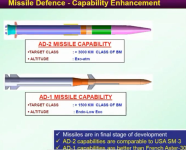
1. We know AD-1 is capable of intercepting targets upto 80-100 km high, (i.e Endo and Low Exo Atmospheric)
2. We also know AD-1 is 8.6m tall and 560mm thick (i.e its quite big)
3. we also know AD-2 is targeting performence equivalent to SM-3 from these unknown origin images (which have so far proven to be correct) so 300 km+ altitude (i.e a 3x jump in range and altitude from AD-1)
4. So unless we have somehow managed to reverse engineer the formulas for SRM of SM-3 we will have to base our missile dimensions assumption on the energy density of SRM of similar missiles made by DRDO (in this case AD-01)
as such reaching 300 km+ altitude on anything smaller than the size of Pralay (i.e 9-10m long 750mm diameter) seems unlikely
 

Attachments

  • 1785446835561.png
    1785446835561.png
    881.9 KB · Views: 8
  • 1785446922574.png
    1785446922574.png
    406.3 KB · Views: 6
  • 1785447558332.png
    1785447558332.png
    1.1 MB · Views: 6
Last edited:
  • Like
Reactions: Aniruddha
If wr wa
1. you can't just eject a burning booster (there's nothing called ejecting a booster early, its always ejected at the 1st possible chance anyways)
2. Kusha's booster fins suggest them being there for stability not maneuverability, and with the tvc alone you can not achieve the required maneuverability to shoot close range targets with such a big *censored* 6.8m long 650 kg missile
3. kusha won't be very maneuverabe in sub 40 km range if it follows a horizontal path with no high ascent phase and relies on its booster TVC (as explained above) and if it follows a vertical path with a high ascent phase it will still bleed quite a bit of horizontal range and in the end will miss quite a bit of sub 40 km area
4. As such unlike Kusha with its Moveable fins + TVC MRSAM would be more agile in this sub 40 km range
5. Can kusha M1 work in sub 40 km range absolutely, but will it be able to protect you from a supersonic AShM at those ranges absolutely not, you will need a MRSAM for that

no, it will not it has a max range of 15 km and a fligh ceiling of 6 km
View attachment 53264


they use aster 15 along with Aster 30, they don't replace Aster 15 with Aster 30 and ask Aster 30 to take over its role, as you were suggesting with MRSAM and Kusha M1

As for the Aster 15 being used in point defence even though it has a booster, may I remind you Aster 15 is tiny at 4.2 m and is very lightweight, as such it can maneuver eaisly even with the booster thanks to the TVC not at all similar to 6.8m long 650 kg Kusha M1


i would have agreed with you here if not for the fact that our armed forces and MoD baboons are absolute penny pinchers
But like you said we'll see what happens eventually.


not PDV, I said PDV NG a replacement for PDV offering similar capabilities to PDV in a reduced footprint similar to THAAD or HQ 19 which can be deployed on a ship.
Also did you forgot the F**k ton of hopium that was recommended beforehand


because according to my guesstimate it is going to be huge (somewhat similar in size to Pralay)

If we want to match THAAD or HQ19 on a ship wouldn't a navalized AD2 be enough.