India-Brazil Defence Swap Deal

spice

Senior member
Oct 18, 2025
697
2,525
Earth

C-390 Millennium aircraft, Akash missiles, and Tejas fighter jets are key assets for an unprecedented agreement between Brazil and India.​


The Brazilian vice president, the defense minister, and the commander of the FAB are negotiating with Indian officials a compensation and technology transfer package.

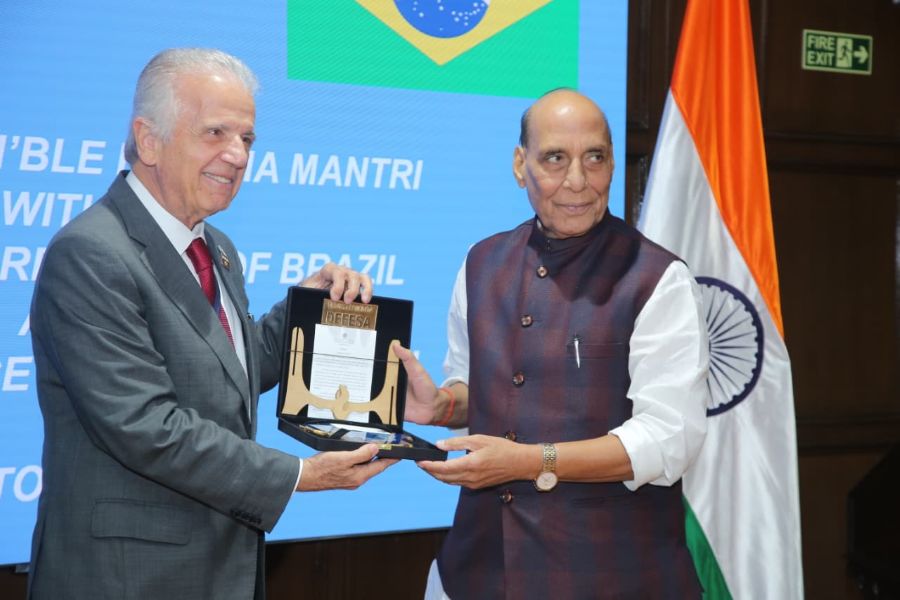
On a high-level government mission, Brazilian Vice President Geraldo Alckmin, accompanied by Defense Minister José Múcio Monteiro Filho, and the Commander of the Brazilian Air Force, Brigadier Marcelo Kanitz Damasceno, are making an official visit to New Delhi (October 15-17) to strengthen bilateral relations between the countries, particularly in the defense sector.

The Brazilian delegation was received by Indian Defense Minister Rajnath Singh to exchange ideas on domestic weapons systems and platforms, in what would mark a new phase of technological, industrial, and strategic cooperation between the two member nations of the BRICS, G20, and IBAS.

According to Vice President Alckmin, the partnership is essential for the diversification and strengthening of both countries' defense industries, reducing external dependencies and expanding national innovation and production capabilities. Cooperation between Brazil and India is not only commercial; it is strategic. "We are building a path that unites technology, defense, and sustainability, strengthening our industries and the autonomy of our people," Alckmin said in New Delhi.

Several Brazilian and Indian defense products are driving the negotiations, including Embraer's C-390 Millennium multi-mission military freighter, the Indian Akash surface-to-air missile system, and the LCA Tejas MK1A light combat fighter.

Embraer is actively promoting discussions for the sale and possible local co-production of the C-390 Millennium, including in talks with Mahindra Defense Systems, a component of the Make in India initiative.

The Indian Air Force has expressed initial interest in up to 80 units of the aircraft, designed for logistics transport, in-flight refueling, and aeromedical evacuation, among other roles. Technology transfer and local production are part of the negotiations, aligned with India's strategy to boost domestic industry.

The Akash system, developed by the Indian air defense agency DRDO, represents a medium-altitude air defense solution, notable for its effective range of up to 30 km and its ability to engage multiple targets simultaneously. It is worth noting that Brazil is currently evaluating it to strengthen its integrated air defense system, with the possibility of acquiring the Akash-NG version (still under development), which features advanced radar technology and the ability to intercept modern threats such as drones and cruise missiles.

The Tejas MK1A fighter, the latest version of the Indian project, features a modern AESA radar design, uses an engine similar to that of Brazil's Gripen fighter, and can be armed with new air-to-air missiles such as the BVR Astra from Bharat Dynamics Limited. Furthermore, the aircraft is designed for low acquisition and maintenance costs per flight hour, offers supersonic performance, and allows safe operational progression for pilots who can advance to the SAAB Gripen E/F.

There are doubts about which version of the Akash would be offered to Brazil, which prefers the more recent NG. Signature: DRDO

India also showcased complementary technologies, such as airborne airborne warning and control (AEW&C) systems using the Embraer EMB-145 platform, WHAP armored vehicles, advanced torpedoes, and electronic warfare sensors, illustrating the technological breadth of cooperation.

The visit also strengthens joint training, interoperability, and maintenance programs. Officials from the Brazilian and Indian navies discussed cooperation in the maintenance of the French Scorpène submarines, which equip Brazilian and Indian navies, and discussed the exchange of naval and anti-submarine warfare strategies.

With President Luis Inácio Lula da Silva's official visit to India approaching, scheduled for early 2026, this mission is intended to prepare for and consolidate the strategic plan to expand bilateral trade to $20 billion by 2030, supported by policies such as the expansion of the Mercosur-India Preferential Trade Agreement.

In his remarks, Minister Rajnath Singh emphasized that India sees Brazil as a reliable partner for the joint production and development of defense systems, and highlighted the importance of technological equity and cooperation in addressing global security and innovation challenges.

In this context, Brazil-India cooperation symbolizes the joint action of the largest democracies in the Global South, seeking to build an alternative technological and strategic development axis that unites Brazilian and Indian industrial capabilities to respond to the demands of the 21st century.

The Tejas, in addition to being supersonic, can be navalized, something that interests the Brazilian Navy to replace its aging A-4K/KU. Signature: Indian Ministry of Defense
 
Negotiations have been going on for an year now at least. An Indian delegation had visited Brazil last year in December. Although, at that deal only consisted of direct swap between Tejas and C-390. The other systems being discussed is a new development. A report by the same author last year. Click on the traducir button on top left and select english for translation. He mentions Tejas mk2, but its a confusion from his side

Here is Brazil's ambassador to India giving hints on the barter deal. Watch for 1 minute and 30 seconds, from the 13th Minute of the video

 
  • Like
  • Informative
Reactions: Gautam and Shan
So now Bharatshakti quotes Brazil's VP saying its not a swap deal. But interest in the systems mentioned above is still there.

Ultimately, it could all just be part of a marketing blitz to push C-390 (good product, no doubt)
Afaik, Brazil has already bought CAMM/ Sea Ceptor for its navy. More than likely, they will acquire the GBAD version and call it a day.

The French are making similar noises about buying Pinaka (which is being readily lapped up by Indian media). However, MBDA and others already working on a local solution to meet French requirements as per this report from Jane's.


Main issue according to me, is Brazil's ability to pay up. It could lead to bad optics and used for propaganda against Indian systems. From what I have read successive governments have essentially neutered the Brazilian armed forces, especially the air force.

At one point Brazil was suppose to buy 108 Gripen's, which later lowered to 66 and then finally to current 36. Even then, they had difficulties paying up for the aircrafts. 15-20 of which are to be manufactured in Brazil.

From the same author:-

Budgetary unpredictability: Brazil spends more than 13% above the initial value of the Gripen contract​


Due to contract delays, the South American giant paid the equivalent of six more Gripen fighters that it will not receive.

check the timelines in the image programa F-X2

Same issue during their own procurement of C-390, they had originally planned to procure 28 C-390's which were then reduced to 19. See the image in the article. Currently their own deliveries are expected to over 2034. Delay resulting in value equivalent to two C-390s, which they will not get.

Recently after BRICS summit few months ago, they shut down half or even most of their airforce till december 2025.

Image in the article says 40 aircraft grounded till december 2025.

Here is their airforce fighters according to wikipedia currently:-
10 Gripen
42 F-5's + 4 used as trainers
24 A1M's
68 A-29's

From what I read on one other Brazilian defense website. Comments by the users suggest the actual operational numbers of F-5 is 11 and 7-8 for A1M

The value of land based CAMM contract is 1 billion dollars. I would be surprised if they go ahead with it.

The VP said there is no precedence on the barter deal, but he is wrong.

On 9 November 2024, the Brazilian Minister of Defence José Múcio signed a letter of intent, to increase the contract with Saab by 25%, increasing to 45 Gripens for the FAB. In exchange, the Swedish Air Force announced the selection and the beginning of negotiations to procure the Embraer C-390 Millenium airlifter. (Sweden bought 4 C-390's recently)

On 16 September 2025, the FAB commander Marcelo Kanitz Damasceno and the Swedish Minister of Defence Pål Jonson announced negotiations for six more Gripen E and a batch of 12 second-hand C/Ds aircraft of the Swedish Air Force inventory.
 
  • Informative
Reactions: YoungWolf

India and Brazil are accelerating their strategic defence cooperation, with both nations actively exploring co-development, joint production, and industrial partnerships across multiple military platforms. The recent high-level engagements, including the 6th Strategic Dialogue and the 8th Joint Defence Committee Meeting in 2025, have set the stage for a broader collaboration in air defence, artillery, naval systems, and aerospace.

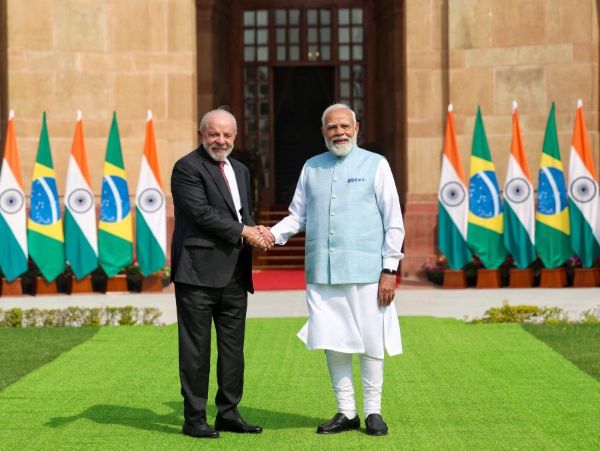
Prime Minister Narendra Modi and President Luiz Inácio Lula da Silva highlighted the “significant growth in bilateral strategic interactions” and reiterated their commitment to fostering defence cooperation. Both leaders encouraged industries in India and Brazil to fast-track collaboration, creating mutually beneficial partnerships that strengthen local defence ecosystems.

Brazil Considers Akash Missile for Air Defence

Brazil is actively evaluating India’s Akash surface-to-air missile system as part of its Medium/High Altitude Air Defence Artillery program. Developed by the Defence Research and Development Organisation (DRDO) and produced by Bharat Dynamics Limited and Bharat Electronics Limited, Akash offers medium-range aerial defence capabilities far exceeding Brazil’s current systems, which intercept threats only up to 3,000 meters.

“The system is under evaluation,” a senior diplomatic source told BharatShakti, confirming India’s engagement following Brazil’s Request for Information. High-ranking Brazilian Army officials are reportedly advocating a government-to-government acquisition, underlining the strategic priority of modernising Brazil’s air defence.

Garuda 105 V2: Lightweight Artillery for Rapid Deployment

Brazil has also expressed interest in the Garuda 105 V2, an ultra-lightweight, mobile artillery system developed by Kalyani Strategic Systems, part of Bharat Forge. Designed for high mobility and rapid deployment, the Garuda’s modular design and digital fire control make it suitable for expeditionary operations and jungle warfare, capabilities aligned with Brazil’s operational needs in the Amazon region.

Naval Cooperation and Offshore Patrol Vessels

Naval collaboration remains a key pillar of the partnership. Brazil, a member of the “Scorpène Club” of nations operating French-designed Scorpène-class submarines, has inked a trilateral agreement with Mumbai-based Mazagaon Dock Ltd for joint maintenance and operational expertise with India.

Secretary East P. Kumaran said that the two sides have a trilateral MoU between MDL and both navies “for the maintenance of Scorpène-class submarines and other military ships.”

Brazil is also evaluating Offshore Patrol Vessels (OPVs) from India, alongside expertise in coastal surveillance and battlefield communications. Top diplomats confirmed that “shipbuilding is an area where Brazil has expressed interest in working together in jointly building warships and learning best practices”.

Industrial Partnerships: Embraer, CBC, Taurus, and Beyond


The defence-industrial collaboration extends to aerospace and small arms manufacturing. Brazilian companies Taurus Armas S.A. and Companhia Brasileira de Cartuchos (CBC) have already established joint ventures in India. Bengaluru-based SSS Defence partnered with CBC Global Ammunition, while Jindal Defence signed a JV with Taurus Armas for production within India.

“Maybe down the line, some more joint ventures are expected to come up either in Brazil or in India, because both countries are keen on ensuring that the platforms or other military stores should be made locally,” said sources familiar with the talks.

C-390 Millennium


Under a separate collaboration, Embraer and Mahindra Group are working to establish Maintenance, Repair, and Overhaul (MRO) capabilities for the C-390 Millennium transport aircraft. The facility aims to provide full-spectrum support, including base and heavy maintenance, avionics, structural inspections, and pilot training, strengthening India’s operational autonomy.

“A state-of-the-art C-390 Millennium MRO capability in India would ensure high aircraft availability, enhanced operational autonomy and a comprehensive local sustainment solution,” said Vinod Sahay, Member of the Group Executive Board, Mahindra Group.

PS Akash has already been eliminated, according to one Brazilian outlet. Link to my post for the same.