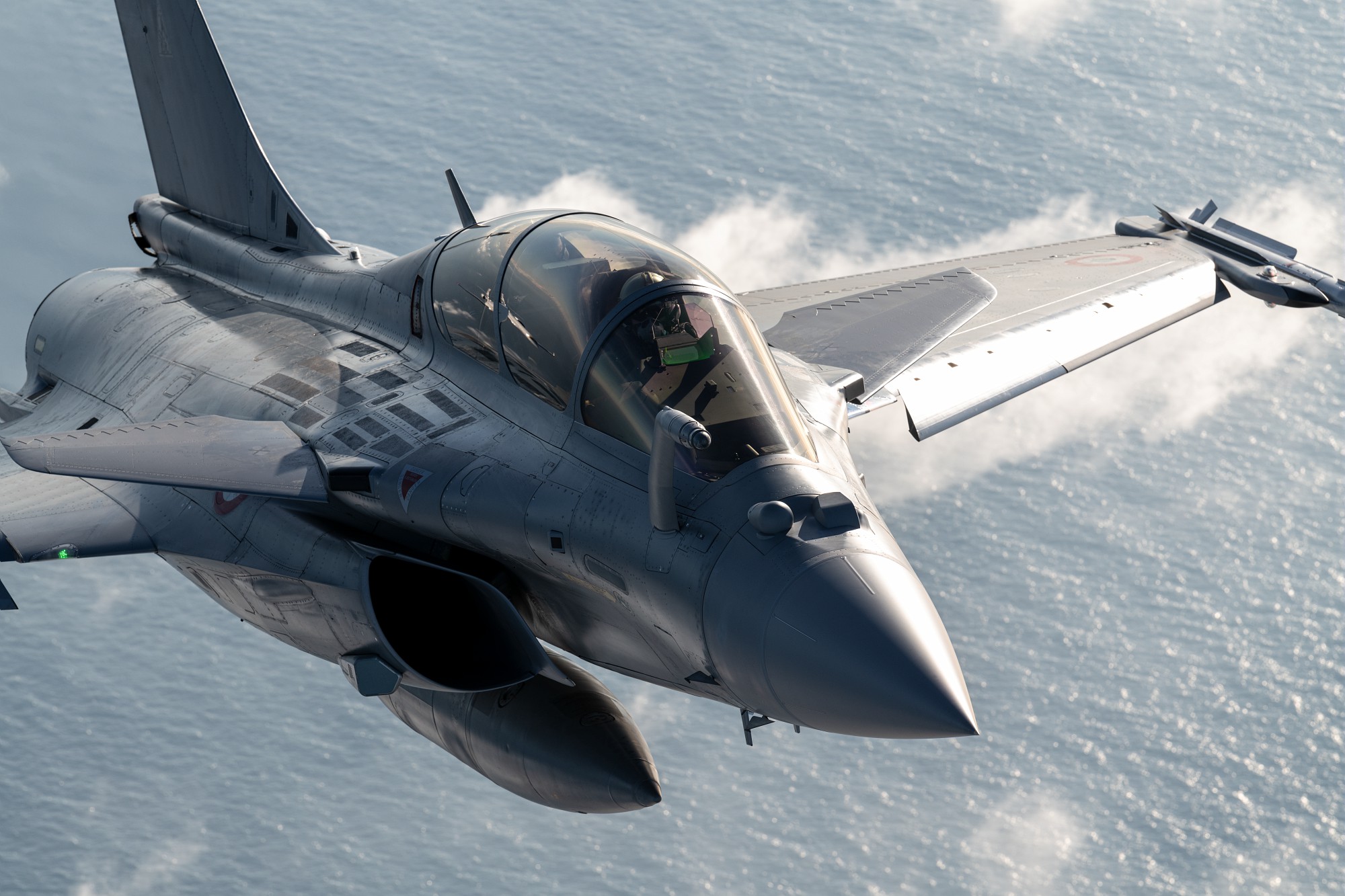
Dassault Rafale - Updates and Discussion

An F-15C Eagle fighter from the USAF's 85th Test and Evaluation Squadron (85th TES) carried out the first fire of an AIM-120 AMRAAM missile guided by the infrared search and track system (IRST), successfully shooting down a QF- 16. The event took place on the 05th of August.

frenchies are 5 years late but hey better late thn never, oui?
You are partially wrong.
This fire was made with a MICA NG.
But another same kind of fire, with a legacy MICA, was made in 2007 using another Rafale radar.

Where is the IRST in a serially produce F15C ? How many F15 are in this config now ?
(in fact just a trial)
 
  • Agree
Reactions: Amarante
Lock on after launch missiles cued by IRST or HMS, have been around for a while now, but it's good to see France entering the tech
Have they got a date on the new radar, the last I heard it was going to be pushed out to 2035, that should improve things
A MICA fired by a Rafale on a target in its 180° hit his target in 2007. But the target was designated by another Rafale.
(nearly 20 yars ago.... you are late Bro)
 
  • Like
Reactions: Amarante
Rafale has the ability to guide MICA without radar emission with its Front Sector Optronics (FSO). IRST alone cannot generate fire control solution as they cannot measure distance. French cleverly introduced a laser range finder in Rafale's FSO. So FSO is actually more than simple IRST present on other 4th gen aircrafts. Which enables it to generate fire control system solution upto 40km (maximum range of the laser range finder) this is barely BVR.

What USAF has for sometime is gen next stuff.

IRST Legion POD feature world class sensor and more importantly advanced data link that enables it to connect with other legion pod flown in the formation. So it is actually able to triangulate target's precise 3D location by collaborating with other legion pods and generate passive fire control data. More importantly, not limited by any laser range finder. And able to provide weapon quality track at 50nm in optimal condition. USN super Hornets also has similar capability.


French might introduce this capability with Rafale F 4.3 iteration as well as true collaborative engagement as they planned enhanced sensor fusion and an indigenous intra-flight high bandwidth secure data link. Then you might see two IRST sensors on two Rafale working in similar fashion and not limited by laser range finder.

However, with existing Link 16, Rafale is not there yet.
 
Last edited:
You are partially wrong.
This fire was made with a MICA NG.
But another same kind of fire, with a legacy MICA, was made in 2007 using another Rafale radar.

Where is the IRST in a serially produce F15C ? How many F15 are in this config now ?
(in fact just a trial)
Legion is a plug and pay all F-15's have legion capability and right now only 40 legion exist so 40 F-15's can be deployed with legion. Btw F-35 has this capability.
 
  • Informative
Reactions: Bon Plan
September 1, 2026

What if Egypt ordered another 24 Rafales?​


Cairo could order an additional 24 Rafales from Dassault Aviation. Egypt would then possess a fleet of nearly 80 French fighter jets.

After a quiet period due to financial difficulties, Egypt appears to intend to resume its arms procurement. According to our information, the country recently sent a Request for Proposal (RFP)—a call for proposals in both technical and commercial terms—to France, specifically to Dassault Aviation, for the purchase of 24 additional Rafales. Contacted by *La Tribune*, the aircraft manufacturer declined to comment. By the end of 2026, Cairo will have a fleet of 54 active fighter jets delivered by Dassault Aviation—aircraft ordered in two batches (24 in February 2015 and 31 in May 2021). In total, should it confirm its interest, the Egyptian Air Force would possess a fleet of nearly 80 Rafales (78).

The second edition of the El Alamein International Air Show, taking place from September 8 to 10, 2026, at El Alamein International Airport, could offer clues regarding Cairo's willingness to rapidly modernize its active fleet—currently estimated at over 200 F-16s out of the 240 originally ordered. Some airframes are aging, particularly those delivered between 1982 and 1985 (42 F-16 Block 15s), as well as those delivered between 1986 and 1988 (40 F-16 Block 32s) and between 1991 and 1995 (47 F-16 Block 40s). Egypt represents significant potential for Dassault Aviation, as a portion of this fleet will need to be replaced.

Chinese disinformation campaign

Regardless of the outcome, this RFP is very good news for two key reasons. Egypt might once again place its trust in Dassault Aviation to renew part of its combat aircraft fleet. Above all, the Chinese disinformation campaign regarding the Rafale’s capabilities versus the J-16—launched following the second "Eagles of Civilization 2026" Sino-Egyptian exercise held in August—clearly failed to sway the Egyptians. This disinformation campaign supports a Chinese sales push in the combat aviation sector that has been underway in Egypt for several months... (paywall)
 
A MICA fired by a Rafale on a target in its 180° hit his target in 2007. But the target was designated by another Rafale.
(nearly 20 yars ago.... you are late Bro)
That isn't LOAL, but the new mica ng is LOAL, Why you guys need to BS is beyond me

Same with the Radar, the new one has been pushed to 2035
"The Thales Group RBE2-XG is a next-generation Gallium Nitride (GaN) Active Electronically Scanned Array (AESA) radar scheduled to equip the Dassault Aviation Rafale F5 standard around 2035."
 
Last edited:
Same with the Radar, the new one has been pushed to 2035
"The Thales Group RBE2-XG is a next-generation Gallium Nitride (GaN) Active Electronically Scanned Array (AESA) radar scheduled to equip the Dassault Aviation Rafale F5 standard around 2035."
First air trial of this new radar expected in 2028.
first delivery of Rafale F5 is planned in 2032, with this new radar, so as to fine tune the tactics.
2035 is for export.
 
Rafale has the ability to guide MICA without radar emission with its Front Sector Optronics (FSO). IRST alone cannot generate fire control solution as they cannot measure distance. French cleverly introduced a laser range finder in Rafale's FSO. So FSO is actually more than simple IRST present on other 4th gen aircrafts. Which enables it to generate fire control system solution upto 40km (maximum range of the laser range finder) this is barely BVR.

What USAF has for sometime is gen next stuff.

IRST Legion POD feature world class sensor and more importantly advanced data link that enables it to connect with other legion pod flown in the formation. So it is actually able to triangulate target's precise 3D location by collaborating with other legion pods and generate passive fire control data. More importantly, not limited by any laser range finder. And able to provide weapon quality track at 50nm in optimal condition. USN super Hornets also has similar capability.


French might introduce this capability with Rafale F 4.3 iteration as well as true collaborative engagement as they planned enhanced sensor fusion and an indigenous intra-flight high bandwidth secure data link. Then you might see two IRST sensors on two Rafale working in similar fashion and not limited by laser range finder.

However, with existing Link 16, Rafale is not there yet.

nothing hitech here triangulate an airborne target like Legion Pod.”
Rafale had passive 3D localization capability before F4. Dassault documentation from the F3R-era already lists “Passive 3D localization” as part of Rafale’s collaborative air-dominance capability, and the underlying DGA R&D program dates back to 2011the work started from early 2000s

So F4/TRAGEDAC isn't the introduction of the basic concept; it appears to be a more advanced implementation of an existing collaborative passive-localization capability, with improved networking and the new-generation OSF-IRST..
 
.
nothing hitech here triangulate an airborne target like Legion Pod.”
Rafale had passive 3D localization capability before F4. Dassault documentation from the F3R-era already lists “Passive 3D localization” as part of Rafale’s collaborative air-dominance capability, and the underlying DGA R&D program dates back to 2011the work started from early 2000s

So F4/TRAGEDAC isn't the introduction of the basic concept; it appears to be a more advanced implementation of an existing collaborative passive-localization capability, with improved networking and the new-generation OSF-IRST..

Strawmanning is waste of everyone's time.

I literally said Rafale can guide MICA using its FSO passively. Which requires 3D localisation. However it is limited by the range of laser range finder.

Also, Spectra might achieve 3D localisation. But that is dependent on other side continuesly emitting.

What is old here is link 16. It does not operate in real time. simply doesn't have enough bandwidth to handle collaborative sensor fusion driven fire control in real time.

What is next gen for USAF is CEC real time data links.

Rafale isn't getting intra-flight real time high bandwidth data link until F4.3/2027
 
  • Like
Reactions: Photon Vish
nothing hitech here triangulate an airborne target like Legion Pod.”
Rafale had passive 3D localization capability before F4. Dassault documentation from the F3R-era already lists “Passive 3D localization” as part of Rafale’s collaborative air-dominance capability, and the underlying DGA R&D program dates back to 2011the work started from early 2000s

So F4/TRAGEDAC isn't the introduction of the basic concept; it appears to be a more advanced implementation of an existing collaborative passive-localization capability, with improved networking and the new-generation OSF-IRST..
Yes, F3R performs passive localisation using track triangulation. Tragedac, which is implemented in F4, performs triangulation of measurements and must therefore utilise F4’s new connectivity. Triangulation of measurements amounts to creating distributed sensors (i.e. spread across several aircraft); this is a step towards multistatic radar, for example, where there will be a single transmitter and several receivers...
 
Do you want to make a list of aircraft that triangulate a target? It will be a long one

'Multistatic', you mean what others including the F-35 are doing now? Try to look outside of your bubble

"Multistatic systems use multiple radar transmitters and receivers separated by significant distances (often miles) rather than a single combined unit (monostatic radar). This distributed network architecture is a key component of modern electronic warfare and radar design, deeply relevant to advanced platforms like the F-35 Lightning II.

The concept of one F-35 transmitting radar signals while other F-35s passively receive is a real tactical capability known as bistatic or multistatic radar operation, enabled by the aircraft's advanced sensor fusion and data link architecture. [1]

How Distributed Aperture and Fusion Work
    • Active Transmission (LPI Radar): An F-35 uses its AN/APG-81 (or future AN/APG-85) AESA (Active Electronically Scanned Array) radar in a Low Probability of Intercept (LPI) mode. It emits tightly controlled, rapidly frequency-hopping signals to illuminate a target without easily alerting the enemy that they are being tracked. [1, 2, 3]
    • Passive Reception: Neighboring F-35s in the formation maintain radio silence or keep their own radars quiet. Instead, they use their sensitive receivers—including electronic support measures and communication nodes—to listen for the reflections bouncing off targets illuminated by the transmitting jet. [1, 2]
What isn't being said is that these radar signals are security encoded
 
Last edited:
Do you want to make a list of aircraft that triangulate a target? It will be a long one
and who disagreed here pal every one know a lot can do
as i said nothing high tech here just improvement

.


Strawmanning is waste of everyone's time.

I literally said Rafale can guide MICA using its FSO passively. Which requires 3D localisation. However it is limited by the range of laser range finder.

Also, Spectra might achieve 3D localisation. But that is dependent on other side continuesly emitting.

What is old here is link 16. It does not operate in real time. simply doesn't have enough bandwidth to handle collaborative sensor fusion driven fire control in real time.

What is next gen for USAF is CEC real time data links.

Rafale isn't getting intra-flight real time high bandwidth data link until F4.3/2027
the larp wont stop
idk ppl here dont posses enough skills to search for a basic pdf posted by thales themselves
and read what i wrote
and also read what you wrote
 
F5 initial 2033 and 2035, if it doesn't slip, you only need to look at past updates to see this answer
They need to update the Rafale soon by the looks of it, We won't talk about Chinese 5th gen


Nothing official and the numbers are broad, but no one is saying the Rafale won
China says LER 7 rafale to 1 j-16
Egypt is saying 2 rafale to 1 j-16

Where the Rumors Come From
    • Social Media Claims: Unverified scores—such as a rumored 7-1 or other specific ratios—began circulating on Chinese social media and military blogs after the drills. [1, 2]
    • Official Stance: As reported by Defence Security Asia, neither the Chinese nor the Egyptian military released official kill ratios, engagement records, or scoring. [1, 2]
    • Drill Purpose: The exercises focused on basic tactical exchanges, long-range force projection, and dissimilar air combat training rather than formal competition. [1, 2, 3]
 
Last edited:
HSrWEdBXkAEbQkX
 

By Julien Lausson

Dassault Aviation has flown two artificial intelligence systems on board a Rafale. The stated aim: sovereign algorithms that assist the pilot on missions.
The announcement came from the aircraft manufacturer itself, in a press release published on Tuesday 22 September 2026. Two algorithms described as ‘sovereign’ (meaning: designed and developed in France, without reliance on foreign technology) were installed on the Rafale, the flagship of the French air force, to be tested under real-world flight conditions.

These are two new artificial intelligence systems with different origins: the first was developed in-house by teams at Dassault Aviation, whilst the second was developed in partnership with cortAIx, the AI accelerator set up by Thales, one of France’s defence heavyweights, specialising in electronics and communications systems.

A virtual co-pilot with no firing authority.

What, exactly, do these two new algorithms do? Dassault does not specify. The press release merely states the intention to integrate into the cockpit ‘a controlled and supervised AI to assist the human crew’. The system sorts and prioritises the stream of data coming on board so that the pilot can make decisions more quickly, without ever taking away their control over firing or the aircraft.

The French aircraft manufacturer asserts that these systems have reached a sufficient ‘level of maturity’ to be fitted to future versions of the Rafale. In short, these new capabilities are not intended for the current generations of the fighter aircraft, which are already in service with the armed forces, but rather for future variants due to be introduced in the coming years.

For the time being, the announcement is primarily a demonstration of technical expertise: two algorithms that have taken flight, functions kept secret, and a red line maintained behind the scenes – that of the human pilot retaining control whilst the AI remains at the pilot’s service. The next stage will take place on the F5, where these AI systems will have to prove their worth when faced with a real mission.

The strategic direction of the F5 standard.

Currently, the standard Rafale is the F4 version, which has undergone two minor upgrades with the F4.1 (in 2023) and F4.2 (in 2025) updates. In the short term, the next step will be the F4.3 upgrade, which is currently under evaluation. But the real technological leap will come with the Rafale F5, which is described as a technological breakthrough.

However, the F5 is still some way off. Production of the future variant is scheduled to begin in late 2026, and it will take several more years of development before it actually enters service with the armed forces. The on-board AI components currently in use will therefore only find their true place in the aircraft by the end of the decade.

The integration of AI into the Rafale is simply the logical next step in Dassault’s strategy over recent years: a partnership formed with Thales in late 2025 to integrate AI into the Rafale, followed by an investment in the French start-up Harmattan AI in January 2026, which is set to provide part of the Rafale F5’s digital brain.

More recently, in July, Dassault had already announced the first collaborative combat trial between a Rafale and a drone. The aim was to test the NAMIB payload, designed for electronic warfare by Dassault and Harmattan AI. More broadly speaking, the future of the Rafale will certainly involve joint flights with drones.

All these developments are driven by a single objective: sovereignty. The same AI-driven approach is also evident in naval combat, where Thales is supporting Naval Group. It is also a way of nurturing its autonomy and its own capabilities (particularly its industrial base) whilst the major European SCAF programme remains bogged down, undermined by tensions between Dassault and Airbus.
 
October 1, 2026

In the era of combat drones and AI, the Rafale prepares for its evolution​

The conflict in Ukraine has reshaped the battlefield. With the rise of drones and automation, the return of high-intensity warfare is forcing the French military to rethink the future of its aviation. That future is expected to involve collaborative combat drones capable of flying alongside a new Rafale standard: the F5. The project already has a name: HypAIRion.


The French military's ambition is clear: to have combat drones and fighter jets operate in tandem. It was with this goal in mind that the HypAIRion project was launched last summer, spearheaded by the Directorate General of Armaments (DGA) and the Ministerial Agency for Defense Artificial Intelligence (AMIAD). Its objective? To test a new architecture combining AI, autonomy, and open systems.

In practical terms, the aim is to enable aircraft and drones to exchange data and share specific mission tasks. The insights gained will prove invaluable in preparing for the arrival of the Rafale F5, expected around 2033.

There is no question, then, of replacing the French Air Force's flagship aircraft. "We are certain that the Rafale is—and will remain—the heart of air combat," explains Colonel Cédric, head of the capability development office at the Air and Space Force headquarters. However, this new technological layer would "thicken" the combat system surrounding the aircraft: drones would be able to see further and force the adversary to reveal their position by activating their radars, while also carrying their own weaponry or executing missions deemed too risky for a manned aircraft.


Autonomous drones alongside the Rafale​

The technical challenge is significant: a pilot already has to manage their aircraft and sensors, analyze the tactical situation, communicate with the control center, and decide on a course of action—all within a dense, dynamic, and stressful environment. Asking them to pilot multiple drones on top of that is simply out of the question.

That is why AMIAD is working on mission autonomy and command and control (C2), aiming to train models using operational data, determine which decisions can be made by each platform, and secure the algorithms.

But at this rate, will a human still be needed in the cockpit? "Replacing the pilot is not on the agenda at all," assures Colonel Thibault, deputy director in charge of AI deployment at AMIAD. Beyond the colossal technological challenge this would entail, the officer points to operational and ethical reasons: AI is not infallible, and the final decision must remain the prerogative of the human.


The Rafale F5: primed for AI​

On the other hand, this new technology could significantly speed up crew decision-making while easing their workload. A concrete example? As early as next year, AI could be integrated into a laser targeting pod capable of automatically analyzing images and then detecting and categorizing vehicles or potential threats. The crew will then simply need to view the selected thumbnails to identify targets of interest. At least, that is the promise made by the military regarding the F5 standard. The DGA (French Defense Procurement Agency) is working specifically on enhancing onboard computing capabilities, creating a more open architecture, managing data, and enabling algorithms to learn from information gathered during missions.


"Flying computers"​

One of the key challenges of the HypAIRion project concerns this very aspect of an adaptable architecture. The Air Force aims to have open, modular systems under state control, allowing for rapid adaptation to evolving threats.

"We will finish conflicts and battles with different equipment than what we started with,"
warns Colonel Cédric. In practical terms, a pilot encountering a new threat in the morning could return to base, process the collected data, and then head out again with a system adapted to better counter that threat.

The goal is to modify equipment much more quickly—particularly through software updates—moving ultimately toward the concept of "flying computers." Two Mirage 2000 aircraft are scheduled to be used for testing initial use cases at Mont-de-Marsan starting late this year.

While Dassault Aviation and the Rafale industrial partners remain involved in the project, the State intends to retain control over the architecture and the ability to integrate new AI specialists. This is as much an industrial challenge as a military one: preventing an overly closed architecture from slowing down the integration of new technologies.


Mobilize an industrial hub​

“With this level of ambition, we can no longer reason as before with a block of 1,000 pages to express the need and 5,000 pages of technical clauses,” explains Colonel Thibault. The ministry would rather like to create an "industrial hub" bringing together large groups, SMEs and start-ups, in order to be able to select the most efficient players and algorithms throughout the program.

The flight planned for 2028 will therefore only constitute a first step. The experiments will gradually increase in complexity and their lessons, particularly between 2028 and 2030, must feed the development of future collaborative combat drones called to accompany the Rafale F5. By 2033, the challenge will therefore no longer be just to have a more efficient Rafale, but to make it the heart of a combat system where planes, drones, sensors and AI will act in concert. /end

 

France Broadens CCA Ambitions With 2028 Rafale Trial​

The French air force will trial a collaborative combat aircraft (CCA) with a Dassault Rafale in 2028 as the service prepares to embrace autonomy and artificial intelligence (AI) to boost the lethality and survivability of its crewed platforms.
Meanwhile, France’s defense materiel agency, the DGA, issued a request for information (RFI) for CCAs in June. It is seeking multirole platforms able to carry up to 500 kg (1,102.3 lb.) of payload, with a combat radius of more than 1,000 km (621.3 mi.) and speeds exceeding Mach 0.8. French industry has already begun proposing platforms. Toulouse-based Aura Aero revealed in June that it aims to fly a CCA demonstrator in 2028.
The aim is to field a CCA capability as part of the Rafale F5 upgrade package, which is due to enter service in the late 2030s.
 
  • Like
Reactions: Amarante