October 1, 2026
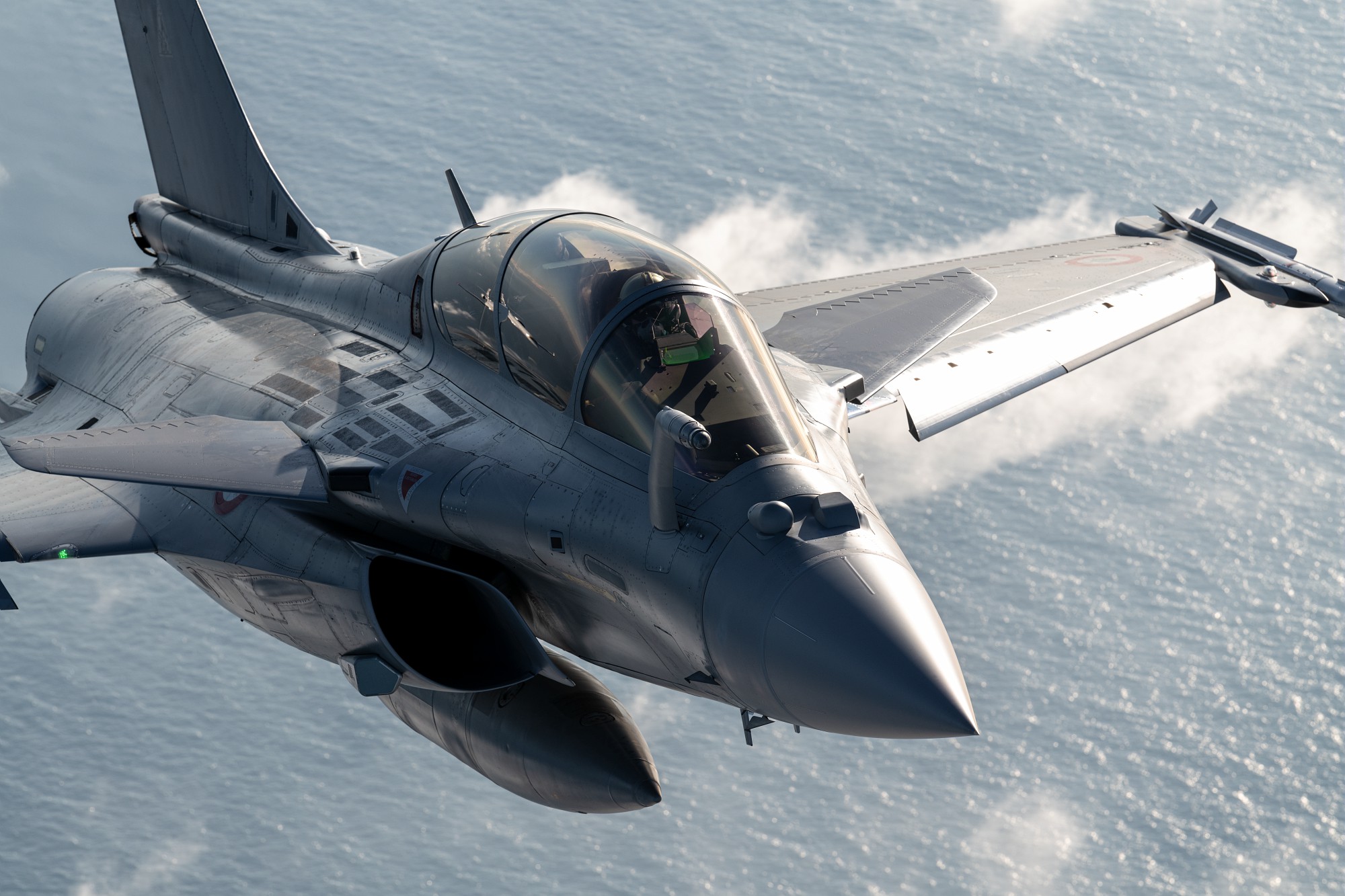
The conflict in Ukraine has reshaped the battlefield. With the rise of drones and automation, the return of high-intensity warfare is forcing the French military to rethink the future of its aviation. That future is expected to involve collaborative combat drones capable of flying alongside a new Rafale standard: the F5. The project already has a name: HypAIRion.
The French military's ambition is clear: to have combat drones and fighter jets operate in tandem. It was with this goal in mind that the HypAIRion project was launched last summer, spearheaded by the Directorate General of Armaments (DGA) and the Ministerial Agency for Defense Artificial Intelligence (AMIAD). Its objective? To test a new architecture combining AI, autonomy, and open systems.
In practical terms, the aim is to enable aircraft and drones to exchange data and share specific mission tasks. The insights gained will prove invaluable in preparing for the arrival of the Rafale F5, expected
around 2033.
There is no question, then, of replacing the French Air Force's flagship aircraft. "We are certain that the Rafale is—and will remain—the heart of air combat," explains Colonel Cédric, head of the capability development office at the Air and Space Force headquarters. However, this new technological layer would "thicken" the combat system surrounding the aircraft:
drones would be able to see further and force the adversary to reveal their position by activating their radars, while also carrying their own weaponry or executing missions deemed too risky for a manned aircraft.
Autonomous drones alongside the Rafale
The technical challenge is significant: a pilot already has to manage their aircraft and sensors, analyze the tactical situation, communicate with the control center, and decide on a course of action—all within a dense, dynamic, and stressful environment. Asking them to pilot multiple drones on top of that is simply out of the question.
That is why AMIAD is working on mission autonomy and command and control (C2), aiming to train models using operational data, determine which decisions can be made by each platform, and secure the algorithms.
But at this rate, will a human still be needed in the cockpit? "Replacing the pilot is not on the agenda at all," assures Colonel Thibault, deputy director in charge of AI deployment at AMIAD. Beyond the colossal technological challenge this would entail, the officer points to operational and ethical reasons: AI is not infallible, and the final decision must remain the prerogative of the human.
The Rafale F5: primed for AI
On the other hand, this new technology could significantly speed up crew decision-making while easing their workload. A concrete example? As early as next year, AI could be integrated into a laser targeting pod capable of automatically analyzing images and then detecting and categorizing vehicles or potential threats. The crew will then simply need to view the selected thumbnails to identify targets of interest. At least, that is the promise made by the military regarding the F5 standard. The DGA (French Defense Procurement Agency) is working specifically on enhancing onboard computing capabilities, creating a more open architecture, managing data, and enabling algorithms to learn from information gathered during missions.
"Flying computers"
One of the key challenges of the HypAIRion project concerns this very aspect of an adaptable architecture. The Air Force aims to have open, modular systems under state control, allowing for rapid adaptation to evolving threats.
"We will finish conflicts and battles with different equipment than what we started with," warns Colonel Cédric. In practical terms, a pilot encountering a new threat in the morning could return to base, process the collected data, and then head out again with a system adapted to better counter that threat.
The goal is to modify equipment much more quickly—particularly through software updates—moving ultimately toward the concept of "flying computers." Two Mirage 2000 aircraft are scheduled to be used for testing initial use cases at Mont-de-Marsan starting late this year.
While Dassault Aviation and the Rafale industrial partners remain involved in the project, the State intends to retain control over the architecture and the ability to integrate new AI specialists. This is as much an industrial challenge as a military one: preventing an overly closed architecture from slowing down the integration of new technologies.
Mobilize an industrial hub
“With this level of ambition, we can no longer reason as before with a block of 1,000 pages to express the need and 5,000 pages of technical clauses,” explains Colonel Thibault.
The ministry would rather like to create an "industrial hub" bringing together large groups, SMEs and start-ups, in order to be able to select the most efficient players and algorithms throughout the program.
The flight planned for
2028 will therefore only constitute a first step. The experiments will gradually increase in complexity and their lessons, particularly between 2028 and 2030, must feed the development of future collaborative combat drones called to accompany the Rafale F5.
By 2033, the challenge will therefore no longer be just to have a more efficient Rafale, but to make it the heart of a combat system where planes, drones, sensors and AI will act in concert.
/end