

Africa : News, Discussion & Updates
- Thread starter RISING SUN
- Start date
You are using an out of date browser. It may not display this or other websites correctly.
You should upgrade or use an alternative browser.
You should upgrade or use an alternative browser.
India to start FTA talks with African Customs union in next 3-4 months
India and the five-member South African Customs Union (SACU) nations are exploring a free-trade agreement (FTA) and are expected to begin talks in the next three to four months, people aware of the matter said.SACU, which comprises South Africa, Namibia, Botswana, Lesotho, and Eswatini, is the world’s oldest Customs union, dating back over a century.
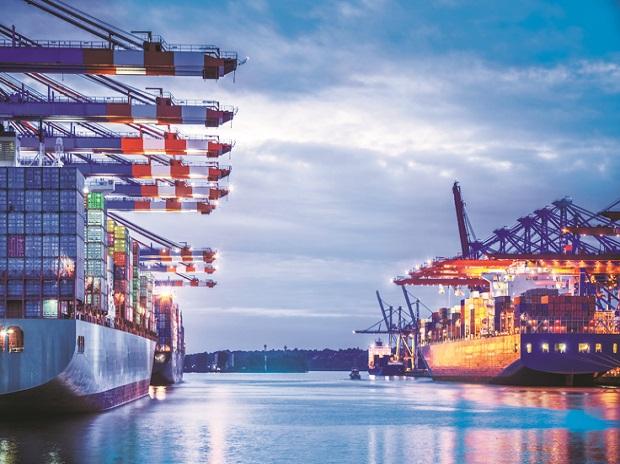
India to start FTA talks with African Customs union in next 3-4 months
Deal to focus on wider market access for goods and services

(nyt, jul.29)
Coast to Coast, a Corridor of Coups Brings Turmoil in Africa
This past week’s military takeover in Niger completed a domino chain of countries ruled by leaders who seized power by force, fueling instability and presenting a conundrum for the United States.
Africa’s coup belt spans the continent: a line of six countries crossing 3,500 miles, from coast to coast, that has become the longest corridor of military rule on Earth.
This past week’s military takeover in the West African nation of Niger toppled the final domino in a band across the girth of Africa, from Guinea in the west to Sudan in the east, now controlled by juntas that came to power in a coup — all but one in the past two years.
The last leader to fall was Niger’s Mohamed Bazoum, a democratically elected American ally who disappeared on Wednesday when his own guards detained him at the presidential palace in the capital, Niamey. His security chief now claims to be running the country.
“We have decided to intervene,” Gen. Abdourahmane Tchiani, Niger’s new self-appointed ruler, said in a televised address on Friday.
The coup instantly reverberated far beyond Niger, a sprawling and impoverished country in one of the world’s toughest neighborhoods. African leaders sounded the alarm over the latest blow to democracy on a continent where decades of hard-won advances are slipping away.
“Africa has suffered a serious setback,” Kenya’s president, William Ruto, said on Friday.
For the United States and its allies, the coup raised urgent questions about the fight against Islamist militants in the Sahel, the vast semiarid region where groups linked to Al Qaeda and the Islamic State are gaining ground at an alarming pace, moving from the desert toward the sea. Much of the Sahel overlaps with Africa’s newly formed, coast-to-coast coup belt.
“I’m very worried that Sahelian Africa is going to melt down,” said Paul Collier, a professor of economics and public policy at Oxford’s Blavatnik School of Government.
The Sahel has surpassed the Middle East and South Asia to become the global epicenter of jihadist violence, accounting for 43 percent of 6,701 deaths in 2022, up from 1 percent in 2007, according to the Global Terrorism Index, an annual study by the Institute for Economics and Peace.
Understand the Military Coup in Niger
A takeover. Military officers in the West African nation of Niger announced on July 26 that they had ousted the country’s president, throwing into uncertainty the future of one of the West’s few reliable partners in a region marred by coups and insecurity. Here is what to know:
How did the coup unfold? Members of the country’s presidential guard encircled the president’s palace in Niamey, Niger’s capital, and detained Mohamed Bazoum, the country’s president. A group of army officials representing different branches of the military later declared on national television that they had “put an end to the regime” of Bazoum and a general was announced as the head of the transitional leadership.
How have people in Niger reacted? Hundreds briefly demonstrated in the streets of Niamey to demand Bazoum’s release before being violently dispersed by security forces. The Nigerien government called on the public to reject the takeover, but the military officers who appeared on television said that it was necessary to avoid strife between branches of the country’s security forces.
What could the events mean for Niger? A successful coup could further destabilize a poor country and nascent democracy. Bazoum became president in 2021, taking the reins in Niger’s first peaceful, democratic transition since it gained independence from France in 1960 and ending a period during which it experienced four military coups. The events could also affect dynamics in a region plagued by violent militants, poverty and coups.
Until this past week, Niger was the cornerstone of the Pentagon’s regional strategy. At least 1,100 American troops are stationed in the country, where the U.S. military built drone bases in Niamey and the northern city of Agadez, one at a cost of $110 million. Now, all of that is in jeopardy.
Secretary of State Antony J. Blinken, speaking at a news conference in Australia, warned on Saturday that the United States could end its financial support and security cooperation for Niger if Mr. Bazoum were not reinstated as president. Though officials say the United States would be reluctant to go that far, Mr. Blinken was unequivocal.
“The very significant assistance that we have in place — that is making a material difference in the lives of the people of Niger — is clearly in jeopardy,” he said. “And we’ve communicated that as clearly as we possibly can to those responsible for disrupting the constitutional order.”
Any American withdrawal could open a door to Russia.
The sight of Russian flags being waved by coup supporters in Niamey this past week echoed similar scenes after a coup in neighboring Burkina Faso last year. The flags do not mean the Kremlin was behind the coup, analysts say. But they do symbolize how Russia has positioned itself as the torch bearer of anti-Western, and especially anti-French, sentiment in a swath of Africa in recent years.
President Vladimir V. Putin of Russia sought to exploit that gap at this past week’s Africa summit in St. Petersburg, where he proposed to liberate African countries from “colonialism and neocolonialism” — even as his country’s own Wagner mercenaries have exploited African gold and diamonds, and committed civilian atrocities.
For Wagner’s mercurial boss, Yevgeny Prigozhin, the run of coups is a business opportunity. His forces already operate openly in Mali and Sudan in the coup belt, as well as in the nearby Central African Republic and Libya. Hovering on the margins of the St. Petersburg summit this past week, Mr. Prigozhin praised the coup in Niger, then proposed sending his own armed fighters to help.
But if the coup belt has become a theater of geopolitical maneuvering, the coups themselves are rooted in an explosive mix of local factors, experts say.
In Guinea, the coup leaders justified their actions by citing public anger at widespread corruption; in Mali and Burkina Faso, they claimed to have an answer to the tide of Islamist militancy plaguing their countries.
In fact, insurgent violence has spread under the military juntas, accelerating the spiral of instability.
In Burkina Faso, attacks once confined to the north of the country have come closer to the capital in recent months. In Mali, where the military replaced 5,000 French troops with about 1,000 Wagner mercenaries, civilian deaths have soared, according to the Armed Conflict Location & Event Data Project, which tracks casualties.
Everywhere, weak states are a factor. The Sahel has some of the world’s poorest countries and the highest birthrates (Niger, where an average woman has seven children, tops the list). Their soaring populations of frustrated, jobless young people swell the ranks of the insurgents.
The youth bulge shows up among coup-makers, too. Most of the recent takeovers were led by men in their 30s or early 40s, on a continent where the average leader is in their 60s. Capt. Ibrahim Traoré, who was just 34 when he seized power in Burkina Faso last year, is the world’s youngest head of state.
African countries have experienced 98 successful coups since 1952, a recent United Nations report on coups in Africa found. Jonathan Powell, an associate professor at the University of Central Florida, said the most coups had occurred in Sudan, where the latest takeover, in 2021, seeded an explosive military feud that recently grew into full-scale war.
The takeovers dipped to their lowest level in the decade up to 2017, a period that included the Arab Spring and the ouster of longtime autocrats like Egypt’s Hosni Mubarak. Then the pendulum swung hard in the opposite direction.
In Chad, seizing power is a family tradition. The country’s ruler, Mahamat Idriss Déby, took over in 2021 after his father, who had come to power in a 1990 coup, was killed in a battle.
Niger seemed different.
Despite a long history of coups, the desert-dominated nation of 25 million people seemed to be on a path to stability under Mr. Bazoum, who was elected president in 2021.
He was making progress against the militants, appeared to enjoy the support of the armed forces and was celebrated by influential Westerners. Onstage with Bill Gates and Melinda French Gates at a talk last October, the smiling Mr. Bazoum was introduced as a “gender warrior” for promoting the education of girls and a reduction in the birthrate.
But then a personal factor struck: tensions with the head of the presidential guard, General Tchiani, that seem to have initiated this past week’s mutiny, said Dr. Issaka K. Souaré, the author of a book on coups in West Africa.
Sometimes, Dr. Souaré added, coups simply come like swallows.
“There’s a contagion effect,” he said. “You see your colleagues in neighboring countries have toppled the civilians, and now the red carpet is rolled under your feet. You want the same.” /end

Italian ex-premier says French missile downed an airliner in 1980 by accident in bid to kill Gadhafi
A former Italian premier is contending that a French air force missile brought down a passenger jet over the Mediterranean Sea in 1980 and is appealing to France's president to respond.
 apnews.com
Italian ex-premier says French missile downed an airliner in 1980 by accident in bid to kill Gadhafi
1 of 2 |
FILE - Italian Interior Minister Giuliano Amato looks on next to an empty seat, during a press conference after a cabinet meeting in Rome’s Palazzo Chigi premier’s office, Friday March 16, 2007. A former Italian premier is contending that a French air force missile brought down a passenger jet over the Mediterranean Sea in 1980 and is appealing to France’s president to respond. The crash of the Italian domestic airliner killed all 81 persons aboard. What caused the crash is an enduring mystery. (AP Photo/Plinio Lepri, File)
Read More
2 of 2 |
FILE - An Italian Carabinieri police officer patrols a hangar, in Pratica di Mare, near Rome, Monday Dec. 15, 2003, the reconstructed wreckage of the Itavia DC-9 passenger jetliner which crashed near the tiny Mediterranean island of Ustica in June 27, 1980. A former Italian premier is contending that a French air force missile brought down a passenger jet over the Mediterranean Sea in 1980 and is appealing to France’s president to respond. The crash of the Italian domestic airliner killed all 81 persons aboard. What caused the crash is an enduring mystery. (AP Photo/Emiliano Grillotti, File)
BY FRANCES D’EMILIO
Updated 9:11 AM CDT, September 2, 2023
Share
ROME (AP) — A former Italian premier, in an interview published on Saturday, contended that a French air force missile accidentally brought down a passenger jet over the Mediterranean Sea in 1980 in a failed bid to assassinate Libya’s then leader Moammar Gadhafi.
Former two-time Premier Giuliano Amato appealed to French President Emmanuel Macron to either refute or confirm his assertion about the cause of the crash on June 27, 1980, which killed all 81 persons aboard the Italian domestic flight.
In an interview with Rome daily La Repubblica, Amato said he is convinced that France hit the plane while targeting a Libyan military jet.
While acknowledging he has no hard proof, Amato also contended that Italy tipped off Gadhafi, and so the Libyan, who was heading back to Tripoli from a meeting in Yugoslavia, didn’t board the Libyan military jet.
OTHER NEWS
Hundreds more migrants reach the Greek islands in boats and smaller vessels from Turkey
UN-backed panel says Italy can do more to fight racism, discrimination in sports and society
A train slams into a group of workers on the tracks at an Italian station, killing 5 of them
What caused the crash is one of modern Italy’s most enduring mysteries. Some say a bomb exploded aboard the Itavia jetliner on a flight from Bologna to Sicily, while others say examination of the wreckage, pulled up from the seafloor years later, indicate it was hit by a missile.
Radar traces indicated a flurry of aircraft activity in that part of the skies when the plane went down.
“The most credible version is that of responsibility of the French air force, in complicity with the Americans and who participated in a war in the skies that evening of June 27,” Amato was quoted as saying.
NATO planned to “simulate an exercise, with many planes in action, during which a missile was supposed to be fired” with Gadhafi as the target, Amato said.
In the aftermath of the crash, French, U.S. and NATO officials denied any military activity in the skies that night.
According to Amato, a missile was allegedly fired by a French fighter jet that had taken off from an aircraft carrier, possibly off Corsica’s southern coast.
Macron, 45, was a toddler when the Italian passenger jet went down in the sea near the tiny Italian island of Ustica.
“I ask myself why a young president like Macron, while age-wise extraneous to the Ustica tragedy, wouldn’t want to remove the shame that weighs on France,” Amato told La Repubblica. ”And he can remove it in only two ways — either demonstrating that the this thesis is unfounded or, once the (thesis’) foundation is verified, by offering the deepest apologies to Italy and to the families of the victims in the name of his government.”
Amato, who is 85, said that in 2000, when he was premier, he wrote to the then presidents of the United States and France, Bill Clinton and Jacques Chirac, respectively, to press them to shed light on what happened. But ultimately, those entreaties yielded “total silence,” Amato said.
When queried by The Associated Press, Macron’s office said Saturday it wouldn’t immediately comment on Amato’s remarks.
Italian Premier Giorgia Meloni called on Amato to say if he has concrete elements to back his assertions so that her government could pursue any further investigation.
Amato’s words “merit attention,’' Meloni said in a statement issued by her office, while noting that the former premier had specified that his assertions are “fruit of personal deductions.”
Assertions of French involvement aren’t new. In a 2008 television interview, former Italian President Francesco Cossiga, who was serving as premier when the crash occurred, blamed it on a French missile whose target had been a Libyan military jet and said he learned that Italy’s secret services military branch had tipped off Gadhafi.
Gadhafi was killed in Libya’s civil war in 2011.
A few weeks after the crash, the wreckage of a Libyan MiG, with the badly decomposed body of its pilot, was discovered in the remote mountains of southern Calabria.

India, Germany to support development projects in Ethiopia, Madagascar
New Delhi and Berlin have thus far worked together to develop projects in Peru, Ghana, Cameroon and Malawi.
 www.livemint.com
Africa-India Cooperation Sets Benchmark for Partnership
Africa’s special relationship with India provides a foundation for a mutually beneficial and sustainable partnership built on African agency and capacity building.India’s first prime minister, Jawaharlal Nehru, termed Africa as India’s “sister continent,” in recognition of the long ties of affinity. Since the 1960s, India’s prime ministers have visited Africa 76 times, a level of engagement unmatched by Africa’s other external partners. Between 2015 and 2022, New Delhi received over 100 African leaders, while each African country received an Indian cabinet minister. Indo-African ties cover culture, education, trade, technical cooperation, energy, agriculture, maritime security, peacekeeping, and professional military education.
India also builds capacity for good governance through institutions like the India International Institute of Democracy and Election Management, which has trained hundreds of African and Asian stakeholders. To better understand this important yet underlooked relationship, the Africa Center for Strategic Studies spoke to several Indian and African experts for their insights.
India’s Strategic Engagements in Africa
Thanks, in part, to heavy Indian lobbying, the African Union was included as a full member of the G-20 at the New Delhi Summit in September 2023. Calling Africa “India’s top priority,” Prime Minister Narendra Modi, said, “When we use the term ‘Global South,’ it is not just a diplomatic term. … In our shared history, we have together opposed colonialism and apartheid. It was on the soil of Africa that Mahatma Gandhi used powerful methods of non-violence and peaceful resistance. It is on this strong foundation of history that we are shaping our modern relations."
The next triennial India-Africa Forum Summit is planned for 2024. In January 2023, 47 African countries attended the Voice of the Global South Summit. In June 2023, African and Indian government, private sector, and industry leaders converged in New Delhi for the 18th India-Africa Conclave hosted by the India Export Import (EXIM) Bank in partnership with India’s foreign and trade ministries.
India-Africa trade has grown 18 percent annually since 2003, reaching $103 billion in 2023. This makes India Africa’s third largest trading partner after the European Union and China.
India is also the second largest lender in Africa, with strong public-private partnerships and safeguards protecting borrowers from debt distress. In fact, most Indian aid is channeled through the African Development Bank (ADB), which New Delhi joined in 1983. India’s total investments in Africa amount to $70 billion, a figure the powerful Confederation of Indian Industry aims to increase to $150 billion by 2030.
“India’s unique story in Africa gives texture to its strategic engagement,” notes Aly-Khan Satchu, a Kenyan Indian and leading entrepreneur and investor. “Indian-Africans occupy a fascinating space in Africa’s landscape,” explains Veda Vaidyanathan, an associate fellow at the Centre for Social and Economic Progress (CSEP) in New Delhi and Harvard University’s Asia Center. They are an essential part of Africa’s middle class and play a major role in education, health, industrialization, and trade as well as participate in politics and serve in the military.
Indian-Africans are an essential part of Africa’s middle class and play a major role in education, health, industrialization, and trade.
While first generation Indians are outsiders to these African landscapes, the second, third generation Indian origin Africans are either familiar foreigners or not considered foreigners at all,” Vaidyanathan adds. “When I interview Kenyan Indians who have been in the country for generations, for example, they consider me ‘the other,’ a common feature of Indo-African attitudes. “They are insiders, weaved into the tapestry of their adopted countries.” Shobana Shankar, Professor at Stony Brook University, highlights the nuanced and historically complex African-Indian relationship that is dynamic, calling this an “emotional infrastructure” with its ups and downs that help mitigate tensions and
maintain ties.”
Since independence, India believed it was destined to be a Great Power, meaning a self-reliant and economically and militarily powerful India with global respect and influence. These ambitions remain anchored in Africa. Abhishek Mishra, an associate fellow at the Manohar Parrikar Institute for Defence Studies and Analyses says that India’s global ambitions rest on South-South cooperation, which hinges on an “ascendant India and a resurgent Africa.” Hence, the thrust of India’s Africa policy is to “develop together as equals.” These are fleshed out in the “Kampala Principles,” 10 core tenets articulated by Prime Minister Modi during his address to Uganda’s Parliament in July 2018. The first two state the following:
“Africa will be at the top of our priorities. We will continue to intensify and deepen our engagement with Africa. As we have shown, it will be sustained and regular.
"Our development partnership will be guided by your [African] priorities. We will build as much local capacity and create as many local opportunities as possible. It will be on terms that are comfortable to you, that will liberate your potential and not constrain your future.”
These overarching principles include India’s other medium-term interests:
Secure African support in India’s bid for a permanent membership on the UN Security Council
Work with African countries to restructure global financial and multilateral institutions to prioritize the Global South
Partner with African countries to suppress terrorism and ensure freedom of movement in the Indian Ocean
Secure India’s resource and energy security
Where and how is India most active in Africa?
Abhishek Mishra observes that India traditionally focused on East and Southern Africa due to maritime proximity across the Indian Ocean and the large Indian diaspora. Over time, India expanded its engagements to over 44 countries thanks to the Ministry of External Affairs’ Indian Technical and Economic Cooperation (ITEC), which, since 1964, has devoted more than a third of its accounts to African countries in four areas: capacity building, project assistance, scholarships, and institution-building. It has trained over 200,000 civilian and defense professionals from 160 countries—mostly in Africa and Asia. India’s EXIM Bank has devoted 50 percent of its international financing, technical assistance, and trade promotion schemes to Africa. Africa’s largest digital project, the Pan African e-Network, is connecting Africa’s 54 countries to India and one another to share expertise in telecoms, medicine, health, resource mapping, and e-governance.
India has consistently been perceived as a trusted ally in Africa.
The prioritization of Africa within India’s investments is one of the reasons why India has consistently been perceived as a trusted ally in Africa. India enjoys observer status in the Common Market for Eastern and Southern Africa (COMESA), Southern African Development Community (SADC), and the Economic Community of West African States (ECOWAS).
In what areas does India feel it has unique advantages, and where can it add value to Africa?
India won independence from Britain in 1947 and was active in Africa’s independence movements. Besides Mahatma Gandhi, its early leaders (and prime ministers) Jawaharlal Nehru, his successor and daughter, Indira Gandhi, and grandson, Rajiv Gandhi, received dozens of decorations across Africa for their work on African liberation. Africa retains support across the political spectrum in India today.
Most of Africa’s 3-million-strong Indian population descended from Indian indentured workers brought to Africa by the British during the early 18th century. Long before that, however, African communities were taken to India through the Arab slave trade. Their descendants—one of India’s minority populations—are called Sidhis.
“One thing we hear from African colleagues is that India does not act or speak like a donor,” says Veda Vaidyanathan. “It focusses on creating space to work together as equals, enabling the African side to exert agency and leadership, while India facilitates.” Professor Harsh Pant, a vice president at the Observer Research Foundation, in New Delhi, agrees. “India makes the following argument: we want to be part of your developmental journey, but we do not want this to be a donor-recipient relationship. We want this to be a relationship between two partners and to build greater capacity and resilience across African countries.”
The inclusion of African and Indian private sectors and professional associations in official India-Africa platforms enhances citizen agency. These groups are not engaged on the sidelines but participate in all deliberations in mechanisms like the India-Africa Forum Summit and the India-Africa Conclave.
India also leverages its unique access to African grassroots communities. An illustration of this is the Solar Mamas Project, a people-to-people venture in Rajasthan, India, created by Barefoot College in Tiloniya, so-named to reflect its grassroots focus. Veda Vaidyanathan explains: “This College equips women from impoverished communities in India and faraway African towns as solar engineers. After training together for 6 months, they go back to electrify their villages, earning them the title of ‘Solar Mamas.’”
“We do not want this to be a donor-recipient relationship. We want this to be a relationship between two partners.”
Recognizing this project’s game-changing potential to reduce dependence on fossil fuels, the Indian government helped extend it to 36 African countries. This dovetails with the objectives of India’s International Solar Alliance to assist 733 million people who live without power—the vast majority from Africa—to switch to renewable energy.
India also sponsors a robust pipeline of African students in India, a practice built in Nehru’s time and sustained throughout. Indian teachers and university faculty were also a critical part of the diaspora who came after the commercial Indian settlers in East and Southern Africa. In Senegal, the first president, Leopold Senghor, established a university exchange between his country and India for Indo-African studies, supported by Prime Minister Indira Gandhi.
The unique place of Indians in Africa creates a strong foundation for the larger relationship. Mahatma Gandhi spent 21 years in South Africa where he invented his principles of civil disobedience. The long list of prominent anti-apartheid icons of Indian heritage in South Africa includes his granddaughter, Ela Gandhi, and Fatima Meer, Ahmed Kathrada, Amina Cachalia,
and Frene Ginwala. Prominent Indian-Africans in Africa’s democratization movements include: Anirut Jugnath and Navinchandra Ramgoolam (Mauritius); Nandini Patel (Malawi); Manilal Chandaria, Pio Gama Pinto, Fitzval Remedios Santana de Souza, and Pheroze Nowrojee (Kenya); Rajini Kanabar, JK Chande, and Issa Shivji (Tanzania); Wavel Ramkalawan (Seychelles); Ahmed Moosa Ebrahim (Zimbabwe); and Yash Tandon and Mahmood Mamdani (Uganda).
What are India’s defense and security cooperation priorities?
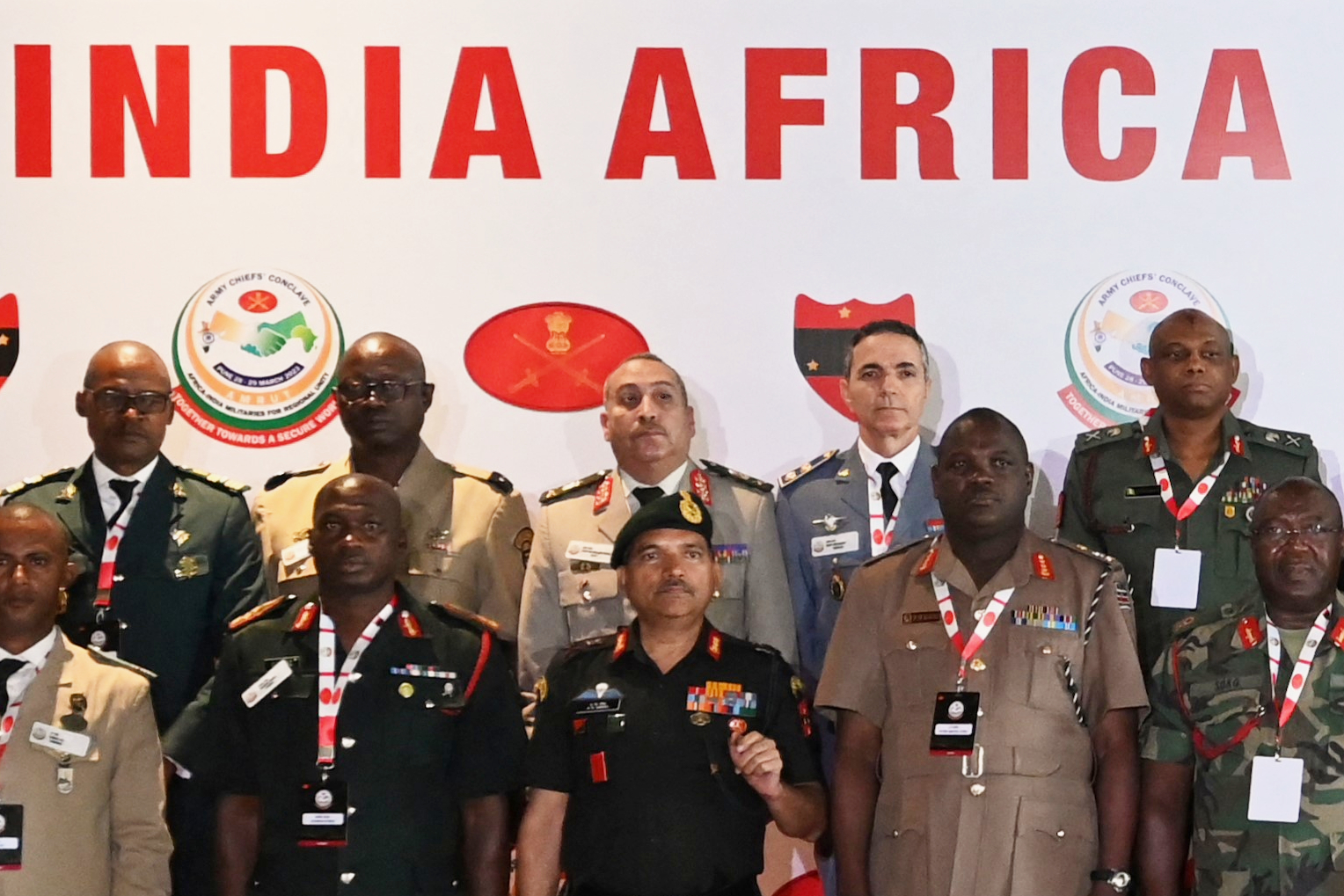
Abhishek Mishra notes that defense and security have emerged as a key pillar of India-Africa relations. This was underscored in March 2023, when the two sides convened the first ever India-Africa Army-Chiefs Conclave, alongside the second edition of the Africa-India Field Training Exercise (AFINDEX), held over 10 days in Pune, India. The two sides also conduct an annual India-Africa Defence Dialogue (IADD) that coincides with India’s Defence Expo.
India’s October 2022 “Gandhinagar Declaration” calls for more professional military education (PME) training slots for African countries under ITEC. Additionally, India and Africa engage in “specialized training and joint research in new areas like artificial intelligence, cyber security, munition systems, maritime surveillance, unmanned vehicles, space, and undersea scanning technologies,” explains Mishra.
African navies have participated in all 47 editions of India’s Maritime Partnership Exercise (MPX) in the Western Indian Ocean. Among its key outcomes is a Memorandum of Understanding (MOU) with Tanzania and Kenya on shipbuilding and port development. “We have also invited African officers to attend various Indian institutions like our Information Fusion Center (IFC-IOR) and instituted an India-Africa Security Fellowship hosted by the Manohar Parrikar Institute for Defence Studies and Analyses,” Mishra adds. “We recently hosted fellows from Kenya and Tanzania and will soon be inviting Nigerian officers.”India focusses most of its security assistance on building partner self-sufficiency.
Port Lamu in Kenya
Naval Ship Sumedha at Port Lamu in Kenya in December 2023. (Photo: India Ministry of Defence)
In line with its policy of “developing together as equals,” India focusses most of its security assistance on building partner self-sufficiency. This has led to the deployment of Indian technicians to strengthen African capacity to repair and maintain equipment, dock facilities, boats, tanks, guns, and aircraft. India also supplies hardware like offshore patrol craft, combat helicopters, interceptor boats, and armored vehicles.
What more do Africans wish to see and what is the future of Indo-African relations?
Sanusha Naidu, a third-generation South African–Indian and Senior Associate at South Africa’s Institute for Global Dialogue contends that, “The African Union should integrate key initiatives like the African Continental Free Trade Area and New Partnership for African Development into the larger Africa-India partnership. There is appetite on the Indian side for this type of partner agency and leadership.” Aly-Khan Satchu calls for a closer “triangulation” on all sides. “Indian diasporas have an embedded inclination to reach out to their home governments and connect them to the Indian government and private sector. However, this is not being fully leveraged, and it is only recently that Indian and African colleagues moved on this with greater intentionality.”
“Indian diasporas have an embedded inclination to reach out to their home governments and connect them to the Indian government and private sector. However, this is not being fully leveraged.”
Abhishek Mishra says that the Indian private sector should diversify into new areas in Africa in addition to traditional ones like pharmaceuticals, education, and agriculture. “African countries are also wary of taking more loans and clearly prefer foreign direct investment. New Delhi should offer more innovative financial instruments to augment what India’s EXIM Bank continues to offer, which have served both sides well. Veda Vaidyanathan points to an emerging trend of subnational Indian actors crafting their own relationships with African counterparts. The partnership between the Kerala State government and Ethiopia and South Africa on poverty reduction and empowering women is one example. “There is demand in Africa for more of these ties, which can play a critical role in the continent’s growth story.”
Going forward, Indo-African ties will continue to draw on the unique place of Indians and Africans in each other’s complex histories. “Consider the daily life in a country like Kenya, Nigeria, South Africa, or India and Pakistan,” says Shobana Shankar. “Their diversity comes from Afro-Asian migrations. India also has a steadily growing African population. How migrants make their voices heard and impact host societies, how diversities and cohesions are navigated is the story of the future.”
Africa-India Cooperation Sets Benchmark for Partnership – Africa Center for Strategic Studies
Africa’s special relationship with India provides a foundation for a mutually beneficial and sustainable partnership.
 africacenter.org

russia is a "reliable" "ally":

Tunisia unveils plans for ambitious overland trade corridor to connect North Africa with the Sahel
Tunisia is advancing plans for a strategic overland trade corridor linking North Africa to the Sahel, as it seeks to reposition itself as a gateway between the Mediterranean and sub-Saharan Africa

India, SACU sign terms of reference for preferential trade pact
India and the five-member Southern African Customs Union (SACU) signed the Terms of Reference (ToR) on Wednesday to start negotiations for a Preferential Trade Agreement (PTA), with an aim to conclude the trade talks within a year.The agreement will cover eight chapters, including trade in goods, market access, customs procedures, sanitary and phytosanitary (SPS) measures, trade remedies, technical barriers to trade (TBT), rules of origin and dispute settlement. However, both sides agreed that the chapters can further expanded if the negotiations demand.
Commerce and Industry Minister Piyush Goyal on Wednesday said India hopes to conclude the negotiations in the next few months, underscoring the need to move quickly while cautioning against rushing the process.
"Speed is necessary for outcomes,” Goyal said, adding that he was not advocating haste. “India will not touch sensitive issues on your side as we would expect reciprocity and your consideration on sensitive issues on the Indian side,” he said.
India is expected to seek duty concessions for sectors like automobiles, especially for auto parts, pharmaceuticals, machinery, electrical equipment, chemicals and textiles, stated the Commerce Ministry. Automobiles and auto parts were India's second-largest export category to SACU after petroleum products, with shipments worth $1.7 billion in the fiscal year ended March 2026.
The move comes more than two decades after the Union Cabinet had approved the commencement of trade negotiations with SACU, that comprises South Africa, Namibia, Botswana, Eswatini and Lesotho .
Commerce Secretary Rajesh Agrawal said this was the first ToR India has signed for a trade agreement in the African region.
India is already the second-largest supplier to the SACU region, and the proposed pact is expected to provide greater market access for Indian businesses in sectors such as healthcare, information technology and automobiles. Goyal said Indian companies operating in these sectors had already established a presence in the region and contributed to local job creation.

India, SACU sign terms of reference for preferential trade pact
India and the five-member Southern African Customs Union (SACU) signed the Terms of Reference (ToR) on Wednesday to start negotiations for a Preferential Trade
www.newindianexpress.com