Chandrayaan-3 : News and Updates

Laser Instrument on NASA’s LRO Successfully ‘Pings’ Indian Moon Lander

For the first time at the Moon, a laser beam was transmitted and reflected between an orbiting NASA spacecraft and an Oreo-sized device on ISRO’s Vikram lander on the lunar surface. The successful experiment opens the door to a new style of precisely locating targets on the Moon’s surface.

At 3 p.m. EST on Dec. 12, 2023, NASA’s LRO (Lunar Reconnaissance Orbiter) pointed its laser altimeter instrument toward Vikram. The lander was 62 miles, or 100 kilometers, away from LRO, near Manzinus crater in the Moon’s South Pole region, when LRO transmitted laser pulses toward it. After the orbiter registered light that had bounced back from a tiny NASA retroreflector aboard Vikram, NASA scientists knew their technique had finally worked.

1705769283876.png
ISRO's Vikram lander, with a NASA retroreflector on it, touched down on the Moon on Aug. 23, 2023. The camera aboard NASA's LRO (Lunar Reconnaissance Orbiter) took this picture four days later. The lander is in the center of the image, its dark shadow visible against the bright halo around it. The halo formed after rocket plume interacted with the fine-grained regolith (similar to soil) on the Moon's surface. The image shows an area that's 1 mile, or 1.7 kilometers, wide. NASA’s Goddard Space Flight Center/Arizona State University.

Sending laser pulses toward an object and measuring how long it takes the light to bounce back is a commonly used way to track the locations of Earth-orbiting satellites from the ground. But using the technique in reverse – to send laser pulses from a moving spacecraft to a stationary one to determine its precise location – has many applications at the Moon, scientists say.

“We’ve showed that we can locate our retroreflector on the surface from the Moon’s orbit,” said Xiaoli Sun, who led the team at NASA’s Goddard Space Flight Center in Greenbelt, Maryland, that developed the retroreflector on Vikram as part of a partnership between NASA and ISRO. “The next step is to improve the technique so that it can become routine for missions that want to use these retroreflectors in the future.”

Only 2 inches, or 5 centimeters, wide, NASA’s tiny but mighty retroreflector, called a Laser Retroreflector Array, has eight quartz-corner-cube prisms set into a dome-shaped aluminum frame. The device is simple and durable, scientists say, requiring neither power nor maintenance, and can last for decades. Its configuration allows the retroreflector to reflect light coming in from any direction back to its source.

1705769379637.png
Only 2 inches, or 5 centimeters, wide, NASA's Laser Retroreflector Array has eight quartz-corner-cube prisms set into a dome-shaped aluminum frame. This configuration allows the device to reflect light coming in from any direction back to its source. NASA’s Goddard Space Flight Center.

Retroreflectors can be used for many applications in science and exploration and, indeed, have been in use at the Moon since the Apollo era. By reflecting light back to Earth, the suitcase-size retroreflectors revealed that the Moon is moving away from our planet at a rate of 1.5 inches (3.8 centimeters) per year.

This new generation of tiny retroreflectors has even more applications than their larger predecessors. On the International Space Station, they’re used as precision markers that help cargo-delivery spacecraft dock autonomously.

In the future, they could guide Artemis astronauts to the surface in the dark, for example, or mark the locations of spacecraft already on the surface, helping astronauts or uncrewed spacecraft land next to them.

But there’s more work to do before retroreflectors can light up the Moon. The biggest hurdle to their immediate adoption is that LRO’s altimeter, which has operated for 13 years beyond its primary mission, is the only laser instrument orbiting the Moon for now. But the instrument wasn’t designed to pinpoint a target; since 2009, the altimeter – called LOLA - has been responsible for mapping the Moon’s topography to prepare for missions to the surface.

“We would like LOLA to point to this Oreo-sized target and hit it every time, which is hard,” said Daniel Cremons, a NASA Goddard scientist who works with Sun. It took the altimeter eight tries to contact Vikram’s retroreflector.

LOLA works by dispatching five laser beams toward the Moon and measuring how long it takes each one to bounce back (the quicker the light returns, the less distance between LOLA and the surface, and thus the higher the elevation in that area). Each laser beam covers an area 32 feet, or 10 meters, wide, from a 62-mile, or 100-kilometer, altitude. Because there are large gaps between the beams, there is only a small chance that the laser pulse can contact a retroreflector during each pass of the lunar orbiter over the lander.

Altimeters are great for detecting craters, rocks, and boulders to create global elevation maps of the Moon. But they aren’t ideal for pointing to within one-hundredth of a degree of a retroreflector, which is what’s required to consistently achieve a ping. A future laser that slowly and continuously rakes the surface without any gaps in coverage would help tiny retroreflectors meet their potential.

For now, the team behind NASA’s miniature retroreflectors will continue to use LRO’s laser altimeter to help refine the position of targets on the surface, especially landers.

Several NASA retroreflectors are slated to fly aboard public and private Moon landers, including one on JAXA’s (Japan Aerospace Exploration Agency) SLIM lander, due to land on the Moon on Jan. 19, 2024, and one built by Intuitive Machines, a private company scheduled to launch its spacecraft to the Moon in mid-February. Intuitive Machines will carry six NASA payloads, including the retroreflector, under NASA’s Commercial Lunar Payload Services (CLPS) initiative.

Laser Instrument on NASA’s LRO Successfully ‘Pings’ Indian Moon Lander - NASA Science

 
  • Like
Reactions: Parthu and Amarante
Chandrayaan-3: Pragyan rover discovers ancient 160-km-wide crater on the Moon

India Today Science Desk
New Delhi, UPDATED: Sep 22, 2024, 20:42 IST

The data beamed back by the Pragyan rover from Moon's south polar region has now led to the discovery of an ancient crater.
1727120448721.png

India’s Chandrayaan-3 mission continues to make groundbreaking discoveries after its successful mission ended on the Moon in 2023.

The data beamed back by the Pragyan rover from the Moon’s south polar region has now led to the discovery of an ancient crater.

The Pragyan rover has discovered an ancient, 160-kilometre-wide buried crater near its landing site. The findings have been published in the latest issue of Science Direct by scientists from the Physical Research Laboratory, Ahmedabad.

1727120499269.png

This significant find occurred as the Pragyan rover traversed the highland terrain at its landing site, approximately 350 kilometers from the South Pole-Aitken basin, the largest and oldest impact basin on the lunar surface.

The crater is believed to have formed before the creation of the South Pole-Aitken basin, making it one of the Moon's oldest geological structures. Due to the crater's age, it was mostly buried by debris from later impacts, particularly from the South Pole-Aitken event, and has been degraded over time.

Images taken by the Pragyan rover’s navigation and optical high-resolution cameras revealed the structure of this ancient crater, offering vital clues about the Moon's geological history.

The crater’s discovery provides scientists with a rare opportunity to study deeply buried lunar material that dates back to some of the earliest impacts on the Moon.

GYKuEX-aQAA4lnU.jpeg

The landing site, rich in material from past impacts, has been a prime location for lunar exploration.

The South Pole-Aitken basin contributed nearly 1,400 meters of debris, while smaller craters and basins added hundreds of meters of material to the landscape. This ancient regolith, the layer of dust and rock on the Moon’s surface, is crucial for understanding lunar formation and evolution.

The Pragyan rover’s findings, including the crater, have excited scientists around the world. The information it gathers from this ancient and heavily cratered region could reshape our understanding of the Moon's early history, and the formation of its unique terrain.

Chandrayaan-3: Pragyan rover discovers ancient 160-km-wide crater on the Moon

This thread provides a better & more detailed explanation:

 
India’s Chandrayaan 3 rover may or may not have stumbled upon the Moon’s mantle material

By Jatan Mehta
05 May 2025 — 8 min read
1757443275402.png
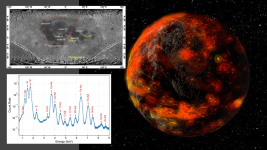
Top left: Locations of samples collected by previous nearside Moon missions. The Chandrayaan 3 landing site marked down south lies far from these sites, which are either within or close enough to the Procellarum KREEP Terrane region (red dashed outline)—thus containing more heat-producing and radioactive elements and therefore representing a distinct lunar interior source than for the rest of the Moon; Bottom left: The co-added X-ray spectrum from all 23 lunar surface soil and rock measurements by the Chandrayaan 3 rover; Right: An artist’s concept of our Moon shortly after its formation, with a magma ocean and a newly forming rocky crust. Images: Rishitosh Sinha, et al. / Santosh Vadawale, et al. / NASA Goddard.

Scientists analyzing the elemental composition of our Moon’s southern high-latitude surface as measured by ISRO’s Chandrayaan 3 rover have concluded that the excess sulfur detected in the landing site’s soil and rocks compared to other regions likely originated in the Moon’s mantle. After rejecting or accommodating other mechanisms known to enhance sulfur in the lunar soil, the authors of the paper published in Nature surmise that the majority of these sulfur-enhanced materials would’ve likely gotten deposited in the Chandrayaan 3 landing region by the massive South-Pole Aitken (SPA) basin impact roughly 200 million years after our Moon’s formation. The SPA’s impactor is thought to have excavated material from more than 100 kilometers below the Moon’s surface, altering the evolution of our Moon’s farside and south pole.

Note that unlike media reports calling the Chandrayaan 3 rover’s curious finds as definitively being material from the Moon’s mantle, it’s not a certainty. Even if the materials may have originated from the lunar interior, they might be from the lower crust instead of the mantle, for example. We need direct sample collection and analysis to confirm or constrain their origin. Either way, it’s important to remember that ISRO optimized the Chandrayaan 3 rover’s traverse path heavily for engineering safety rather than scientific return, more so than your typical tradeoff in a planetary science mission due it being India’s first extraterrestrial rover. Furthermore, having faced more roving difficulties than expected due to the high-latitude lunar environment and uneven local topography, the rover moved only about 100 meters from the lander, which is shorter than the originally expected drive of 300–400 meters. There’s no doubt that more elemental measurements from distinct areas in the landing region would’ve increased Chandrayaan 3’s scientific oomph. With India’s lunar landing and roving technological foundations set though, measurements from the upcoming complex and capable Chandrayaan 4 and Chandrayaan 5 / LUPEX missions should be very exciting from a scientific standpoint.

In any case, finding the sulfur-enhanced materials certainly add the Chandrayaan 3 landing region to the list of potential mantle sampling locations on the Moon, expanding said scope. The findings are also important in another way as explained in the paper:

Prior to ISRO’s Chandrayaan-3 mission, there were no in-situ volatile abundance measurements from the lunar southern high-latitude highlands. Consequently, our understanding of the variations in the concentrations of volatiles across the lunar surface is constrained by the limited scope of measurements obtained primarily from lunar samples collected from equatorial regions. This points to a substantial gap in our understanding of the mechanisms governing enrichment-depletion of volatiles such as sodium (Na), potassium (K) and sulfur (S) on the Moon.

1757443945925.png
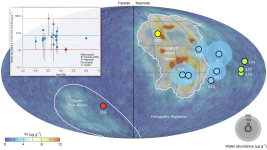
Locations of samples collected by nearside Moon missions are both farther away and geologically distinct from the Chang’e 6 landing site inside the SPA basin on the Moon’s farside. The sizes of outer circles around location dots reflect the estimated maximum water abundance in the mantle sources beneath the sampled sites. The inset image shows how measurements of farside Chang’e 6 samples indicate lower mantle water abundance than the nearside Apollo, Luna, and Chang’e 5 ones. Images: Yangtin Lin, et al.

Relatedly, the first geological map of Chandrayaan 3’s landing region was published recently. It revealed the region to be 3.7 billion years old, and that it has been significantly altered since its formation by subsequent crater impacts and their material ejections. Another paper posited specifically that Chandrayaan 3’s landing site lies atop an ancient crater spanning about 160 kilometers across and being up to 4.4 kilometers deep. This inference is primarily based on ejecta trails around the landing site as imaged by the mission’s Pragyan rover coupled with high-resolution views of the larger region from the Chandrayaan 2 orbiter.

A related study of Chang’e 6 Moon samples published in Nature recently added to the long march of notable scientific results from the Chinese mission and continued anchoring events in our Moon’s evolution. This study involved analyzing 578 particles weighing a total of 5 grams. It revealed for the first time that the Moon’s farside mantle contains less water than within the nearside, adding to the debate on the topic by lending firm and unique credence to the hypothesis that our Moon indeed lost most of its water during its fiery formation. CASC’s news release on the study noted how Francis McCubbin, NASA’s Astromaterials Curator and a peer reviewer of the paper, called the work “a landmark study on the water abundance of the lunar farside.”

Moon Monday #224: A curious find from Chandrayaan 3, Artemis updates, and more
 
  • Like
Reactions: Amarante
Chandrayaan-3 Fly-by

November 13, 2025

Chandrayaan-3 (CH-3) mission is to demonstrate safe and soft landing on Lunar Surface, demonstrate Rover roving on the Moon and conduct in-situ experiments. CH-3 mission consisted the Lander Module, Propulsion Module and a Rover. The satellite was successfully launched on-board LVM3 from SDSC SHAR, Sriharikota on July 14, 2023, at 14:35 Hrs. IST.

After the historic lunar landing of CH3 on August 23, 2023, its Propulsion Module (PM) was operated in its lunar orbit at an altitude of nearly 150 km till October 2023. The PM was then relocated to a high-altitude Earth-bound orbit by executing Trans-Earth Injection (TEI) manoeuvres in October 2023. Since then, CH3-PM was revolving in this orbit under the influence of the Earth's and Moon's gravity fields.

This interplay of gravity fields has led the spacecraft to enter the Moon Sphere of Influence (SOI) on November 04, 2025, where the Moon's gravitation dominates the motion. On November 06, 2025 07:23 UT, the first lunar flyby event took place outside the Indian Deep Space Network (IDSN) visibility at a distance of 3740 km from the Moon's surface. The second flyby event was visible from the IDSN, the closest approach distance was 4537 km from the Moon's surface on November 11, 2025, 23:18 UT. CH3-PM is expected to exit the Moon's SOI on November 14, 2025.

The satellite orbit has changed from 1 lakh x 3 lakh km to 4.09 lakh x 7.27 lakh km in terms of size and its inclination changed from 34 deg to 22 deg due to this flyby events. The flyby event trajectory has been monitored very closely from ISRO Telemetry, Tracking and Command Network (ISTRAC), ISRO. A special care was taken to monitor its trajectory and close proximities from the Beyond Earth Space Objects. The overall Satellite performance is normal during the flyby and no close approach was experienced with the other lunar orbiters. This event garnered valuable insights and experience from mission planning, operations, flight dynamics perspectives, and especially enhanced the understanding of disturbance torques effects.

Chandrayaan-3 Fly-by
 
Chandrayaan-3's RAMBHA-LP Instrument Delivers Critical 'Ground Truth' on the Moon’s Plasma Environment

December 09, 2025
RAMBHA_091225.jpg.webp

Analysis of the Chandrayaan-3 lander data obtained from data from August 23, 2023 to September 03, 2023 has yielded significant, and first-of-its-kind of results on the plasma environment near the Moon’s surface at the Southern higher latitudes, revealing that the electrical environment near the Moon's surface at the South Polar Region is far more active than previously understood.

In physics, plasma is often called the fourth state of matter, consisting of a mixture of charged particles, including ions and free electrons. Despite being electrically neutral overall, plasma is highly conductive and responds strongly to electromagnetic fields. The Moon's thin plasma environment, or lunar ionosphere, is governed by several major processes. Solar wind, which is a continuous stream of charged particles (primarily electrons, Hydrogen and Helium ions) ejected from the Sun's upper atmosphere, constantly impinges on the Moon's surface. This, along with the photo-electric effect—where high-energy photons from the Sun knock out outer-shell electrons from atoms on the surface and in the sparse atmosphere, causing ionization—is the primary mechanism for creating the plasma. The lunar plasma is further influenced by the deposition of charged particles originating from the Earth's magnetosphere (specifically the magnetotail) when the Moon passes through that region (typically 3-5 days during a period of 28 days), resulting in a constantly changing and dynamic electrical environment near the surface.

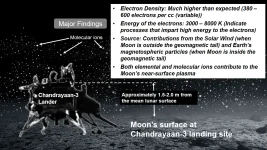
In this context, the results, obtained by the Radio Anatomy of the Moon Bound Hypersensitive ionosphere and Atmosphere – Langmuir Probe (RAMBHA-LP) instrument onboard the Vikram lander of Chandrayaan-3, mark the first-ever direct, or "in situ," measurements of the lunar plasma at such low altitudes. The key findings include the fact that the electron density near the landing site of Chandrayaan-3, named as Shiv Shakti point (69.3° S, 32.3° E) was measured to be between 380 and 600 electrons per cubic centimeter. This is significantly higher than estimates derived from observations taken at higher altitudes, which are primarily based on observing the changes in the phase of electromagnetic signals from satellites passing the Moon’s thin atmosphere at grazing angles, a technique known as Radio Occultation.

It is further found that the electrons near the Moon’s surface possess remarkably high energy, with equivalent temperatures (called kinetic temperature) soaring between 3,000 and 8,000 Kelvin.

The study uncovered that the lunar plasma is not static but is constantly modulated by two distinct factors, depending on the Moon's orbital position around the Earth. When the Moon is facing the Sun (lunar daytime) and outside the Earth’s magnetic field, changes in the near-surface plasma are driven by particles from the Solar Wind interacting with the sparse neutral gas (exosphere) on the Moon. In contrary, when the Moon passes through the geomagnetic tail, the plasma changes are caused by charged particles streaming from the tapered region of Earth's long magnetic tail (towards the opposite side of the Sun), known as the geomagnetic tail.

Furthermore, in-house developed Lunar Ionospheric Model (LIM) suggests that apart from the elemental ions, the molecular ions (likely originating from gases like CO2, H2O) also play a crucial role in creating this electrically charged layer close to the lunar surface.

These results from the RAMBHA-LP experiment provide essential ground truth needed for the next phase of lunar exploration.

The RAMBHA-LP experiment was designed and developed by Space Physics Laboratory (SPL), Vikram Sarabhai Space Centre (VSSC), Thiruvananthapuram.

Reference: “In situ ionospheric observations near lunar south pole by the Langmuir Probe on Chandrayaan-3 lander”, G. Manju et.al., Monthly Notices of the Royal Astronomical Society, 542, 2647 – 2656 (2025);

DOI: https://doi.org/10.1093/mnras/staf1276

Chandrayaan-3's RAMBHA-LP Instrument Delivers Critical 'Ground Truth' on the Moon’s Plasma Environment
 
  • Like
Reactions: spice