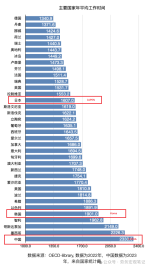
China has consistently maintained an institutional infrastructure that grants the global plutocracy unfettered access across its entire domain. This framework uniquely encompasses two divergent socio-economic systems—namely, mainland oligarchical state capitalism and Hong Kong/Macau Western-style capitalism—where physical transit between these sub-jurisdictions still strictly mandates passports and customs clearance. Concurrently, it operates across three distinct currency regimes. Paradoxically, this architecture represents the absolute zenith of the free-market doctrine you routinely champion, unmatched by any other sovereign entity on Earth—a reality I have continuously emphasized.
The problem is that's only in risky enterprises and only domestically. And the proximity to Lenin is due to its heavy lean towards monopolistic tendencies.
Sectors considered "commanding heights" do not allow even private sector involvement, let alone foreign. Banking, finance, energy, defense, aerospace etc.
What China has is some sectors of the economy are federally administered solely due to contract with the British. Everything else is Lenin style with some private sector and some FDI in limited sectors. It's just that sectors that the CCP consider unimportant are just very large, like cars, appliances, real estate etc. This only gives the illusion of a free market.
You can easily tell by the way money flows. India has capital controls due to a current account deficit. But China has capital controls 'cause people want to leave this "free market." You don't have a free market if your cities now have infrastructure and lifestyles as good or better than Western countries and China's wealthy still want to emigrate. Wealthy Indians leave India due to lower living standards. You can see that Britain is now experiencing the same thing as China, a massive exodus of the wealthy due to the loss of the free market.
Furthermore, any theoretical lineage linking Marxism-Leninism to the contemporary Chinese Communist Party is entirely illusory; if a relationship exists at all, it is as arbitrary as the correlation between a fallen leaf and a metallic briefcase. Consider also that the ruling apparatus has spent decades engaged in the systemic divestment and liquidation of state-owned assets at rock-bottom valuations; under what logical framework would they suddenly covet a private enterprise of your scale?
The Chinese Communist Party’s operational anchoring and commitment to the underlying mechanics of capitalism are, in fact, far more deeply entrenched than your own ideological dogmatism
Then people will stay.
The assertion that the wealthy are fundamentally incapable of redistributing capital misreads the historical nature of accumulation. Historically, neither churches nor temples have ever subverted their revenue streams to execute substantive wealth redistribution to the impoverished. By your flawed logic, the contemporary plutocracy exhibits a structural and capital retention capacity far superior even to that of entrenched ecclesiastical institutions
Synopsis of what Hindu temples did before the British.
Historically, Indian temples functioned as massive engines of socio-economic redistribution. Kingdoms and merchants endowed them with land, gold, and cattle. Temples reinvested these reserves into the community through agrarian development, irrigation, healthcare, feeding programs, and employment for artisans. Today, state endowments manage temple wealth, funding both religious and civic welfare.
- Agrarian Investment: Temples acquired vast tracts of land through royal patronage. They leased these lands to tenant farmers and reinvested the proceeds into building massive irrigation tanks and canals.
- Banking and Credit: Temples acted as indigenous banks, lending gold and agrarian surplus to farmers and merchants. This organized credit helped expand regional trade and agricultural output.
- Artisan Patronage: Temples employed thousands of weavers, metalworkers, architects, and sculptors, sustaining specialized craft guilds and keeping wealth flowing into local economies.
- Social Safety Nets: They functioned as public welfare centers by running community kitchens (Annadanam), Ayurvedic hospitals, and centers of learning (Gurukuls) to distribute food, education, and healthcare to the needy.
Hinduism directly influenced the creation of all major religions and political systems in the world. Iranians and Greeks copied Hinduism. The Romans and Phoenicians copied the Greek. Judaism was born under the influence of Hinduism. The Christians combined Judaism and Buddhism to create Catholicism.
The problems globally began from that point. The Catholics replaced Buddha with Jesus, but replaced Karma and individual accountability of Buddhism with the authority of the church. In India, Buddhism between 300 BC and 300 AD was an extremely toxic existence which was fixed only with the revival of Hinduism after the 300 AD. But the Christians turned it into an even more toxic system and they put Europe through the dark ages until geopolitics forced the Europeans to chase after reality which led to the Industrial Revolutions. Catholicism gave the church dictatorial powers and that led to the failure of redistribution. Islam copied Christianity and created a more toxic system. These systems gave birth to facism, communism etc.
In Hinduism's polytheistic system, temples competed with each other and understood that more redistribution meant more wealth down the line, so it created a profitable circular economy. This led to the complete domination of the global economy by India at the time. With the formation of republics and caste system, people were involved in profit-sharing, there was separation of church from state, and lack of interference in each others' business. It also meant India did not have slavery. Once empires came into being, after the brief period of Buddhism, temples became centers of redistrbution once again until the British put an end to it, and after independence, Nehru simply took full control of temples, he was worse than the British at this. Even then temples today continue redistribution to the extent they are allowed to, but it happens under govt control and a lot of it is stolen. Modi intends to change that.
So yes, profitable wealth redistribution is the only system that works and the proof is available in India with records going back 3000 years. And all attempts at non-profitable redistribution have failed in their entirety every single time.
What you're saying is simply that India's wealthy haven't yet gained power. In a fully capitalized country like the United States and China, none of what you mentioned would exist — for example, Elon Musk could buy votes at $47.50 each, and no one would dare call it illegal.
In India, votes are bought for tiny amounts, so the govt told people they can take money and still vote for whoever they want.
That's why you need an educated population for a democracy to function. And that's why communists destroy education first. That's also why the British destroyed our temple education system.
The overarching framework you are articulating evokes a distinct narrative déjà vu, as the Chinese state apparatus previously deployed an identical stream of strategic communications and promotional rhetoric to project the very same illusions
But your economic system does not support that change. For example, you need to create a system where women choose marriage first, not career. Your system, like all other systems, tells girls to choose a career first and then have a family. Reality is women can only choose one.
In our system, women tend to join the workforce but quit after marriage to have children. This is for the middle class and above. In the lower classes, women work only if their husbands cannot bring home enough money when the economy is weak. Female labor force participation is 40% compared to China's 60%. Urban India's participation is 25% compared to China's 65%.
The ultimate cognitive antagonism across human history resides in the forced inoculation of one's conceptual framework into the consciousness of another. Concurrently, once the female demographic acquires formal knowledge and intellectual autonomy, a resurgence in reproductive utility becomes a statistical and behavioral impossibility.
In India, female labor force is divided between economic necessity among poorer households and highly skilled with masters or doctrorates. Those who have school and bachelor level tend to stay at home at higher rates than the other two.
As education becomes more expensive and work becomes more technology-focused than people-focused due to AI, women will simply choose to stay at home instead or find other means of earning an income over regular office work.
Clear educational differences are evident. Female LFPR is highest among women with no schooling (54.7%rural; 29.9% urban) and those educated up to primary level (56.8% rural; 32.1% urban), declines among women with secondary and higher secondary education (40.3% and 30.6% in rural areas), and rises again among women with graduate and above education (39.8% urban; 44.1% rural), reflecting a U-shaped pattern.
Currently married women show substantially higher participation in rural areas (54.7%) compared to urban areas (28.4%), while participation among never-married women is relatively low and similar across residence (25.1% rural; 26.4% urban).
And you can see that majority of women work to support their bigger families after having children, which is a desirable trait.