
Dassault Rafale - Updates and Discussion
- Thread starter Domobran7
- Start date
You are using an out of date browser. It may not display this or other websites correctly.
You should upgrade or use an alternative browser.
You should upgrade or use an alternative browser.

my dear kangaroo, french 6th gen fighter will be a reality before the first australian SSN reach its harbor.French polls are so funny
With the failure of FCAS, we will only hear more on how Rafale is really a 6th gen and the best in the world


The french air force doctrine is to positively identify a target before firing at it.The OSF’s TV link extends this limit to 50 kilometres. At this distance, the Rafale pilot can formally identify the type of aircraft, assess its weapon configuration, and launch a MICA missile whilst remaining out of range.
(to avoid friendly shoot)
It is not why uncle Sam don't use or master that technology that it's impossible. Remember : we are french...."The infrared channel detects targets in rain, fog or at night at ranges of over 100 kilometres"
The author Denis Mayet is an idiot, Everything is BS, Rain and fog severely inhibits range due to scattering and absorption, atmospheric dust is also an issue after bombing
put up the specs

Ah, The luxury of not having real adversaries.The french air force doctrine is to positively identify a target before firing at it.
(to avoid friendly shoot)
Not false.Ah, The luxury of not having real adversaries.
At least so far.
Last edited:
Happy 40th Birthday
Indian Rafales for another 40 years

 www.facebook.com
Rafale at 40: How India's Fleet Could Evolve Over the Next Four Decades
www.facebook.com
Rafale at 40: How India's Fleet Could Evolve Over the Next Four Decades
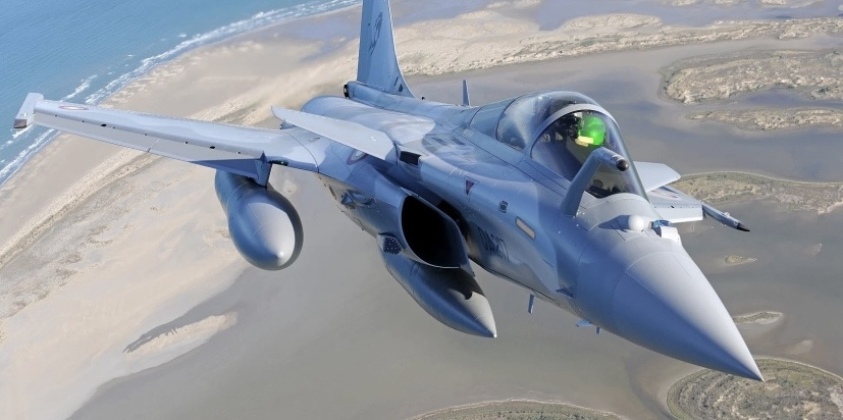
As the Dassault Rafale marks four decades since the programme's inception, attention is turning to how the Indian Air Force and the Indian Navy could evolve their Rafale fleets over the coming decades through upgrades, new weapons, and indigenous technologies.
 militarywatchmagazine.com
The French Rafale fighter program on July 4, 2026, marked 40 years since the first flight of its first technology demonstrator in 1986.
The French Air Force began defining requirements for the fighter in 1983, just three years before its first flight, although major development delays meant that it would be 18 years before the aircraft could be belatedly into service in 2001.
Indian Rafales for another 40 years
The Modern Army
Rafale at 40: How India's Fleet Could Evolve Over the Next Four Decades As the Dassault Rafale marks four decades since the programme's inception, attention is turning to how the Indian Air Force...
www.facebook.com
As the Dassault Rafale marks four decades since the programme's inception, attention is turning to how the Indian Air Force and the Indian Navy could evolve their Rafale fleets over the coming decades through upgrades, new weapons, and indigenous technologies.
Europe’s Top Fighter Has Lagged Far Behind For Decades: Rafale Marks 40 Years in the Air
The French Rafale fighter program on July 4, 2026, marked 40 years since the first flight of its first technology demonstrator in 1986, with the program having since evolved into by far the most succ…
The French Rafale fighter program on July 4, 2026, marked 40 years since the first flight of its first technology demonstrator in 1986.
The French Air Force began defining requirements for the fighter in 1983, just three years before its first flight, although major development delays meant that it would be 18 years before the aircraft could be belatedly into service in 2001.

So will F4 series receive any changes in Spectra some news outlet reports Gan jammers which im skeptical abtand any one who can clarify F4 upgrades in detail and technical stuff !
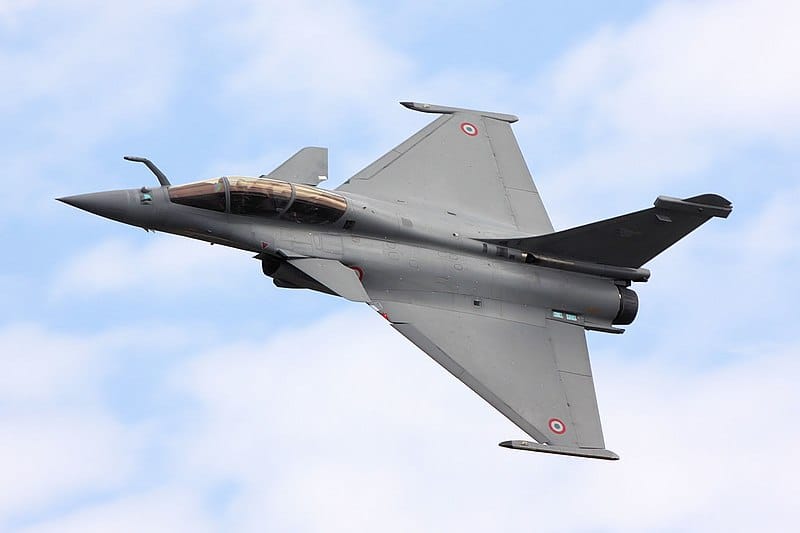
French Dassault Rafale F4 and F5 Standards: Next-Gen Connectivity, Drone Ops, and Strike Precision
Equipped with the Thales RBE2 XG radar and helmet-mounted displays, the F4 upgrade boosts situational awareness and data fusion for seamless coordination with allied forces. F5 standard, expected post-2033, will integrate hypersonic ASN4G missiles for nuclear deterrence.
 www.grosswald.org
The F4 standard — qualified in three increments from 2023 to 2027 — transforms the aircraft from a capable fourth-generation fighter into a networked combat system with Meteor missiles, AESA radar, and collaborative datalinks. Beyond F4, the F5 standard (entering service ~2030) will add a 20%-more-powerful M88 T-REX engine, a loyal wingman UCAV derived from the nEUROn demonstrator, and AI-enabled autonomy.
1. The F4 Ladder
The F4 standard is structured as three incremental sub-standards, each adding capabilities that build on the last:| F4.1 | Mar 2023 | MBDA Meteor BVR missile, Thales TALIOS targeting pod, Scorpion helmet-mounted display, CONTACT radio (initial), improved data fusion |
| F4.2 | Oct 2025 | Collaborative combat datalink (centrepiece), Link 16 Block 2, SATCOM, TRAGEDAC/CAPOEIRA sensor fusion, AI-assisted operations |
| F4.3 | ~2027 (testing) | MBDA MICA NG (dual IR/RF seeker), upgraded SPECTRA EW suite, TALIOS with AI target recognition, enhanced multi-domain connectivity |
The step change is F4.2. It turns the Rafale from an individually capable aircraft into a networked node — the ability to fight as part of a system of systems rather than as an individual platform.
2. The F5 Standard: Engine, Drone, AI
The F5 is not an incremental sub-standard. It is a generational upgrade — the last major evolution of the Rafale airframe before whatever follows FCAS. Full-scale development begins 2026–2027, with entry into service targeted for approximately 2030.Three elements define the F5:
The M88 T-REX engine. Unveiled by Safran at the Paris Air Show in June 2025, the T-REX produces 88.2 kN (9 metric tons) of thrust with afterburner — a 20% increase over the current M88. It achieves this through an improved low-pressure compressor, a new high-pressure turbine with advanced cooling, and a modified exhaust nozzle, all within the same physical envelope as the existing engine. Qualification is aligned with F5 entry into service. Safran explicitly describes the T-REX as a technology bridge toward FCAS engine requirements.
The loyal wingman UCAV. In October 2024, the French Minister of the Armed Forces formally launched development of the Collaborative Combat Aircraft (CCA) — a stealth UCAV derived from the nEUROn demonstrator, which has completed 170+ test flights since its December 2012 maiden flight. A new UCAS model was debuted at the Paris Air Show in June 2025. Capabilities include an internal weapons bay, autonomous ISR, SEAD, and electronic warfare. Operational deployment is targeted for 2033.
Harmattan AI. On 12 January 2026, Dassault and Thales announced an agreement to develop embedded AI functions for the F5, with particular focus on controlling unmanned aerial systems. The programme is named Harmattan — a sovereign AI capability that will give the Rafale F5 autonomous control over its loyal wingman without dependence on external AI stacks or allied systems.
Additional F5 features include the RBE2 XG radar (gallium nitride AESA, a significant leap in power and electronic attack capability), the ASN4G hypersonic nuclear cruise missile (replacing the ASMPA), and enhanced electronic warfare and cyber resilience. The F5 is the first French combat aircraft conceived from the outset for networked operations with drones and AI.

NAMIB, the new airborne electronic warfare product developed by Harmattan AI and Dassault Aviation, conducts a collaborative flight with a Rafale.
Dassault Aviation and Harmattan AI announce today the successful flight execution of a simulated collaborative engagement between a Rafale F4 and a drone carrying a NAMIB payload—a new electronic warfare product jointly developed by the two companies. Paris – Saint-Cloud, July 13, 2026 –
Dassault Aviation and Harmattan AI announce today the successful flight execution of a simulated collaborative engagement between a Rafale F4 and a drone carrying a NAMIB payload—a new electronic warfare product jointly developed by the two companies. NAMIB is an electronic warfare payload capable of detecting, identifying, and locating electromagnetic emissions, particularly those from air defense systems. It can be carried by tactical drones, such as quadcopters or longer-endurance fixed-wing aircraft.
During the demonstration flight, NAMIB discreetly and precisely located a radar from a distance of several tens of kilometers. This location data was transmitted to the Rafale, which then simulated a firing run on the target. The development of NAMIB, launched in January 2026, is part of the strategic partnership between Dassault Aviation and Harmattan AI, which aims to integrate advanced autonomous capabilities into the next generation of air combat systems.
"This flight highlights the Rafale’s real, tangible multi-domain collaborative combat capabilities. The F4 standard architecture enables seamless communication with a wide range of actors—including ground forces—thereby allowing for the effective use of new features, such as NAMIB’s electromagnetic detection and localization capabilities," explains Eric Trappier, Chairman and CEO of Dassault Aviation.
"This also serves as a further illustration of the Rafale’s continuous adaptation to evolving operational needs—specifically the ‘high-low mix,’ which combines complex systems with expendable, autonomous effectors. Electronic warfare has become a decisive factor in operational superiority.
With NAMIB, we are demonstrating that it is now possible to deploy these capabilities on lightweight autonomous systems, operating in close proximity to the threat. This achievement highlights the complementary strengths of Dassault Aviation and Harmattan AI, combining experience in air combat systems with our expertise in autonomy and onboard intelligence.
Together, we are showing that it is possible to accelerate the integration of disruptive technologies for the benefit of the armed forces and to lay the groundwork today for the collaborative combat architectures of tomorrow," stated Mouad M’Ghari, co-founder and CEO of Harmattan AI.
Dassault Aviation and Harmattan AI announce today the successful flight execution of a simulated collaborative engagement between a Rafale F4 and a drone carrying a NAMIB payload—a new electronic warfare product jointly developed by the two companies. Paris – Saint-Cloud, July 13, 2026 –
Dassault Aviation and Harmattan AI announce today the successful flight execution of a simulated collaborative engagement between a Rafale F4 and a drone carrying a NAMIB payload—a new electronic warfare product jointly developed by the two companies. NAMIB is an electronic warfare payload capable of detecting, identifying, and locating electromagnetic emissions, particularly those from air defense systems. It can be carried by tactical drones, such as quadcopters or longer-endurance fixed-wing aircraft.
During the demonstration flight, NAMIB discreetly and precisely located a radar from a distance of several tens of kilometers. This location data was transmitted to the Rafale, which then simulated a firing run on the target. The development of NAMIB, launched in January 2026, is part of the strategic partnership between Dassault Aviation and Harmattan AI, which aims to integrate advanced autonomous capabilities into the next generation of air combat systems.
"This flight highlights the Rafale’s real, tangible multi-domain collaborative combat capabilities. The F4 standard architecture enables seamless communication with a wide range of actors—including ground forces—thereby allowing for the effective use of new features, such as NAMIB’s electromagnetic detection and localization capabilities," explains Eric Trappier, Chairman and CEO of Dassault Aviation.
"This also serves as a further illustration of the Rafale’s continuous adaptation to evolving operational needs—specifically the ‘high-low mix,’ which combines complex systems with expendable, autonomous effectors. Electronic warfare has become a decisive factor in operational superiority.
With NAMIB, we are demonstrating that it is now possible to deploy these capabilities on lightweight autonomous systems, operating in close proximity to the threat. This achievement highlights the complementary strengths of Dassault Aviation and Harmattan AI, combining experience in air combat systems with our expertise in autonomy and onboard intelligence.
Together, we are showing that it is possible to accelerate the integration of disruptive technologies for the benefit of the armed forces and to lay the groundwork today for the collaborative combat architectures of tomorrow," stated Mouad M’Ghari, co-founder and CEO of Harmattan AI.

NAMIB resembles a distributed SEAD/DEAD component: a remote electronic warfare sensor carried by a relatively expendable drone that seeks out adversary emissions close to the threat, pinpoints their location, and transmits actionable targeting data to the Rafale. The Rafale no longer needs to go and "sniff out" the radar itself while on the front line; it can remain at a distance, receive the electromagnetic location data, and then engage the target with the appropriate weapon.
The most important passage is this one:
"NAMIB discreetly pinpointed a radar from several dozen kilometers away with high precision. This location data was transmitted to the Rafale, which then simulated a firing run on the target."
This is not merely a data-link demonstration. It represents a complete chain: detection → identification → localization → transmission → simulated engagement. In other words, Dassault and Harmattan are integrating into the Rafale architecture the kind of capabilities that the Ukrainians are currently cobbling together using a mix of drones, intelligence, and strikes.
It is also precisely the French answer to the "passive stealth versus active electronic warfare" debate. The Rafale does not turn into an F-35; instead, it surrounds itself with remote sensors—cheaper and more expendable—capable of creating the necessary tactical situation. The Rafale thus becomes the decision-making and firing node, rather than necessarily the exposed sensor platform.
The choice of Harmattan AI is also significant. We are not dealing with the cumbersome, bureaucratic FCAS (Future Combat Air System) model slated for 2045. This follows a rapid-turnaround logic: development launched in January 2026, with a collaborative flight scheduled for July 2026. Six months. That is the Ukrainian pace, not the traditional tempo of major defense programs. And that is likely what Trappier wants to demonstrate: the Rafale F4 is already sufficiently open-architecture to rapidly integrate autonomous effectors and sensors.
The reference to a "high-low mix" is central. Trappier explicitly states that the Rafale will operate alongside complex systems and expendable or autonomous effectors. This paves the way for the F5 standard, though the process begins with the F4. The NAMIB drone is not necessarily a sophisticated "loyal wingman"; it could be a quadcopter or a fixed-wing drone with greater endurance. We are therefore talking about a capability that can be multiplied, dispersed, and adapted to the terrain.
The most important passage is this one:
"NAMIB discreetly pinpointed a radar from several dozen kilometers away with high precision. This location data was transmitted to the Rafale, which then simulated a firing run on the target."
This is not merely a data-link demonstration. It represents a complete chain: detection → identification → localization → transmission → simulated engagement. In other words, Dassault and Harmattan are integrating into the Rafale architecture the kind of capabilities that the Ukrainians are currently cobbling together using a mix of drones, intelligence, and strikes.
It is also precisely the French answer to the "passive stealth versus active electronic warfare" debate. The Rafale does not turn into an F-35; instead, it surrounds itself with remote sensors—cheaper and more expendable—capable of creating the necessary tactical situation. The Rafale thus becomes the decision-making and firing node, rather than necessarily the exposed sensor platform.
The choice of Harmattan AI is also significant. We are not dealing with the cumbersome, bureaucratic FCAS (Future Combat Air System) model slated for 2045. This follows a rapid-turnaround logic: development launched in January 2026, with a collaborative flight scheduled for July 2026. Six months. That is the Ukrainian pace, not the traditional tempo of major defense programs. And that is likely what Trappier wants to demonstrate: the Rafale F4 is already sufficiently open-architecture to rapidly integrate autonomous effectors and sensors.
The reference to a "high-low mix" is central. Trappier explicitly states that the Rafale will operate alongside complex systems and expendable or autonomous effectors. This paves the way for the F5 standard, though the process begins with the F4. The NAMIB drone is not necessarily a sophisticated "loyal wingman"; it could be a quadcopter or a fixed-wing drone with greater endurance. We are therefore talking about a capability that can be multiplied, dispersed, and adapted to the terrain.

Laser-guided rockets for the #Rafale are a go!
DICOD has confirmed the arrival of the LADAC (Counter-UAS for Combat Aircraft) capability. In just a few months, the DGA and CEAM integrated the 68mm rocket using the TALIOS pod.
The hunt for Shahed drones is on.
DICOD has confirmed the arrival of the LADAC (Counter-UAS for Combat Aircraft) capability. In just a few months, the DGA and CEAM integrated the 68mm rocket using the TALIOS pod.
The hunt for Shahed drones is on.
#Rafale M / AASM 1000 x2
On July 6 and 7, the carrier strike group conducted training exercises at the Karavia firing range in Greece. CEPA/10S also took part by catapulting two Rafale Marine aircraft—each armed with two AASM 1000s—from the *Charles de Gaulle*; this marked a first, validating a new capability.
On July 6 and 7, the carrier strike group conducted training exercises at the Karavia firing range in Greece. CEPA/10S also took part by catapulting two Rafale Marine aircraft—each armed with two AASM 1000s—from the *Charles de Gaulle*; this marked a first, validating a new capability.

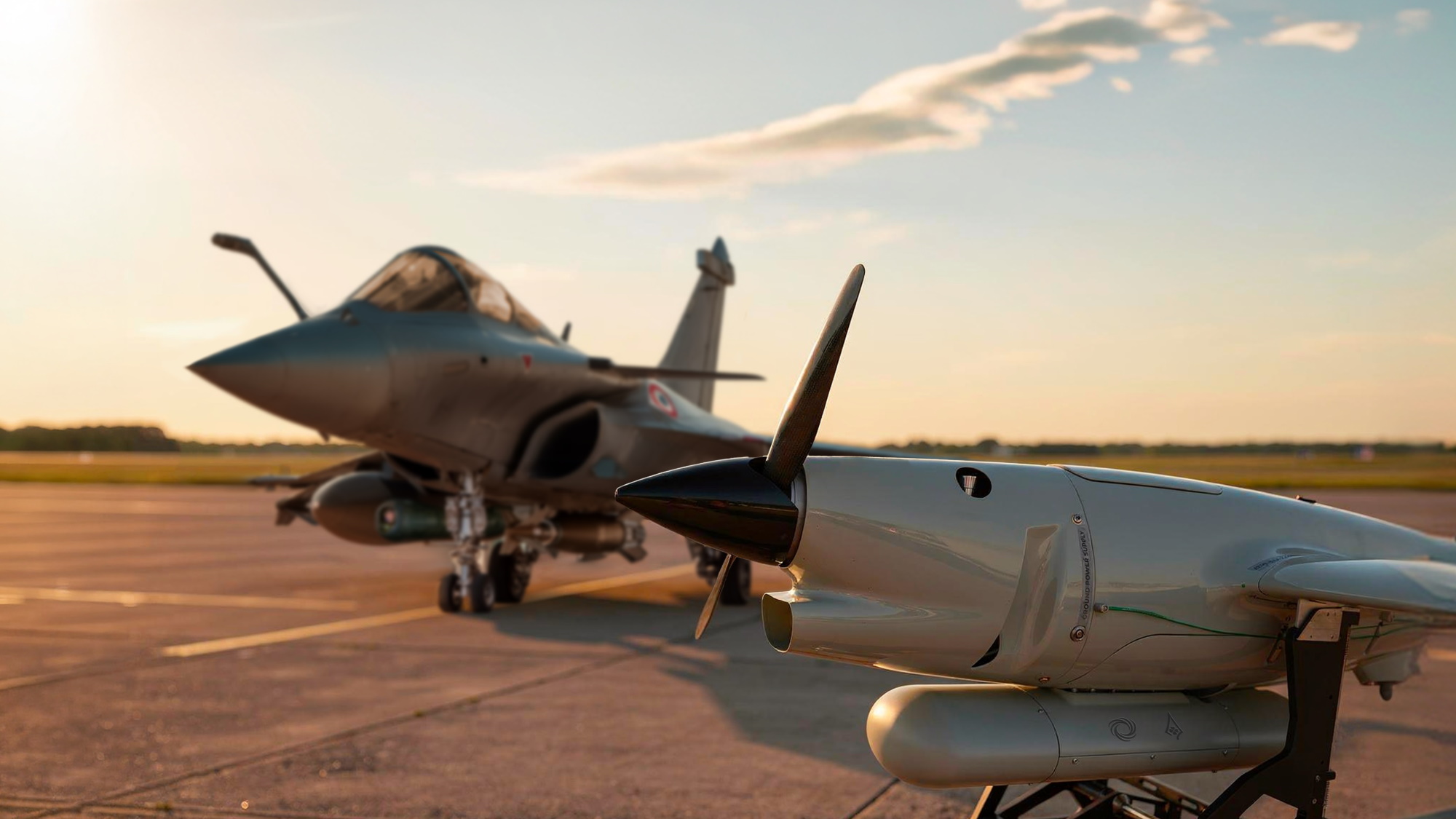
NAMIB, the New Electronic Warfare Payload Successfully Completes a Collaborative Flight with a Rafale - Press kits
Dassault Aviation and Harmattan AI today announced the successful execution of a collaborative in-flight engagement between a Rafale F4 and an unmanned aerial system equipped with the NAMIB payload, a new electronic warfare device jointly developed by both companies. © Harmattan - Dassault Aviation
 www.dassault-aviation.com
NAMIB, the New Electronic Warfare Payload Successfully Completes a Collaborative Flight with a Rafale
Dassault Aviation and Harmattan AI today announced the successful execution of a collaborative in-flight engagement between a Rafale F4 and an unmanned aerial system equipped with the NAMIB payload, a new electronic warfare device jointly developed by both companies.
NAMIB is an electronic warfare payload capable of detecting, identifying, and geolocating electromagnetic emissions, in particular those from air defense systems. It can be carried by tactical drones, including quadcopters, as well as by longer-endurance, fixed-winged unmanned aircraft.
During the flight, NAMIB discreetly detected and precisely geolocated a radar located several dozen kilometers away. The target’s location was transmitted to the Rafale, which then simulated a strike on the target.
The development of NAMIB, initiated in January 2026, is one of the key initiatives under the strategic partnership between Dassault Aviation and Harmattan AI, which aims to integrate advanced autonomous capabilities into the next generation of air combat systems.
“This flight demonstrates the Rafale’s real and tangible multi-domain collaborative combat capabilities. The F4 standard architecture enables seamless communication with a very broad range of operational assets, including ground forces, allowing it to effectively leverage new capabilities, such as NAMIB’s electromagnetic detection and geolocation functions”, said Eric Trappier, Chairman and CEO of Dassault Aviation. “It also provides another illustration of the Rafale’s continuous adaptation to evolving operational requirements, and, in this case, to ‘high-low mix’, that is, the combination of highly sophisticated systems with autonomous and expendable effectors.”
“Electronic warfare has become a decisive factor in achieving operational superiority. Through NAMIB, we are demonstrating that these capabilities can now be deployed on lightweight autonomous systems operating close to the threat. This achievement highlights the complementary strengths of Dassault Aviation and Harmattan AI, combining decades of experience in air combat systems with our expertise in autonomy and embedded intelligence. Together, we are demonstrating that it is possible to accelerate the integration of disruptive technologies for the benefit of the armed forces and lay the groundwork for the collaborative combat architectures of tomorrow”, said Mouad M’Ghari, Co-Founder and CEO of Harmattan AI.

Ukraine agrees on plan to acquire 16 Rafale jets, France’s Macron says
Ukraine has agreed on a plan to acquire 16 Rafale fighter jets from France together with the accompanying weapon systems, along with air-defense equipment.
 www.defensenews.com
Ukraine has agreed on a plan to acquire 16 Rafale fighter jets from France together with the accompanying weapon systems, French President Emmanuel Macron said at a press conference here late Monday following a meeting of the group of countries that have pledged support to Ukraine.
"upgraded SPECTRA EW suite,"French Dassault Rafale F4 and F5 Standards: Next-Gen Connectivity, Drone Ops, and Strike Precision
Equipped with the Thales RBE2 XG radar and helmet-mounted displays, the F4 upgrade boosts situational awareness and data fusion for seamless coordination with allied forces. F5 standard, expected post-2033, will integrate hypersonic ASN4G missiles for nuclear deterrence.
The F4 standard — qualified in three increments from 2023 to 2027 — transforms the aircraft from a capable fourth-generation fighter into a networked combat system with Meteor missiles, AESA radar, and collaborative datalinks. Beyond F4, the F5 standard (entering service ~2030) will add a 20%-more-powerful M88 T-REX engine, a loyal wingman UCAV derived from the nEUROn demonstrator, and AI-enabled autonomy.
1. The F4 Ladder
The F4 standard is structured as three incremental sub-standards, each adding capabilities that build on the last:
F4.1 Mar 2023 MBDA Meteor BVR missile, Thales TALIOS targeting pod, Scorpion helmet-mounted display, CONTACT radio (initial), improved data fusion F4.2 Oct 2025 Collaborative combat datalink (centrepiece), Link 16 Block 2, SATCOM, TRAGEDAC/CAPOEIRA sensor fusion, AI-assisted operations F4.3 ~2027 (testing) MBDA MICA NG (dual IR/RF seeker), upgraded SPECTRA EW suite, TALIOS with AI target recognition, enhanced multi-domain connectivity
The step change is F4.2. It turns the Rafale from an individually capable aircraft into a networked node — the ability to fight as part of a system of systems rather than as an individual platform.
2. The F5 Standard: Engine, Drone, AI
The F5 is not an incremental sub-standard. It is a generational upgrade — the last major evolution of the Rafale airframe before whatever follows FCAS. Full-scale development begins 2026–2027, with entry into service targeted for approximately 2030.
Three elements define the F5:
The M88 T-REX engine. Unveiled by Safran at the Paris Air Show in June 2025, the T-REX produces 88.2 kN (9 metric tons) of thrust with afterburner — a 20% increase over the current M88. It achieves this through an improved low-pressure compressor, a new high-pressure turbine with advanced cooling, and a modified exhaust nozzle, all within the same physical envelope as the existing engine. Qualification is aligned with F5 entry into service. Safran explicitly describes the T-REX as a technology bridge toward FCAS engine requirements.
The loyal wingman UCAV. In October 2024, the French Minister of the Armed Forces formally launched development of the Collaborative Combat Aircraft (CCA) — a stealth UCAV derived from the nEUROn demonstrator, which has completed 170+ test flights since its December 2012 maiden flight. A new UCAS model was debuted at the Paris Air Show in June 2025. Capabilities include an internal weapons bay, autonomous ISR, SEAD, and electronic warfare. Operational deployment is targeted for 2033.
Harmattan AI. On 12 January 2026, Dassault and Thales announced an agreement to develop embedded AI functions for the F5, with particular focus on controlling unmanned aerial systems. The programme is named Harmattan — a sovereign AI capability that will give the Rafale F5 autonomous control over its loyal wingman without dependence on external AI stacks or allied systems.
Additional F5 features include the RBE2 XG radar (gallium nitride AESA, a significant leap in power and electronic attack capability), the ASN4G hypersonic nuclear cruise missile (replacing the ASMPA), and enhanced electronic warfare and cyber resilience. The F5 is the first French combat aircraft conceived from the outset for networked operations with drones and AI.
what excatly ???
i want to know this + whats the current rf spectrum range of spectra some say 2-20 other say 2-40
and some clarification here does spectra has gaas aesa based jammers and othogonal detector or anyq equivalent system ??
Another question can a targeting pod-based system work together with an IRST (Infrared Search and Track) sensor on an aircraft, where both systems collect imagery and sensor data to improve long-range detection of low-RCS targets?
Could a targeting pod also contribute to this kind of detection role? Now imagine a group of aircraft equipped with similar systems working together — how would that kind of network function?
Could a targeting pod also contribute to this kind of detection role? Now imagine a group of aircraft equipped with similar systems working together — how would that kind of network function?
These are beginner-level questions that have already been answered dozens of times: historically—meaning since the early 2000s—the frequency band covered by SPECTRA was 0.6–18 GHz; it was later extended to 0.6–40 GHz, and finally, for the F4 standard, it was expanded up to 300 GHz as well as into the lower frequency ranges (though I don't know the exact lower limit).Typical answer to hard questions
put up pictures or videos with music
Targeting pods feature much larger optics than built-in IRST systems, resulting in significantly better performance; there is no benefit to operating both simultaneously on the same aircraft. However, using them on two different aircraft is advantageous—particularly for triangulation, which allows for pinpointing the enemy's exact location rather than just determining their bearing.