
Defence Budget Allocation & Defence Procurement Procedure : News & Discussions
- Thread starter Ashwin
- Start date
You are using an out of date browser. It may not display this or other websites correctly.
You should upgrade or use an alternative browser.
You should upgrade or use an alternative browser.


This is a controversial topic to dabble into. But I was looking at the impact of OROP on our defence expenditure. Although as expected it had a negative impact on our defence expenditure by stagnating the capital outlay. I noticed a trend. Even without OROP - salary, allowance and pensions were growing consistently every year and had touched 44% of defence budget by 2013-14. By 2014-15 just before OROP became a thing, pensions were already eating 21% of the pie. So, we were already heading towards a budgetary crisis it is just that OROP made it extra bad. One of the worst decision by the government. But even in alternative scenario without OROP we would have probably been in a similar position looking at the historical trend. Although it would have been slightly better than current situation.
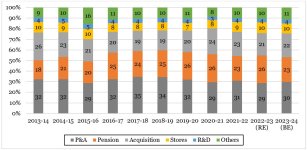
I would not mind getting corrected and hear feedbacks from folks here, what alternative steps could have been taken or can be taken to resolve this problem. Like NPS for new entrant instead of OROP perhaps? What is your take guys on this crisis we are facing?
I would not mind getting corrected and hear feedbacks from folks here, what alternative steps could have been taken or can be taken to resolve this problem. Like NPS for new entrant instead of OROP perhaps? What is your take guys on this crisis we are facing?


Pension ratios cannot drastically change without OROP. Pay commission changes come into effect for both salary and pension equally. So the assumption of inevitability is not correct.This is a controversial topic to dabble into. But I was looking at the impact of OROP on our defence expenditure. Although as expected it had a negative impact on our defence expenditure by stagnating the capital outlay. I noticed a trend. Even without OROP - salary, allowance and pensions were growing consistently every year and had touched 44% of defence budget by 2013-14. By 2014-15 just before OROP became a thing, pensions were already eating 21% of the pie. So, we were already heading towards a budgetary crisis it is just that OROP made it extra bad. One of the worst decision by the government. But even in alternative scenario without OROP we would have probably been in a similar position looking at the historical trend. Although it would have been slightly better than current situation.
View attachment 48119
I would not mind getting corrected and hear feedbacks from folks here, what alternative steps could have been taken or can be taken to resolve this problem. Like NPS for new entrant instead of OROP perhaps? What is your take guys on this crisis we are facing?
OROP was a bad idea. NPS is not possible for armed forces. Only long term solution is to implement Agniveer.
But even with Agniveer we are gonna still stuck with 40%+ going into P&A and Pensions for another decade or so. Why not create a much for fiscally affordable variant of pension scheme for new entrants? So we won't have to deal with OROP in the future at all.Pension ratios cannot drastically change without OROP. Pay commission changes come into effect for both salary and pension equally. So the assumption of inevitability is not correct.
OROP was a bad idea. NPS is not possible for armed forces. Only long term solution is to implement Agniveer.
Affordable how? Every soldier deserves all benefits of a central government employee. You cant take that away.But even with Agniveer we are gonna still stuck with 40%+ going into P&A and Pensions for another decade or so. Why not create a much for fiscally affordable variant of pension scheme for new entrants? So we won't have to deal with OROP in the future at all.
One easier thing to do is to reduce the size of the army forces. We have the largest standing army, and there is no reason to maintain such a size when incorporating so much technology.
I meant something like the BRS system in the states. But I get the point, soldiers deserve all benefits for their full filing their duty.Affordable how? Every soldier deserves all benefits of a central government employee. You cant take that away.
One easier thing to do is to reduce the size of the army forces. We have the largest standing army, and there is no reason to maintain such a size when incorporating so much technology.
A more hybrid approach rather a predefined benefit that goes up every 5 years with new pay grade. With a separate ministry with its own budget to deal with management of pay, allowances & pension.
Last edited:
Pushing to separate ministries won't solve anything. That's just accounting obfuscation, which is what Pakistanis do. End of the day both comes from the Consolidated Fund.I meant something like the BRS system in the states. But I get the point, soldiers deserve all benefits for their full filing their duty.
A more hybrid approach rather a predefined benefit that goes up every 5 years with new pay grade. With a separate ministry with its own budget to deal with management of pay, allowances & pension.
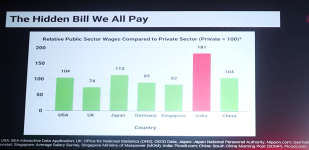
In my opinion, the fundamental issue is with government employee wage inflation compared to that of private employees. Its not a defence only issue.
Yeah. Two budgets can maybe do the trick. But the goal ultimately is to have an economy that can not only afford the pensions, salary, other benefits given to forces, but also have outmatching it, capex for acquisition and such.I meant something like the BRS system in the states. But I get the point, soldiers deserve all benefits for their full filing their duty.
A more hybrid approach rather a predefined benefit that goes up every 5 years with new pay grade. With a separate ministry with its own budget to deal with management of pay, allowances & pension.
Big News
Defence Procurement Procedure getting Revamped in 2026
Defence Procurement Procedure getting Revamped in 2026


DAP Unlikely to Treat Indian Arm of FOEMs as Domestic Companies
The much-awaited amendments to the Defence Acquisition Procedure (DAP), 2020, are in their final stages of review and are likely to be made public in a draft form soon for different stakeholders to re
 bharatshakti.in
DAP Unlikely to Treat Indian Arm of FOEMs as Domestic Companies
By Nitin A. GokhaleThe much-awaited amendments to the Defence Acquisition Procedure (DAP), 2020, are in their final stages of review and are likely to be made public in a draft form soon for different stakeholders to react, comment and suggest changes, according to indications available from sources in the Ministry of Defence (MoD).
In a decision that will please Indian domestic manufacturers, the MoD is unlikely to allow wholly owned Indian subsidiaries of foreign OEMs (Original Equipment Manufacturers) to be treated as Indian companies, at least for the time being.
Last released in 2020, the new version is likely to have only three procurement categories: Buy (Indian-IDDM), Buy and Make (Indian) and Buy Global (Manufacture in India). In the DAP 2020, there are five different categories for procurement.
Another important change is likely to be the decision to amend the no-cost, no-commitment (NCNC) trials procedure. So far, those vendors who cleared the trials and got shortlisted but did not necessarily win the contract had to bear substantial expenditure to participate in the stringent tests. Now, there is a likelihood of the MoD reimbursing the cost of participation in the trials to those who pass the test and get shortlisted before commercial bids are opened, reducing the financial burden on the companies.
One more proposal that might help the industry in the long run is to have variable pricing clauses in long-term contracts. So far, once a contract is signed, companies have had to supply platforms and equipment at a fixed cost throughout the period of supply, irrespective of escalation in the cost of materials or production. There is a suggestion, therefore, to factor in rising inflation with a fixed ceiling in long-term contracts to give space for better financial planning to the companies.
No one is sure whether the upcoming DAP manual will be as thick as the earlier ones, but introducing greater flexibility and ease of doing business is the main principle on which this document will be based, the sources added. There will be more features (squeezing the timelines from AoN to contract signing, simplified testing and trial procedures, stricter adherence to delivery deadlines, and stricter penalties for non-delivery within a contracted deadline, for instance), among other changes, it is learnt.
Provisions of EP (Emergency procurement), adopted post-2020 (the 6th iteration is currently in progress), will likely be a permanent feature in the DAP, under what is called Fast Track Procedure, letting Service HQs buy what is of immediate need within a specified financial limit. Although the Fast Track Procedure is available under the current DAP, it requires the Defence Minister’s nod in each case.
There is also a proposal to provide flexibility in furnishing bank guarantees by Indian companies and to allow Service HQs to buy a limited quantity of certain equipment/platforms from Indian vendors, with the provision that more orders will be placed if the company can demonstrate the ability to carry out spiral development within a specified time. These provisions are likely to be based on an assumption that there will be a mindset change among procurement professionals since the services are now sourcing more and more from domestic companies and therefore need to do initial hand-holding for these companies.
Overall, the defence sector is likely to grow at a much faster pace as India navigates the global churn and faces an uncertain future, located as it is in a highly volatile region. A 20 per cent increase in the capital expenditure (new acquisitions) budget has been demanded by the MoD in the upcoming Union budget, mainly to cater to the increased needs of the Indian Air Force (IAF). If that comes through, Indian defence manufacturers can hope to become an important part of the supply chains of defence majors, who will be mandated to have a larger Indian presence in the coming years.


Rafale purchase is guaranteed now

Defence Sec. says this 21% increase in CAPEX won't be one-off and we will see the same 20% growth for the next 5 years. Also, the defence budget reached from 1.8% to 2% of GDP and plan to reach 2.5% within next 5 years. Watch from 3:29:05
