
Volkswagen is considering deeper cost cuts — potentially up to 100,000 jobs and multiple factory closures in Germany. But unlike many global carmakers, VW faces a powerful force: its workers. Backed by strong unions and the unique “Volkswagen Law,” labour has significant influence over the company’s biggest decisions.
European Union - News and Updates
- Thread starter Shan
- Start date
You are using an out of date browser. It may not display this or other websites correctly.
You should upgrade or use an alternative browser.
You should upgrade or use an alternative browser.
The European Union buys nearly a third of Pakistan's exports but how important is Pakistan to Europe?

Western Europe just recorded its hottest June ever, driven by a severe heatwave. The news comes as another heatwave sweeps across Europe this week. As the world's fastest-warming continent, Europe is experiencing more frequent and intense heatwaves.

'Project Firepower': Inside Rheinmetall's gunpowder expansion as Europe races to replenish its ammunition
Scarcity of gunpowder is seen as a choke point for ramping up production of ammunition for militaries, and a barrier for Europe to ensure defense sovereignty
Hidden among forests and farmland beneath the Bavarian Alps, Rheinmetall’s sprawling industrial site feels more like a small village than one of Europe’s most strategically important defense facilities.
Factory buildings are spread across roughly 90 hectares of land as construction crews work on a vast expansion, known as “Project Firepower,” that will transform the site into one of Europe’s largest gunpowder plants.
The quiet surroundings belie the significance of what is being built there. As European governments dramatically increase defense spending following Russia’s invasion of Ukraine, one of the biggest challenges has become producing enough ammunition. And one of the biggest constraints on that effort has been gunpowder.
Gunpowder prices have spiked as the war in Ukraine depleted stockpiles.
“Without gunpowder, it’s impossible to protect our people because at the end of the day, you need gunpowder for ammunition,” Rheinmetall CEO Armin Papperger told CNBC’s Annette Weisbach at the Bavarian site on Wednesday. “Without gunpowder, no warhead will go out of the barrel.”

Severe wildfires in Spain and France have forced thousands of people to leave their homes as firefighters struggle to control the flames. In Spain, three wildfires west of Madrid have merged into one massive blaze. Officials said the fire is currently beyond fire-fighters’ ability to fully contain because of extreme heat, strong winds, and dry conditions. Spain’s government has declared a national emergency, with more than 60,000 people in the Madrid region have been affected, with around 30,000 evacuated and others ordered to stay indoors.
Madrid’s regional leader Isabel Díaz Ayuso called it the worst wildfire in the region’s history. The Military Emergency Unit has been sent to protect towns near El Escorial and other affected areas.
In south-west France, more than 140,000 people have been evacuated as wildfires spread through the Gironde and Landes regions. The Gironde fire has destroyed homes and burned more than 19,000 hectares of forest. Authorities said the fire is unusually powerful and difficult to control because of drought, high temperatures, and strong winds.
French President Emmanuel Macron has sent additional support, including military assistance and help from European countries. Around 50 firefighters have been injured while fighting the flames.
Italy's Interior Ministry has ordered the closure of the country's sea and air borders with Spain, temporarily suspending the Schengen free movement regime between the two countries.
The move was announced on Thursday evening by Prime Minister Giorgia Meloni and Deputy Prime Ministers Antonio Tajani and Matteo Salvini following the arrival of thousands of migrants in the Spanish North African enclave of Ceuta.
"The temporary suspension of Schengen with Spain is a necessary choice to safeguard the security of our citizens and defend the European borders. A measure provided for by the treaties and made unavoidable today," Tajani wrote on X.
"The migrant crisis in Ceuta reminds us that the management of the Union’s borders is a shared responsibility among our countries, one toward the other. We must work together to prevent uncontrolled migrant flows from entering EU territory, with all the consequent risks and the threat of terrorism, which must be countered without hesitation."
Spain has said the death toll in the Ceuta border crisis with Morocco has risen to 72. The victims include migrants who drowned and others who died in a stampede while attempting to cross into the Spanish enclave. In response to the unprecedented influx, Spanish authorities have begun installing a 500-metre-long containment barrier along the sea border between Ceuta and neighbouring Morocco to curb illegal crossings.
Meanwhile, the European Union will hold emergency talks on Tuesday to discuss the migration crisis in Ceuta. Twenty-two member states have issued a joint letter calling for coordinated action and the strengthening of the EU’s external borders after around 60,000 migrants entered the Spanish enclave from Morocco earlier this week. Spain’s Interior Ministry said most of the migrants have already returned to Morocco, while authorities on both sides continue efforts to restore order and address the humanitarian situation.
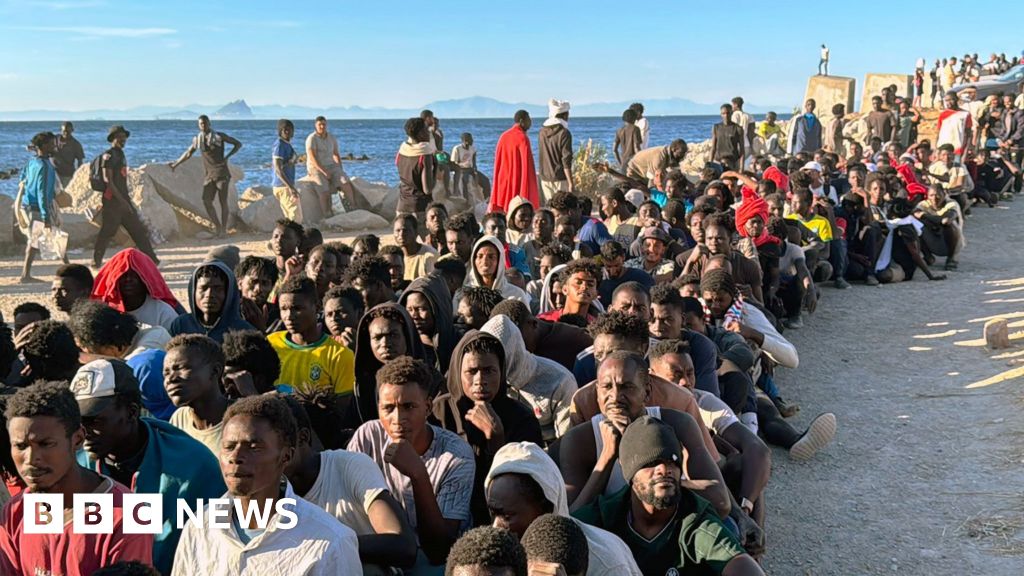
Spain to impose border controls against Italy as row over Ceuta migrant influx intensifies
Italy introduced border controls following an influx of about 78,000 migrants from Morocco into the neighbouring Spanish exclave of Ceuta.
 www.bbc.com
Spain has imposed border controls on all air and sea travel from Italy as a row between the two EU countries intensifies.
The measures - which started at midnight (22:00 GMT) and will last for a month - come a week after Italy introduced similar restrictions following an influx of about 78,000 migrants from Morocco into the Spanish exclave of Ceuta.
On Friday, Spain demanded Italy reverse its checks by Sunday. Rome said they would stay until at least 15 August - when, it said, Spain "expects a new wave of migration" to hit Ceuta.
The crisis has pitted Spain's socialist leader Pedro Sanchez against Italy's conservative leader Giorgia Meloni - who has long called for stricter EU migration rules.
Poland is expanding its defences with the aim of creating Europe's largest army by 2030. Across European capitals, the focus is on cutting U.S. reliance and making weapons at home. Can Europe achieve this ambitious target? Palki Sharma tells you.
European gas prices have surged around 120% in 2026, reaching roughly €64 per megawatt-hour as extreme heat, low gas storage, Norwegian supply disruptions and geopolitical risks around the Strait of Hormuz tighten the market. Europe is using more gas to compensate for weaker hydroelectric and nuclear generation during the heatwave, leaving less fuel available for storage ahead of winter. With reserves around 60% full and demand potentially rising sharply during a cold winter, analysts warn that another supply shock could push gas prices higher, adding to inflation and increasing pressure on European households, industry and monetary policy.

The New Reconquista !
Spain's making amends for what it did to the Moors more than half a century ago . Of course the Jews don't enjoy any such concession.
Never have now will they in the future , this brief interval of around a century wherein they established their own state & enjoyed a free pass from the west notwithstanding .
Remains to be seen how will the EU see these new citizens of Spain. Seems to me the conquest of Europe by the Arabs thwarted by Charles Martel in the Battle of Tours in the 7th century is about to be undone.
Not inconceivable that Islam may eventually disappear from the land of its origin & close proximity only to thrive in Europe.
Alhamdulillah !
You may be interested ! @Bon Plan ; @Amarante ; @BMD et al

On September 10, Saudi Arabia shut its 1,200-kilometre East-West pipeline after drone attacks in the Riyadh and Medina regions. The pipeline will remain mostly out of service for weeks. The disruption threatens up to 4% of global oil supply, with Brent crude trading above $113 a barrel as Houthi forces simultaneously tighten their grip on the Bab el-Mandeb Strait.
Last edited:

Italian Prime Minister Giorgia Meloni is pushing a new set of measures that could ban burqas and niqabs in schools, limit the number of foreign students in classrooms and require some parents of foreign students to learn Italian. Meloni says the measures are about equality, integration and ensuring that those living in Italy participate fully in Italian society. But the proposals also come against the backdrop of her government’s broader focus on migration, national identity and 'Italy First' politics. With Italy heading towards another election, what does Meloni’s latest push tell us about the country’s changing political landscape?
Energy prices are rising worldwide, but Europe has been hit especially hard. EU energy ministers are searching for ways to contain the impact, as consumers have already paid more than €100 billion extra this year and winter has yet to begin. Why does Europe remain so vulnerable to energy shocks, and can policymakers prevent another painful winter?
High school students across France set fires and clashed with police on Wednesday and Thursday, escalating nearly a week of disruption. As President Emmanuel Macron’s government weighs how to balance historic public debt with already strained state spending, an under-resourced, overstretched education sector lies at the root of students’ anger.

The clashes occurred as thousands of protesters took to the streets of the Belgian capital, including students inspired in part by demonstrations in neighbouring France. The strike disrupted public transport and air travel, while many schools and childcare facilities were also affected.
Among the demonstrators, some carried placards reading "I skipped class to defend class" and "Education is a right, not a privilege."
The Belgian walkout is part of a wave of protests sweeping Europe, with students in France and Italy, among other countries, taking to the streets over education funding, while tens of thousands have rallied in Spain over a housing crisis.
Police said while the march itself, joined by around 30,000 people, passed off peacefully, clashes erupted near Brussels Central Station and in central Brussels where groups threw bottles, bricks, stones and fireworks at police, set fires and damaged public property.
France and Germany are proposing a new "second-strike" trade weapon to counter China’s economic coercion. This marks a major shift for Berlin, signaling a united front against Beijing’s growing trade dominance. The plan aims to bypass slow EU bureaucracy and protect critical industries from unfair subsidies. If adopted, it could significantly escalate trade tensions and redefine Europe’s approach to global commerce.