

Last edited:
Explosion near Red Fort: At least 9 dead, several injured in blast
- Thread starter Defc0n
- Start date
You are using an out of date browser. It may not display this or other websites correctly.
You should upgrade or use an alternative browser.
You should upgrade or use an alternative browser.

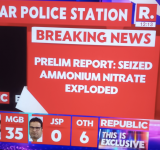
There's no way that's an accident. FSL were professionals. This is sabotage! All 2900kg gone???? Trying to destroy evidence? Wtf
There's no way that's an accident. FSL were professionals. This is sabotage! All 2900kg gone???? Trying to destroy evidence? Wtf
There is no effin' way --

FSL would be the last people on Earth to poorly handle such stuff.Poor handling of explosives, what else.
View attachment 47803


Poor handling of explosives, what else.
View attachment 47803
How does Ammonium Nitrate explode without a detonator? Also - it needs to be mixed with FO, right?
This is beyond comprehension as far as I am concerned.
No way!! It's ammonium nitrate, which doesn't go off by itself. Then the FSL had professionals. In such a high profile case, only the best of the best would be sent.Poor handling of explosives, what else.
View attachment 47803
They won't make mistakes that would make substance to explode. There is definitely another angle to it. It's the same station which cracked this module. Someone is angry and wanna destroy evidence? If the explosives itself is gone.. it's gonna be easier for sibbal to defend themselves and lordies to acquit them.
No way it's mishandling. And what were they doing in the station. At night. They found a lead? Don't FSL had specialised labs to handle such explosives with all precautionary mechanism? Is there a mole inside the police who turned fidayeen?
Damn! This white collar terror network has made me feel like a conspiracy theorists.
Ammonium Nitrate catches fire easily. The infamous Beirut explosion was also ammonium nitrate stored in a warehouse.How does Ammonium Nitrate explode without a detonator? Also - it needs to be mixed with FO, right?
This is beyond comprehension as far as I am concerned.
Ammonium Nitrate catches fire easily. The infamous Beirut explosion was also ammonium nitrate stored in a warehouse.
True. But the thing is, it has to be mixed with Fuel oil to be that combustible. On its own, it’s not a fuel. Were stored ANFO there? And FSL people were negligent around such stuff? Well, this week has been nothing short of bizarre!

Ammonium Nitrate is used in making fertilizer. It is transported in trucks in sacks with normal cloth cover. A typical bomb having Ammonium Nitrate uses mineral oil or diesel to ignite and bring the required temperature for detonation to happen.There is no effin' way --
Impossible. No one can mix 30 quintals of Ammonium Nitrate and diesel fuel or mineral oil and keep it just like that. Thats a major hazard and it will be netralized immediately. Either by detonating it or by separating both.Were stored ANFO there? And FSL people were negligent around such stuff? Well, this week has been nothing short of bizarre!
Ammonium Nitrate catches fire easily. The infamous Beirut explosion was also ammonium nitrate stored in a warehouse.
Arre but why would FSL lit up a fire knowing they are investigating an explosive.
And beruit explosion wasn't done by mishandling by professional. But sheer neglect of a welder.
From Google AI.
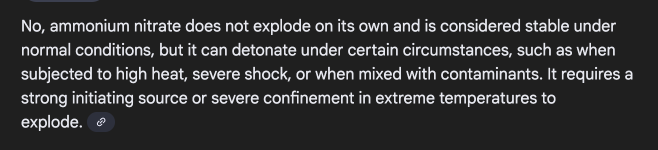
Ammonium nitrate itself is not a high explosive but a powerful oxidizing agent. It becomes a potent and dangerous explosive under certain conditions, such as when contaminated with combustible materials, heated under confinement, or initiated by a powerful shock.
Key points regarding its explosive nature:
Oxidizer: Ammonium nitrate provides oxygen to support combustion, meaning it accelerates the burning of other materials.
Requires Sensitization: In its pure form, it is relatively stable and difficult to detonate. To be used as an explosive, it must be mixed with a fuel (like fuel oil, forming ANFO, a common industrial explosive) and requires a strong external detonation source to initiate a reaction.
Conditions for Accidental Explosion: Catastrophic accidental explosions, such as those in Texas City (1947) and Beirut (2020), occurred when large quantities of ammonium nitrate were stored improperly, especially when exposed to fire under confinement or mixed with organic/combustible materials.
Regulation: Due to its potential for misuse in improvised explosive devices, its manufacture, storage, and sale are strictly regulated in many countries.
In summary, while not an explosive on its own, it is a key component in the manufacture of many commercial and improvised explosives.
2.
Major accidental explosions of
ammonium nitrate generally stem from two primary mechanisms: contamination with combustible materials and an intense, confined fire, or detonation by an external explosive source.
Here are details on some of the most catastrophic accidental cases:
The Texas City Disaster (1947)
This was the deadliest industrial accident in U.S. history.
- Date: April 16, 1947.
- Location: Port of Texas City, Texas, USA.
- Circumstances: A fire broke out in the cargo hold of the French-registered vessel SS Grandcamp, which was being loaded with approximately 2,300 tons of ammonium nitrate. The captain ordered the hold sealed and pressurized steam pumped in to smother the fire. This attempt failed and likely contributed to the conditions necessary for detonation. The fire produced yellow-orange smoke (nitrogen dioxide), attracting a crowd of spectators.
- Impact: The ship exploded with massive force, killing at least 581 people, including all but one member of the local volunteer fire department who were on the docks. The blast caused a 15-foot wave, launched flaming debris that started a chain reaction of fires in nearby chemical plants and oil storage facilities, and ignited another ship, the High Flyer, which exploded the next day.
The Oppau Explosion (1921)
This disaster was one of the largest artificial non-nuclear explosions ever recorded.
- Date: September 21, 1921.
- Location: BASF plant in Oppau, Germany.
- Circumstances: Workers were using industrial explosives to break up a hardened mass of approximately 4,500 tonnes of a fertilizer mixture (a 50:50 mix of ammonium nitrate and ammonium sulfate) in a warehouse. This method had been used successfully over 20,000 times before without incident, but it is believed that poor mixing in that specific section led to a higher concentration of ammonium nitrate, making it more sensitive.
- Impact: The explosion killed 561 people and injured more than 2,000, devastating the factory and the town of Oppau.
The Beirut Explosion (2020)
A recent high-profile case resulting from years of negligence and improper storage.
- Date: August 4, 2020.
- Location: Port of Beirut, Lebanon.
- Circumstances: Around 2,750 tonnes of confiscated technical-grade ammonium nitrate had been stored in a port warehouse for six years without appropriate safety measures. A fire, reportedly started by workers welding a door in the same warehouse or by stored fireworks nearby, spread to the ammonium nitrate and triggered the massive detonation.
- Impact: The blast killed over 218 people, injured more than 7,000, and displaced around 300,000 people from their homes. It created a crater 140 meters (460 feet) wide and was felt as far away as Cyprus. The distinctive red-orange cloud seen in videos was caused by nitrogen dioxide, a byproduct of the decomposition.
The Tianjin Explosions (2015)
A series of explosions at a hazardous goods warehouse in China.
- Date: August 12, 2015.
- Location: Port of Tianjin, China.
- Circumstances: A fire started in a warehouse storing flammable chemicals, including nitrocellulose, which spontaneously combusted due to overheating. Firefighters initially responded to the scene, but the fire spread to approximately 800 tonnes of ammonium nitrate stored nearby, causing a massive detonation. The storage of incompatible materials was a major safety violation.
- Impact: The incident resulted in 173 deaths, many of whom were emergency personnel, and hundreds of injuries.
Common Factors
These disasters highlight recurring failures in safety management, including:
- Improper Storage: Storing large quantities in a single, confined space, often in urban areas or near incompatible combustible materials.
- Lack of Knowledge/Adherence to Guidelines: A failure to understand or follow safety warnings and regulations regarding the dangers of the substance when exposed to heat or fire.
- External Ignition Source: In most cases, a primary fire or a smaller explosive charge initiated the reaction.
3.
Regarding FSL's Hypothetical mishandling. What it takes :-
Reasons for Potential Accidents
While professional FSL and law enforcement teams are trained to handle hazardous materials safely, mistakes or negligence can lead to an explosion for the following reasons:
Improper Handling: Handling the substance without the correct personal protective equipment (PPE), in an unventilated area, or without due care can create dangerous conditions. The material should be kept dry and away from all heat sources.
Contamination: A key factor in many accidental explosions is the mixing of ammonium nitrate with incompatible and combustible materials, such as fuel oil, organic substances, or finely divided metals. The presence of such contaminants drastically lowers the temperature and pressure threshold required for detonation. If officers are unaware of contamination or if the material was seized mixed with other chemicals, the risk increases significantly.
Heat or Fire: Accidental fires are a primary cause of ammonium nitrate disasters. If seized material is stored near an ignition source (e.g., faulty electrical circuits, welding sparks) or exposed to intense heat, it can ignite and potentially detonate, especially if confined.
Lack of Proper Storage Conditions: Storing large quantities in confined spaces (like a standard police station room or an unventilated warehouse) without adherence to specific safety guidelines (such as those from PESO in India or the ATF in the US) increases the risk of deflagration-to-detonation transition in the event of a fire.
Inadequate Training/Awareness: Though procedures exist, not all personnel may have the specialized training required for handling bulk quantities of highly sensitive or already-mixed explosive materials. The seized material often comes with unknown variables, making initial handling particularly risky.
Strict adherence to safety protocols is crucial to prevent such accidents. Safety guidelines recommend that the area be evacuated in the event of a fire, and the material should be kept in well-ventilated, fire-resistant buildings away from other chemicals.
Last edited:
Who knows, if it was a cigarette, a hidden timer and fuse, a sabotage attempt by someone who gave the fire source and ran away, or a short circuit...Arre but why would FSL lit up a fire knowing they are investigating an explosive.
And beruit explosion wasn't done by mishandling by professional. But sheer neglect of a welder.
I just hope no one is in danger.
Ammonium Nitrate is used in making fertilizer. It is transported in trucks in sacks with normal cloth cover. A typical bomb having Ammonium Nitrate uses mineral oil or diesel to ignite and bring the required temperature for detonation to happen.
Impossible. No one can mix 30 quintals of Ammonium Nitrate and diesel fuel or mineral oil and keep it just like that. Thats a major hazard and it will be netralized immediately. Either by detonating it or by separating both.
Exactly my point. How does this stuff accidentally blow up?

Who knows, if it was a cigarette, a hidden timer and fuse, a sabotage attempt by someone who gave the fire source and ran away, or a short circuit...
I just hope no one is in danger.
Exactly my point. How does this stuff accidentally blow up?
Look at my above post again. I edited it to include some info.
From what I understand, it would take extreme coincidence for an accident. Either FSL team was substandard, which is unlikely for such high profile cases. OR it's an internal sabotage!
It could be anyone from an attendant, sweeper to a guard.. I firmly believe this is a revenge or further provocative action against India. A terror attack.
Remember.. They transported the nitrate successfully. And we are to believe, it was accident in a lab under professionals, lab specifically for such tasks?
And why was explosives with J&K police, when the case was with NIA. Why was it taken to Kashmir?
Just looking for some answer.

Just looking for some answer.
Last edited:
Who said it was taken there? Only a fraction was recovered in Faridabad, most was recovered in Kashmir. And the police stations in J&K have explosive handling facilities unlike other police units in India due to obvious historical reasons.And why was explosives with J&K police, when the case was with NIA. Why was it taken to Kashmir?
Just looking for some answer.
NIA isn't gonna examine explosives.
Prompts were subpar since I rushed. And forgot to customise it to not be agreeable. Haven't used in a while. Take it with a pinch of salt.And why was explosives with J&K police, when the case was with NIA. Why was it taken to Kashmir?
Just looking for some answer.
I know NIA won't examine. But they must have labs under their jurisdiction too, right?Who said it was taken there? Only a fraction was recovered in Faridabad, most was recovered in Kashmir. And the police stations in J&K have explosive handling facilities unlike other police units in India due to obvious historical reasons.
NIA isn't gonna examine explosives.
Sorry mate, i am just having hard time digesting this.
Either it's a massive carelessness or massive attack.
Last edited: