General News, Questions And Discussions - Indian Navy


So, this year we will see commissioning of total 05 frigates (04 P-17A + 01 P11356) and in 2027 only 1 P11356 will be commissioned.

If we talk about planned PSC commissioning post 2027 then:
1. Contract for NGC will be signed this year and the first vessel (out of 08) will be commissioned after 5 years so 2031-2032.
2. Contract for P-17B will also be signed this year or probably next year and the first vessel (out of 07) will be commissioned after 06 years so 2033.
3. NGD will go in construction around 2029 and first vessel will be commissioned after 7 years so 2035-2036.

So, we will not be commissioning any PSC till 2032 but we will be retiring 03 Rajput class destroyers by 2030.
Fleet strength would look like:
10 DDG
23 FFG

Note: I did not count the existing corvette classes under PSC but NGC will definitely be a PSC.
 

So, this year we will see commissioning of total 05 frigates (04 P-17A + 01 P11356) and in 2027 only 1 P11356 will be commissioned.

If we talk about planned PSC commissioning post 2027 then:
1. Contract for NGC will be signed this year and the first vessel (out of 08) will be commissioned after 5 years so 2031-2032.
2. Contract for P-17B will also be signed this year or probably next year and the first vessel (out of 07) will be commissioned after 06 years so 2033.
3. NGD will go in construction around 2029 and first vessel will be commissioned after 7 years so 2035-2036.

So, we will not be commissioning any PSC till 2032 but we will be retiring 03 Rajput class destroyers by 2030.
Fleet strength would look like:
10 DDG
23 FFG

Note: I did not count the existing corvette classes under PSC but NGC will definitely be a PSC.
The 11 NG-OPV currently under construction are frigate sized ships at ~3000t displacement. Some of them can be equipped with NASM-MR (soon to start flight trials reportedly) + TTL + point defence sam for a multirole capability (containerized if required)

This is essentially what the Pakistanis have done with their Yarmook class opv built by Damen.
 
  • Like
Reactions: YoungWolf

So, this year we will see commissioning of total 05 frigates (04 P-17A + 01 P11356) and in 2027 only 1 P11356 will be commissioned.

If we talk about planned PSC commissioning post 2027 then:
1. Contract for NGC will be signed this year and the first vessel (out of 08) will be commissioned after 5 years so 2031-2032.
2. Contract for P-17B will also be signed this year or probably next year and the first vessel (out of 07) will be commissioned after 06 years so 2033.
3. NGD will go in construction around 2029 and first vessel will be commissioned after 7 years so 2035-2036.

So, we will not be commissioning any PSC till 2032 but we will be retiring 03 Rajput class destroyers by 2030.
Fleet strength would look like:
10 DDG
23 FFG

Note: I did not count the existing corvette classes under PSC but NGC will definitely be a PSC.
Just to add a bit here, if the RFP for the 4xLPDs goes through (probably towards the end) this year (expected by MDL, as stated in their Q2 call), the navy might actually award a contract by 2027-28. Now, depending on the build time, you could see the first LPDs entering service by 2032-33.

That aside, there's of course, no significant/confirmed news on the second aircraft carrier.

Between 2027 and the early 2030s (until the NGCs start delivery), the only vessels the IN will induct will be submarines, OPVs, NGMVs, and auxiliaries, most notably -

11xNGOPV
6XNGMV
5XFSS

and possibly new survey vessels, and training ships.

As for submarines, there's P75I (assuming they sign the contract early this year), S4*, and if there's any movement on it, INS Chakra.

All in all, a reflection of a build plan that leaves a lot to be desired.
 

When the ship departed Porbandar, several senior political figures, from Prime Minister Narendra Modi to BJP MP Tejasvi Surya, marked the moment on social media, highlighting the use of an “ancient Indian” stitched-ship technique and India’s rich maritime traditions. On Monday, as the vessel moved closer to Muscat, Sanyal posted on X: “Day 15. We are now well inside Omani waters, north of Sur. Winds are down and back to glassy seas. So close and yet immobile. Nonetheless, the main objective of the Kaundinya now stands proved: we have demonstrated how ancient “stitched” ships from India could cross the oceans, we know the strengths and drawbacks of this design, and have good idea of the human experience of ancient mariners.”

The stitched-ship technique is not uniquely Indian. It is part of a wider Indian Ocean littoral tradition, stretching from Oman to Malaysia, says Indian Ocean historian Himanshu Prabha Ray. “It varies from place to place. Even within Oman there were different kinds of stitched boats depending on their purpose. There was never a single template that everyone followed.”

Around fifteen years ago, Oman undertook a similar exercise. The Jewel of Muscat was built using evidence from a ninth-century shipwreck discovered off the coast of Indonesia. Like the Kaundinya, it was constructed by Babu Shankaran, but its design was based on material recovered from the seabed rather than visual representations alone. “The Jewel was meticulously researched; Kaundinya’s origin, design, and historical veracity remain speculative,” says Mukherjee.

The Kaundinya voyage needs to be seen in the context of Project Mausam, a Ministry of Culture initiative for UNESCO's transnational nomination of cultural routes across the Indian Ocean in collaboration with other nations, says Ray. This initiative, announced in 2014, has failed to build partnerships with countries that are a part of this shared heritage, or develop a sustained collaborative research and study programme on maritime archaeology.
 
  • Like
Reactions: spice
Had a few things to ask here, hopefully that's fine.

Is the LR-MFR supposed to replace the EL/M-2248 MFSTAR in future IN combatants?

But given how physically big, and (therefore) power-hungry the radar (or at least the version mounted on the INS Anvesh) would be, would it be safe to assume that it would need to be scalable, and would need a scaled-down version for a 11,000-12,000-ton destroyer to mount 4 whole panels (INS Anvesh, itself a 11,000+ton ship, mounts only 2)?
 
  • Like
Reactions: aditya g
Is the LR-MFR supposed to replace the EL/M-2248 MFSTAR in future IN combatants?
That's the plan. Although, for now the only future ship that would use the LR-MFR is the P-18 class.
But given how physically big, and (therefore) power-hungry the radar (or at least the version mounted on the INS Anvesh) would be, would it be safe to assume that it would need to be scalable, and would need a scaled-down version for a 11,000-12,000-ton destroyer to mount 4 whole panels (INS Anvesh, itself a 11,000+ton ship, mounts only 2)?
All modern AESA radars are scalable. LR-MFR should be no exception. The current massive panels would be fine if the P-18's radars are superstructure mounted. We could have a 4-panel setup if it is superstructure mounted.

But if the LR-MFR needs to be mast mounted, like the EL/M-2248s on the P15A/B & P-17A, then the panels need to be scaled down.

I have written about this in the past:

Project 18, Next Generation Destroyer (NGD) : News and Updates

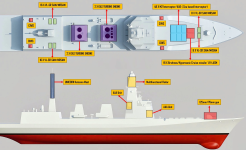
The latest renders of the P-18 show both. A 4-panel superstructure mounted radar & a 4 panel mast mounted radar:
1768501696797.png
 
If you are in comparison game against the 2 superpowers then Indian defence may not be for you.
But what's crazy is US Navy surface fleet alone is almost as much as entire PLAN fleet in terms of tonnage!!!! This isn't even about Indian defence it's about how crazy fhe capability of US is.
Tonnage is old metric.
The strength of a navy is now defined by the number of VLS tubes.
No. Submarines as well where US is well ahead of China. VLS is important but is almost helpless against super quiet SSN and SSK.
 
That's the plan. Although, for now the only future ship that would use the LR-MFR is the P-18 class.

All modern AESA radars are scalable. LR-MFR should be no exception. The current massive panels would be fine if the P-18's radars are superstructure mounted. We could have a 4-panel setup if it is superstructure mounted.

But if the LR-MFR needs to be mast mounted, like the EL/M-2248s on the P15A/B & P-17A, then the panels need to be scaled down.

I have written about this in the past:

Project 18, Next Generation Destroyer (NGD) : News and Updates

The latest renders of the P-18 show both. A 4-panel superstructure mounted radar & a 4 panel mast mounted radar:
View attachment 48999
A noobs question on my end but isn't 16 brahmos a rather small offensive capability. It seems the ship is filled to the brim with air defence assets than offensive strike assets. Or perhaps it's so because these destroyers are meant primarily as aircraft carrier escorts? Even then 16 seems a bit small.
 

INSV ‘Kaundinya’ has successfully completed its historic 18-day voyage from Porbandar, Gujarat, to Muscat’s Sultan Qaboos Port in Oman. Inspired by a 5th-century CE ship depicted in the Ajanta Caves, the vessel was crafted using ancient stitching techniques with coir rope, coconut fiber, and natural resin, blending history, craftsmanship, and modern naval expertise. The 16-member crew, captained by Commander Vikas Sheoran, included PM’s Economic Advisory Council member Sanjeev Sanyal. Upon arrival, INSV ‘Kaundinya’ was welcomed with a spectacular traditional water salute, marking the end of a remarkable maritime journey.
 
A noobs question on my end but isn't 16 brahmos a rather small offensive capability.
For a ship this size 16 Brahmos feels inadequate. There will probably be inclined launchers for NASM-MR/LR class AShMs.

The lack of a UVLM system is hurting our ship's offensive capability. There was a UVLM system under-development. No updates on that for a long time. The development of a separate VLM for Astra/VL-SRSAM isn't an encouraging sign.
It seems the ship is filled to the brim with air defence assets than offensive strike assets.
That is the case with most modern destroyers/cruisers in the world.
 
Frankly a bigger ship with huge weapon overload is a soft target. Many cheap method available both above sea level & subsea & even at surface level now to overload its surrounding protective bubble and it will not be able to function effectively. 16 brahmos is optimal, if those can not do the job then 32 or 64 won't either because you risk enemy counter trying to do mission by lingering out for longer. Therefore a mobile asset with this config is optimum.
 
Frankly a bigger ship with huge weapon overload is a soft target.
True. I would prefer if the Navy were to select a standard ship design to mass produce. Something between like a P-17A/B or even like the NGC. But if we must make large destroyers in token quantities, then at least arm them to the teeth.

The only thing that the P-18 class can do that the P-15B/C cannot do, is that they can run a long-distance sustained land attack campaign. That would of course require a larger cruise missile battery.
 
The only thing that the P-18 class can do that the P-15B/C cannot do, is that they can run a long-distance sustained land attack campaign. That would of course require a larger cruise missile battery.
Also much bigger radar, for ballistic defense.
It ended the debate and Basically the main reason p18 was chosen instead of more p15A/B successors.
 
That's the plan. Although, for now the only future ship that would use the LR-MFR is the P-18 class.

All modern AESA radars are scalable. LR-MFR should be no exception. The current massive panels would be fine if the P-18's radars are superstructure mounted. We could have a 4-panel setup if it is superstructure mounted.

But if the LR-MFR needs to be mast mounted, like the EL/M-2248s on the P15A/B & P-17A, then the panels need to be scaled down.

I have written about this in the past:

Project 18, Next Generation Destroyer (NGD) : News and Updates

The latest renders of the P-18 show both. A 4-panel superstructure mounted radar & a 4 panel mast mounted radar:
View attachment 48999