TikTok’s founder wonders what hit him
Zhang Yiming was having breakfast at home in Beijing in July when a message popped on his computer screen. A friend sent a link featuring President Trump, in which he said the coronavirus came from China and, as part of a U.S. response, he might ban TikTok, the hit video app Mr. Zhang founded.
Mr. Zhang was astonished. “China virus?" he told people around him later. What did the coronavirus have to do with TikTok?
From that initial shock, things quickly got worse.
First, Mr. Trump upped the stakes by ordering that TikTok’s parent company sell the app’s American operation or face a U.S. ban, on grounds it threatens national security through the data it gathers.
Next, as Chinese nationalists lashed out at Mr. Zhang on social media for not fighting the Trump order, Mr. Zhang’s heavy-hitting Western investors were applying pressure on him to do the opposite—heed the order and sell.
View Full Image
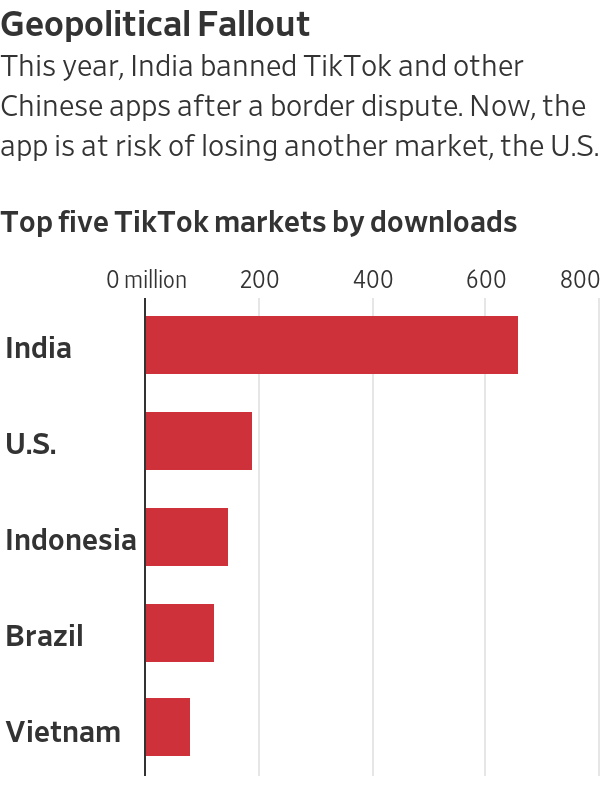
Geopolitical fallout
Mr. Zhang fired back at Mr. Trump on Monday with a lawsuit filed in federal court in California to stop the White House order. Then, he suddenly lost the high-profile lieutenant he had hired to extend TikTok’s globalization. Kevin Mayer, brought in barely three months ago from Walt Disney Co., announced Thursday he was quitting as TikTok CEO because the political circumstances had changed his role so much.
Thus has the Chinese founder of an app for teens, filled with goofy dancing and lip-synching videos, been dragged into the tense U.S.-China geopolitical relationship. Mr. Zhang, a 37-year-old admirer of Silicon Valley, always wanted the company he created to be seen as global. But not this way.
Thanks to the specter of a ban on TikTok’s U.S. business unless it’s sold, the app’s lucrative American operation is in play, with Microsoft Corp., Twitter Inc. and Oracle Corp. all negotiating to buy it or exploring a bid.
View Full Image
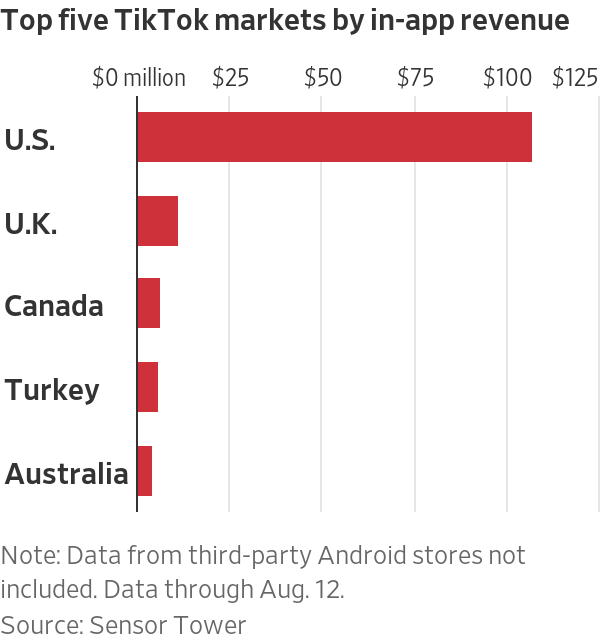
Top five TikTok markets by in-app revenue
An ultimatum from the White House was decidedly not the future Mr. Zhang imagined as a young, entrepreneurial-minded software engineer in China.
He is different from an earlier generation of Chinese tech-company founders who sought favor from China’s ruling Communist Party establishment. Mr. Zhang skews more California than Great Hall of the People. He wears a T-shirt and jeans, eats at the company cafeteria and cites tech mottos such as Amazon.com founder Jeff Bezos’s “Always Day 1" rule that a company should never stop acting like a startup.
Employees of the TikTok parent company, ByteDance Ltd., which Mr. Zhang founded, refer to him by his given name, Yiming. He isn’t a Communist Party member.
Born in the southeastern province of Fujian in 1983, a period when China was starting to open up, Mr. Zhang studied software engineering at a university in the northern city of Tianjin, where he met his wife and gained a reputation as a guy who could fix computers. He worked at various startups and had a brief stint in corporate life, joining Microsoft’s Beijing office as an engineer in 2008.
He stayed less than a year at Microsoft, telling Chinese media he found the work so unchallenging that he spent half his time reading books.
China in those years was fortifying its control of the internet, and after riots in the restive far-western region of Xinjiang in 2009, authorities blocked several websites on grounds the unrest had been organized online. Mr. Zhang, by then working for a Chinese Twitter clone called Fanfou, rallied against the restrictions.
“Go out and wear a T-shirt supporting Google," he wrote in a blog post. “If you block the internet, I’ll write what I want to say on my clothes."
The blog is no longer accessible online. Google pulled its search-engine operations from mainland China a year later.
Mr. Zhang started ByteDance, TikTok’s parent, in a Beijing apartment in 2012. From the start it had global ambitions, though many employees had never been abroad. “The biggest meeting room was about 10 square meters, but your ideas could be very big," Mr. Zhang reminisced last year in an anniversary video.
One of its first products was a news-aggregation app called Jinri Toutiao, or “Today’s Headlines." Mr. Zhang, who is ByteDance’s CEO as well as founder, didn’t have a media background, but he could code. The app used artificial intelligence to feed people news based on their reading habits: What did they tend to click on? How long did they linger? Did they finish the article?
It also received more than 100 lawsuits and complaints from other online news portals and from newspapers, some accusing it of swiping their content. In some cases, ByteDance had to compensate content creators for using their work without permission. ByteDance said the company “faced some confusion" about copyright laws in China in its early years and has since formed partnerships with many media sites.
A trip to California in 2014 solidified Mr. Zhang’s resolve to build a global company. With a group of other young Chinese business founders, he toured Facebook Inc. and Tesla Motors Inc. and met figures such as Yahoo Inc. co-founder Jerry Yang. He left convinced that Chinese tech entrepreneurs could compete in the big leagues.
TikTok proved him right. Powered by algorithms that can make its video feed addictive, it became a global sensation. TikTok has been downloaded more than two billion times world-wide, according to market research firm Sensor Tower. Its still-private parent ByteDance has a $100 billion valuation.
Besides being the first consumer app from China to make it big in the West, TikTok, unlike many of China’s past successes, can’t be accused of copying Western technology rather than innovating.
TikTok now is the primary social-media platform for millions of teenagers around the world. “An entrepreneur doesn’t have a country. When they develop something, it’s just not for any particular market, it’s for people globally," said Anis Uzzaman, founder of investor Pegasus Tech Ventures.
Although technology was once seen as a sector where the U.S and China could work together—American venture capitalists fueled China’s startups and Chinese engineers moved into Silicon Valley—it is instead emerging as a front line in the superpowers’ standoff. TikTok has landed at the center of the tussle, along with Huawei Technologies Co. and Tencent Holdings’ WeChat messaging and payment app, which also faces an impending ban in the U.S. imposed by the Trump administration.
TikTok will increasingly be seen by Chinese authorities as a strategically important company, said Ian Bremmer, president of political risk consultancy Eurasia Group. Its importance lies in the immense quantity of user data it collects, which drives “deep learning" and AI, he said.
“China suddenly realizes they need these tech capabilities internally, and they need them fast," Mr. Bremmer said.
ByteDance launched TikTok in 2017, then acquired a Shanghai-based rival, Musical.ly, that was gaining traction among American teens, and folded it into TikTok. Mr. Zhang told a forum at Beijing’s Tsinghua University in March 2018 that he expected TikTok to have more users outside of China than inside it within three years.
A few weeks after that forum, the Chinese government shut down a ByteDance joke-sharing app for publishing “vulgar" content.
This time, rather than denounce censorship, Mr. Zhang responded with a lengthy social-media post apologizing and promising to nearly double the number of censors at the company. Asked about that this week, a ByteDance spokesman said the apology was an explanation to users upset that Mr. Zhang hadn’t protected the platform from content that didn’t match their values.
As TikTok expanded abroad, its young workforce struggled to navigate regulatory minefields. Authorities in the U.S., the Netherlands and France began scrutinizing its practices surrounding the protection of user data. In June, TikTok was among Chinese apps banned in India, TikTok’s biggest market by downloads, on cybersecurity grounds. South Korea’s telecom regulator fined TikTok in July for mishandling the data of users under 14.
A Wall Street Journal analysis found this month that for more than a year, the app tracked users using a tactic banned by Google, which enabled it to collect unique identifiers from millions of mobile devices without letting users opt out.
TikTok says it no longer does this and has promised to create a firewall between China and overseas users.
The Trump administration worries about potential Chinese government access to TikTok’s user data. China’s national-security law obliges Chinese companies to assist in investigations related to national security. This means, according to Fergus Ryan, an analyst at the Australian Strategic Policy Institute, an independent research organization, that ByteDance would be likely to have some trouble pushing back against certain data requests from authorities in Beijing.
ByteDance says it doesn’t share data with the Chinese government and wouldn’t do so if asked.
Late last year, as the U.S. Committee on Foreign Investment in the United States began a review of ByteDance and TikTok practices to be sure they don’t pose a national-security risk, Mr. Zhang reached out to Microsoft President Brad Smith and CEO Satya Nadella for advice on how to address data-security concerns and earn the trust of regulators, according to people privy to Mr. Zhang’s thinking.
The people said this resulted in plans by TikTok to open a center in Los Angeles aimed at providing more transparency to outsiders about the app’s operations. The talks eventually evolved into discussions of a sale, the people said.
Mr. Zhang read a book by Mr. Smith on tech-company governance, “Tools and Weapons," and had it translated into Chinese. He ordered his ByteDance management team to read it, said a person familiar with the matter.
In one corporate chat conversation, Mr. Zhang highlighted an excerpt from the book about the 2019 mosque massacre in Christchurch, New Zealand, which the shooter live-streamed on the internet, leading to criticism of social-media companies. He urged his staff to test ByteDance’s ability to respond to such a situation, according to a screenshot of the chat seen by the Journal.
Mr. Zhang, who last year spent much of his time jet-setting, is now stuck in China because of the coronavirus. He is keeping U.S. hours, often in meetings with investors across the Pacific about the fate of his company.
As he faces pressure from investors to agree to a sale of TikTok’s U.S. business to satisfy Mr. Trump—the president has said the U.S. Treasury should get part of the sale price—Mr. Zhang has held out hope for a different solution. He is growing increasingly isolated in the talks, one person said.
Lately, he has come around to the idea that a sale is inevitable, people familiar with the matter say. ByteDance declined to comment on the status of the talks.
In a letter to employees earlier this month, Mr. Zhang advised forbearance. “There has been a rise in anti-Chinese sentiment in many countries," he wrote. “Don’t mind any short-term praise or loss, and patiently do the right thing."
Zhang Yiming, who always wanted to build a global tech company, has found his creation caught in the U.S.-China standoff

www.livemint.com