

If Ukraine war continue for prolonged period, we will be end up with a strong desi weapon industry.Balu Forge can produce 360, 000 units of 155mm artillery & 125mm tank shell casings per year. Most of these are sold to YIL for propellant filling. They recently started supplying artillery shell casings to some eastern European countries:
View attachment 54697
View attachment 54699
View attachment 54700
View attachment 54698
You are using an out of date browser. It may not display this or other websites correctly.
You should upgrade or use an alternative browser.
You should upgrade or use an alternative browser.


Order Scope: 184 guns (60% L1 share of 307 systems) under the ₹6,900 Cr MoD contract.
Last edited:


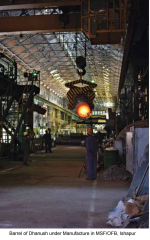
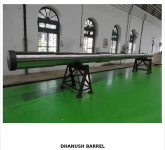
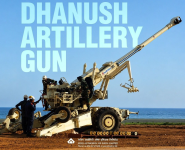
Dhanush artillery gun's barrels are made in Metal & Steel factory, Ishapore.
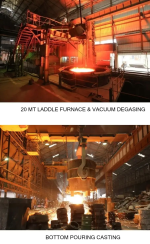
The raw steel is sourced from Alloy Steel Plant (ASP), Durgapur operated by SAIL. The steel is described as Ultra-High strength (Yield- 1750 to 2000 MPa) low carbon steel with Ni-Cr-Mo additives. Exact composition isn't known. The steel is brought in in billet or slab form melted & refined through LF-VD & ESR processes. Then cast on to an octagonal beam shape.
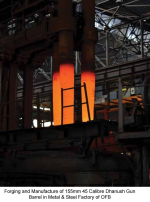
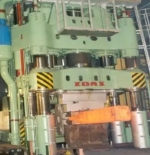
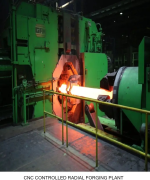
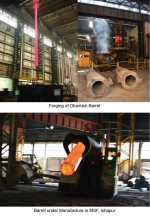
The cooled cast steel is then re-heated uniformly the pressed in a heavy vertical press to obtain the optimal microstructure. Then it is taken to radial forging to obtain a nearly cylindrical structure:
When the external surface start to cool down, but the inner part is still red hot, the cast steel is taken for internal piercing:
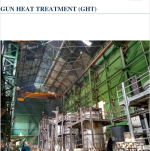
Then heat treatment:
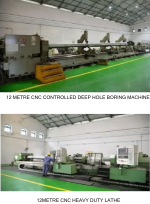
Then the cast barrels are machined in lathe & boring machines:
The raw steel is sourced from Alloy Steel Plant (ASP), Durgapur operated by SAIL. The steel is described as Ultra-High strength (Yield- 1750 to 2000 MPa) low carbon steel with Ni-Cr-Mo additives. Exact composition isn't known. The steel is brought in in billet or slab form melted & refined through LF-VD & ESR processes. Then cast on to an octagonal beam shape.
The cooled cast steel is then re-heated uniformly the pressed in a heavy vertical press to obtain the optimal microstructure. Then it is taken to radial forging to obtain a nearly cylindrical structure:
When the external surface start to cool down, but the inner part is still red hot, the cast steel is taken for internal piercing:
Then heat treatment:
Then the cast barrels are machined in lathe & boring machines:


Sure this isn't AI?
I guess this must be for 122mm rockets?

IIT Madras ramjet shell could help artillery reach farther without bigger guns
IIT Madras has tested ramjet-assisted 155 mm shells that may extend artillery range by nearly 50 per cent. The work, done with the Indian Army, is still being refined after September 2025 trials in Deolali.
 defence.economictimes.indiatimes.com
The Indian armed forces have been pushing for ammunition that can stretch firing ranges and give troops an edge on the battlefield, and researchers at IIT Madras have now tested a possible answer. According to ThePrint, the institute has developed ramjet-assisted 155 mm artillery shells that could extend the reach of conventional gun systems by nearly 50 per cent.
The requirement, conveyed in October, comes as researchers in India and abroad look for ways to increase the range of conventional artillery systems without changing the guns themselves. One of the approaches under study is ramjet propulsion for artillery ammunition.
Conventional shells depend on the force created at firing, but a ramjet lets the projectile produce extra thrust after it leaves the barrel. A ramjet is an air-breathing engine that uses the speed of a moving object to compress incoming air, mix it with fuel and generate thrust. It has no moving parts such as turbines.
The technology places a ramjet engine inside an existing 155 mm artillery shell and replaces the shell’s usual base-bleed unit. The project began in 2020 and was carried out with the Indian Army. It was led by IIT Madras faculty member Prof. P.A. Ramakrishna of the Department of Aerospace Engineering.
The work moved from early trials with a 76 mm gun developed at IIT Madras to tests on 155 mm artillery systems. Trials in September 2025 at the School of Artillery in Deolali showed clean gun exit, stable flight and ramjet ignition. The project is still being refined before it can reach full operational capability.