

Indian Economy : News,Discussions & Updates
- Thread starter Butter Chicken
- Start date
-
- Tags
- indian defence forum
You are using an out of date browser. It may not display this or other websites correctly.
You should upgrade or use an alternative browser.
You should upgrade or use an alternative browser.


Nomura sees India's Q1 GDP growth near 8%, rupee at ₹93 by December - CNBC TV18
Robert Subbaraman, Head of Global Macro Research at Nomura Singapore, sees stronger fundamentals and contained inflation supporting the rupee. Nomura forecasts the rupee at ₹93 per dollar by December. Subbaraman also expects India to benefit more from the artificial intelligence (AI) boom over time.
Two BIG Achievements for the Agricultural Sector

 www.newindianexpress.com

 swarajyamag.com
Godavari waters to flow into North Andhra through Polavaram canal today
VISAKHAPATNAM: Carved through the Eastern Ghats with tunnels, aqueducts and a siphon beneath the Yeleru river, the 213-km Polavaram Left Main Canal will finally
India's Longest Water Tunnel: Excavation Completed For Madhya Pradesh's Rs 1,600 Crore Project To Irrigate 1.85 Lakh Hectares
The excavation of the Sleemanabad Tunnel in Madhya Pradesh's Katni district has been completed , marking a major milestone in the state's irrigation e
swarajyamag.com
Refinery to the world: Energy expert Anas Alhajji on India's surprising fuel advantage
By Nikhil Agarwal
Published On Sep 1, 2026, at 11:39 AM IST
India didn't just weather the worst oil crisis in a generation but emerged as a net winner, overtaking Saudi Arabia and the United Arab Emirates to become the top supplier of petrol, diesel and jet fuel to Kenya, while its fuel exports to Africa climbed to their highest level ever.
It was the only economy in Asia that fully recovered its oil imports after the shock, refilled its strategic reserves and resumed exporting, energy economist Dr. Anas Alhajji said at Elara Capital's Ashwamedh — Elara India Dialogue 2026. While other big Asian economies stayed on the back foot, India kept moving.
The scale of what India pulled off comes into focus against the backdrop of the crisis itself. The Strait of Hormuz, the narrow Gulf passage that carries roughly a fifth of the world's oil, has been largely blocked since late February, after a war with Iran shut it down. Alhajji calls it the biggest crisis of our lifetime, and not just for oil: the helium that chip factories depend on, a large share of the world's fertilizer, and the methanol used in cleaner fuels all move through the same chokepoint. When it jams, he notes, prices jump and shortages spread far beyond the petrol pump.
Against that backdrop, India kept its refineries running at full tilt, topped up its emergency stocks, and turned itself into a supplier the rest of the world could buy from. It is the "refinery to the world" strategy that Indian policy has been chasing for years.
Alhajji is careful to flag that this is not a clean victory. India leans heavily on the Gulf, and the crisis has battered the Gulf economies it depends on.
More pointedly, the same blocked strait that has let India profit by selling fuel also threatens it from another direction: India's fertilizer plants run on Gulf gas, and a large share of global fertilizer trade moves through Hormuz. The passage that has made India look strong sits right beside its biggest vulnerability as it needs that route open to grow its food.
The much-hyped alternatives look thinner on closer inspection, too. The US deal for Venezuelan oil, pitched as a major new source of supply, is built around a headline figure that describes oil still in the ground rather than oil that can actually be pumped, the realistic volume is a fraction of that number. The crude itself is also the wrong type for making petrol, and first barrels are years away. There is, in short, no quick substitute for the Gulf.
The takeaway, in Alhajji's framing, is that this kind of crisis is not a one-off. Chokepoints like Hormuz can be squeezed again and will be. The countries that come out ahead next time will be the ones that keep refining capacity running, diversify their supplier base instead of leaning on one region, and store emergency oil well away from the danger points.
India has largely pulled this off on instinct so far. The task now, as the crisis window shows, is to turn that instinct into a plan before the next shock tests it. The strait will reopen eventually but the advantage India has stumbled into will not wait around forever.
Refinery to the world: Energy expert Anas Alhajji on India's surprising fuel advantage
By Nikhil Agarwal
Published On Sep 1, 2026, at 11:39 AM IST
India didn't just weather the worst oil crisis in a generation but emerged as a net winner, overtaking Saudi Arabia and the United Arab Emirates to become the top supplier of petrol, diesel and jet fuel to Kenya, while its fuel exports to Africa climbed to their highest level ever.
It was the only economy in Asia that fully recovered its oil imports after the shock, refilled its strategic reserves and resumed exporting, energy economist Dr. Anas Alhajji said at Elara Capital's Ashwamedh — Elara India Dialogue 2026. While other big Asian economies stayed on the back foot, India kept moving.
The scale of what India pulled off comes into focus against the backdrop of the crisis itself. The Strait of Hormuz, the narrow Gulf passage that carries roughly a fifth of the world's oil, has been largely blocked since late February, after a war with Iran shut it down. Alhajji calls it the biggest crisis of our lifetime, and not just for oil: the helium that chip factories depend on, a large share of the world's fertilizer, and the methanol used in cleaner fuels all move through the same chokepoint. When it jams, he notes, prices jump and shortages spread far beyond the petrol pump.
Against that backdrop, India kept its refineries running at full tilt, topped up its emergency stocks, and turned itself into a supplier the rest of the world could buy from. It is the "refinery to the world" strategy that Indian policy has been chasing for years.
Alhajji is careful to flag that this is not a clean victory. India leans heavily on the Gulf, and the crisis has battered the Gulf economies it depends on.
More pointedly, the same blocked strait that has let India profit by selling fuel also threatens it from another direction: India's fertilizer plants run on Gulf gas, and a large share of global fertilizer trade moves through Hormuz. The passage that has made India look strong sits right beside its biggest vulnerability as it needs that route open to grow its food.
The much-hyped alternatives look thinner on closer inspection, too. The US deal for Venezuelan oil, pitched as a major new source of supply, is built around a headline figure that describes oil still in the ground rather than oil that can actually be pumped, the realistic volume is a fraction of that number. The crude itself is also the wrong type for making petrol, and first barrels are years away. There is, in short, no quick substitute for the Gulf.
The takeaway, in Alhajji's framing, is that this kind of crisis is not a one-off. Chokepoints like Hormuz can be squeezed again and will be. The countries that come out ahead next time will be the ones that keep refining capacity running, diversify their supplier base instead of leaning on one region, and store emergency oil well away from the danger points.
India has largely pulled this off on instinct so far. The task now, as the crisis window shows, is to turn that instinct into a plan before the next shock tests it. The strait will reopen eventually but the advantage India has stumbled into will not wait around forever.
Refinery to the world: Energy expert Anas Alhajji on India's surprising fuel advantage


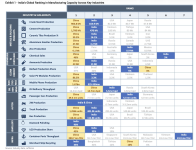

Solar seems to be expanding its non-defence sector capabilities.
Minus electronics & engineering goods most of the exports have been flat for years. Textiles, leather, Shoes & many labour intensive sectors the growth has plateaued. If all sectors of economy fire, they can reach 600B merchandise exports
India's new fast-track entry route for trusted foreign investors has drawn 164 registrations in just over 100 days, data from the Indian depository showed on Tuesday, signaling early adoption by sovereign wealth funds and pension funds, among others.
The Single Window Automatic and Generalised Access for Trusted Foreign Investors (SWAGAT-FI) framework came into force on June 1, as part of efforts to attract more stable foreign investment.
The new route allows for simpler registration and compliance for a select category of foreign portfolio investors (FPIs) considered low risk, including sovereign wealth funds, pension funds, insurance companies and regulated public retail funds.
These investors account for 70% of total foreign investment in India.
Among other rules, investors will now get a 10-year registration period instead of the earlier 3-year cycle applicable to FPIs, sharply reducing renewal-related paperwork and compliance costs for large long-term investors.
The early registrations include investment structures linked to some of the world's largest asset managers, including BlackRock, Vanguard, State Street and Franklin Templeton, data from the National Securities Depository shows.
Korea Investment Corporation — South Korea's sovereign investment pool — Malaysian pension funds and other government-related investors are also using this window.
The registration data does not show how much capital has entered India, but since the framework became operational foreign investors have added a net 702 billion rupees ($7.34 billion) to Indian equity markets till August-end, before sentiment weakened again in September with foreign investors pulling out 278.1 billion rupees so far.
Reuters reported earlier this week that a separate route for funds that seek to invest only in government bonds has received interest from South Korea's state-run pension fund, the world's third-largest. Dutch hedge fund Allianz Europe B.V. has also registered under this route, the data showed.
The Single Window Automatic and Generalised Access for Trusted Foreign Investors (SWAGAT-FI) framework came into force on June 1, as part of efforts to attract more stable foreign investment.
The new route allows for simpler registration and compliance for a select category of foreign portfolio investors (FPIs) considered low risk, including sovereign wealth funds, pension funds, insurance companies and regulated public retail funds.
These investors account for 70% of total foreign investment in India.
Among other rules, investors will now get a 10-year registration period instead of the earlier 3-year cycle applicable to FPIs, sharply reducing renewal-related paperwork and compliance costs for large long-term investors.
The early registrations include investment structures linked to some of the world's largest asset managers, including BlackRock, Vanguard, State Street and Franklin Templeton, data from the National Securities Depository shows.
Korea Investment Corporation — South Korea's sovereign investment pool — Malaysian pension funds and other government-related investors are also using this window.
The registration data does not show how much capital has entered India, but since the framework became operational foreign investors have added a net 702 billion rupees ($7.34 billion) to Indian equity markets till August-end, before sentiment weakened again in September with foreign investors pulling out 278.1 billion rupees so far.
Reuters reported earlier this week that a separate route for funds that seek to invest only in government bonds has received interest from South Korea's state-run pension fund, the world's third-largest. Dutch hedge fund Allianz Europe B.V. has also registered under this route, the data showed.
Cabinet approves Commitment of Rs.10,000 Crore towards establishment of the SME Growth Fund for direct equity investments in Small and Medium Enterprises to create future champions
The Union Cabinet, chaired by Prime Minister Shri Narendra Modi, today approved the Government of India’s commitment of Rs.10,000 crore towards the establishment of the SME Growth Fund (SGF) aimed at catalysing growth-oriented capital for India's Small and Medium Enterprises (SMEs) and enabling the emergence of champion Indian enterprises across manufacturing, services, technology, innovation-driven sectors, and strategic value chains as per Para 28 of Union Budget 2026-27. This was in part of the holistic set of announcements that were made in Union Budget 2026-27 focussing on providing equity, liquidity and professional support for the MSME ecosystem as a whole.
There are existing funds which provide equity support but majority of them focus on early-stage enterprises and cover majorly Micro enterprises. A structural gap exists for equity growth capital for Small and Medium Enterprises.
The landmark initiative reflects the Government's commitment towards realizing the vision of Viksit Bharat 2047 by strengthening India's entrepreneurship ecosystem, deepening the domestic capital market for growth-stage enterprises, and creating a new generation of Indian companies capable of competing at the global level.
SMEs constitute the backbone of the Indian economy, contributing significantly to employment generation, exports, manufacturing output, and innovation. While various initiatives have enhanced access to credit for SMEs, a gap remains in the availability of long-term risk capital required by enterprises seeking to scale, innovate, expand internationally, adopt advanced technologies, undertake acquisitions, and transform into industry leaders. The SME Growth Fund is designed to address this critical financing gap by providing patient growth equity capital to high-potential SMEs with demonstrated business viability and scalability.
The Fund is envisioned as a transformational instrument to support enterprises at critical inflection points in their growth journey. Majority allocation from SGF will be made towards small and medium manufacturing focused enterprises. Fund will also consider SME’s operating in industrial clusters in Tier II and Tier III cities
By providing long-term capital, the initiative will enable Indian SMEs to scale operations, invest in technology and manufacturing capacity, expand into international markets, integrate into global value chains, and undertake strategic investments. The Government expects the Fund to accelerate the emergence of a strong pipeline of Indian companies with the scale, innovation capability, and competitiveness required to become champions in their respective sectors.
The Government’s commitment to the SME Growth Fund complements its ongoing efforts to strengthen the SME sector through reforms, digitalization initiatives, credit support mechanisms, ease of doing business measures, public procurement reforms, startup promotion initiatives, and production-linked incentive programmes.
Under the initiative, the Government of India will provide an aggregate commitment of Rs.10,000 crore to the Alternative Investment Fund (AIF) established under the SGF framework. By enabling manufacturing enterprises to expand capacity, adopt advanced technologies and achieve greater scale, the SGF is expected to improve scale, productivity, and strengthen export competitiveness. Investments across industrial clusters, including those in Tier-II and Tier-III cities, will support balanced regional industrial development, reinforce local supply chains and generate high-quality employment opportunities.
With this initiative, the Government reaffirms its commitment to empowering India's entrepreneurs and fostering a new generation of competitive enterprises. By catalysing investment in high-growth SMEs, the Fund will help create champions, drive innovation-led industrialization, and generate quality employment opportunities across the country. The initiative will serve as a key pillar in advancing the vision of Viksit Bharat @ 2047.
There are existing funds which provide equity support but majority of them focus on early-stage enterprises and cover majorly Micro enterprises. A structural gap exists for equity growth capital for Small and Medium Enterprises.
The landmark initiative reflects the Government's commitment towards realizing the vision of Viksit Bharat 2047 by strengthening India's entrepreneurship ecosystem, deepening the domestic capital market for growth-stage enterprises, and creating a new generation of Indian companies capable of competing at the global level.
SMEs constitute the backbone of the Indian economy, contributing significantly to employment generation, exports, manufacturing output, and innovation. While various initiatives have enhanced access to credit for SMEs, a gap remains in the availability of long-term risk capital required by enterprises seeking to scale, innovate, expand internationally, adopt advanced technologies, undertake acquisitions, and transform into industry leaders. The SME Growth Fund is designed to address this critical financing gap by providing patient growth equity capital to high-potential SMEs with demonstrated business viability and scalability.
The Fund is envisioned as a transformational instrument to support enterprises at critical inflection points in their growth journey. Majority allocation from SGF will be made towards small and medium manufacturing focused enterprises. Fund will also consider SME’s operating in industrial clusters in Tier II and Tier III cities
By providing long-term capital, the initiative will enable Indian SMEs to scale operations, invest in technology and manufacturing capacity, expand into international markets, integrate into global value chains, and undertake strategic investments. The Government expects the Fund to accelerate the emergence of a strong pipeline of Indian companies with the scale, innovation capability, and competitiveness required to become champions in their respective sectors.
The Government’s commitment to the SME Growth Fund complements its ongoing efforts to strengthen the SME sector through reforms, digitalization initiatives, credit support mechanisms, ease of doing business measures, public procurement reforms, startup promotion initiatives, and production-linked incentive programmes.
Under the initiative, the Government of India will provide an aggregate commitment of Rs.10,000 crore to the Alternative Investment Fund (AIF) established under the SGF framework. By enabling manufacturing enterprises to expand capacity, adopt advanced technologies and achieve greater scale, the SGF is expected to improve scale, productivity, and strengthen export competitiveness. Investments across industrial clusters, including those in Tier-II and Tier-III cities, will support balanced regional industrial development, reinforce local supply chains and generate high-quality employment opportunities.
With this initiative, the Government reaffirms its commitment to empowering India's entrepreneurs and fostering a new generation of competitive enterprises. By catalysing investment in high-growth SMEs, the Fund will help create champions, drive innovation-led industrialization, and generate quality employment opportunities across the country. The initiative will serve as a key pillar in advancing the vision of Viksit Bharat @ 2047.