Indian Hypersonic Propulsion Developments

Adding this report by Adithya Krishna Menon:


The LR-AShM is a Hypersonic Glide Missile capable of engaging static and moving targets and is designed to carry various payloads. The missile is a first-of-its-kind with indigenous avionics systems and high accuracy sensor packages. This hypersonic missile follows a quasi-ballistic trajectory with hypersonic speeds starting at Mach 10 and maintaining average Mach 5.0 with multiple skips. Indigenously developed sensors are provided for engaging the moving targets in the terminal phase. As this missile flies in low altitude with high speed and manoeuvrability, enemy ground and ship based radars cannot detect this missile during most of its trajectory. The LR-AShM is configured with a two stage solid propulsion rocket motor system. These propulsion systems boost the missile to the required hypersonic velocities. Stage-1 of the vehicle is separated after it is spent. After Stage-II burnout, the vehicle performs an unpowered glide with required manoeuvres in the atmosphere before engaging the target.
 
Adding this report by Adithya Krishna Menon:


The LR-AShM is a Hypersonic Glide Missile capable of engaging static and moving targets and is designed to carry various payloads. The missile is a first-of-its-kind with indigenous avionics systems and high accuracy sensor packages. This hypersonic missile follows a quasi-ballistic trajectory with hypersonic speeds starting at Mach 10 and maintaining average Mach 5.0 with multiple skips. Indigenously developed sensors are provided for engaging the moving targets in the terminal phase. As this missile flies in low altitude with high speed and manoeuvrability, enemy ground and ship based radars cannot detect this missile during most of its trajectory. The LR-AShM is configured with a two stage solid propulsion rocket motor system. These propulsion systems boost the missile to the required hypersonic velocities. Stage-1 of the vehicle is separated after it is spent. After Stage-II burnout, the vehicle performs an unpowered glide with required manoeuvres in the atmosphere before engaging the target.
I won't call something that does atmospheric re-entry, skip-glide manoeuvres, and rocket-sustained cruising as a "quasi-ballistic" trajectory that actual quasi-ballistic missiles like Pralay or Iskander follow.

It's more like a hybrid cruise-glide vehicle.
 
The official classification:

According to the DRDO, the Long Range Anti-Ship Missile (LRAShM) is a state-of-the-art hypersonic glide missile designed specifically for the Indian Navy to engage both static and moving maritime targets. It is a two-stage, solid-propellant system capable of speeds up to Mach 10 and designed for low-altitude, high-maneuverability trajectories to evade enemy radars.
 
At Rmax it will probably take 10-12 minutes for LRAShM to get close to the target to activate the seeker. So a moving ship can at best linearly (if not evasively zigzagging) traverse 10-12 km in that time period. A >50km seeker range means it doesn't really need any mid course guidance due to such compressed time periods. This is less than 27° search angle at that range, and 13.5° at half angle from the initial ship location. Correct me if I'm wrong.

 
To air-launch this massive missile we would need to replace the current Stage 1 solid booster with a much smaller booster. Or we could buy/lease a proper bomber like Tu-160M:

But not just booster whole body surface will be re designed to be launched from already moving air platform to maintain the launch stability and also the unlocking mechanism, or drop mechanism fixed to the missile body even if you drop it from Tu160.
 

ANI National Security Summit 2.0: DRDO Chairman Dr Samir V Kamat says, "For short-range ballistic missiles, the Pralay is now in the final stages of testing. With respect to hypersonic, we are working on two programs, the hypersonic glide missile and the hypersonic cruise missiles. The glide missile will come out first. We should be doing the first trials fairly soon. And that is at a more advanced stage than the cruise missile. The cruise missile program has not yet been sanctioned, although we are working on the various technologies which will get into the cruise missile..."

"For short-range ballistic missiles, the Pralay is now in the final stages of testing and should be ready. Then we have some of our strategic missiles, which can be converted to tactical usage for the medium range and the long range. With respect to hypersonic, we are working on two programs, the hypersonic glide missile and the hypersonic cruise missiles. The hypersonic cruise missiles is one which has a scramjet engine and it is powered during its flight. The hypersonic glide missile is a missile which uses a booster to give it initial velocity, and then it just glides without any powering. The glide missile will come out first. We should be doing the first trials fairly soon. And that is at a more advanced stage than the cruise missile. The cruise missile program has not yet been sanctioned, although we are working on the various technologies which will get into the cruise missile. Recently, we have done a scramjet propulsion for more than 1,000 seconds. So that's been a major achievement, and once the program is sanctioned, we'll convert the scramjet propulsion into a working missile system. And I think that should take about five years after the sanction."

 
Apart from a cruise missile, an air to air version is more important imho. An astra variant with hypersonic propulsion will allow us to leapfrog the current capability gap vis-a-vis China & Pakistan. That will also increase the prospect of Indian fighter jet exports.
 
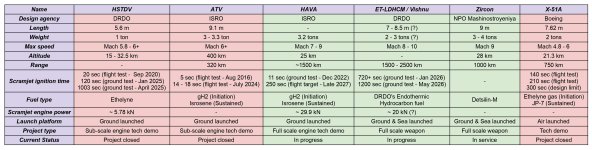
What we know of our scramjet so far and how it stacks up to its closest global competition:
View attachment 51553
Zircon only cruises at M5.5 based on radar measurements. Shouldn't compare ground tests with flying though, you have drag and thermal loads to consider under real flight conditions.
 
Zircon only cruises at M5.5 based on radar measurements.
I am going by Wikipedia, which is not the most accurate. So maybe, Mach 5.5 is cruise speed & Mach 9 is max or terminal speed. Then there is the question of altitude vs. speed & range.

Shouldn't compare ground tests with flying though, you have drag and thermal loads to consider under real flight conditions.
Fair point. But we have had just 3 scramjet flight tests so far, ground test durations are the only reliable parameter we have to track project progress right now.

Apart from a cruise missile, an air to air version is more important imho. An astra variant with hypersonic propulsion will allow us to leapfrog the current capability gap vis-a-vis China & Pakistan. That will also increase the prospect of Indian fighter jet exports.
LFRJ was deemed too heavy for AAM role. If we can make a solid fueled scramjet then maybe. Otherwise improving the SFDR is the best option.

They are beating the best in the world in terms of sheer endurance.
Northrop and AFRL managed 30 minutes over several tests on their 18-feet 58kn engine.
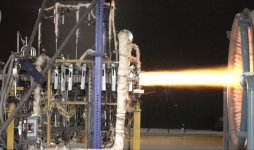
Apparently, DRDO has only built one hypersonic engine with active cooling that uses the new endothermic fuel. So, this is the 2nd run of this engine. 720+ sec on the 1st run & 1200 secs on the second. 32+ minutes of total run time. Even if the fuel injector struts were replaced, we don't know if they were, the intake ramps, engine walls etc. remain the same. Still miles to go but this is good progress.