
You are using an out of date browser. It may not display this or other websites correctly.
You should upgrade or use an alternative browser.
You should upgrade or use an alternative browser.


[Combined Air Defense Thread] - News, analysis and posts related to radars, surface to air missiles, AD guns, networking and ESM.
[Thread]
[@Mods] How about a new sticky thread in Strategic Systems Section purely for Radars?
Radars deployed or under development
[Thread]
[Thread]
[@Mods] How about a new sticky thread in Strategic Systems Section purely for Radars?
Radars deployed or under development
[Thread]
India has awarded a $200 million contract to Israel for supplying an undisclosed number of SPICE bomb-guidance kits, and between 300 and 320 Spike-Long Range Anti-Tank Guided Missiles.

India stocks up missile arsenal as it prepares for another tense summer in Ladakh
India has awarded a $200 million contract to Israel for supplying an undisclosed number of SPICE bomb-guidance kits, and between 300 and 320 Spike-Long Range Anti-Tank Guided Missiles.
 theprint.in


This is an excellent news
We have 100 plus HAWK trainers
They can now also be used for dropping Stand off Bombs during War time
Since they are slow moving trainers
It is better to use them.from well inside our territory
Last edited:



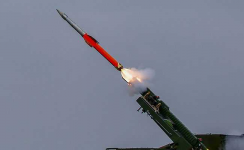
DRDO appears to have streamlined the cannister design for all land based AD missiles. Some naval missiles(like the VL-SRSAM) will borrow the same.
QR-SAM cannister :
Akash NG cannister :

VL SRSAM cannister :
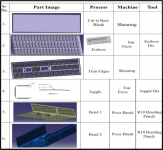
A majority of the manufacturing process has been out-sourced and will definitely help grow our nascent defence manufacturing ecosystem. The process list of the cannister manufacturing :
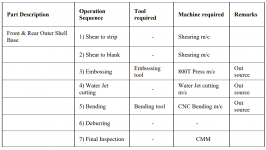
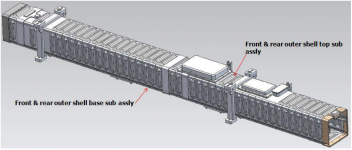
After the operations outlined above there will be 2 separate components. One will be the "Top assembly" as shown below :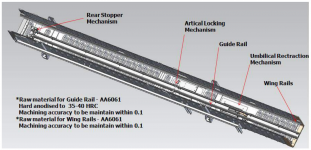
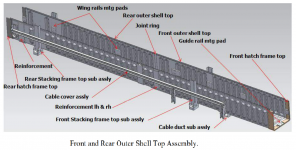
The other will be called the "Base assembly":
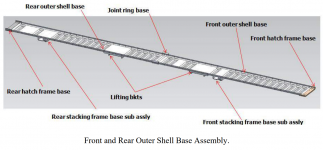
The missile will be guided out of the cannister by means of a guide rail. Further there will be elastomeric pads to reduce friction when the missile climbs out of the cannister. The pads will be made up of butadiene rubber(not sure if it is Styrene-butadiene or plain Poly-butadiene).
Overall, it is good to see some semblance of standardization across out now vast & ever growing list of munitions. For the Army & Air Force it would mean easier maintenance, simpler logistics etc. Also a standard design allows us to quickly ramp up manufacturing in case of urgent need.
But what of the Navy though ? The VL-SRSAM coming up would mean the Navy will have any combination of Brahmos VLS, VL-SRSAM's VLS, Barak-8 VLS, Barak-1 VLS, Sthil-1 arm launcher/VLS & RBU-6000 on the same deck. Absolute zoo of weapons on board a ship, no commonality anywhere. Add to that Nirbhay missile's successor ITCM, the LR-LACM etc. When will the Navy think about standardization ?
QR-SAM cannister :
Akash NG cannister :
VL SRSAM cannister :
A majority of the manufacturing process has been out-sourced and will definitely help grow our nascent defence manufacturing ecosystem. The process list of the cannister manufacturing :
After the operations outlined above there will be 2 separate components. One will be the "Top assembly" as shown below :
The other will be called the "Base assembly":
The missile will be guided out of the cannister by means of a guide rail. Further there will be elastomeric pads to reduce friction when the missile climbs out of the cannister. The pads will be made up of butadiene rubber(not sure if it is Styrene-butadiene or plain Poly-butadiene).
Overall, it is good to see some semblance of standardization across out now vast & ever growing list of munitions. For the Army & Air Force it would mean easier maintenance, simpler logistics etc. Also a standard design allows us to quickly ramp up manufacturing in case of urgent need.
But what of the Navy though ? The VL-SRSAM coming up would mean the Navy will have any combination of Brahmos VLS, VL-SRSAM's VLS, Barak-8 VLS, Barak-1 VLS, Sthil-1 arm launcher/VLS & RBU-6000 on the same deck. Absolute zoo of weapons on board a ship, no commonality anywhere. Add to that Nirbhay missile's successor ITCM, the LR-LACM etc. When will the Navy think about standardization ?

Posted a few tweets on the VL-SRSAM's VLU recently :
Continuing from that :
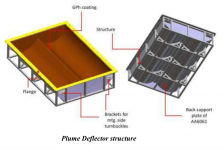
The plume deflector has a Glass Phenolic(GPh) Coating. Excellent choice of material I think. GPh has very high ablation resistance, low thermal conductivity, low toxicity & is relatively easy to formulate. Only downside is that is it very brittle, so any coating has to be thin & uniformly spread out. Processes like Chemical Vapour Deposition(CVD) are ideal for making such coating. It is an expensive & time consuming process though.
The VL-SRSAM has Jet Vane Control (JVC) as was previously discussed here. I reckon this will be a common feature across most new missiles irrespective of use or size. The Dhruvastra, AAD, QR-SAM has it, the upcoming NASM-SR will have it. From the 2 pics released so far it seems the Akash-NG has it too.
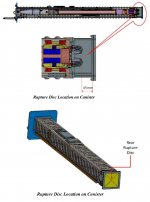
The rear rupture disc is also made of butadiene rubber. Is there a PSU in South India that deals with rubber manufacturing ? @Ashwin @Amal @randomradio et al.
The tender makes mention of purchasing the same from that PSU. South India has a lot of rubber plantations. But the rubber in question here is not the natural poly-isoprene rubber but a synthetic rubber. Maybe they have similar processing requirements, I don't know.
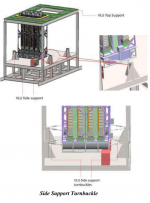
The VLU is placed on a ramp and is secured in place by means of some side support turnbuckles. The turnbuckles will prevent movement that maybe caused by the rolling of the ship.
Notice the two handles on the top panel. Those are to be used to pull the cannister out of the VLU in case of reloading.
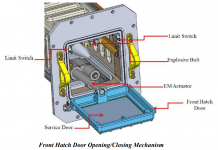
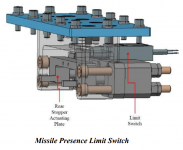
The Limit switch ensures a number of fail safe procedures are in place. For example if the missile is not properly seated between the mid body & rear latches of the "Article Locking Mechanism" then Limit switch will prevent the hatch door from being shut.
There are 2 doors : (1)The service door & (2)The Hatch door.
The hatch door is sealed shut by the manufacturer & will remain shut unless the cannister needs to be re-loaded or a loaded cannister is handed back to them in case of some form of failure.
The service door is sealed shut by means of explosive bolts. After the bolts go off & the service door is flung in air, the missile ignition command is passed. Every step is monitored by a couple of sensors, in case something didn't work or didn't work in the right sequence the limit switch will prevent the missile firing. In case of re-loading, the manufacturer will take the used cannister, run safety checks, open the hatch door to load another missile, bolt on a new service door & seal the cannister.
Additional care is put on to fire safety as it is an hot launched missile( i.e. the ignition happens while the missile is still inside the cannister).
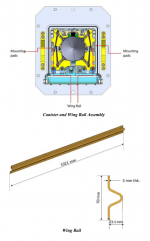
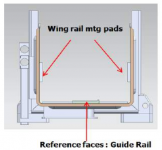
There is also an "Wing rail" inside the cannister that prevents the missile's folded wing from rubbing off or getting stuck anywhere during the missile's ejection.
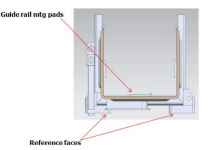
And here is the Guide rail on which the missile remains mounted :
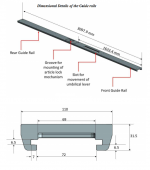
The entire point of having such a rail in the cannister is to minimize the contact surface area between the missile & the cannister. This in turn reduces friction & any friction related damage. There was some older DRDO documents that stated the intention to coat the rail with a thin layer of rubber. That was for the Nirbhay missile, the Nirbhay missile's launcher also has a guide rail.
But the idea was rather dropped as the gains were minimal & was considered not worth the trouble.
Continuing from that :
The plume deflector has a Glass Phenolic(GPh) Coating. Excellent choice of material I think. GPh has very high ablation resistance, low thermal conductivity, low toxicity & is relatively easy to formulate. Only downside is that is it very brittle, so any coating has to be thin & uniformly spread out. Processes like Chemical Vapour Deposition(CVD) are ideal for making such coating. It is an expensive & time consuming process though.
The VL-SRSAM has Jet Vane Control (JVC) as was previously discussed here. I reckon this will be a common feature across most new missiles irrespective of use or size. The Dhruvastra, AAD, QR-SAM has it, the upcoming NASM-SR will have it. From the 2 pics released so far it seems the Akash-NG has it too.
The rear rupture disc is also made of butadiene rubber. Is there a PSU in South India that deals with rubber manufacturing ? @Ashwin @Amal @randomradio et al.
The tender makes mention of purchasing the same from that PSU. South India has a lot of rubber plantations. But the rubber in question here is not the natural poly-isoprene rubber but a synthetic rubber. Maybe they have similar processing requirements, I don't know.
The VLU is placed on a ramp and is secured in place by means of some side support turnbuckles. The turnbuckles will prevent movement that maybe caused by the rolling of the ship.
Notice the two handles on the top panel. Those are to be used to pull the cannister out of the VLU in case of reloading.
The Limit switch ensures a number of fail safe procedures are in place. For example if the missile is not properly seated between the mid body & rear latches of the "Article Locking Mechanism" then Limit switch will prevent the hatch door from being shut.
There are 2 doors : (1)The service door & (2)The Hatch door.
The hatch door is sealed shut by the manufacturer & will remain shut unless the cannister needs to be re-loaded or a loaded cannister is handed back to them in case of some form of failure.
The service door is sealed shut by means of explosive bolts. After the bolts go off & the service door is flung in air, the missile ignition command is passed. Every step is monitored by a couple of sensors, in case something didn't work or didn't work in the right sequence the limit switch will prevent the missile firing. In case of re-loading, the manufacturer will take the used cannister, run safety checks, open the hatch door to load another missile, bolt on a new service door & seal the cannister.
Additional care is put on to fire safety as it is an hot launched missile( i.e. the ignition happens while the missile is still inside the cannister).
There is also an "Wing rail" inside the cannister that prevents the missile's folded wing from rubbing off or getting stuck anywhere during the missile's ejection.
And here is the Guide rail on which the missile remains mounted :
The entire point of having such a rail in the cannister is to minimize the contact surface area between the missile & the cannister. This in turn reduces friction & any friction related damage. There was some older DRDO documents that stated the intention to coat the rail with a thin layer of rubber. That was for the Nirbhay missile, the Nirbhay missile's launcher also has a guide rail.
But the idea was rather dropped as the gains were minimal & was considered not worth the trouble.


is akash NG and QRSAM same ?? ITS made so damn confusing by technically illerate indian news outlets.
No.is akash NG and QRSAM same ?? ITS made so damn confusing by technically illerate indian news outlets.
Akash NG
Primary User: Air Force
Weight : ~370kg
Range: 40km+
Dual Pulse Solid Rocket Motor
QRSAM
Primary User: Army
Weight: 270kg
Range: 5-30Km
Single Solid Rocket Motor

India has D-Gps network?
If so then the main threat is not jamming but destruction of actual transmitters which have to be fixed and position known to the enemy.

India has D-Gps network?
I know of along the coast. Not sure of hinterland.
Here you go :
Isnt it supposed to be the more advanced version of gps.?India has D-Gps network?
If so then the main threat is not jamming but destruction of actual transmitters which have to be fixed and position known to the enemy.
also the twitter yoddha is talkin about jamming enemy D GPS and not our own
Its a simple concept.Isnt it supposed to be the more advanced version of gps.?
also the twitter yoddha is talkin about jamming enemy D GPS and not our own
Let me explain.
First thing we need to understand is that GPS us 100% US owned and operated and legally still non operational and in experimental stage.
So USA is under no obligation to provide any GPS services except Military grade signals to allies they have contracts with.
Accuracy of the signal is on USA discretion. They can deteriorate the Accuracy at any time for any region without notice.
That's where D-GPS comes in.
Its a fixed radio transmitter who's accurate Geographical position has been determined by other means.
So it knows its exact Latitude Longitude and elevation.
Then it also receives its position as per GPS signals.
It then compares its already known precise Longitude , Latitude and elevation, with what is being told to it by GPS.
The difference between the two is the amount of GPS error at that location at that time.
Then it transmits to all the GPS receivers with D-GPS link.
It tells them the difference between its position and what GPS told it and transmits the difference as a correction. Which the receiver applies to its GPS position and gets centimeters level accuracy

India has D-Gps network?
If so then the main threat is not jamming but destruction of actual transmitters which have to be fixed and position known to the enemy.
Nope. Even better. We use SBAS.
GPS-aided GEO augmented navigation - Wikipedia
Now the other side of the story.
D-GPS is great for civilian use in peace time .
During a war there are many limitations.
The D-GPS transmitter has to be fixed and cannot be mobile. So its vulnerable to enemy attack.
The error correction it calculates and y
transmits Is only valid for a limited area as error will be different for different areas and times.
I still remember when GPS satellite coverage was low and we only used to get one GPS fix every 6 hours.
That we used to apply as error correction to our Loran-c position or sometimes to Omega position fix.
Now GPS gives a position every 3 seconds.
D-GPS is great for civilian use in peace time .
During a war there are many limitations.
The D-GPS transmitter has to be fixed and cannot be mobile. So its vulnerable to enemy attack.
The error correction it calculates and y
transmits Is only valid for a limited area as error will be different for different areas and times.
I still remember when GPS satellite coverage was low and we only used to get one GPS fix every 6 hours.
That we used to apply as error correction to our Loran-c position or sometimes to Omega position fix.
Now GPS gives a position every 3 seconds.
The basic principles and vulnerability remains similar or the same.Nope. Even better. We use SBAS.
GPS-aided GEO augmented navigation - Wikipedia
en.wikipedia.org
The SBAS relies on 15 fixed ground stations across India which calculate GPS error and transmit via satellite? Right?
The position of those stations are known and fixed.
And there's the vulnerability.
The basic principles and vulnerability remains similar or the same.
The SBAS relies on 15 fixed ground stations across India which calculate GPS error and transmit via satellite? Right?
The position of those stations are known and fixed.
And there's the vulnerability.
What's publicly known is for civilians.