Indian Missiles and Munitions Discussion

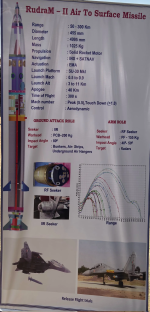
It has to be rudram 2, the Data matches with it
As I said in the explanation post above, this glide phase trajectory optimization technique is sort of universal model that you can implement in many missiles and shape the trajectory accordingly. Any guided flight vehicle usually has 2 phases of flight generally, boost phase and glide phase. This is why these are called atmospheric boost glide vehicles, ie the entire flight envelope is within the lower altitude and range is extended compared to a pure ballistic trajectory flight vehicle by using aerodynamic lift more precisely. This flight envelope is optimised for a max height constraint of 30 km in this particular graph, it can be also for a 40km apogee high point too.

This one reason why R2 R3 is generally cylindrical shape rocket motors with blunt front. This means such missiles stay within lower altitude region, but can face very high speed and heat loading for a brief period when the rocket motor burns out. That is the peak velocity it attains at the apogee point. this apogee point if you notice in the poster graph, is almost 100km away from launch point. So the boost phase can also give approx 60-100 km lateral distance (can be less ofc but general figure). Then the glide phase program kicks in.

Now the glide phase from the graph, think it as a whole chicken. You went to buy chicken meat, but only want the best cut piece. So the graph shown here is of the entire possible trajectory model wrt velocity where peak is 1800m/s to finally zero almost. But you need certain kinetic thrust & velocity so impact can be supersonic ie 550 m/s. So plot it on the velocity-time graph and we get approx near 270-300sec flight time , then from range-time graph we get approx 300km+ range for that flight duration. So add with the boost phase distance 60km minimum and you get a missile that is capable of striking a longer range than we admit all while in prime condition to evade any ad system.

btw its not essentially for R2, but it can explain the way R2 would fly in this specific trajectory. By changing other parameters , you can create multiple trajectory options thereby increasing the unknown probability factor manyfold. This trajectory can be implemented in any ground or air launched missile. For ground launch you would need a bigger booster that is.
 
How exactly do you think path planning , trajectory optimization and control law algos are conceptualised, written, verified and then implemented after several hundred times model simulation runs via super computing facilities ? It is why I said this is a general model where by choosing a specific parameter as primary constraint, trajectory planning is done.
Given different parameters are in the equation , hence by varying the primary constraint, various trajectories can be shaped accordingly and implemented via algo. This can be seen in the poster itself. The OBC has a library of the programs stored and user chooses which one is suitable for a specific mission, prior ground checkout simulation is also run on the basis of it.


EO SAAW , due to import dependence need various testing as RCI has only just supplied tot for their IIR tech, dome mfg etc and similar goes for the EO level tech too. If we had very good industry base within the country , this would not have been an issue. But here you do trials for various things, first during development phase with imported stuff then if desi alternative is there in future again qualify the same. Actual integrated article test is very costly so you have to plan accordingly. Now the actuators , dsp modules, batteries various other critical stuff keep getting changed or replaced hence many testing. SAT-SAAW BDL has delivered some numbers for inventory so other version will also come.
SAT SAAW BDL has delivered some numbers for inventory.

So SAAW is already in IAF service. There are no public announcements of inking a deal to procure Saaw though like we have seen in case of Astra missile.
 
SAT SAAW BDL has delivered some numbers for inventory.

So SAAW is already in IAF service. There are no public announcements of inking a deal to procure Saaw though like we have seen in case of Astra missile.
small batches are always taken up for internal testing and sort out any niggles in the system. BDL had released tender in recent months on saaw, small nos again.
 
The range can varies,
Rudram2 has 350km range, maybe it likely can Go 400km
Probably, if you stretch it's flight profile, but then it would become lot easier to intercept in terminal.

But the weapon in the chart imo is rudram3.

So whenever a missile system is designed and the flight trajectory model is conceptualised, one of the primary constraint that is specified is the range bracket up to where the system will work. Otherwise it is not possible to make a model that would run any missile without any constraints attached. Would not be a good optimised guidance scheme to enhance performance & survive against enemy AD.

This is reason why missile range enhancement is in this way, first enhanced version then long range (LR) then very long range. All of it due to implementing different model where the primary range constraint differ accordingly (like 300km then 450km then 800km range bracket) and other constraints value are calculated , plotted to find out boundary conditions and then fed to the program model so the model can calculate for each value under the boundary conditions and feed to obc for due course action aka calculate the optimised trajectory.

This other graph is good for understanding that. See the difference to initial trajectory vs the optimised trajectory. This is even within the glide phase where the difference add to the layer of unpredictability further to deceive any adversary tracking system targeting the flight vehicle.

1749987192177.png
1749988507975.png

Now that you know how this works somewhat, there are couple more interesting things that can be easily understood, but I wan to see if you all also can guess it already. Post your assumptions. Hint is the sort of confidence drdo scientists showed on the same systems, some we have even seen in videos. These observations if you can work out will help in the NG ones understanding too , so guess away ;)
 
So whenever a missile system is designed and the flight trajectory model is conceptualised, one of the primary constraint that is specified is the range bracket up to where the system will work. Otherwise it is not possible to make a model that would run any missile without any constraints attached. Would not be a good optimised guidance scheme to enhance performance & survive against enemy AD.

This is reason why missile range enhancement is in this way, first enhanced version then long range (LR) then very long range. All of it due to implementing different model where the primary range constraint differ accordingly (like 300km then 450km then 800km range bracket) and other constraints value are calculated , plotted to find out boundary conditions and then fed to the program model so the model can calculate for each value under the boundary conditions and feed to obc for due course action aka calculate the optimised trajectory.

This other graph is good for understanding that. See the difference to initial trajectory vs the optimised trajectory. This is even within the glide phase where the difference add to the layer of unpredictability further to deceive any adversary tracking system targeting the flight vehicle.

View attachment 44493
View attachment 44494

Now that you know how this works somewhat, there are couple more interesting things that can be easily understood, but I wan to see if you all also can guess it already. Post your assumptions. Hint is the sort of confidence drdo scientists showed on the same systems, some we have even seen in videos. These observations if you can work out will help in the NG ones understanding too , so guess away ;)
These are most probably for an article which is released at the said alt be it 30 km or 40 km by a booster.

As for RudraMII or RudraMIII, its terminal vel is subsonic at max range as borne out by the specs of warheads.

RudraMIII has a max range of 550 km but at this range its terminal speed is under 300 m/s. If it’s used for a range of 400 km, then it’s terminal speed is just above M 1.
 
These are most probably for an article which is released at the said alt be it 30 km or 40 km by a booster.

As for RudraMII or RudraMIII, its terminal vel is subsonic at max range as borne out by the specs of warheads.

RudraMIII has a max range of 550 km but at this range its terminal speed is under 300 m/s. If it’s used for a range of 400 km, then it’s terminal speed is just above M 1.
This optimisation model is for a specific phase of flight for operation within a specific range bracket and the model allows the user to customise trajectory shaping as per the mission choice as well as on demand basis via the user interface input.

Typically the atmospheric boost glide vehicle operates at high speed but mostly in the high supersonic regime and differ slightly from the HBGV. So when the choice of propulsion is a single solid rocket motor with a limited time of burn, this option becomes very promising due to the shorter range bracket envelope.

Compared to a fully powered flight at a certain altitude, optimising for glide mode has the advantage of not being time constrained since the solid motor can burn for a specific duration only. The propellant composition, burn rate etc can be for short or long duration, but the time for each choice is finite ie the motor will work for x or y sec duration. So to extract better flight performance like range & provide the unpredictability of flight path from the same flight vehicle, optimisation of trajectory is essential.

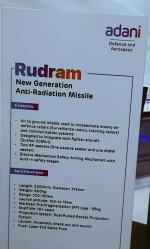
About the warhead of the rudrams, not at all like that. The fuzing system used are impact fuzes but there is slight ms level delay involved otherwise mission objective will not be met. Since warhead options are different, pcb fcb pf various types, missile roles are different in ARM and ground attack too. So mission plan is also done accordingly and it is associated with angle of attack.

For ARM role , even against fixed radar site or an AD zone where mobile AD system (multiple TELs) is deployed in scattered way the AOA is shallow but not too much else the miss distance becomes unacceptable, CEP must be < 25-30m. Hence an AOA is chosen 40-45deg which keeps the miss distance within acceptable tolerance and the pre frag warhead can do the desired damage even if CEP at 30m. The missile can glide at supersonic speed till target and impact still >1mach. But try making the missile fly at 30deg or below angle of attack approach to target, you will see more drag and it will not be able to have desired miss distance, CEP will be . 60 , 70m even more due to closing in to target at very low angle. No course correction possible in those last few sec.

In dive from top mode, final approach only minor course correction, and impact speed 550m/s near mach 2 at a steep 80-85deg angle. Here the role is like a sledgehammer, missile will penetrate and fuze activates within few mili sec resulting in blast after penetration. warhead is also shaped accordingly. PF like a fat jug and pcb like a bullet. In case of rudram 3 one warhead size small as missile speed does the penetration job aka high terminal velocity likely 550-600m/s with slight post impact delay fuzing that survives thru impact then blast to take out inside.

Quite sure terminal speed will vary in same way for different trajectory shapes ie prioritizing different primary constraint factor each time. This is actually where the development stage work happens, those algos can have many flaws and create condition due to data fed via sensor that degrade the performance. Hence the dev team would make necessary fixes, change parameter in cases. Much like software version rollout.
 
This optimisation model is for a specific phase of flight for operation within a specific range bracket and the model allows the user to customise trajectory shaping as per the mission choice as well as on demand basis via the user interface input.

Typically the atmospheric boost glide vehicle operates at high speed but mostly in the high supersonic regime and differ slightly from the HBGV. So when the choice of propulsion is a single solid rocket motor with a limited time of burn, this option becomes very promising due to the shorter range bracket envelope.

Compared to a fully powered flight at a certain altitude, optimising for glide mode has the advantage of not being time constrained since the solid motor can burn for a specific duration only. The propellant composition, burn rate etc can be for short or long duration, but the time for each choice is finite ie the motor will work for x or y sec duration. So to extract better flight performance like range & provide the unpredictability of flight path from the same flight vehicle, optimisation of trajectory is essential.

About the warhead of the rudrams, not at all like that. The fuzing system used are impact fuzes but there is slight ms level delay involved otherwise mission objective will not be met. Since warhead options are different, pcb fcb pf various types, missile roles are different in ARM and ground attack too. So mission plan is also done accordingly and it is associated with angle of attack.

For ARM role , even against fixed radar site or an AD zone where mobile AD system (multiple TELs) is deployed in scattered way the AOA is shallow but not too much else the miss distance becomes unacceptable, CEP must be < 25-30m. Hence an AOA is chosen 40-45deg which keeps the miss distance within acceptable tolerance and the pre frag warhead can do the desired damage even if CEP at 30m. The missile can glide at supersonic speed till target and impact still >1mach. But try making the missile fly at 30deg or below angle of attack approach to target, you will see more drag and it will not be able to have desired miss distance, CEP will be . 60 , 70m even more due to closing in to target at very low angle. No course correction possible in those last few sec.

In dive from top mode, final approach only minor course correction, and impact speed 550m/s near mach 2 at a steep 80-85deg angle. Here the role is like a sledgehammer, missile will penetrate and fuze activates within few mili sec resulting in blast after penetration. warhead is also shaped accordingly. PF like a fat jug and pcb like a bullet. In case of rudram 3 one warhead size small as missile speed does the penetration job aka high terminal velocity likely 550-600m/s with slight post impact delay fuzing that survives thru impact then blast to take out inside.

Quite sure terminal speed will vary in same way for different trajectory shapes ie prioritizing different primary constraint factor each time. This is actually where the development stage work happens, those algos can have many flaws and create condition due to data fed via sensor that degrade the performance. Hence the dev team would make necessary fixes, change parameter in cases. Much like software version rollout.
Aren't the Rudram 2 and 3 have MMW Seeker and IIR seeker for better CEP and pin point accuracy,
Does impact angle plays a factor even when you have advanced seekers for navigation?
 

Attachments

  • 1749908701518.png
    1749908701518.png
    2.2 MB · Views: 11
Aren't the Rudram 2 and 3 have MMW Seeker and IIR seeker for better CEP and pin point accuracy,
Does impact angle plays a factor even when you have advanced seekers for navigation?
Seeker does its work and feed the collected data onto the obc where the guidance algo process the data fed and accordingly endgame engagement happens. Now given these flight vehicles have very high speed, hence even guided the CEP is still can veer a bit away , sometimes tens of meters. Same missile propulsion but control guidance algo difference give different performance. Even different unit of same missile would give varied performance sometimes.

To understand the impact angle part, try imagining the rocket striking target at that angle and then try imagine the rocket flying to the target in that angle prior to hit and you can understand. Steep dive high AoA 80deg from up top, less veering. At 40 deg flying angle, much less steep and facing thru lower atmosphere drag for longer so can cross over the target zone or fall short nearby.
 
So we have learned trajectory optimisation for a short/extended range envelope air to surface engagement where the flight vehicle will work under an initial acceleration and within a velocity regime of maximum 1800 m/s sort of figure.

In the previous 12 months period, we had seen certain very interesting article. We have heard of some article that will work in the velocity regime of approx 3300 m/s (maximum) to approx 2200 m/s (minimum) sort of value. So who want to rough calculate or estimate the possible range/reach and lethality of the similar class of flight vehicle, based on the knowledge gained ?

Hint/caution⚠️: you may have mind blown a little ;)

1750151952147.png
1750152069755.png
 
So we have learned trajectory optimisation for a short/extended range envelope air to surface engagement where the flight vehicle will work under an initial acceleration and within a velocity regime of maximum 1800 m/s sort of figure.

In the previous 12 months period, we had seen certain very interesting article. We have heard of some article that will work in the velocity regime of approx 3300 m/s (maximum) to approx 2200 m/s (minimum) sort of value. So who want to rough calculate or estimate the possible range/reach and lethality of the similar class of flight vehicle, based on the knowledge gained ?

Hint/caution⚠️: you may have mind blown a little ;)

View attachment 44543
View attachment 44544
Why haven't we developed/are developing a anti ship varient of Agni Prime or new bm 04, reentry vehicles of both these missiles will behave more similar to "american dark eagle" missile warhead, aka quasi-hvg/ concial hgv.

Lack of guidance? Can we put a seeker in those reentry vehicles?
 
  • Like
Reactions: Rajput Lion
Why haven't we developed/are developing a anti ship varient of Agni Prime or new bm 04, reentry vehicles of both these missiles will behave more similar to "american dark eagle" missile warhead, aka quasi-hvg/ concial hgv.

Lack of guidance? Can we put a seeker in those reentry vehicles?
A RV can not be used to target a moving target like a ship without major tweaking and even then not the choice method in anti ship role.
 
  • Like
Reactions: Rajput Lion
A RV can not be used to target a moving target like a ship without major tweaking and even then not the choice method in anti ship role.
We can tweak it tho.
Is it a worse choice than LRASHM? Can it compliment it, another type of missile to defend against for plan carrier group?
 
re-entry vehicle is entirely different thing. You will miss by miles. If you want to hit a ship, it would need pinpoint accuracy.
So not worth it.
Guess chinese went with it because they had no other way of targeting US carriers at long ranges at that time, but again they had to invest heavily on guidance chain so that the missile and anti ship RV hits the ship.
 
So we have learned trajectory optimisation for a short/extended range envelope air to surface engagement where the flight vehicle will work under an initial acceleration and within a velocity regime of maximum 1800 m/s sort of figure.

In the previous 12 months period, we had seen certain very interesting article. We have heard of some article that will work in the velocity regime of approx 3300 m/s (maximum) to approx 2200 m/s (minimum) sort of value. So who want to rough calculate or estimate the possible range/reach and lethality of the similar class of flight vehicle, based on the knowledge gained ?

Hint/caution⚠️: you may have mind blown a little ;)

View attachment 44543
View attachment 44544
Is Rudram 4 gonna be a pure air launched HGV