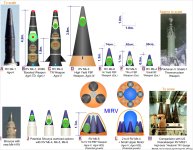

Considering the missile diameter and the fact we've tested only 6 times, if it is MIRV the MIRVed warheads will only be 15 maybe 20 kilotons, maybe with boosting 25-30 kilotons. Not more than that. And even then perhaps it can carry only 2 warheads.I'd say SLBMs are MIRV capable by default. K4 would be no exception, esp in our strategic scenario. This missile will form the core of our 2nd strike N capability for the next 7-10 years. S5 is still a long way off.
First Soviet SLBMs were single warhead and believe it or not iirc under SALT Treaty for some years Trident had only 1 warhead tooSLBMs are prime mirv candidates for any country that has the tech. After all, the goal is to maximize the deterrent effect.
Barring the earliest versions of the Polaris, I can't think of any SLBM with a single whd. Mirv also provides redundancy in case one whd fails to deploy from the pbv in the terminal phase.
To answer your second point, it really depends on the throw weight or total payload capacity of K4 (reported to be 2t > A5's ~1.5t.)
India has achieved a high degree of miniaturization in payload/bus configuration. For comparison, the much smaller Agni Prime has a comparable throw weight and is reportedly MIRV capable too. And there is significant cross-pollination between the Agni and K-series missiles.
 . Edit: that was actually Minuteman which is land based. But the earlier Chinese SLBMS JL1 and even JL2 is described as MIRV capable but deployed in single warhead config in open sources.