Indian Naval Aviation : Updates and Discussions

Leak exposes radar failures in India’s MiG-29K fighters


The document — titled “Report on the Reliability and Performance of the Zhuk-ME Radar in MiG-29K/KUB Aircraft of the Indian Navy” — was reportedly taken from sources connected to Rostec, Russia’s state defense conglomerate. It outlines years of discussions between Russian and Indian officials concerning low radar reliability, repeated component failures, and unresolved contractual obligations.

According to the report, the radar’s reliability fell far below the levels specified in India’s 2004 procurement contract with Russia’s MiG Corporation (RAC MiG).


The document cites contractual requirements setting the radar’s mean time between failures (MTBF) at 150 flight hours and its mean time between defects (MTBD) at 120 hours. However, real-world performance data gathered during annual Russo-Indian reliability conferences at the Indian Navy’s INS Hansa airbase revealed much lower results.

Between 2016 and 2018, the MiG-29K fleet logged repeated radar breakdowns. In early 2016, reliability values were recorded at only 20 hours MTBD and 97 hours MTBF, well below the contract’s threshold.

By mid-2017, MTBF had dropped to just 60 hours, though later tests briefly showed improvement. Even then, Indian officers continued to raise formal complaints about “unsatisfactory radar operation” and repeated equipment failures in memos to RAC MiG and Russia’s defense export agencies.

The internal correspondence references several memoranda from the Indian Navy criticizing radar reliability, including documents dated March, June, and July 2018, all highlighting malfunctioning Zhuk-ME units and delays in repairs. The Indian side reportedly requested that all radar systems be reworked at Russian expense after limited tests on three upgraded radars showed “satisfactory” results but failed to solve broader reliability concerns.

The leaked report also indicates that part of the recorded flight time used for reliability calculations included sorties flown with mock radar modules, artificially inflating reliability statistics and masking the system’s true operational shortcomings. “The actual indicator cannot represent the factual reliability of the Zhuk-ME radar,” the document states.

In response to the repeated failures, Russia’s NIIR Phazotron, the radar’s developer, reportedly carried out several redesigns and block replacements under the supervision of KRET, another Rostec subsidiary. These efforts were meant to bring the radar up to its contractual performance levels. However, according to the leaked material, the question of who would fund the remaining upgrades “remains open.”

By May 2019, the Indian Navy had formally removed the Zhuk-ME radar from its Original Manufacturer Certificate, effectively delisting it as a certified component of its MiG-29K/KUB aircraft.

The leak is the latest in a series of disclosures by Black Mirror, which has repeatedly targeted Russian state defense entities, including firms within Rostec. The newly released materials shed light on long-standing reliability issues affecting one of India’s most expensive fighter procurement programs — and on the growing strain in Russian-Indian defense cooperation over technical quality and post-sale support.

Time to switch..

1000136402.jpg
 
Can someone give me an idea why air launched surface missiles like Rampage , Rudram are getting integrated with Mig 29 k earlier than IAF ?

Mig 29 K is freely available?
Navy is keen on making its limited air arm potent ?
 
Can someone give me an idea why air launched surface missiles like Rampage , Rudram are getting integrated with Mig 29 k earlier than IAF ?

Mig 29 K is freely available?
Navy is keen on making its limited air arm potent ?
Navy keeps some of their carrier capable Migs on ground in standby. Those fighters have a much more lenient flight schedule than IAF's Su-30s. They are more readily available. The Migs & the Su-30s share some pylons, so integration with one can be seen as integration with both.
 
Also we get to open a new direction of attack which will catch enemy grid not just by surprise, but also it is hard to counter. Adversary would get stretched & certainly panic much sooner than say only facing a land based attack vector. Extremely useful in war situation. This land attack capability via multi front (land and sea both) will pin down enemy naval forces from countering land based attack together as seen recently. Navy IAC deployment pinned down pak navy.
 
  • Like
Reactions: Sathya

Leak exposes radar failures in India’s MiG-29K fighters


The document — titled “Report on the Reliability and Performance of the Zhuk-ME Radar in MiG-29K/KUB Aircraft of the Indian Navy” — was reportedly taken from sources connected to Rostec, Russia’s state defense conglomerate. It outlines years of discussions between Russian and Indian officials concerning low radar reliability, repeated component failures, and unresolved contractual obligations.

According to the report, the radar’s reliability fell far below the levels specified in India’s 2004 procurement contract with Russia’s MiG Corporation (RAC MiG).


The document cites contractual requirements setting the radar’s mean time between failures (MTBF) at 150 flight hours and its mean time between defects (MTBD) at 120 hours. However, real-world performance data gathered during annual Russo-Indian reliability conferences at the Indian Navy’s INS Hansa airbase revealed much lower results.

Between 2016 and 2018, the MiG-29K fleet logged repeated radar breakdowns. In early 2016, reliability values were recorded at only 20 hours MTBD and 97 hours MTBF, well below the contract’s threshold.

By mid-2017, MTBF had dropped to just 60 hours, though later tests briefly showed improvement. Even then, Indian officers continued to raise formal complaints about “unsatisfactory radar operation” and repeated equipment failures in memos to RAC MiG and Russia’s defense export agencies.

The internal correspondence references several memoranda from the Indian Navy criticizing radar reliability, including documents dated March, June, and July 2018, all highlighting malfunctioning Zhuk-ME units and delays in repairs. The Indian side reportedly requested that all radar systems be reworked at Russian expense after limited tests on three upgraded radars showed “satisfactory” results but failed to solve broader reliability concerns.

The leaked report also indicates that part of the recorded flight time used for reliability calculations included sorties flown with mock radar modules, artificially inflating reliability statistics and masking the system’s true operational shortcomings. “The actual indicator cannot represent the factual reliability of the Zhuk-ME radar,” the document states.

In response to the repeated failures, Russia’s NIIR Phazotron, the radar’s developer, reportedly carried out several redesigns and block replacements under the supervision of KRET, another Rostec subsidiary. These efforts were meant to bring the radar up to its contractual performance levels. However, according to the leaked material, the question of who would fund the remaining upgrades “remains open.”

By May 2019, the Indian Navy had formally removed the Zhuk-ME radar from its Original Manufacturer Certificate, effectively delisting it as a certified component of its MiG-29K/KUB aircraft.

The leak is the latest in a series of disclosures by Black Mirror, which has repeatedly targeted Russian state defense entities, including firms within Rostec. The newly released materials shed light on long-standing reliability issues affecting one of India’s most expensive fighter procurement programs — and on the growing strain in Russian-Indian defense cooperation over technical quality and post-sale support.
Has anyone scene the original report? Antidotally I’ve heard Zhuk is pretty decent when it works but this would explain a lot.
 
The last 2 points of the 3 mentioned in the first para is probably attributable to many other mil gadgets we buy. i think our armed forces always demand a lot of customisation in the original product (so it works the way they want it to work in the diverse environmental challenges they face) from the OEM and this becomes a point of dispute very often because OEM either want to charge huge bill for it naturally or simply refuse to bear the cost themselves thereby entire customised work get stuck leading to other issues. Supply chain issue is real, has been the case for decades not just post covid.
 
  • Like
Reactions: F-2
The UPG uses Zhuk-ME yes? Could it just be a navalized issue? Only the Mig-29k is mentioned.
 
G3r8QeFXkAAV-A6

G3r8Rr4WgAAqR3D

modi with Mig-29k
 

The French manufacturer of aerospace equipment Aresia (formerly Rafaut) signed a contract with the Indian Navy to equip eight Russian Ka-28 helicopters with lifts. These systems will then be integrated with hydroacoustic buoys and torpedoes.

These Russian helicopters, designed to combat submarines, are based on the first Indian aircraft carrier Vikrant, which was commissioned into the Indian Navy in 2022. According to Aresia, the signed agreement is a contract for the modernization of these aircraft using the NATO standard equipment. The company is already a supplier of subsystems for Rafale in India, where it operates through a joint venture with the Nucon Aerospace group – Nucon-Aresia Aerospace (NAAPL).

This contract for equipping Russian helicopters looks unexpected, given the agreement signed on November 17 by French President Emmanuel Macron and Volodymyr Zelensky to supply about 100 Rafale fighters to Ukraine. Aresia also reported that obtaining an export license from the General Directorate of Armaments (DGA) was extremely difficult.
- infantmilitario Telegram
 
  • Like
Reactions: redpanda and Ashwin
G9-FIwMbcAM_usn

G9-FIwNboAA1-_K

G9-FIwYbAAAeUiY

Celebrating 20 years of an enduring legacy. Commissioned in 2006, INAS 342 stands proud as the alma mater of all RPA pilots of the Indian Navy,
 
  • Like
Reactions: aditya g and Shan
HCd7UGbbUAEOGCM


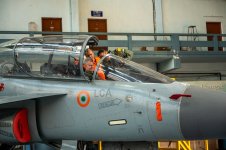
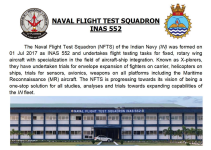
Indian Naval Air Squadron 552 (INAS 552) was commissioned into the IndianNavy on 07 July 2005 as Sea Harrier Training Squadron. Post de-induction of Sea Harriers aircraft from service, the squadron was revived as Naval Flight Test Squadron with effect from 01 July 2017. The squadron is entrusted with trials of aviation platforms, airborne systems, ship borne aviation complex, aviation weapon systems and equipment related to flying including flying clothing and ground support equipment. The squadron also undertakes training of Rotary Wing Experimental Test Pilots and Production Test Pilots for undertaking Ship Helicopter Operating Limitation trials. INAS 552 has been numbered as per sequential serial number of the Air Squadrons of Indian Navy. The crest depicts a flaming torch with wings over the Blue and White Sea waves over a Blue background, signifying the illumination of path of enlightenment to the novices joining the elite naval fighter stream. The flame also signifies the burning desire within the individual to learn and excel in his profession. The golden wings are symbolic of Naval Aviation. The two fighter jets soaring into the sky signify the glory and spirit of fighter flying. The motto of the squadron is ‘Enable, Enhance, Evolve’.

1772536580503.png