

Indian Science and Technology Developments : Updates and Discussions
- Thread starter Gautam
- Start date
You are using an out of date browser. It may not display this or other websites correctly.
You should upgrade or use an alternative browser.
You should upgrade or use an alternative browser.


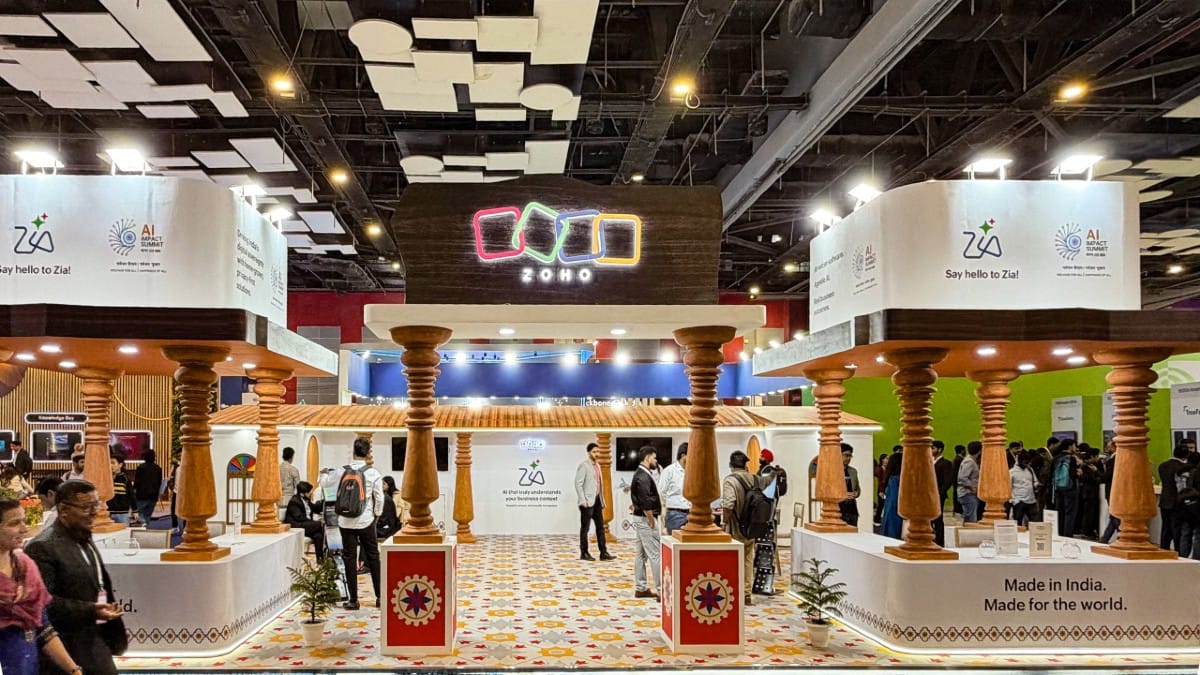
Govt spent Rs 180 cr on Zoho-backed email platform; 16.68 lakh official accounts migrated
MeitY said pricing under contract with Zoho ranges from Rs 170 to Rs 300 per account per month for mailbox sizes between 30 GB and 100 GB.
 theprint.in

Food for thought:
In spite of buying German TBM machines, India has been at the mercy of China because they're manufactured there.
Iran has built world class TBM tech but their scientists/engineers are currently out of a job.
Should India poach them to jumpstart its TBM industry?
In spite of buying German TBM machines, India has been at the mercy of China because they're manufactured there.
Iran has built world class TBM tech but their scientists/engineers are currently out of a job.
Should India poach them to jumpstart its TBM industry?

Its not that deep! (pun intended).Food for thought:
In spite of buying German TBM machines, India has been at the mercy of China because they're manufactured there.
Iran has built world class TBM tech but their scientists/engineers are currently out of a job.
Should India poach them to jumpstart its TBM industry?
They saw tunnels as a strategic necessity for their national objectives, such as nuclear and missile developments. West obviously wont help them in this regard. Thus they planned and worked for decades to master it.
YES! but I sadly dont think our babus are smart enough. Thankfully though BEML seems to have started TBM development so we might have indegenous TBMS relatively soon.Food for thought:
In spite of buying German TBM machines, India has been at the mercy of China because they're manufactured there.
Iran has built world class TBM tech but their scientists/engineers are currently out of a job.
Should India poach them to jumpstart its TBM industry?
the German TBM maker is also expanding production to large scale TBMs in their chennai facility so we will have at least one by end of 2027 and maybe 2 by 2032 ish.

Right thread for this?

 timesofindia.indiatimes.com
The US Food & Drug Administration (USFDA) approval of Wockhardt’s Zaynich, a first-in-class "breakthrough antibiotic" for severe drug-resistant infections, opens up a significant global market opportunity and marks a watershed moment for India’s pharmaceutical industry, the company’s founder chairman Habil Khorakiwala told TOI on Monday.
Zaynich, a combination of cefepime and zidebactam, is the first novel drug discovered and developed in India to secure USFDA approval, with peak sales estimated at over $1.5 billion, he said.
====
Indian Pharma companies are moving up the value chain.
'USFDA nod for Zaynich a major boost'
NEW DELIH: The US Food and Drug Administration’s (USFDA) approval of Wockhardt’s Zaynich, a first-in-class ``breakthrough antibiotic'' for severe drug-resistant infections, opens up a significant global market opportunity and marks a watershed moment for India’s pharmaceutical industry, the...
timesofindia.indiatimes.com
The US Food & Drug Administration (USFDA) approval of Wockhardt’s Zaynich, a first-in-class "breakthrough antibiotic" for severe drug-resistant infections, opens up a significant global market opportunity and marks a watershed moment for India’s pharmaceutical industry, the company’s founder chairman Habil Khorakiwala told TOI on Monday.
Zaynich, a combination of cefepime and zidebactam, is the first novel drug discovered and developed in India to secure USFDA approval, with peak sales estimated at over $1.5 billion, he said.
====
Indian Pharma companies are moving up the value chain.

Sarvam says it is making 1 trillion parameter AI model, seeks to challenge OpenAI and Anthropic
Armaan Agarwal
New Delhi, UPDATED: Jul 30, 2026, 13:58 IST
Sarvam has just announced a series of new releases at its AI conference Epoch. From the launch of Sarvam Vision 2.0 to Bulbul 4, and upgrades to its flagship Sarvam 105B model, here are all the details.
Sarvam AI is making a new flagship AI model from scratch in India. (Photo: File Photo)
AI startup Sarvam has made a series of announcements during its AI conference, called Epoch 2026. At the event, the Indian AI lab claimed that its models can deliver strong performance at a fraction of the cost of global frontier models. From Sarvam 105B to the launch of Sarvam Vision 2.0 and Bulbul V4, here is everything you need to know.
During the keynote, Sarvam co-founder Pratyush Kumar said that the startup was building a foundational AI model with over a trillion parameters in India "We are very happy to announce that we are building a trillion-plus parameter model right here in India. We are building them from scratch to be competitive in coding, cybersecurity, simulation, science and more," he said.
Parameters refer to the dataset used to train AI. The more the parameters the stronger the AI can perform. For context, Kimi K3, the largest open-weight model right now, is a 2.8 trillion parameter model. That is, with a trillion-parameter model, Sarvam may get closer to leading AI labs like Anthropic and OpenAI.
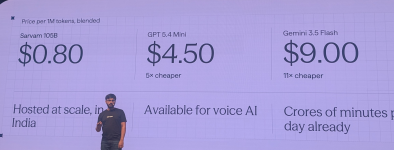
Sarvam has made improvements to its flagship 105B model, when it comes to how the model works with AI agents. According to benchmarks shared by the company, Sarvam 105B is better at voice call capabilities, instruction following, and other tasks when compared to OpenAI’s GPT-5.4 Mini and Google’s Gemini 3.5 Flash.
AI costs have quickly become a concern for companies, and Sarvam says that the 105B is 5.5 times cheaper than GPT-5.4 Mini. Sarvam 105B costs $0.80 per one million blended tokens, compared with $4.50 for GPT-5.4 Mini. On the other hand, the Sarvam model is 11 times cheaper than Google’s Gemini 3.5 Flash which costs $9 for a million blended tokens.
Saravm says that the model is being hosted in India and is available for voice products. The company said, "If you are building a voice product today, Sarvam is the cheapest, fastest and most scalable solution," and added that competing voice offerings from ChatGPT are not currently available while Gemini is not available at comparable scale.
Sarvam also announced Vision 2.0, the next generation of Sarvam Vision. Vision 2.0 focuses on optical character recognition (OCR) capabilities for enterprise document processing. That is, the AI model can read and interpret documents and text. Vision 2.0 brings major improvements when compared to the original Vision 1, which had managed to outperform models from OpenAI and Google in OCR. Vision 2.0 is also better at recognizing Indian handwritten text and extracting tables or key values.
Sarvam also announced commercial availability of Sarvam Vision Edge, its document intelligence platform that can run locally on any device. Vision Edge is being used by the Odisha government on a research initiative to digitize and extract information from land records.
For speech recognition, Sarvam has launched Saras V4 that gets even better at recognizing Indic languages. Apart from languages like Hindi and Bengali, Saras V4 can also transcribe languages that other AI models cannot, such as Odia, Sanskrit and Manipuri.
Sarvam says that Saras V4 is also the SOTA or state of the art model for English, ahead of rivals.
Apart from Saras, Sarvam has also improved the text-to-speech (TTS) model, Bulbul with Bulbul V4. You can now add emotions like laughter or put emphasis on certain words to make the audio feel more natural.
A highlight of Epoch were the Sarvam Kaze smart glasses. The Kaze smart glasses were first showcased during the India AI Impact Summit in February this year. Now, the company showed a demo video, where a visually impaired person used the glasses to get information about bus routes, how far was their stop, and how long the bus ride would be. As per the clip, the Kaze smart glasses use cameras to recognize the bus and then find information about its routes.
Apart from new models and devices, Sarvam also announced a service to rent Indian phone numbers. In a demo shown during the launch, a user could rent a number within 30 seconds after sharing PAN and Aadhaar details.
The announcements add to Sarvam's broader strategy of offering domestically hosted AI infrastructure and models tailored for Indian enterprises and public sector deployments. The company recently crossed $1.5 billion in market cap after a 234 million fundraising round, led by HCL Tech.
Sarvam says it is making 1 trillion parameter AI model, seeks to challenge OpenAI and Anthropic
Armaan Agarwal
New Delhi, UPDATED: Jul 30, 2026, 13:58 IST
Sarvam has just announced a series of new releases at its AI conference Epoch. From the launch of Sarvam Vision 2.0 to Bulbul 4, and upgrades to its flagship Sarvam 105B model, here are all the details.
Sarvam AI is making a new flagship AI model from scratch in India. (Photo: File Photo)
AI startup Sarvam has made a series of announcements during its AI conference, called Epoch 2026. At the event, the Indian AI lab claimed that its models can deliver strong performance at a fraction of the cost of global frontier models. From Sarvam 105B to the launch of Sarvam Vision 2.0 and Bulbul V4, here is everything you need to know.
During the keynote, Sarvam co-founder Pratyush Kumar said that the startup was building a foundational AI model with over a trillion parameters in India "We are very happy to announce that we are building a trillion-plus parameter model right here in India. We are building them from scratch to be competitive in coding, cybersecurity, simulation, science and more," he said.
Parameters refer to the dataset used to train AI. The more the parameters the stronger the AI can perform. For context, Kimi K3, the largest open-weight model right now, is a 2.8 trillion parameter model. That is, with a trillion-parameter model, Sarvam may get closer to leading AI labs like Anthropic and OpenAI.
Sarvam 105B is 5.5 times cheaper than competition
Sarvam has made improvements to its flagship 105B model, when it comes to how the model works with AI agents. According to benchmarks shared by the company, Sarvam 105B is better at voice call capabilities, instruction following, and other tasks when compared to OpenAI’s GPT-5.4 Mini and Google’s Gemini 3.5 Flash.
AI costs have quickly become a concern for companies, and Sarvam says that the 105B is 5.5 times cheaper than GPT-5.4 Mini. Sarvam 105B costs $0.80 per one million blended tokens, compared with $4.50 for GPT-5.4 Mini. On the other hand, the Sarvam model is 11 times cheaper than Google’s Gemini 3.5 Flash which costs $9 for a million blended tokens.
Saravm says that the model is being hosted in India and is available for voice products. The company said, "If you are building a voice product today, Sarvam is the cheapest, fastest and most scalable solution," and added that competing voice offerings from ChatGPT are not currently available while Gemini is not available at comparable scale.
Sarvam Vision 2.0 and Vision Edge
Sarvam also announced Vision 2.0, the next generation of Sarvam Vision. Vision 2.0 focuses on optical character recognition (OCR) capabilities for enterprise document processing. That is, the AI model can read and interpret documents and text. Vision 2.0 brings major improvements when compared to the original Vision 1, which had managed to outperform models from OpenAI and Google in OCR. Vision 2.0 is also better at recognizing Indian handwritten text and extracting tables or key values.
Sarvam also announced commercial availability of Sarvam Vision Edge, its document intelligence platform that can run locally on any device. Vision Edge is being used by the Odisha government on a research initiative to digitize and extract information from land records.
Sarvam Bulbul 4 and Saras v4
For speech recognition, Sarvam has launched Saras V4 that gets even better at recognizing Indic languages. Apart from languages like Hindi and Bengali, Saras V4 can also transcribe languages that other AI models cannot, such as Odia, Sanskrit and Manipuri.
Sarvam says that Saras V4 is also the SOTA or state of the art model for English, ahead of rivals.
Apart from Saras, Sarvam has also improved the text-to-speech (TTS) model, Bulbul with Bulbul V4. You can now add emotions like laughter or put emphasis on certain words to make the audio feel more natural.
Sarvam Kaze AI glasses
A highlight of Epoch were the Sarvam Kaze smart glasses. The Kaze smart glasses were first showcased during the India AI Impact Summit in February this year. Now, the company showed a demo video, where a visually impaired person used the glasses to get information about bus routes, how far was their stop, and how long the bus ride would be. As per the clip, the Kaze smart glasses use cameras to recognize the bus and then find information about its routes.
Rent a number in 30 seconds
Apart from new models and devices, Sarvam also announced a service to rent Indian phone numbers. In a demo shown during the launch, a user could rent a number within 30 seconds after sharing PAN and Aadhaar details.
The announcements add to Sarvam's broader strategy of offering domestically hosted AI infrastructure and models tailored for Indian enterprises and public sector deployments. The company recently crossed $1.5 billion in market cap after a 234 million fundraising round, led by HCL Tech.
Sarvam says it is making 1 trillion parameter AI model, seeks to challenge OpenAI and Anthropic
https://www.youtube.com/watch?v=TInc0TIsEso
Aum procesor tape-out in August-September. Samples by Feb-March 2027. Qualifiy it and have some production numbers during July 2027. Towards end of next year, deployment in a 5 petaflop machine which will host 2000 such processors in a single facility. Facility could be in Pune, Hyderabad or Bangalore.
Aum procesor tape-out in August-September. Samples by Feb-March 2027. Qualifiy it and have some production numbers during July 2027. Towards end of next year, deployment in a 5 petaflop machine which will host 2000 such processors in a single facility. Facility could be in Pune, Hyderabad or Bangalore.
Researchers at the National Institute of Technology (NIT), Rourkela, have developed a novel three-dimensional (3D) reinforced advanced composite manufacturing technology that will enhance the strength, durability and damage tolerance of fibre-reinforced polymer (FRP) composites, paving the way for their use in aerospace, automotive, renewable energy and other high-performance engineering sectors.
The patented technology, developed at the FRP Composite Laboratory of the Department of Metallurgical and Materials Engineering, NIT Rourkela, addresses one of the major limitations of conventional FRP composites: their vulnerability to internal damage under heavy loading that can lead to cracks, delamination and structural failure over prolonged use.
The innovation is expected to improve the reliability and lifespan of lightweight structural components used in commercial aircraft, defence platforms, space launch vehicles, high-speed rail systems, wind energy installations and hydrogen storage infrastructure.
FRP composites are widely regarded as advanced engineering materials because of their exceptional strength-to-weight ratio, high fatigue resistance, design flexibility and excellent corrosion resistance.
These characteristics have made them indispensable in industries where reducing weight without compromising structural integrity is critical. However, conventional FRP composites often suffer from weak interlaminar bonding, making them susceptible to damage under repeated or heavy loading conditions.
The NIT team has developed a hybrid three-dimensional reinforced composite by integrating glass fibres with graphene nanoplatelets aligned through the thickness of the composite during manufacturing.
"This unique internal architecture enables the fibres, graphene nanoplatelets and epoxy matrix to work together more efficiently, resulting in a significantly tougher and more durable material capable of resisting crack propagation and structural failure," said Rajesh Kumar Prusty, assistant professor at NIT Rourkela.
A distinguishing feature of the patented technology is its ability to align unmodified graphene nanoplatelets within glass fibre-reinforced epoxy composites using a simple and industry-compatible manufacturing process.
Instead of requiring expensive or complex fabrication techniques, the researchers introduced only a minor modification to conventional composite manufacturing by applying a standard 50 Hz alternating current electric field of 800 volts during the curing stage.
According to the researchers, this makes the process readily adaptable to existing industrial composite production systems without substantial changes in manufacturing infrastructure.
"The technology has broad applications wherever lightweight materials with superior damage tolerance are essential. Aircraft panels, automotive crash structures, wind turbine blades, pressure vessels, marine structures and several other advanced engineering components could directly benefit from the innovation," said Prusty.
During performance evaluations, the newly developed material recorded a 37 per cent increase in tensile strength, a 30 per cent improvement in flexural strength, a 63 per cent rise in flexural modulus, a 26 per cent enhancement in tensile modulus, and a 24 per cent increase in interlaminar shear strength.
The researchers also observed a 33 per cent improvement in Mode-I fracture toughness, a 53 per cent increase in Mode-II fracture toughness and a 55 per cent higher storage modulus at 40 degrees Celsius, indicating superior stiffness and durability under operating conditions.
Bankim Chandra Ray, a professor at NIT Rourkela, said the innovation could lower maintenance costs, improve energy efficiency and promote sustainable manufacturing by producing lighter yet more durable structural materials.
"The technology has the potential to contribute significantly to India's Atmanirbhar Bharat mission by strengthening domestic capabilities in advanced materials manufacturing," he said.
The research team is now preparing to validate the technology in larger structural components and assess its long-term environmental durability under real-world operating conditions.
They have also sought industry collaborations to facilitate commercialisation and accelerate the adoption of the patented composite technology across aerospace, automotive, renewable energy and other advanced manufacturing sectors.
The patented technology, developed at the FRP Composite Laboratory of the Department of Metallurgical and Materials Engineering, NIT Rourkela, addresses one of the major limitations of conventional FRP composites: their vulnerability to internal damage under heavy loading that can lead to cracks, delamination and structural failure over prolonged use.
The innovation is expected to improve the reliability and lifespan of lightweight structural components used in commercial aircraft, defence platforms, space launch vehicles, high-speed rail systems, wind energy installations and hydrogen storage infrastructure.
FRP composites are widely regarded as advanced engineering materials because of their exceptional strength-to-weight ratio, high fatigue resistance, design flexibility and excellent corrosion resistance.
These characteristics have made them indispensable in industries where reducing weight without compromising structural integrity is critical. However, conventional FRP composites often suffer from weak interlaminar bonding, making them susceptible to damage under repeated or heavy loading conditions.
The NIT team has developed a hybrid three-dimensional reinforced composite by integrating glass fibres with graphene nanoplatelets aligned through the thickness of the composite during manufacturing.
"This unique internal architecture enables the fibres, graphene nanoplatelets and epoxy matrix to work together more efficiently, resulting in a significantly tougher and more durable material capable of resisting crack propagation and structural failure," said Rajesh Kumar Prusty, assistant professor at NIT Rourkela.
A distinguishing feature of the patented technology is its ability to align unmodified graphene nanoplatelets within glass fibre-reinforced epoxy composites using a simple and industry-compatible manufacturing process.
Instead of requiring expensive or complex fabrication techniques, the researchers introduced only a minor modification to conventional composite manufacturing by applying a standard 50 Hz alternating current electric field of 800 volts during the curing stage.
According to the researchers, this makes the process readily adaptable to existing industrial composite production systems without substantial changes in manufacturing infrastructure.
"The technology has broad applications wherever lightweight materials with superior damage tolerance are essential. Aircraft panels, automotive crash structures, wind turbine blades, pressure vessels, marine structures and several other advanced engineering components could directly benefit from the innovation," said Prusty.
During performance evaluations, the newly developed material recorded a 37 per cent increase in tensile strength, a 30 per cent improvement in flexural strength, a 63 per cent rise in flexural modulus, a 26 per cent enhancement in tensile modulus, and a 24 per cent increase in interlaminar shear strength.
The researchers also observed a 33 per cent improvement in Mode-I fracture toughness, a 53 per cent increase in Mode-II fracture toughness and a 55 per cent higher storage modulus at 40 degrees Celsius, indicating superior stiffness and durability under operating conditions.
Bankim Chandra Ray, a professor at NIT Rourkela, said the innovation could lower maintenance costs, improve energy efficiency and promote sustainable manufacturing by producing lighter yet more durable structural materials.
"The technology has the potential to contribute significantly to India's Atmanirbhar Bharat mission by strengthening domestic capabilities in advanced materials manufacturing," he said.
The research team is now preparing to validate the technology in larger structural components and assess its long-term environmental durability under real-world operating conditions.
They have also sought industry collaborations to facilitate commercialisation and accelerate the adoption of the patented composite technology across aerospace, automotive, renewable energy and other advanced manufacturing sectors.

Superhydrophobic nanocomposite coating boosts PV power output by 16%, outperforms manual cleaning - pv magazine India
An Indian research team developed a transparent, nanocomposite coating that makes solar panels superhydrophobic, enabling self-cleaning and reducing dust-related performance losses. Six months of outdoor testing showed coated panels produced 16% more power than dusty panels and 7% more than...
 www.pv-magazine-india.com
How Sarvam is helping India seek its DeepSeek moment and what it needs to do next to get there
On July 30, Indian AI startup Sarvam held the Epoch conference. The startup made a bunch of announcements including better models, and a new office in the US. But does this mean that Sarvam may finally bring India to the big boys club in the AI race?
Armaan Agarwal
New Delhi, UPDATED: Aug 5, 2026 18:29 IST
At Epoch 2026, Sarvam co-founder Pratyush Kumar made a big announcement. He claimed that the AI startup was building a foundational AI model with over a “trillion-plus” parameters in India from scratch.
Parameters refer to the dataset used to train AI. The more the parameters the stronger the AI can perform. If Sarvam manages to have its own trillion-plus parameter model, it could bring the Indian startup closer to leading AI labs like Anthropic and OpenAI. But to understand how Sarvam has reached this stage, we must first understand what the startup has done so far.
What Sarvam has done so far
You see, Sarvam wants India to have sovereign AI models that are designed for local use cases.
For this, there are models like Saaras V4 that can detect speech clearly, not just in Indian languages, but in English too. Saras V4 comes with a multi-speaker mode that Sarvam says is the “best-in-class speech recognition model that accurately captures overlapping conversations and multi-speaker interactions.” That is, even in English, it is billed as the best model out there when it comes to speech recognition.
Then there’s Vision 2.0. It is designed for digitising documents, and in particular Indian documents. Already, over 35 million documents have been digitised with Vision 1, and now the Odisha government is also using the model.
You also have the flagship Sarvam 105B AI model that now works with AI agents.
According to benchmarks shared by Sarvam, this model is better at certain tasks, such as voice call capabilities and instruction following when compared to OpenAI’s GPT-5.4 Mini and Google’s Gemini 3.5 Flash.
Why Sarvam’s work matters for India
Clearly, Sarvam is doing a lot of work when it comes to AI. And this becomes particularly important today when there is growing debate around AI sovereignty. Ever since the US temporarily banned Anthropic’s Mythos 5 and Fable 5 models for all foreigners, there have been growing concerns among companies that were using foreign-made AI models.
"Given the growing geopolitical, supply chain and national security risks, the case for sovereign AI models is becoming increasingly compelling,” Deloitte India Partner Vijay Gopalakrishnan tells India Today Tech. “The risks are real.”
Till now, Indians really had to use AI models from US companies like OpenAI and Anthropic, or go for Chinese alternatives like Kimi K3 and DeepSeek V4. Some AI pioneers like OpenAI’s Sam Altman even declared that building AI was not for Indian companies. “You (Indians) can try to build AI like ChatGPT, but you will fail,” he said in 2023 though he later clarified his comment was taken out of context.
But Sarvam’s work shows that India too can join the big leagues of AI. “Sarvam’s progress means infrastructure (in India) exists. Models can be built, Compute is available,” cybersecurity firm eScan’s CEO Govind Rammurthy tells India Today Tech.
Shivam Rajput, CEO of tech startup ElectraWireless adds, “Companies like Sarvam are helping strengthen India's AI capabilities, and a diverse ecosystem of specialised AI companies will ultimately benefit the country's innovation landscape.”
But there is a catch
But just making a model is not enough, suggests Gurleen Khurana, the co-founder of AI consulting firm SimplifyGenAI. Rather, the Sarvam models will have to be the ones people actually use. “Sovereign AI shouldn't quietly become second-best AI. The actual test is whether Indian companies choose these models on merit, when nobody's watching. That's the bar,” he tells India Today Tech.
As we mentioned earlier, Sarvam is seeing user adoption when it comes to its Vision model for documents. The Indus by Sarvam app on the Google Play store has over 1,00,000 downloads. While we don’t have Sarvam’s userbase numbers, it is likely that they still pale in comparison to AI behemoths like OpenAI or Google.
And the reason for this may be that tools like Claude Code or OpenAI’s ChatGPT Work simply do some things better. “If you're building Indian language applications, Sarvam becomes relevant, which I believe is their strength. Most techies in India work in English-first environments,” Govind Rammurthy explains. “The market Sarvam is targeting doesn't yet overlap with people choosing tools. That gap takes years to close."
Gurleen Khurana insisted that there was no real reason for you to switch to a Sarvam model unless you really wanted something specific. “Sarvam doesn't have anything close to frontier today, and pretending otherwise helps nobody. But for Indian language voice work specifically, absolutely worth trying. Use the right tool for the job, not the patriotic one,” he said.
What makes things more difficult is that Sarvam does not have millions of dollars in revenue from paying users either. Govind notes, “Sarvam hasn’t proved a sustainable business model exists. No one is paying a premium for Indian LLMs yet. Other startups face the same fundamental problem – customers won't pay unless forced to. And, even if they are forced to, they will end up negotiating $10 for a $100 price point.” He added, “Sarvam's achievements make the path clearer technically. They don't make the market exist. That requires either a government mandate or genuinely superior products. Sarvam has neither yet."
That is, Sarvam faces two major hurdles – building a frontier model to truly match global players, something which its upcoming 1 trillion-plus parameter model can help it reach, and to have a proper set of premium plans for a steady flow of income.
But in cases where Sarvam has an edge, it does become a strong factor in bringing more users. Gurleen Khurana says that his firm was interested in using Bulbul V4, Sarvam’s latest text-to-speech (TTS) model. “We're actively evaluating Bulbul V4. We work with a lot of Indian brands in the creative space, and it's one of the more expressive models for Indian voices, especially code-mixed Hinglish, which most global models still handle badly,” he says.
With Bulbul V4, you can add emotions like laughter or put emphasis on certain words to make the audio feel more natural. Gurleen adds, “That's where their edge is real and defensible."
The way forward for Sarvam
Though, Sarvam is making progress and it is growing fast. The startup recently became India’s first AI unicorn with a $1.5 billion market cap after raising $234 million in a funding round. The round was led by HCLTech. Additionally, Sarvam has also opened its first research lab in the US, in the city of San Francisco. Star AI expert Devendra Singh Chaplot – who previously worked at xAI, Mistral and Thinking Machine Labs – has joined the startup as a part-time advisor too.
The new US lab may help accelerate the company’s plans as it gives it access to the most talented AI engineers in Silicon Valley, including many Indians. Gurleen says, “A lot of the people building frontier models are Indian, they're in the US because that's where the pay and the GPUs are. A San Francisco lab is really just access to that pool. It's not that India lacks talent, we clearly have it.”
Govind Rammurthy called Chaplot’s arrival “pragmatic” for Sarvam, but admitted that this showed that India may not be fully prepared for frontier AI development. He explained, “It also exposes the reality – building a competitive frontier AI requires operating globally, not just in India. That's expensive and requires resources most Indian startups lack."
While Sarvam has got a lot in the pipeline, it cannot become the next big name in the AI world unless it finds a breakthrough. Gurleen Khurana says that the AI startup must have its own DeepSeek moment, referring to the Chinese AI startup that shocked the world with its R1 and V3 models.
“Sarvam will have to do something extraordinary. DeepSeek got noticed for landing near the frontier at a fraction of the cost, not for being Chinese. So Sarvam needs either that, or something genuinely new,” Gurleen notes. “Being best at Indian languages is a good business, but it won't make you a global name by itself.”
All of this is a sign of progress, but the market is tough to crack. Today, when AI models continue to improve, there is no real loyalty when it comes to a user. A person may switch, for instance, from ChatGPT to Claude after Anthropic releases a better model.
Govind Rammurthy insists that the journey will not be easy for Sarvam. “Without government procurement mandates or forced adoption, Sarvam becomes another well-funded startup burning capital,” he says. On top of that, the market for premium AI plans in India is smaller than somewhere like the US. Govind adds, “The market for Indian LLMs doesn't pay like global markets. That's, unfortunately, the real constraint."
How Sarvam is helping India seek its DeepSeek moment and what it needs to do next to get there
On July 30, Indian AI startup Sarvam held the Epoch conference. The startup made a bunch of announcements including better models, and a new office in the US. But does this mean that Sarvam may finally bring India to the big boys club in the AI race?
Armaan Agarwal
New Delhi, UPDATED: Aug 5, 2026 18:29 IST
At Epoch 2026, Sarvam co-founder Pratyush Kumar made a big announcement. He claimed that the AI startup was building a foundational AI model with over a “trillion-plus” parameters in India from scratch.
Parameters refer to the dataset used to train AI. The more the parameters the stronger the AI can perform. If Sarvam manages to have its own trillion-plus parameter model, it could bring the Indian startup closer to leading AI labs like Anthropic and OpenAI. But to understand how Sarvam has reached this stage, we must first understand what the startup has done so far.
What Sarvam has done so far
You see, Sarvam wants India to have sovereign AI models that are designed for local use cases.
For this, there are models like Saaras V4 that can detect speech clearly, not just in Indian languages, but in English too. Saras V4 comes with a multi-speaker mode that Sarvam says is the “best-in-class speech recognition model that accurately captures overlapping conversations and multi-speaker interactions.” That is, even in English, it is billed as the best model out there when it comes to speech recognition.
Then there’s Vision 2.0. It is designed for digitising documents, and in particular Indian documents. Already, over 35 million documents have been digitised with Vision 1, and now the Odisha government is also using the model.
You also have the flagship Sarvam 105B AI model that now works with AI agents.
According to benchmarks shared by Sarvam, this model is better at certain tasks, such as voice call capabilities and instruction following when compared to OpenAI’s GPT-5.4 Mini and Google’s Gemini 3.5 Flash.
Why Sarvam’s work matters for India
Clearly, Sarvam is doing a lot of work when it comes to AI. And this becomes particularly important today when there is growing debate around AI sovereignty. Ever since the US temporarily banned Anthropic’s Mythos 5 and Fable 5 models for all foreigners, there have been growing concerns among companies that were using foreign-made AI models.
"Given the growing geopolitical, supply chain and national security risks, the case for sovereign AI models is becoming increasingly compelling,” Deloitte India Partner Vijay Gopalakrishnan tells India Today Tech. “The risks are real.”
Till now, Indians really had to use AI models from US companies like OpenAI and Anthropic, or go for Chinese alternatives like Kimi K3 and DeepSeek V4. Some AI pioneers like OpenAI’s Sam Altman even declared that building AI was not for Indian companies. “You (Indians) can try to build AI like ChatGPT, but you will fail,” he said in 2023 though he later clarified his comment was taken out of context.
But Sarvam’s work shows that India too can join the big leagues of AI. “Sarvam’s progress means infrastructure (in India) exists. Models can be built, Compute is available,” cybersecurity firm eScan’s CEO Govind Rammurthy tells India Today Tech.
Shivam Rajput, CEO of tech startup ElectraWireless adds, “Companies like Sarvam are helping strengthen India's AI capabilities, and a diverse ecosystem of specialised AI companies will ultimately benefit the country's innovation landscape.”
But there is a catch
But just making a model is not enough, suggests Gurleen Khurana, the co-founder of AI consulting firm SimplifyGenAI. Rather, the Sarvam models will have to be the ones people actually use. “Sovereign AI shouldn't quietly become second-best AI. The actual test is whether Indian companies choose these models on merit, when nobody's watching. That's the bar,” he tells India Today Tech.
As we mentioned earlier, Sarvam is seeing user adoption when it comes to its Vision model for documents. The Indus by Sarvam app on the Google Play store has over 1,00,000 downloads. While we don’t have Sarvam’s userbase numbers, it is likely that they still pale in comparison to AI behemoths like OpenAI or Google.
And the reason for this may be that tools like Claude Code or OpenAI’s ChatGPT Work simply do some things better. “If you're building Indian language applications, Sarvam becomes relevant, which I believe is their strength. Most techies in India work in English-first environments,” Govind Rammurthy explains. “The market Sarvam is targeting doesn't yet overlap with people choosing tools. That gap takes years to close."
Gurleen Khurana insisted that there was no real reason for you to switch to a Sarvam model unless you really wanted something specific. “Sarvam doesn't have anything close to frontier today, and pretending otherwise helps nobody. But for Indian language voice work specifically, absolutely worth trying. Use the right tool for the job, not the patriotic one,” he said.
What makes things more difficult is that Sarvam does not have millions of dollars in revenue from paying users either. Govind notes, “Sarvam hasn’t proved a sustainable business model exists. No one is paying a premium for Indian LLMs yet. Other startups face the same fundamental problem – customers won't pay unless forced to. And, even if they are forced to, they will end up negotiating $10 for a $100 price point.” He added, “Sarvam's achievements make the path clearer technically. They don't make the market exist. That requires either a government mandate or genuinely superior products. Sarvam has neither yet."
That is, Sarvam faces two major hurdles – building a frontier model to truly match global players, something which its upcoming 1 trillion-plus parameter model can help it reach, and to have a proper set of premium plans for a steady flow of income.
But in cases where Sarvam has an edge, it does become a strong factor in bringing more users. Gurleen Khurana says that his firm was interested in using Bulbul V4, Sarvam’s latest text-to-speech (TTS) model. “We're actively evaluating Bulbul V4. We work with a lot of Indian brands in the creative space, and it's one of the more expressive models for Indian voices, especially code-mixed Hinglish, which most global models still handle badly,” he says.
With Bulbul V4, you can add emotions like laughter or put emphasis on certain words to make the audio feel more natural. Gurleen adds, “That's where their edge is real and defensible."
The way forward for Sarvam
Though, Sarvam is making progress and it is growing fast. The startup recently became India’s first AI unicorn with a $1.5 billion market cap after raising $234 million in a funding round. The round was led by HCLTech. Additionally, Sarvam has also opened its first research lab in the US, in the city of San Francisco. Star AI expert Devendra Singh Chaplot – who previously worked at xAI, Mistral and Thinking Machine Labs – has joined the startup as a part-time advisor too.
The new US lab may help accelerate the company’s plans as it gives it access to the most talented AI engineers in Silicon Valley, including many Indians. Gurleen says, “A lot of the people building frontier models are Indian, they're in the US because that's where the pay and the GPUs are. A San Francisco lab is really just access to that pool. It's not that India lacks talent, we clearly have it.”
Govind Rammurthy called Chaplot’s arrival “pragmatic” for Sarvam, but admitted that this showed that India may not be fully prepared for frontier AI development. He explained, “It also exposes the reality – building a competitive frontier AI requires operating globally, not just in India. That's expensive and requires resources most Indian startups lack."
While Sarvam has got a lot in the pipeline, it cannot become the next big name in the AI world unless it finds a breakthrough. Gurleen Khurana says that the AI startup must have its own DeepSeek moment, referring to the Chinese AI startup that shocked the world with its R1 and V3 models.
“Sarvam will have to do something extraordinary. DeepSeek got noticed for landing near the frontier at a fraction of the cost, not for being Chinese. So Sarvam needs either that, or something genuinely new,” Gurleen notes. “Being best at Indian languages is a good business, but it won't make you a global name by itself.”
All of this is a sign of progress, but the market is tough to crack. Today, when AI models continue to improve, there is no real loyalty when it comes to a user. A person may switch, for instance, from ChatGPT to Claude after Anthropic releases a better model.
Govind Rammurthy insists that the journey will not be easy for Sarvam. “Without government procurement mandates or forced adoption, Sarvam becomes another well-funded startup burning capital,” he says. On top of that, the market for premium AI plans in India is smaller than somewhere like the US. Govind adds, “The market for Indian LLMs doesn't pay like global markets. That's, unfortunately, the real constraint."
How Sarvam is helping India seek its DeepSeek moment and what it needs to do next to get there