Indian Unmanned Aerial Vehicles Developments

DRDO completes development trials of Unmanned Aerial Vehicle Launched Precision Guided Missile-V3 in Air-to-Ground & Air-to-Air modes


Posted On: 19 MAY 2026 9:50PM by PIB Delhi​


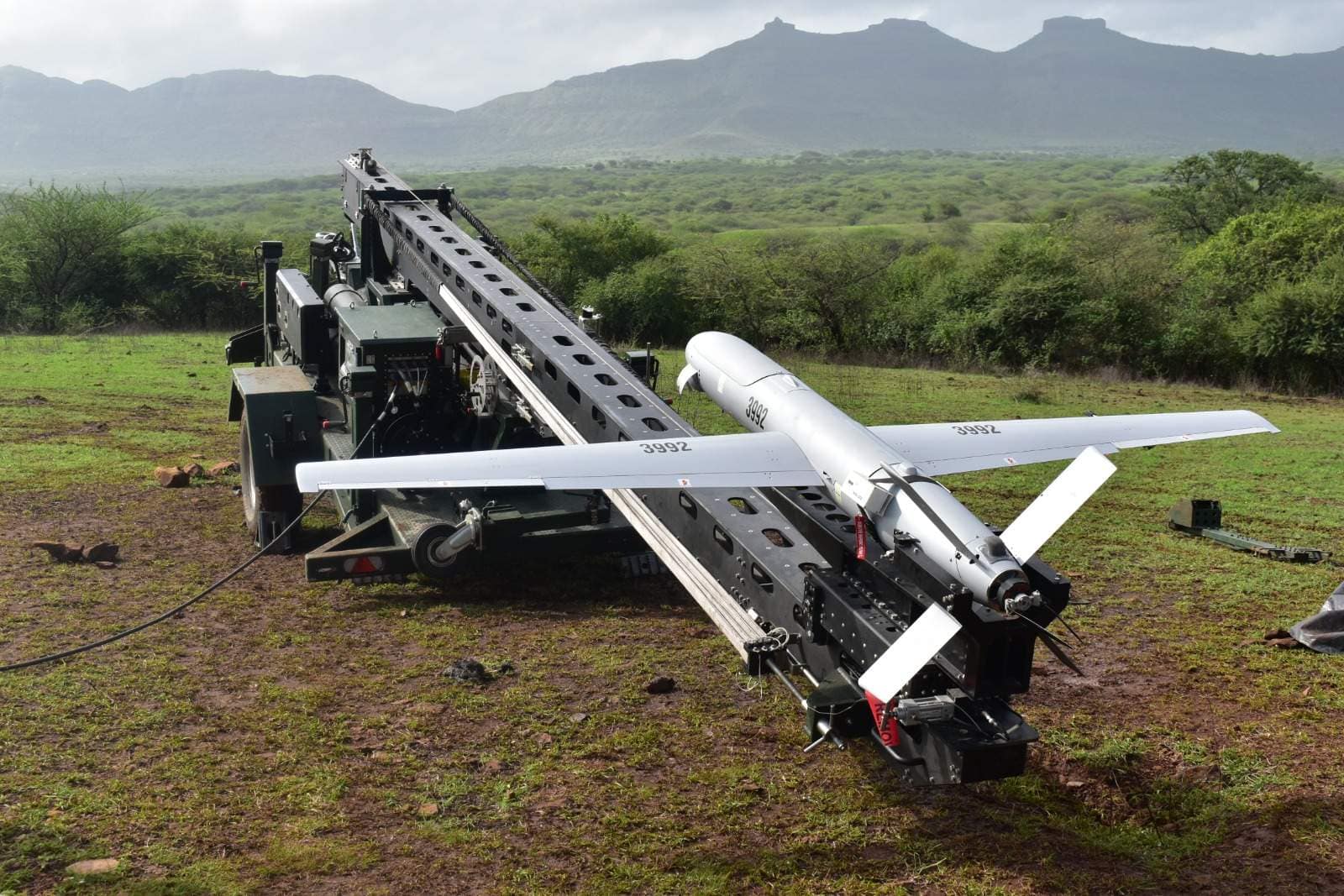
Defence Research & Development Organisation (DRDO) has successfully completed the final deliverable configuration development trials of Unmanned Aerial Vehicle Launched Precision Guided Missile (ULPGM)-V3 in Air-to-Ground and Air-to-Air modes at DRDO test range near Kurnool, Andhra Pradesh. The trials were carried out using an integrated Ground Control System (GCS) to command and control the ULPGM weapon system. The GCS features state-of-the-art technologies to automate readiness and launch operations.

image.jpeg


image.jpeg


DRDO has partnered with two production agencies - Bharat Dynamics Limited, Hyderabad and Adani Defence Systems & Technologies Limited, Hyderabad - for the development and production of the missiles. The system has been integrated on UAVs developed by Newspace Research and Technologies, Bengaluru for current trials.

The ULPGM missile has been developed by Research Centre Imarat, Hyderabad as the nodal lab along with other DRDO laboratories namely Defence Research & Development Laboratory (DRDL) Hyderabad, Terminal Ballistics Research Laboratory (TBRL), Chandigarh and High Energy Materials Research Laboratory (HEMRL), Pune.

The missile has been produced entirely through the Indian defence ecosystem involving a large number of MSMEs and other industries. The trials confirmed fully mature domestic supply chain, equipped for immediate serial mass production.

Raksha Mantri Shri Rajnath Singh has complimented DRDO, PSUs, Defence cum Production Partners and industry for the successful development trials of ULPGM-V3 in Air-to-Ground mode for anti-tank role and Air-to-Air modes for Drone, Helicopter and other airborne targets. He termed it a strategic milestone achieved towards Aatmanirbharta in Defence.
 

Although the article focuses on Ghatak, the CDS is talking about loyal wingman drones.

The only indigenous option for a medium-sized aircraft today is Warrior. Svayatt M1 and Abhimanyu are much smaller and carry no weapons. It's unclear yet if IAF is going for Warrior class drones, not just the Svayatt/Abhimanyu class. The former is slow and expensive. The latter is highly maneuverable and cheap/expendable. The CDS wishes for a 2030 IOC.

American options are far more capable than Warrior. Ghost Bat, Dark Merlin, Valkyrie, and Fury are pretty much the same weight but can quite literally accompany fighters at 40000-50000 feet and mach 0.85 and carry plenty of fuel. The USAF's versions can carry 2 AMRAAMs and have fighter-class agility. Valkyrie can be launched from shipping containers and trucks. Warrior needs more fuel and a more powerful engine at the very least.
 
I've often heard about single-use turbojets. How about something like single-use turboprops? This eliminates the altitude limitations of Shahed-type OWA drones while being cheaper than a single-use turbojet which itself isn't as expensive. Piston engine drones can be hit with AAA guns and interceptor drones, so they must fly higher to raise the costs for the enemy and being more survivable while not being a fiscal burden upon the user.

You only get more speed and altitude with turboprop at a much higher cost. The objective of piston drone is fuel economy and long range. It's also easier to manufacture in large numbers and can use regular petrol or diesel depending on design.

So piston for mass and range. Jet for speed.
 
SLMUAV already had it's first flight,
Who will be the DcPP it gonna be interesting?
View attachment 47800View attachment 47801
Where is the 2nd image from I can't find the November 2025 newsletter which has the 2nd image, if anyone of you have this particular issue of the newsletter please do share it.
I checked with way back machine too even the 16th November 2025 archive doesn't have them.
 
Payload capacity- 1,100 kg
AUW- 12T
Fuel- 3,700 kg
The fuel is more than 1.5 times of lca, and with lower MTOW and no afterburner, the combat radius should be much higher compared to LCA.

It seems that Ghatak is specifically being built to drop couple of 500 kg bombs deep inside enemy territory. Hope they add mid air refueling to enable take from central bases too.
 
  • Like
Reactions: Photon Vish
I
The fuel is more than 1.5 times of lca, and with lower MTOW and no afterburner, the combat radius should be much higher compared to LCA.

It seems that Ghatak is specifically being built to drop couple of 500 kg bombs deep inside enemy territory. Hope they add mid air refueling to enable take from central bases too.
doubt the ghatak will be able to fly right into enemy territory to drop bombs. Pakistan maybe after we conduct a proper SEAD/DEAD campaign but even then its risky. the fuel Limit is probably meant to allow the ghatak to travel from bases in the middle of the country which are much harder to hit and are a lot easier to protect.

Stealth doesnt mean your invisible to radar, it just reduces the range at which your detected. You cant just fly your drone right into the middle of networked AD.
 
I

doubt the ghatak will be able to fly right into enemy territory to drop bombs. Pakistan maybe after we conduct a proper SEAD/DEAD campaign but even then its risky. the fuel Limit is probably meant to allow the ghatak to travel from bases in the middle of the country which are much harder to hit and are a lot easier to protect.

Stealth doesnt mean your invisible to radar, it just reduces the range at which your detected. You cant just fly your drone right into the middle of networked AD.

It depends on how dense the network is. Density depends on the platform meant to penetrate, and if the density is too high, then SEAD/DEAD will reduce the density to adequate levels to allow penetration. What stealth does is decrease the effectiveness of IADS.

It's all relative, but Ghatak has been designed to penetrate IADS, it just won't literally fly over a radar inside its detection range.

Airspace-penetration-AFA-stealth-study-1024x583.jpg
 
If airframe weight is 2.5T
And fuel+payload= 4,800 kg

So how AUW is 12T ?

Will it have external hardpoints ?

I hoped that it may be able to carry 2 Gaurav or 2*1000 kg Tara bombs but itd fine even if it can carry 2*500kg glide bomb
Don't forget there will be Engine, landing gears and Actuators+ Sensors+ Avionics. As much as I know it'll be capable to be operated from Aircraft Carriers too. So the landing gears will be heavier.

So approximately, Airframe = 2.5 T, Fuel = 3.7 T, Payload inside weapon bay = 1.1 T, Engine ( Dry Kaveri ) = 1 T, Landing Gears = 1 T, Sensors + Avionics+ Actuators = 2 T

Total ( 2.5 + 3.7 + 1.1 + 1 + 1 + 1.5 ) = 11.3 T or, approx. 12 T.

My calculations are not accurate, so it'll differ.
 
  • Like
Reactions: Photon Vish
If airframe weight is 2.5T
And fuel+payload= 4,800 kg

So how AUW is 12T ?

Will it have external hardpoints ?

I hoped that it may be able to carry 2 Gaurav or 2*1000 kg Tara bombs but itd fine even if it can carry 2*500kg glide bomb
Airframe: 2.5 tons
Payload: 1.1 tons
Fuel: 3.7 tons
Engine + APU + accessories: say about 1.5 tons
Landing gear + actuators + sensors etc.: say about 2.2 tons

Adds up to a total of ~11 tons.
 
No as of now because it is currently a R&D/Experimental type project
I believe it would be used for testing Dry Kaveri.
doubt the ghatak will be able to fly right into enemy territory to drop bombs.
That is exactly what it is intended to do. To peal the layers off of the networked air defence. Powered munitions have a large initial signature that could give warning to the enemy. Glide bombs like SAAW, if released at a high altitude would allow the UCAV to be sufficiently within the striking distance without putting it in danger.
Assuming it would release bombs at 100km distance from a high altitude, VHF radars would have hundreds of meters of range ambiguity to deal with, negating a SAM launch. Their likely response would be to scramble fighters to search and engage the UAV, which would need to climb higher that would put them on IAF's own radars.

It would have a much better chance at it than a manned fighter. Besides, there would likely be diversionary activity.
 
  • Like
Reactions: BoredBear
SABAL 200 should build to be used something like this apart from Cargo lifting variants. Launch Astra missile flying at an altitude of 20,000 ft and positioned 3 km from the border. IAF fighters LCA or SU 30 MKI guide the missile via a data link, allowing mid-course updates. The advantage of this concept is that the launch platform can be repositioned as needed, providing greater flexibility and effectively extending the missile's engagement range.


1781801762644.png
 
  • Like
Reactions: Gautam