Industry insider slams Lockheed’s F-55 as “repackaged failure”
Defense & SecurityNews
By
Dylan Malyasov
Jul 31, 2025
Modified date: Jul 31, 2025

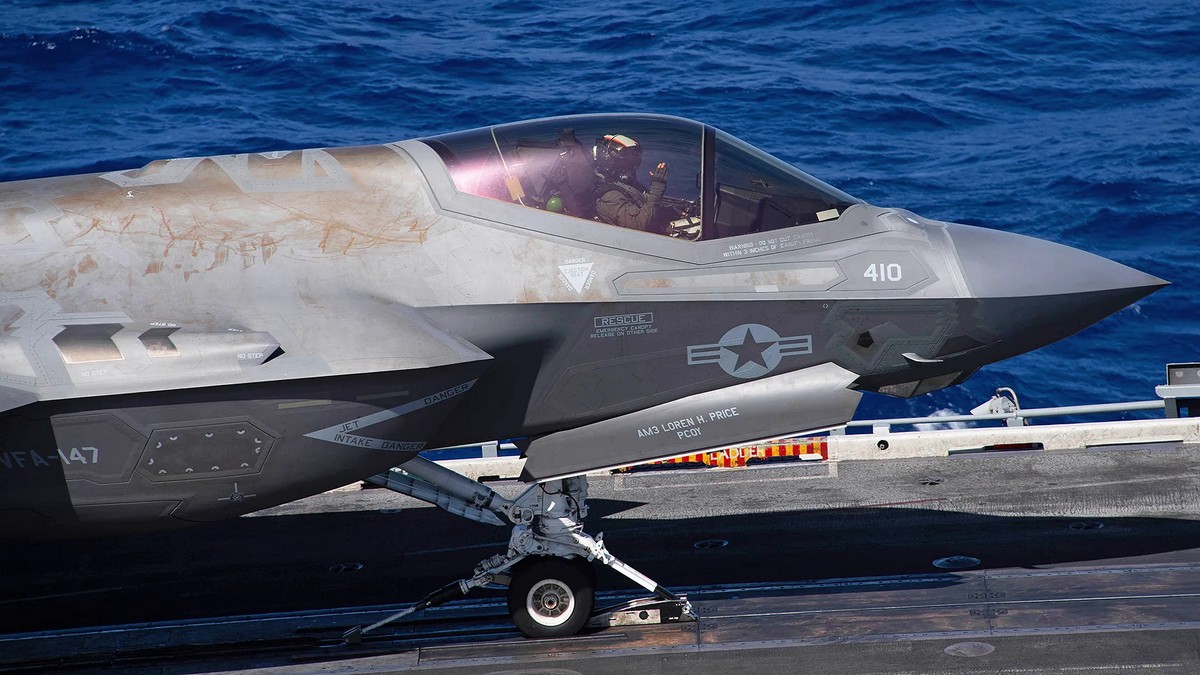
File photo of a F-35 by Jay Hewitt
As Lockheed Martin faces growing scrutiny over its role in U.S. next-generation air dominance efforts, a defense industry source has issued a sharp rebuke of the company’s rumored strategy to develop a twin-engine derivative of the F-35, also known as F-55.
The criticism comes amid fresh financial pressure on Lockheed, whose second-quarter 2025 earnings revealed deep losses tied to troubled legacy programs.
The Pentagon’s top contractor reported steady
revenues of $18.2 billion, up slightly from $18.1 billion a year earlier, but net earnings fell dramatically to $342 million, or $1.46 per share, compared to $1.6 billion, or $6.85 per share, in Q2 2024. The company cited $1.6 billion in program-related losses and $169 million in other charges, stemming in part from internal program reviews.
- ADVERTISEMENT - CONTINUE READING BELOW -
“The F-35 is a broken design—too many of its basic problems are baked into the airframe,” a Western defense industry source familiar with the matter told us. “Lockheed’s financial results reflect exactly what long-time critics have warned about for two decades: when you hardwire compromises into a fighter’s structure, you eventually hit limits you can’t engineer your way out of.”
The remarks follow U.S. President Donald Trump’s May 15
announcement in Qatar, where he confirmed plans to develop a new twin-engine aircraft to be designated the F-55 and a parallel effort to modernize the F-22 Raptor fleet.
Trump called the F-55 a “super upgrade on the F-35,” stating: “It’s going to be also with two engines because the F-35 has a single engine. I don’t like single engines.”
But the idea of building on the F-35 for such a design was dismissed outright by the source, who described it as “marketing, not engineering.”
“To make a twin-engine jet from the F-35, you’d need to completely redesign the fuselage, wing, tail, and stealth shaping,” the source said. “You’re not building a variant—you’re building an entirely new aircraft. These types of proposals are rarely about capability. They’re about keeping development dollars flowing after losing a major program like NGAD.”
The insider added that Lockheed’s problems run deeper than any one aircraft: “This is what happens when you prioritize sales over engineering. Boeing followed that path in the commercial world. Lockheed followed it in defense, and the F-35 is the outcome.”
Referring to Lockheed’s internal dynamics, the source noted that most of the public still doesn’t see how fragile the program has become. “Because it’s military, the performance failures are easier to bury behind procurement cycles and classified briefs. But the system is showing strain. The losses reported this quarter are just the beginning.”
Cash flow figures underscore the point. Lockheed reported only $201 million in operating cash, down from $1.9 billion a year earlier, and negative free cash flow of $150 million, compared to $1.5 billion positive in Q2 2024.
Former Air Force Secretary Frank Kendall previously
stated that a twin-engine F-35 concept was never discussed during his time in office. Other defense analysts have questioned whether any such effort could succeed without years of redesign and tens of billions in new investment.
For the source, a better option would be to revisit a platform that never should have been retired: “Reopening the F-22 line and upgrading it would be smarter, cheaper, and faster. But doing so would force too many people in Washington to admit the truth—that the F-35 was never a true replacement.”
Looking ahead, the source warned that Lockheed’s positioning around the F-55 could create false expectations in defense planning. “It’s a political maneuver designed to look like progress. What we’re seeing now is not innovation. It’s damage control.”
“The F-35 was oversold from the start,” the source concluded. “The F-55 proposal is just the latest attempt to repackage a deeply flawed program—and to avoid facing the consequences of two decades of compromised design choices.”


 ROFLMAO: