Lockheed Martin F-35 Lightning and F-22 'Raptor' : News & Discussion

The ground crew didn't follow hydraulic fluid maintenance procedure and got water in it, possibly hydroscopic

The video doesn't show a gun kill, but that doesn't stop the French, the same story they did on the F-22
The video did show a kill on a FA-18, Notice they don't show the Rafale getting snuffed, Air forces don't normally boast, So most don't release any video

Leaving aside the 1v1 dogfights aren't operationally significant and don't happen in the real world, where there is always at least one wingman
 
Last edited:
  • Like
Reactions: Hydra
As I have previously said, If the Rafale was half as good as its PR department, It would indeed be a good plane

This is what the well-respected French pilot ATE had to say about it
Worth looking at the whole video


1:50 Ate says the F-22 reverses its turn making it easy for the Rafale. which fires an IR , which cannot be claimed as it is guns only. (In actual fact, I think the F-22 was maneuvering to wash off speed to let the Rafale come within range for the dogfight.)
4:00 R calls Fox 2. (That really excited the fanboys) ..It's a practice shot, Ate said he called it out of habit and doesn't count as it is guns only.
5:00 Ate says he switches to guns.
6:00 Ate says about HMS and HOBS, The f-22 and Rafale doesn't ...(but just about everything else does.)

6:40 Ate says Rafale doesn't have the nose authority to follow the F-22. the f-22 can move.
9:00 Ate says the Rafale is at 80kts and below the 100kts minimum.
:mrgreen:

( the Rafale stalled out and was sitting there like a duck.)


11:40 Ate says the F-22 outperforms the Rafale and closes the door. ( Of course it does.)
12:20 Ate says: "Not enough energy for the Rafale, missing a few kts"..... (The Rafale can't regain energy quickly. The F-22 most certainly can .)

12:40 The F-22 stops the fight and retreats. The Rafale is below the stall speed at 80 kts ( again.
:mrgreen:
the thing is a slug.)


14:00 Rafale continues and picks up speed, has a good position on the F-22, the Rafale does not trigger. (The F-22 has already called the fight and is just flying straight.
:roll:
)
17:30 Ate, repeat that the F-22 called the fight at 12:40 and why the F-22 did not maneuver.
 
Last edited:
  • Haha
Reactions: Bon Plan
(…)
Leaving aside the 1v1 dogfights aren't operationally significant and don't happen in the real world, where there is always at least one wingman
Why don't you go and explain this to the air force staffs around the world, who practice this type of exercise, including in "inter-allied" mode? You'll be well received.
 
  • Like
Reactions: Ironhide
Where the F-35 program stands: big upgrades, long future

From its anonymous digs in Crystal City, the Pentagon’s high-rise civilian annex, the Joint Program Office for the Lockheed Martin F-35 Lightning wrote $36 billion in contracts in 2023 alone. The program is still critical to US military power even if the Boeing F-47 hogs the headlines.

The program’s recent performance has earned a stiff rebuke from the US Air Force, by far its largest customer, which has not yet approved for combat usage a new set of critical software. That problem has added to the woes of a complex set of hardware upgrades called Block 4. And the aircraft needs an upgraded engine and new power and cooling system to fix a long-running problem: the F-35 literally overheats in flight.

At the current pace, the last of the US Air Force’s nominally required 1,763 F-35s will be delivered in 2051. It’s halfway there (full-scale development began in 2001) but the project is under pressure. In the fiscal 2026 budget, the USAF hacked its planned F-35 procurement from 48 to 24 units, the lowest number since 2015, and chief of staff General Dave Allvin stated explicitly in a July interview with Defense One that the service was delaying its buys until it could get ‘F-35s that are most relevant for the fight.’

F-35s delivered since 2023 do not have combat-ready software. Lockheed Martin said in June the fix was awaiting air force approval. But that’s just step one in the huge Block 4 effort to modernise the F-35’s mission systems. The last estimated development bill for Block 4 was $16.5 billion, 60 percent as much as the cost of developing the complete Northrop Grumman B-21 bomber. This wider mission-system modernisation effort has also hit delays, and a promised ‘re-imagining’ plan has not been revealed.

The root cause of the problem is the well-intentioned management philosophy to invite competition for replacing subsystems when new technology is available; this encourages innovation and avoids sole-source bids. But when the program office and Lockheed Martin sought a new integrated core processor in the late 2010s, L3Harris undercut incumbent Northrop Grumman, won the contract—and quickly fell behind schedule. Late-arriving hardware delayed software testing. During flight tests in 2023, pilots frequently had to reset their F-35s’ systems in flight.

The integrated core processor is the center of the Tech Refresh 3 (TR-3) hardware upgrade, which in turn is the foundation stone for Block 4. Under Block 4, more than 80 individual improvements (including the new Northrop Grumman APG-85 radar and Raytheon EO-DAS all-round infrared imaging system) were planned to drop into the F-35 production line every two years between the first TR-3 delivery in 2023 and the end of the decade. F-35s ordered in 2029 and delivered in 2031 would be at the full Block 4 standard.

Congress and the Government Accountability Office said repeatedly that Block 4 was so large an effort that it should be its own major acquisition program—that is, like one for a completely new aircraft. But the program office continued it under the principle of Continuous Capability Development and Delivery it adopted in 2019, in line with the then-universal enthusiasm for ‘agile’ system development.

But there were too many sub-programs to be run this way, particularly since many of them were interdependent. In hearings in early 2024, Lieutenant General Michael Schmidt, then the Joint Project Office director, disclosed that the Block 4 project was being ‘reimagined’, reduced to a ‘subset of capabilities that give us the most bang for the buck’ because ‘we have signed ourselves up to pipedreams’. That reimagination is incomplete—hence the USAF’s decision to cut its fiscal 2026 order. There’s no way for outside observers to tell whether, with the reduced suite of improvements, Block 4 will be delivered as previously scheduled.’

A parallel program, not part of Block 4, is aimed at alleviating thermal management problems that have dogged the program since early flight tests. One F-35 stealth design principle is to dump heat from avionics, actuators and other systems either into the engine bypass duct or into the fuel and cooling air provided by the power and thermal management system (PTMS). Otherwise, internal systems start to exceed their design temperature limits.

This heat-dispersal system falls short in some circumstances (higher speeds and lower altitudes), so more air needs to be bled from the engine to the PTMS, making the engine run hotter and reducing its life. (In 2023 alone the program office ordered 40 more engines than airframes.) And Block 4 and subsequent developments are expected to need even more cooling.

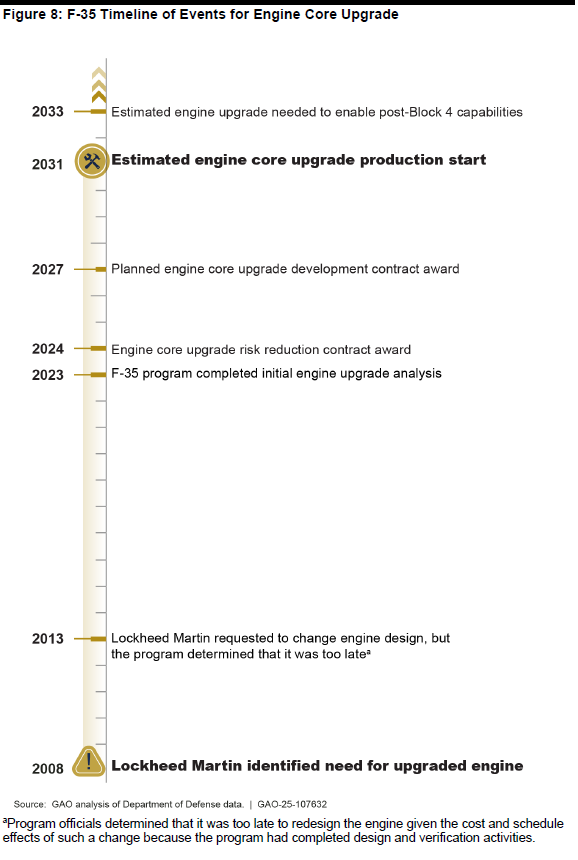
Part of the solution has been to give the F-35 a new-design engine. Until 2022 it was to be one of an efficient but technically challenging configuration called ‘adaptive cycle’. But such an engine would be hard to incorporate on the short take-off and vertical-landing version of the fighter, the F-35B, and Pratt & Whitney lobbied hard to instead improve its F135 engine, the one that the F-35 already uses, with a new high-pressure section. A contract for this, the Engine Core Upgrade, was signed in 2023, with the aim of delivering engines by 2029. But it was disclosed in June 2025 that the critical design review for the engine upgrade, scheduled for this summer, is running a year late.

The second front in the thermal war is to adopt a new PTMS design, with Lockheed Martin running a contest between RTX Collins and incumbent Honeywell. The PTMS is a complex system, combining environmental control, auxiliary and emergency power and engine starting.

The schedule for introducing these new technologies into production is uncertain, but another question is what to do with more than 1,000 pre-TR-3 F-35s, including those flown by Australia, South Korea, Japan and Singapore? Bringing even half of these up to a Block 4 standard, and adding the engine improvement and new PTMS, would be the largest aircraft upgrade program ever carried out, and the unit price tag is unknown.

And, as the USAF seems ready to switch attention to the Boeing F-47, Lockheed Martin chief executive Jim Taiclet has been talking up a future F-35 variant that could use technology from the company’s work on its unsuccessful competitor to the F-47. This technology could deliver ‘80 percent of the capability, potentially, at 50 percent of the cost per unit aircraft. Eventually, there’ll be 3,500 of those [F-35] chassis out there at various stages of technology and capability.’

That sounds less like Block 4 than an all-new avionics system—possibly based on one Northrop Grumman is developing for the B-21—and an adaptive engine that would offer more cooling and a 30 percent increase in range. Some airframes could be retrofitted, but there would be scope for a new production version with the larger wing of the current F-35C and refinements made possible by eliminating provision for short take-off and vertical landing.

It’s a robust strategy because the US Air Force and US Navy must keep buying F-35s to stop their fighter forces ageing out. The F-47 will be too expensive and arrive too late for that, and the Department of Defense doesn’t want to fund a new fighter that’s been in the works for the navy, the F/A-XX.

Even if the air force did seek a completely new low-end fighter to supplement the F-47, there’s little or no chance of any of the three possible suppliers wanting to develop one: Lockheed Martin would be happy to build an updated F-35 instead, Northrop Grumman, a partner in making F-35s, would probably have the same view, and Boeing would be focused on the F-47.

That means that a new low-end fighter would have to be the heavily improved F-35 that Lockheed Martin is talking about. How that would dovetail with Block 4 upgrades and retrofits is anyone’s guess.

One way or another, the F-35 will be around for a long time.

 
  • Agree
  • Like
Reactions: Ironhide and Herciv
Why don't you go and explain this to the air force staffs around the world, who practice this type of exercise, including in "inter-allied" mode? You'll be well received.
Maneuverability and acceleration is about decreasing the missile no escape zone, However 1V1 is still done today in exercises for pilot training, The gun is optional on the F-35B and C, it isn't for everyday use
The odds of a 1v1 gunfight? it isn't going to happen in the modern sensored battlespace, Both pilots would have to make a lot of mistakes to get into a position where they both were out of missiles and alone, The F-35 has a minimum of 4 in a sortie and AEGIS makes a great wingman too, There is going to be a missile available, being a2a or s2a, The fact that you think WW1 Snoopy and the Red Barron bi and triplane is relevant, says more about you
 
Last edited:
  • Haha
Reactions: Amarante
Yes, I was actually being nice before, when I said the Rafale got a fa-18c kill in that video, It got a radar lock, but was too far away for guns, Then the section of video stopped, so who knows what happened

This is what happen when facing the F-35 in exercises, Reported by Singapore, not the RAAF bragging, The F-35 certainly has bragging rights

6 F-15 with aesa radar vs 2 F-35,

The fifth-generation fighters flew against dedicated opposing teams from many countries. Although the results of the mock air combats have not been revealed, according to International Military website Republic of Singapore Air Force (RSAF) F-15SG pilot Major Arumugam Sivaraj who was part of the opposing team said that thanks to this exercise his side was able to gain experience.

It was in fact revealed to the press that during one of his sorties he flew against RAAF F-35As and that the Lightning IIs were able to locate all aircraft belonging to the opposing force.

During one engagement the RAAF deployed 2 F-35As against 6 RSAF F-15SGs. RSAF Detachment Commander Colonel Mark Tan (Singapore Colonel) explained, that the RAAF joint strike fighters were able to find all its opponents in the air and then kill all the them before being detected by the opponents too.
 
Last edited:
(…)
Leaving aside the 1v1 dogfights aren't operationally significant and don't happen in the real world, where there is always at least one wingman
There you go, "a wingman," that's helpful to have clarified, well done.

Now, let me point out this arithmetic for dummies: 2 vs. 2 => 2x (1 vs. 1). Get that?

F-18 with two drop tanks gun killed rafafle.

View attachment 46184
View attachment 46185
Not a word?
Don't be shyyyy, you know this will stay between us, it's our little secret.
 
There you go, "a wingman," that's helpful to have clarified, well done.

Now, let me point out this arithmetic for dummies: 2 vs. 2 => 2x (1 vs. 1). Get that?
It's a deep rabbit hole you have buried yourself in, I like the selective quote too
obviously 2 vs 2 isn't 1 vs 1 and are you suggesting that the 4 have run out of missiles, on guns and are staying at the spear?

What i said was "The odds of a 1v1 gunfight? it isn't going to happen in the modern sensored battlespace, Both pilots would have to make a lot of mistakes to get into a position where they both were out of missiles and alone, The F-35 has a minimum of 4 in a sortie and AEGIS makes a great wingman too, There is going to be a missile available, being a2a or s2a, The fact that you think WW1 Snoopy and the Red Barron bi and triplane is relevant, says more about you"

In a sensored battle space there is always a missile available, Western air forces don't play fair, they throw the kitchen sink of land sea and air weapons

Just out of curiosity, when do you think the last gun kill on a first tier air force with US fighter was? Give the circumstances too
 
F-18 with two drop tanks gun killed rafafle.

View attachment 46184
View attachment 46185
Welcome back sweetie you're a sight for sore eyes. Where've you & your big beautiful booty been , as Carrot Top would put it , all this while ? Spreading legs & happiness in the kibbutzim ?

On topic , you seem to gotten pretty desperate sweetie. No articles to support your claim nor any videos . Just a few random still shots with no supporting information & it's a classic case of trust me bro.

Say when will you give up your self ban & start posting regularly . Stop throwing tantrums & give up being a primadonna.

Make the necessary modifications to this post below & bingo , it applies to you . How things change , Ja ?

Hoofa! You said awful things babe but I get why you said them you were emotionally hurt but now that your back and you have proved me right that you'd be lurking because you can't stay away from here or from me I would like to dedicate another song for youz!!!


Post in thread 'Off-Topic Chit-Chat' Off-Topic Chit-Chat
 
When have I ever said: India should get the F-35?
Where did I write that you said that?
(...) The fact that you think WW1 Snoopy and the Red Barron bi and triplane is relevant, says more about you
Where did I write that I thought that?
You're trying to make me say things I didn't say, in order to discredit me. This is a very low-level, manipulative tactic for which I have infinite contempt.
It's a deep rabbit hole you have buried yourself in, I like the selective quote too
When I agree, I don't quote; it's tacit.
And then I quote whatever I like.

Anyway, if you feel that 1v1 or 2v2 combat training is useless, just report it to the Navy – if you like getting your *censored* kicked, which it seems you do.
 
A new report from GAO:
Actions Needed to Address Late Deliveries and Improve Future Development
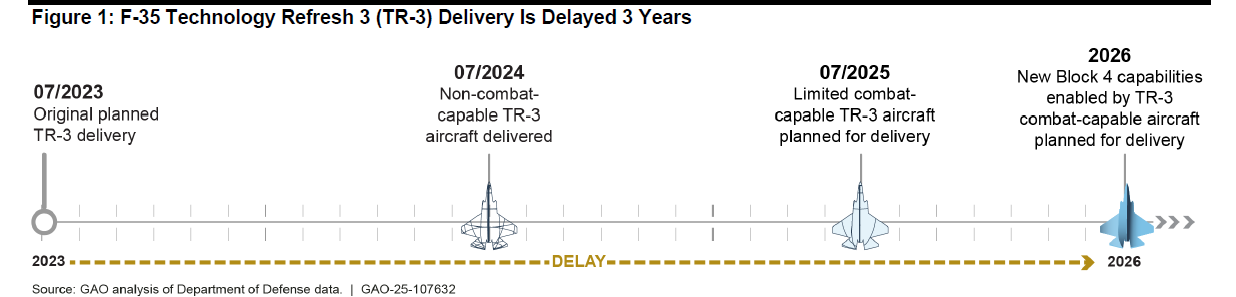
DOD expects to finish the reducedBlock 4 subprogram in 2031, about 5 years later than it originally reportedit would take to complete the whole Block 4 effort. According to programofficials, Lockheed Martin plans to begin delivering combat-capable aircraft with TR-3 that will enable Block 4 capabilities in 2026, a 3-year delay due to hardware and software issues.

Program officials expect to deliver fewer capabilities, generally reducing the content of the Block 4 major subprogram from how DOD has presented it in past years.

Schedule delays. Program officials anticipate completing the reducedBlock 4 subprogram by 2031 at the earliest, 5 years later than originallyplanned, with further delays for capabilities that the program pushed tofuture undefined modernization efforts.

Unknown costs. The estimated costs for the reduced Block 4 major subprogram are currently unknown and program officials stated that a new cost estimate is not expected to be completed until later in 2025.

1756979025-capture-d-cran-2025-09-04-114245.png


1756980095-capture-d-cran-2025-09-04-120120.png


The latest GAO report does not describe a ‘controlled landing’ for the programme, but rather a simultaneous deterioration on three fronts: schedule, industrial governance and technical feasibility of the upgrades.

What is getting worse (highlights from the report)

Block 4 ‘reimagined’ but postponed
The content has been reduced (final list of capabilities still undecided), costs are unknown at this stage, and completion is no longer expected before 2031 (i.e. +5 years). Several capabilities are being pushed back to the mid-2030s.

Chronically delayed production
In 2024, 110 aircraft delivered, 110 delayed — 238 days late on average (vs. 61 in 2023). On the engine side, 123/123 are behind schedule, with the average delay increasing from 68 to 155 days in one year. In 2025, a large portion of deliveries will simply clear the 2023-2024 backlog.

Acceptance of non-combat aircraft (TR-3)
To avoid a ‘graveyard’ of aircraft at the manufacturer's facility, the Pentagon has provisionally accepted 174 non-combat-capable F-35s equipped with TR-3 hardware, withholding approximately £3.5 million per aircraft pending combat-capable software.

Poorly controlled specification deviations (MVR)
Since batch 10, each aircraft has been delivered with an average of ~40 waiver requests; 475 out of 830 unique MVRs remained open in March 2025, some for as long as 15 years. Above all, the internal database does not allow for risk aggregation or estimation of closure costs/timelines; the programme requested £283 million in June 2025 to correct certain defects.

Misaligned incentives
Despite growing delays, manufacturers have received hundreds of millions in bonuses. The current scheme allows fees to be earned by delivering up to 60 days late; for lot 15, incentives were even redirected when it became apparent that no aircraft would be delivered on time. The GAO recommends reassessing these mechanisms.

Engine & cooling modernisation: high risk
Engine & Power/Thermal Management (EPM) combines ECU (Engine Core Upgrade) and PTMU (Power Thermal Management Upgrade). Two critical turbine technologies are only at TRL 5 (immature). ECU production would not start until 2031; the PTMU would not enter production until 2033, the very year that post-Block 4 capabilities will need it — with virtually no margin. PTMU costs are unknown.
In the meantime, the power/cooling deficit is causing premature engine wear, adding £38 billion to the life cycle cost.

Unrealistic planning
The programme continues to plan for volumes close to 156/year, even though the prime contractor has not maintained a lower rate (110 in 2024); the GAO is asking for Lockheed's actual capacity to be assessed before quantities are set.

Overall GAO diagnosis
After nearly 20 years of production, the programme ‘overpromises and underdelivers’ and still rewards performance that falls short of contract requirements.

Why this is particularly concerning
  • Self-perpetuating delay loop: TR-3 delayed → non-combat-capable deliveries → subsequent software/hardware rework → parts queues → new schedule deviations.
  • ‘Pincers’ modernisation: Block 4 is being reduced to decouple engine/PTMS requirements, but the truly demanding capabilities (radar, electronic warfare, etc.) will have to wait for EPM — whose maturity and schedule are fragile.
  • Governance and data: without a reliable MVR repository, it is impossible to know how much compliance will cost or when it will be achieved; at the same time, incentives do not encourage on-time delivery.
What could really turn the tide (and what the GAO recommends)
  • Adjust purchases to proven industrial capabilities, instead of ‘aiming high’ and piling up backlogs.
  • Rebuild incentives so that late deliveries are no longer rewarded; re-establish hard performance milestones.
  • Formally choose an Adaptive Acquisition Framework (AAF) path for EPM and lock in a credible cost-time-performance plan.
  • Institutionalise modern ‘product’ practices: capacity MVP, digital twins, real-time modelling/simulation updates, not just on the margins.
  • Create a usable MVR base (risk, closure plan, costs, deadlines) to quantify the work remaining and prioritise.
To be clear: no, the programme is not yet ‘improving’; on the contrary, TR-3 delays, the reduction/postponement of Block 4 and the immaturity of EPM are creating a plateau of instability. Until volumes, incentives and technological maturity are realigned, the slope will remain steep — with, in the background, a life cycle cost of > £2 trillion that will continue to be affected by these delays.
 
GAO "Program officials expect to deliver fewer capabilities, generally reducing the content of the Block 4 major subprogram from how DOD has presented it in past years."

They originally had 66 new capabilities, they added extra to 80 new capabilities for block 4, So now they are scaling back a bit, Have they said how any new capabilities are in block 4 now?

This is far from how GAO presents 'facts' without explanation of delivering 'fewer'

Sometimes I wish they would give a peak behind the curtain, The tech that is in the F-35 block 4 would bring tears to your eyes, It is a major upgrade
 
Last edited:

US watchdog warns of growing risks to F-35 programme

The latest US Government Accountability Office (GAO) review of the F-35 programme highlights serious concerns over cost growth, late deliveries, and delays to modernisation. For the UK and the many other nations with a significant proportion of their combat air strength dependent on the jet, the findings are of growing concern.

Block 4 modernisation slipping further right​

The report makes clear that the long-promised Block 4 modernisation package is running years late and billions over budget. Initially expected to be complete by 2026, Block 4 will now deliver fewer capabilities than originally envisaged and not finish before 2031 at the earliest. Many enhancements have been deferred into an undefined “future effort,” raising questions about whether frontline squadrons will receive the combat systems needed to keep pace with adversaries.

Block 4 is critical to integrating new weapons, electronic warfare improvements and enhanced sensors. For the UK, this matters directly: the integration of the SPEAR 3 precision weapon and Meteor beyond-visual-range missile is tied to the Block 4 architecture. Without these upgrades, the UK F-35B fleet remains reliant on a small number of US-approved munitions, which considerably handicap the aircraft.

Technology Refresh 3 bottleneck​

Central to Block 4 is the Technology Refresh 3 (TR-3) hardware and software suite, a $1.9 billion upgrade that boosts computing power and memory. TR-3 has proved far harder to deliver than expected. GAO notes continuing problems with sensors, software stability and supply chains. By 2024, every F-35 delivered was late, on average 238 days behind schedule, largely due to TR-3.

In a highly unusual step, the Pentagon began accepting non-combat-capable aircraft with TR-3 hardware installed but immature software. These jets are being used for training while awaiting retrofit. By mid-2025, 174 such aircraft had been accepted. For the UK, this precedent is concerning: should future deliveries to the RAF and RN fall into this category, the Lightning Force could receive expensive jets that are not immediately usable for operations.

The GAO suggests that better use of modern design tools, such as digital models and simulation, could shorten these cycles. Applying these practices earlier in development may allow capabilities to be tested virtually and delivered to squadrons faster.

Engines and sustainment pressures​

The current F135 powerplant is struggling to provide sufficient cooling and electrical output for post-Block 4 systems, adding $38 billion in life-cycle costs. A new Engine Core Upgrade and Power Thermal Management Upgrade (PTMU) are in pre-development, but delays mean they will not enter production until the early 2030s.

For the UK, dependent on a relatively small fleet, reliability and sustainment are particularly critical. High wear on engines and shortages of spares already affect availability rates. GAO warns that without accelerated upgrades, the global F-35 fleet will face escalating maintenance burdens. For the RN, this translates directly into fewer aircraft ready to deploy on the carriers.

One recommendation is to place these modernisation efforts into distinct acquisition pathways with proper oversight, ensuring transparency on cost and timelines. The GAO urges the Pentagon to abandon outdated procurement rules and adopt the Adaptive Acquisition Framework, which would align the engine upgrade process with current best practices.

Late deliveries, weak incentives​

The GAO is blunt about contractor performance. Lockheed Martin and Pratt & Whitney have consistently delivered aircraft and engines late. In 2024, every one of the 110 aircraft built was behind schedule. Despite this, contractors earned hundreds of millions in incentive fees because contracts allowed “on-time delivery” bonuses even when products were up to 60 days late.

The watchdog recommends revising incentive structures to avoid rewarding failure. Without change, there is a risk that late and incomplete deliveries will remain the norm. For the UK, which relies on the US production pipeline, such systemic problems directly threaten delivery schedules. The MoD has already reduced its near-term purchase profile due to delays and budgetary pressures, although it is still committed to buying at least 74 jets.

Fixes​

GAO offers six main remedies: evaluate LM’s true production capacity; reform incentive fee structures; create a comprehensive system to track aircraft defects; select proper acquisition pathways for engine upgrades; and expand the use of modern design practices, such as digital twins, to speed development.

The UK is getting something of a raw deal from US industry and should perhaps cooperate with other international customers to push the Joint Program Office for better performance, and if not, then cost reductions when targets are not met. The GAO urges the JPO to apply stricter contract terms to its suppliers, ending the practice of paying bonuses for late work. Greater transparency on production defects is also vital, since these affect sustainment costs borne by all partners.

There is an opportunity for the UK to apply some of the lessons from the F-35 project to its key future air programme, GCAP. If adopted, these methods could reduce risk, cost and accelerate delivery, avoiding the pitfalls that continue to dog the Lightning.

The GAO report underlines how far the F-35 still has to go to deliver the full spectrum of promised capabilities. For the UK, the findings are sobering but not surprising and are compounded by the struggles to properly support the Lightning Force in service, as we previously reported.

There is a risk that by the time Block 4 is fully in service, peer adversaries will have fielded new air defence systems and sixth-generation fighters. Unless the programme accelerates and delivers on promises, there is a danger the UK and its allies will be left with aircraft that remain stealthy but lack the software and weapons integration to fight at the required level.
 
In the case of the F-35, it's not just that ‘the shit has hit the fan’. It's that the shit keeps pouring out in torrents and the fan is running at full speed.

And LM continues to claim that everything is rosy.
 
  • Haha
Reactions: john0496