
Lockheed Martin F-35 Lightning and F-22 'Raptor' : News & Discussion
- Thread starter Nick
- Start date
You are using an out of date browser. It may not display this or other websites correctly.
You should upgrade or use an alternative browser.
You should upgrade or use an alternative browser.


U.S. F-35 Fighter Jet to Carry 6 Internal Missiles Under Six in the Bay Upgrade by 2030
U.S. F-35 fighter jets modernization boosts internal missile capacity by 50% while preserving stealth for missions against advanced air defenses.
 www.armyrecognition.com

 #theSwissContract
Parliamentary report criticizes shortcomings in Switzerland’s purchase of F-35A aircraft
September 9, 2026In June 2021, while heading the Federal Department of Defence, Civil Protection and Sport (DDPS), Viola Amherd announced that Switzerland would order thirty-six F-35A fighter-bombers from Lockheed Martin (via the US government) for 6 billion Swiss francs, as part of the Air 2030 program. This decision came at the expense of Dassault Aviation’s Rafale (which some French-Swiss media outlets had predicted would win), the Eurofighter consortium’s EF2000/Typhoon, and Boeing’s F/A-18E/F Super Hornet.
Although it had previously won a tender—later cancelled following a May 2014 referendum—with the Gripen E/F, the Swedish company Saab did not deem it worthwhile to participate in this process.
To justify the decision, Ms. Amherd explained that the offer submitted by US authorities on behalf of Lockheed Martin was approximately 2 billion Swiss francs lower than the runner-up bid, in terms of both acquisition and operating costs. Furthermore, she argued that, thanks to its "advanced capabilities," the F-35A would not need to fly as much as its competitors (5,000 hours versus 6,480), and that the use of simulators would allow Swiss pilots to train.
Needless to say, such an argument struck many as peculiar.
To drive the point home, Ms. Amherd asserted that the purchase of the thirty-six F-35A jets would be made at a "fixed price," in accordance with a commitment reportedly made by the US government. This was a curious claim, given that the version ordered—the Block 4—was still under development and would require a more powerful engine... the cost of which would have to be covered by Lockheed Martin’s customers.
In any event, Ms. Amherd’s assertion was quickly challenged by the newspapers *SonntagsBlick* and *SonntagsZeitung*. Citing documents from the Pentagon and the Defense Security Cooperation Agency (DSCA—the body then responsible for US military equipment exports), they argued that there was no such thing as a "fixed price," but rather "estimates based on the best available data."
The DDPS immediately countered, stating that "prices and contractual terms [had been] set in a binding manner" and that, "in the event of cost overruns, the US government would therefore demand firm prices from the manufacturer on Switzerland's behalf."
However, subsequent events proved the German-language newspapers right. First, a report by the Swiss Federal Audit Office (FAO) noted that the "concept of a fixed price" mentioned in the Letter of Offer and Acceptance (LOA) had not been "clearly defined."
And with good reason: for the United States, the concept of a "fixed price" means that a customer must pay the same amount as the Pentagon pays for its own purchases. In other words, if the cost of an F-35A rises, Switzerland must absorb the difference. This is precisely what it was forced to do; last year, in order to stay within the 6-billion-Swiss-franc budget, Martin Pfister—Ms. Amherd’s successor—had to reduce the order to thirty aircraft.
However, the matter took on a new dimension following the publication of a report by the National Council’s Control Committee (CdG-N). The committee concluded that "while Switzerland had indeed negotiated a fixed-price clause, it did not correspond to the fixed lump-sum price that had been communicated."
"The committee bases its assessment on contradictions within the contract, on the Federal Audit Office’s report regarding the US authorities' position during negotiations, and on the legal situation in the United States—which stipulates that there can be neither profit nor loss for the US in transactions under the Foreign Military Sales (FMS) program," the document continues.
Consequently, the CdG-N maintains that the DDPS and the Federal Council "should not have proceeded on the assumption that a fixed lump-sum price had been agreed upon," noting that "not only was this price 'inapplicable,' but it had 'never been contractually agreed to, despite a memo suggesting it was a fixed lump-sum price.'" The committee added that it "fails to understand why the Department of Defence defended this price so staunchly before Parliament."
Furthermore, the report is heavy with implications. "The closer the individuals involved were to the matter, the more one wonders to what extent this ambiguity was accepted with full knowledge of the facts," it suggests.
The CdG-N also points to the progress of the contractual negotiations, the Swiss Armaments Office [Armasuisse] having been, in a way, sidelined.
“The General Secretariat of the DDPS called on a law firm to assist Armasuisse, which had the effect that the office's internal legal department was, in fact, not involved in the negotiation of the contract. This is in contradiction with the legal mandate of Armasuisse, in its capacity as the central procurement service of the Confederation specializing in the field of armaments,” she denounces in her report.
What is more, the CdG-N criticizes the General Secretariat of the DDPS and Ms. Amherd for not having “followed the negotiations closely enough”. And added: The DDPS “was also not sufficiently informed of the key stages of the negotiations, but did not ask to be either”.
The way in which Armasuisse and the DDPS conducted the negotiations “did not live up to the importance of the contract on the political, financial and military levels”, insists the CdG-N, for which it thus lacked the “most basic form of supervision, namely the principle of double control”.
Finally, the latter also noted that certain “relevant” documents had “not been archived in accordance with regulations”, which “considerably complicated” its investigations.
In the meantime, the DDPS is not at the end of its troubles. Even after reducing the F-35A order, the envelope of 6 billion Swiss francs will still be insufficient: the Federal Council must find nearly 400 million more to finance the purchase of the thirty aircraft. /end
September 11, 2026
SETBACKS • Several US reports highlight flaws in the latest versions of the fifth-generation fighter jet, rendering the most recently delivered models unfit for combat for the time being.
It is supposed to be the crown jewel of the US defense industry. Stealth, sensor-fusion software, interoperability... On paper, the fifth-generation F-35 fighter jet is an impressive machine.
But there is sometimes a gap between theory and reality. And judging by the latest reports from the DOT&E (Director, Operational Test & Evaluation)—the US Department of Defense (DoD) office responsible for operational testing and evaluation—and the GAO (Government Accountability Office)—the US federal watchdog—that gap is actually a chasm.
The new "Technology Refresh 3" (TR-3) onboard computer, which succeeds the TR-2, is the source of the problem. "The older version, the TR-2, was no longer powerful enough; that’s why the TR-3 arrived in July 2023 with a more powerful processor," continues Etchenic. "However, once installed in the aircraft, it caused the entire software system to crash. For a full year—until July 2024—the United States suspended F-35 deliveries, an unprecedented move. Yet, production continued at a rate of 130 to 140 aircraft per year, as production lines aren't simply shut down. A storage issue quickly arose, leading the Pentagon and Lockheed Martin to agree on delivering the aircraft with a stripped-down version of the onboard computer—one that included basic flight systems but lacked the complex capabilities required for combat. And we’ve been waiting for them for three years now."
"No TR-3 aircraft fully capable of combat has been delivered to date," confirms the latest version of the DOT&E report, published last March. The combat capabilities present in the aircraft's TR-2 version—already incomplete—even had to be disabled. "Of course, none of this prevents this latest version of the aircraft from flying, but without electronic warfare or data fusion capabilities, it could not go into combat," emphasizes Bruno Etchenic. And there are no signs of improvement so far. "The TR-3 series is falling increasingly behind schedule and accumulating new defects," the DOT&E report further notes.
In total, 245 aircraft equipped with this TR-3 software have been delivered to the United States, 70 to program partner nations (the UK, Italy, the Netherlands, Australia, Norway, and Denmark), and 80 to other customer nations (Belgium, Poland, Finland, Israel, Japan, and South Korea)—amounting to just under 400 aircraft. By contrast, the majority of the 1,355 F-35s delivered worldwide to date are equipped with the TR-2 software and are therefore combat-capable.
Launched in 1994, the F-35 program saw its first officially operational aircraft fly in 2015. Eleven years later, "this aircraft is still not finished," the aviation specialist observes. "And even if it were to become fully operational soon, new problems are already rearing their heads," he continues. For instance, "the cooling system is not efficient enough, and a new system cannot be installed until the new version of the engine—the Engine Core Upgrade (ECU)—is ready, which won't be until 2032... at best."
On the other hand, the F-35 deserves credit for having flown thousands of sorties since the start of the conflict involving Iran, enabling the United States and Israel to suppress enemy defenses and achieve air superiority. "But let us not forget that an American F-35 was detected, tracked, engaged, and hit by an Iranian missile," the specialist points out. "Although it managed to make an emergency landing, the aircraft was written off. That certainly mars the record." /end
"Combat-unfit"… What is this glitch affecting the latest version of the American F-35 fighter jet?
SETBACKS • Several US reports highlight flaws in the latest versions of the fifth-generation fighter jet, rendering the most recently delivered models unfit for combat for the time being.
Key points
- Several reports indicate that the F-35’s new onboard computer—installed in the aircraft's latest versions—deprives the fighter of complex capabilities essential for combat due to malfunctions.
- Furthermore, since 2025, F-35s destined for the United States have been delivered... without radar, due to production delays.
- The aircraft's cooling system is "not efficient enough," explains specialist Bruno Etchenic, "and a new system cannot be installed until the new engine version is ready—which won't be until 2032."
--------
It is supposed to be the crown jewel of the US defense industry. Stealth, sensor-fusion software, interoperability... On paper, the fifth-generation F-35 fighter jet is an impressive machine.
But there is sometimes a gap between theory and reality. And judging by the latest reports from the DOT&E (Director, Operational Test & Evaluation)—the US Department of Defense (DoD) office responsible for operational testing and evaluation—and the GAO (Government Accountability Office)—the US federal watchdog—that gap is actually a chasm.
A stripped-down version of the onboard computer
Bruno Etchenic, a journalist specializing in defense aviation, has thoroughly analyzed GAO reports. "It might seem incredible, but the reports reveal that since July 2023, every F-35 delivered—whether to the U.S. or for export, totaling just over 400 aircraft—has been unfit for combat," he explains. This includes those delivered to Europe, such as the four F-35As received by Belgium in late 2025—part of an order for 34 aircraft placed with the American manufacturer Lockheed Martin in 2018.The new "Technology Refresh 3" (TR-3) onboard computer, which succeeds the TR-2, is the source of the problem. "The older version, the TR-2, was no longer powerful enough; that’s why the TR-3 arrived in July 2023 with a more powerful processor," continues Etchenic. "However, once installed in the aircraft, it caused the entire software system to crash. For a full year—until July 2024—the United States suspended F-35 deliveries, an unprecedented move. Yet, production continued at a rate of 130 to 140 aircraft per year, as production lines aren't simply shut down. A storage issue quickly arose, leading the Pentagon and Lockheed Martin to agree on delivering the aircraft with a stripped-down version of the onboard computer—one that included basic flight systems but lacked the complex capabilities required for combat. And we’ve been waiting for them for three years now."
"No TR-3 aircraft fully capable of combat has been delivered to date," confirms the latest version of the DOT&E report, published last March. The combat capabilities present in the aircraft's TR-2 version—already incomplete—even had to be disabled. "Of course, none of this prevents this latest version of the aircraft from flying, but without electronic warfare or data fusion capabilities, it could not go into combat," emphasizes Bruno Etchenic. And there are no signs of improvement so far. "The TR-3 series is falling increasingly behind schedule and accumulating new defects," the DOT&E report further notes.
In total, 245 aircraft equipped with this TR-3 software have been delivered to the United States, 70 to program partner nations (the UK, Italy, the Netherlands, Australia, Norway, and Denmark), and 80 to other customer nations (Belgium, Poland, Finland, Israel, Japan, and South Korea)—amounting to just under 400 aircraft. By contrast, the majority of the 1,355 F-35s delivered worldwide to date are equipped with the TR-2 software and are therefore combat-capable.
In the United States, aircraft delivered... without radar
That is not all. Since 2025, several F-35s destined for the United States have also been delivered... without a radar. "A new radar, designated the APG-85—the successor to the older APG-81—is slated to equip the US F-35 fleet. However, its production has fallen behind schedule," explains Bruno Etchenic. And since the aircraft had to be modified to accommodate this new radar, installing the older version is not an option. In the meantime, ballast is placed in the aircraft's nose to maintain its balance during flight. Admittedly, only a few aircraft are affected for now, "but potentially, at least a hundred F-35s are involved, as the radar is not expected to be delivered until April 2028 at the earliest."Launched in 1994, the F-35 program saw its first officially operational aircraft fly in 2015. Eleven years later, "this aircraft is still not finished," the aviation specialist observes. "And even if it were to become fully operational soon, new problems are already rearing their heads," he continues. For instance, "the cooling system is not efficient enough, and a new system cannot be installed until the new version of the engine—the Engine Core Upgrade (ECU)—is ready, which won't be until 2032... at best."
An aircraft hit in Iran
To date, thirteen European countries have opted for the F-35. Just under 200 aircraft have been delivered to them out of a total of 550 ordered. "The vast majority of Europeans view their defense solely through the lens of NATO. In this context, the F-35 program is a very practical solution, as it provides a single aircraft type for all countries—including the United States," explains Bruno Etchenic. "However, given its numerous flaws, it is baffling that orders for this aircraft continue to be placed while its development shows no signs of progress."On the other hand, the F-35 deserves credit for having flown thousands of sorties since the start of the conflict involving Iran, enabling the United States and Israel to suppress enemy defenses and achieve air superiority. "But let us not forget that an American F-35 was detected, tracked, engaged, and hit by an Iranian missile," the specialist points out. "Although it managed to make an emergency landing, the aircraft was written off. That certainly mars the record." /end
Are you guys still butt hurt over the Swiss getting the F-35?
Parliamentary report criticizes shortcomings in Switzerland’s purchase of F-35A aircraft
September 9, 2026
In June 2021, while heading the Federal Department of Defence, Civil Protection and Sport (DDPS), Viola Amherd announced that Switzerland would order thirty-six F-35A fighter-bombers from Lockheed Martin (via the US government) for 6 billion Swiss francs, as part of the Air 2030 program. This decision came at the expense of Dassault Aviation’s Rafale (which some French-Swiss media outlets had predicted would win), the Eurofighter consortium’s EF2000/Typhoon, and Boeing’s F/A-18E/F Super Hornet.
Although it had previously won a tender—later cancelled following a May 2014 referendum—with the Gripen E/F, the Swedish company Saab did not deem it worthwhile to participate in this process.
To justify the decision, Ms. Amherd explained that the offer submitted by US authorities on behalf of Lockheed Martin was approximately 2 billion Swiss francs lower than the runner-up bid, in terms of both acquisition and operating costs. Furthermore, she argued that, thanks to its "advanced capabilities," the F-35A would not need to fly as much as its competitors (5,000 hours versus 6,480), and that the use of simulators would allow Swiss pilots to train.
Needless to say, such an argument struck many as peculiar.
To drive the point home, Ms. Amherd asserted that the purchase of the thirty-six F-35A jets would be made at a "fixed price," in accordance with a commitment reportedly made by the US government. This was a curious claim, given that the version ordered—the Block 4—was still under development and would require a more powerful engine... the cost of which would have to be covered by Lockheed Martin’s customers.
In any event, Ms. Amherd’s assertion was quickly challenged by the newspapers *SonntagsBlick* and *SonntagsZeitung*. Citing documents from the Pentagon and the Defense Security Cooperation Agency (DSCA—the body then responsible for US military equipment exports), they argued that there was no such thing as a "fixed price," but rather "estimates based on the best available data."
The DDPS immediately countered, stating that "prices and contractual terms [had been] set in a binding manner" and that, "in the event of cost overruns, the US government would therefore demand firm prices from the manufacturer on Switzerland's behalf."
However, subsequent events proved the German-language newspapers right. First, a report by the Swiss Federal Audit Office (FAO) noted that the "concept of a fixed price" mentioned in the Letter of Offer and Acceptance (LOA) had not been "clearly defined."
And with good reason: for the United States, the concept of a "fixed price" means that a customer must pay the same amount as the Pentagon pays for its own purchases. In other words, if the cost of an F-35A rises, Switzerland must absorb the difference. This is precisely what it was forced to do; last year, in order to stay within the 6-billion-Swiss-franc budget, Martin Pfister—Ms. Amherd’s successor—had to reduce the order to thirty aircraft.
However, the matter took on a new dimension following the publication of a report by the National Council’s Control Committee (CdG-N). The committee concluded that "while Switzerland had indeed negotiated a fixed-price clause, it did not correspond to the fixed lump-sum price that had been communicated."
"The committee bases its assessment on contradictions within the contract, on the Federal Audit Office’s report regarding the US authorities' position during negotiations, and on the legal situation in the United States—which stipulates that there can be neither profit nor loss for the US in transactions under the Foreign Military Sales (FMS) program," the document continues.
Consequently, the CdG-N maintains that the DDPS and the Federal Council "should not have proceeded on the assumption that a fixed lump-sum price had been agreed upon," noting that "not only was this price 'inapplicable,' but it had 'never been contractually agreed to, despite a memo suggesting it was a fixed lump-sum price.'" The committee added that it "fails to understand why the Department of Defence defended this price so staunchly before Parliament."
Furthermore, the report is heavy with implications. "The closer the individuals involved were to the matter, the more one wonders to what extent this ambiguity was accepted with full knowledge of the facts," it suggests.
The CdG-N also points to the progress of the contractual negotiations, the Swiss Armaments Office [Armasuisse] having been, in a way, sidelined.
“The General Secretariat of the DDPS called on a law firm to assist Armasuisse, which had the effect that the office's internal legal department was, in fact, not involved in the negotiation of the contract. This is in contradiction with the legal mandate of Armasuisse, in its capacity as the central procurement service of the Confederation specializing in the field of armaments,” she denounces in her report.
What is more, the CdG-N criticizes the General Secretariat of the DDPS and Ms. Amherd for not having “followed the negotiations closely enough”. And added: The DDPS “was also not sufficiently informed of the key stages of the negotiations, but did not ask to be either”.
The way in which Armasuisse and the DDPS conducted the negotiations “did not live up to the importance of the contract on the political, financial and military levels”, insists the CdG-N, for which it thus lacked the “most basic form of supervision, namely the principle of double control”.
Finally, the latter also noted that certain “relevant” documents had “not been archived in accordance with regulations”, which “considerably complicated” its investigations.
In the meantime, the DDPS is not at the end of its troubles. Even after reducing the F-35A order, the envelope of 6 billion Swiss francs will still be insufficient: the Federal Council must find nearly 400 million more to finance the purchase of the thirty aircraft. /end
There was a set budget and some clown said it's a fixed price, FMS are never fixed until the year in which the item is built and everyone knows it
Really? No counter-arguments, no facts to counter the points made in the article?Really? you want to pollute this thread with your fellow frog forum nutter, Bruno and his nonsense
ad hominem "argument" = invalid...
Well, it's mostly the Swiss who are butt-hurt.Are you guys still butt hurt over the Swiss getting the F-35? (...)
Britain has not seen suppressed American F-35 report
The UK has not had sight of the 2026 edition of the annual U.S. report on F-35 production and modernisation, a document the Pentagon has blocked from publication for the first time in two decades.
 ukdefencejournal.org.uk
Since when was the UK Ministry of Defence on the JPO classified list? They just get briefed from the UK ones who are,
I would have though a public version would have been released by now, redacting the classified that was mistakenly included
I would have though a public version would have been released by now, redacting the classified that was mistakenly included
Last edited:
When your own fellow frog forum members on airdefense infer that he's a F-35 troll, What is there to say?Really? No counter-arguments, no facts to counter the points made in the article?
ad hominem "argument" = invalid...
He distorts everything and has the audacity to call himself a budding journalist

However The French pilot Ate, who i have previously quoted has shown himself again to be an honest person in his latest video and how the French hide the Rafale problems
"Next, I’m obviously a Rafale advocate, which sometimes leads me to be quite lenient toward the Rafale and, inevitably, to withhold certain information I’ve learned about the Rafale—issues that have never been made public because in France we don’t have the same level of transparency
as, for example, the Americans had with the F-35 program. They’re starting to revisit that a bit, but try finding open-source information on the Rafale’s availability in 2025. Good luck with that."
Last edited:


Because they all are obliged to praise it ! to avoid to be kick off their air force.The Swiss pilots start training next year, we will see what they have to say
I think they will praise the aircraft, like the other 20 nations
How surprising!!!Because they all are obliged to praise it ! to avoid to be kick off their air force.
You totally ignored your French pilot saying the Rafale
 is hidden
Are you saying French pilots are honest and Swiss ones are liars?
"Next, I’m obviously a Rafale advocate, which sometimes leads me to be quite lenient toward the Rafale and, inevitably, to withhold certain information I’ve learned about the Rafale—issues that have never been made public because in France we don’t have the same level of transparency,, try finding open-source information on the Rafale’s availability in 2025. Good luck with that"
Last edited:
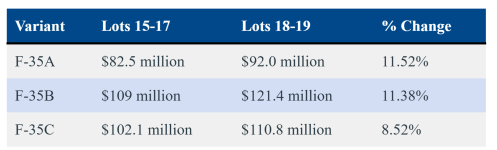
What Each F-35 Variant Really Costs Right Now
F-35 costs for all three variants will hit all-time highs in Lots 18 and 19 of the Lockheed Martin-made Joint Strike Fighter.
 www.airandspaceforces.com
Manufacturer Lockheed Martin lists the price of F-35 variants for Lots 15 through 17 on its website.
The totals are average flyaway costs, which refer to all the basic costs it takes to produce one aircraft. The JPO confirmed those price tags include the cost of the jets’ engines and radars, which are provided to manufacturer Lockheed Martin as government-furnished equipment.
Easy !try finding open-source information on the Rafale’s availability in 2025.
nearly 90% for Greece air force according to themselves. Rafale vs F-16 : un pilote révèle pourquoi la Grèce préfère de loin le Rafale
In Indian Air Force the support deal requested >75% availability. According to IAF the result is better.
for France : https://adorac.fr/le-rapport-parlem...s-seuls-80-sont-operationnels-a-un-instant-t/
lower level but it is a choice to purchase more planes and less spare parts are we are not in a war situation.
Ths Swiss know very well the increase....What Each F-35 Variant Really Costs Right Now
F-35 costs for all three variants will hit all-time highs in Lots 18 and 19 of the Lockheed Martin-made Joint Strike Fighter.
Manufacturer Lockheed Martin lists the price of F-35 variants for Lots 15 through 17 on its website.
The totals are average flyaway costs, which refer to all the basic costs it takes to produce one aircraft. The JPO confirmed those price tags include the cost of the jets’ engines and radars, which are provided to manufacturer Lockheed Martin as government-furnished equipment.
View attachment 53999
Oups. 8 years ago the line was to be transfered to Indian to make F-21 since F-35 had to become the USAF workhorse. Too bad for the F-35.
The Air Force will consider acquiring new F-16 Fighting Falcon jets to help fill capacity shortfalls in its aging fighter fleet, multiple people familiar with the matter told Air & Space Forces Magazine. These discussions are happening as the Air Force is building its proposed fiscal 2028 budget and the five-year spending plan that goes with it.
Buying new F-16s—which would be the U.S.’s first in more than 20 years—is viewed as one way to quickly build back lost fighter capacity, as Lockheed Martin continues to operate a hot production line for the aircraft. Buying F-16s from Lockheed, which also produces the F-35 Lightning II, would have parallels to the decision to acquire F-15EX Eagle IIs from Boeing, which likewise came after a yearslong gap in USAF purchases.
The new-build F-16s, potentially dubbed “F-16G” to reflect upgrades from existing F-16C and D models, could be on the agenda for discussion when Air Force four-stars gather this fall for a Corona gathering of top service officials.
Lockheed Martin deferred questions to the Air Force: “This topic is best addressed by the U.S. government, but we stand ready to support the U.S. Air Force and its mission needs,” Lockheed said in a statement. “Our proven products are the backbone of the USAF fleet and provide the most advanced and versatile capabilities to ensure air dominance now and decades to come.”
The Air Force, in a written response to Air & Space Forces Magazine, said it is examining its options as it looks to the future.
“The Department of the Air Force is in initial phases of analyzing options for the next Future Years Defense Program,” an Air Force spokesperson said. “At this stage, we have neither defined the precise mission requirements nor the spectrum of options that could fill it.”
Lockheed currently produces F-16E and F models, single- and dual-seat variants respectively, for the United Arab Emirates. The company moved its production line for Block 70 F-16s in 2019 from Fort Worth, Texas, to Greenville, S.C.
If the Air Force decided to buy more F-16s, Lockheed would likely keep its Greenville production line going. The potential upgraded F-16 from that line is being referred to as a G model by those familiar with the discussions.
The Air Force today has 826 F-16s in its inventory, with 484 of those operated by the Active-Duty force. The jets average 34 years old, however, and the newest in the inventory have been flying since 2005.
USAF F-16s carry out a variety of critical missions, including air-to-air and air-to-ground strikes. F-16s that carry out suppression of enemy air defense missions are referred to as “Wild Weasels” and have seen heavy action in operations against Iran.
New F-16 purchases would drive other movement in the industry. Both Pratt & Whitney and GE Aerospace make engines that go on the F-16. Pratt, which is owned by RTX, announced Sept. 15 it has licensed Hermeus to manufacture its F100-PW-229 used on the F-15 and F-16, saying the agreement will strengthen the U.S. defense industrial base by creating a new source for the widely used engine.
Northrop Grumman, which is developing two major upgrades for existing F-16s, would also likely benefit. The company is working on the Integrated Viper Electronic Warfare Suite, or IVEWS, and an upgraded large aperture targeting pod called LITENING LA.
IVEWS, also known as the AN/ALQ-257, is an advanced electronic warfare system providing radar warning, active jamming, and detecting, identifying and locating of potential threats.
A source familiar with the issue, who asked not to be named to speak more freely, said any new F-16 would likely have IVEWS and multiple other new capabilities placing it not only beyond the legacy C and D fighters, but also the Block 70 fighters Lockheed is currently building.
“If the Air Force were to buy a new F-16, this would not be your grandfather’s F-16,” the source said. “This would be more akin to buying an F-15EX.”
The source said buying more F-16s would make sense for the Air Force, since Lockheed and Boeing are facing capacity constraints limiting how many F-35As and F-15EXs, respectively, they can build. And the service’s existing fleet of F-16s has been flown hard in the wars of recent decades, the source said.
“There’s only so many times you can do a service life extension program before you begin to lose the strength and integrity of the airframe itself,” the source said.
Air Force Eyes New-Build F-16s to Boost Fighter Force
Sept. 16, 2026 | By Stephen Losey and Chris GordonThe Air Force will consider acquiring new F-16 Fighting Falcon jets to help fill capacity shortfalls in its aging fighter fleet, multiple people familiar with the matter told Air & Space Forces Magazine. These discussions are happening as the Air Force is building its proposed fiscal 2028 budget and the five-year spending plan that goes with it.
Buying new F-16s—which would be the U.S.’s first in more than 20 years—is viewed as one way to quickly build back lost fighter capacity, as Lockheed Martin continues to operate a hot production line for the aircraft. Buying F-16s from Lockheed, which also produces the F-35 Lightning II, would have parallels to the decision to acquire F-15EX Eagle IIs from Boeing, which likewise came after a yearslong gap in USAF purchases.
The new-build F-16s, potentially dubbed “F-16G” to reflect upgrades from existing F-16C and D models, could be on the agenda for discussion when Air Force four-stars gather this fall for a Corona gathering of top service officials.
Lockheed Martin deferred questions to the Air Force: “This topic is best addressed by the U.S. government, but we stand ready to support the U.S. Air Force and its mission needs,” Lockheed said in a statement. “Our proven products are the backbone of the USAF fleet and provide the most advanced and versatile capabilities to ensure air dominance now and decades to come.”
The Air Force, in a written response to Air & Space Forces Magazine, said it is examining its options as it looks to the future.
“The Department of the Air Force is in initial phases of analyzing options for the next Future Years Defense Program,” an Air Force spokesperson said. “At this stage, we have neither defined the precise mission requirements nor the spectrum of options that could fill it.”
Lockheed currently produces F-16E and F models, single- and dual-seat variants respectively, for the United Arab Emirates. The company moved its production line for Block 70 F-16s in 2019 from Fort Worth, Texas, to Greenville, S.C.
If the Air Force decided to buy more F-16s, Lockheed would likely keep its Greenville production line going. The potential upgraded F-16 from that line is being referred to as a G model by those familiar with the discussions.
The Air Force today has 826 F-16s in its inventory, with 484 of those operated by the Active-Duty force. The jets average 34 years old, however, and the newest in the inventory have been flying since 2005.
USAF F-16s carry out a variety of critical missions, including air-to-air and air-to-ground strikes. F-16s that carry out suppression of enemy air defense missions are referred to as “Wild Weasels” and have seen heavy action in operations against Iran.
New F-16 purchases would drive other movement in the industry. Both Pratt & Whitney and GE Aerospace make engines that go on the F-16. Pratt, which is owned by RTX, announced Sept. 15 it has licensed Hermeus to manufacture its F100-PW-229 used on the F-15 and F-16, saying the agreement will strengthen the U.S. defense industrial base by creating a new source for the widely used engine.
Northrop Grumman, which is developing two major upgrades for existing F-16s, would also likely benefit. The company is working on the Integrated Viper Electronic Warfare Suite, or IVEWS, and an upgraded large aperture targeting pod called LITENING LA.
IVEWS, also known as the AN/ALQ-257, is an advanced electronic warfare system providing radar warning, active jamming, and detecting, identifying and locating of potential threats.
A source familiar with the issue, who asked not to be named to speak more freely, said any new F-16 would likely have IVEWS and multiple other new capabilities placing it not only beyond the legacy C and D fighters, but also the Block 70 fighters Lockheed is currently building.
“If the Air Force were to buy a new F-16, this would not be your grandfather’s F-16,” the source said. “This would be more akin to buying an F-15EX.”
The source said buying more F-16s would make sense for the Air Force, since Lockheed and Boeing are facing capacity constraints limiting how many F-35As and F-15EXs, respectively, they can build. And the service’s existing fleet of F-16s has been flown hard in the wars of recent decades, the source said.
“There’s only so many times you can do a service life extension program before you begin to lose the strength and integrity of the airframe itself,” the source said.