

Nature & India : News, Views and Discussions
- Thread starter RISING SUN
- Start date
You are using an out of date browser. It may not display this or other websites correctly.
You should upgrade or use an alternative browser.
You should upgrade or use an alternative browser.

How India proposals at UN event can help elephants, migratory birds
On Thursday, a committee adopted India’s proposals for including three species — great Indian bustard, Asian elephant and Bengal florican — for additional protection under the UN Convention on the Conservation of Migratory Species of Wild Animals (CMS). This happened at the 13th Conference of the Parties to the CMS (CMS COP13), which is under way in Gandhinagar, with “Migratory species connect the planet and together we welcome them home” as its theme.
What does the Convention seek to do?
CMS is a treaty agreed by 129 countries plus the European Union, and functions under the UN Environment Programme (UNEP). It works for protection and conservation of species that migrate across frontiers and are facing threats of extinction or require urgent attention. CMS aims to bring together different countries that are part of range of a given species, and facilitate coherent conservation and protection regimes in a group of countries. The conference is being held in India for the first time. Delegates from at least 78 countries are attending.
Why do migratory species need special attention for conservation?
With a change in season, many mammals and birds move from one country to another in search of food and shelter, and for breeding. Asian elephants, also known as Indian elephants, migrate from India to Bangladesh, Bhutan, Nepal, Myanmar etc.
However, wildlife laws and protection regimes for these species can be different in each country, making them vulnerable to taking, hunting, poisoning etc. Many migratory species are threatened with extinction due to habitat degradation, barriers in their migration routes, and other pressures. Therefore, these species need special attention by all countries that are part of their range.
What were India’s proposals that were accepted?
India has proposed inclusion of the three species on Appendix-I of the Convention. Appendix-I lists species threatened with extinction, while Appendix-II lists those in need of global cooperation for favourable conservation status. If listed on Appendix-I, it would facilitate trans-boundary conservation efforts of the these species.
The proposals cleared the first hurdle when they were adopted unanimously by the conference’s committee of the whole. However, Pakistan, which is the other range country of the great Indian bustard, did not take part in the discussion on the proposals. The plenary of COP13 is expected to take a final call on the listing on Saturday.
What are the grounds on which India has proposed the listing?
Asian elephant: India said the Asian elephant, an endangered species, once used to range from west Asia to north of Yagtze river in China but currently, the range has shrunk to 13 Asian countries, and their population in India to 29,964 in 2017. India said elephants’ inclusion on Appendix-I would ensure better coordination among the range countries, facilitate migration, increase effective habitat area, and reduce killings.
Great Indian bustard: Its range stretching across India and Pakistan, it is a critically endangered species with a
population of just around 150 individuals and its present habitat having shrunk to 10% of its historical range. India said there is prima facie evidence that the birds fly across the India-Pakistan border and hence the need for bilateral cooperation for recovery of the species.
Bengal florican: This too is a critically endangered species of bird that belongs to the bustard family. In its proposal, India said the present population of the South Asian subspecies has shrunk to around 1,000 individuals and its present habitat been restricted to the Terai and Dooars grassland regions of the Indo-Gangetic and Brahmaputra floodplains.
How does listing on a CMS Appendix help a species?
Listing generally leads to concerted actions in different national jurisdictions in which a species ranges. Actions may include cooperation among range countries, harmonisation in policies etc through regional agreements. CMS has working groups specialising in various fauna families, and a Scientific Council that advises research-based solutions for conservation.
Many countries started shifting towards renewable energy by building infrastructure like wind turbines, power transmission lines, solar parks; these pose risks to wildlife. CMS set up in 2014 an Energy Task Force; it advises contracting parties on how to keep their energy projects wildlife-friendly.
Despite the listing and consequent efforts, 73% of 175 migratory species on Appendix-I and 48% of the 518 on Appendix-II have an overall decreasing population trend, CMS says.
So, what changes for the species in India’s proposals?
If the plenary eventually adopts these proposals and the listing goes through, which is expected to happen, a formal regional cooperation among range countries would become possible. Once the listing is done, contracting parties within the range of a species are obliged to cooperate in trans-border conservation efforts.
Bangladesh, for example, welcomed the proposals on the elephant and the florican, a bird that went extinct in that country in 1882. However, Pakistan did not express any views on the proposal on the great Indian bustard. Conservation efforts would also gain from the international expertise of the CMS family, and could increase pressure on Pakistan for preventing alleged hunting of the great Indian bustard.
What else is on the agenda of the conference?
Besides the three species, proposals have been moved for including seven others — jaguar, urial, little bustard, antipodean albatross, oceanic white-tip shark, smooth hammerhead shark and tope shark — for listing on CMS Appendices. COP13 also discussed marine noise pollution, plastic pollution, light pollution, insect decline etc.
India has also invited the COP13 to adopt the ‘Gandhinagar Declaration’ urging the world community to strive for ensuring ecological connectivity, especially for sustainable management and conservation of migratory species. India has proposed that once adopted, CMS forward the Gandhinagar Declaration to the 15th meeting of UN Convention on Biological Diversity conference in China in October this year, for preparing post-2020 global biodiversity framework.
Explained: How India proposals at UN event can help elephants, migratory birds
On Thursday, a committee adopted India’s proposals for including three species — great Indian bustard, Asian elephant and Bengal florican — for additional protection under the UN Convention on the Conservation of Migratory Species of Wild Animals (CMS). This happened at the 13th Conference of the Parties to the CMS (CMS COP13), which is under way in Gandhinagar, with “Migratory species connect the planet and together we welcome them home” as its theme.
What does the Convention seek to do?
CMS is a treaty agreed by 129 countries plus the European Union, and functions under the UN Environment Programme (UNEP). It works for protection and conservation of species that migrate across frontiers and are facing threats of extinction or require urgent attention. CMS aims to bring together different countries that are part of range of a given species, and facilitate coherent conservation and protection regimes in a group of countries. The conference is being held in India for the first time. Delegates from at least 78 countries are attending.
Why do migratory species need special attention for conservation?
With a change in season, many mammals and birds move from one country to another in search of food and shelter, and for breeding. Asian elephants, also known as Indian elephants, migrate from India to Bangladesh, Bhutan, Nepal, Myanmar etc.
However, wildlife laws and protection regimes for these species can be different in each country, making them vulnerable to taking, hunting, poisoning etc. Many migratory species are threatened with extinction due to habitat degradation, barriers in their migration routes, and other pressures. Therefore, these species need special attention by all countries that are part of their range.
What were India’s proposals that were accepted?
India has proposed inclusion of the three species on Appendix-I of the Convention. Appendix-I lists species threatened with extinction, while Appendix-II lists those in need of global cooperation for favourable conservation status. If listed on Appendix-I, it would facilitate trans-boundary conservation efforts of the these species.
The proposals cleared the first hurdle when they were adopted unanimously by the conference’s committee of the whole. However, Pakistan, which is the other range country of the great Indian bustard, did not take part in the discussion on the proposals. The plenary of COP13 is expected to take a final call on the listing on Saturday.
What are the grounds on which India has proposed the listing?
Asian elephant: India said the Asian elephant, an endangered species, once used to range from west Asia to north of Yagtze river in China but currently, the range has shrunk to 13 Asian countries, and their population in India to 29,964 in 2017. India said elephants’ inclusion on Appendix-I would ensure better coordination among the range countries, facilitate migration, increase effective habitat area, and reduce killings.
Great Indian bustard: Its range stretching across India and Pakistan, it is a critically endangered species with a
population of just around 150 individuals and its present habitat having shrunk to 10% of its historical range. India said there is prima facie evidence that the birds fly across the India-Pakistan border and hence the need for bilateral cooperation for recovery of the species.
Bengal florican: This too is a critically endangered species of bird that belongs to the bustard family. In its proposal, India said the present population of the South Asian subspecies has shrunk to around 1,000 individuals and its present habitat been restricted to the Terai and Dooars grassland regions of the Indo-Gangetic and Brahmaputra floodplains.
How does listing on a CMS Appendix help a species?
Listing generally leads to concerted actions in different national jurisdictions in which a species ranges. Actions may include cooperation among range countries, harmonisation in policies etc through regional agreements. CMS has working groups specialising in various fauna families, and a Scientific Council that advises research-based solutions for conservation.
Many countries started shifting towards renewable energy by building infrastructure like wind turbines, power transmission lines, solar parks; these pose risks to wildlife. CMS set up in 2014 an Energy Task Force; it advises contracting parties on how to keep their energy projects wildlife-friendly.
Despite the listing and consequent efforts, 73% of 175 migratory species on Appendix-I and 48% of the 518 on Appendix-II have an overall decreasing population trend, CMS says.
So, what changes for the species in India’s proposals?
If the plenary eventually adopts these proposals and the listing goes through, which is expected to happen, a formal regional cooperation among range countries would become possible. Once the listing is done, contracting parties within the range of a species are obliged to cooperate in trans-border conservation efforts.
Bangladesh, for example, welcomed the proposals on the elephant and the florican, a bird that went extinct in that country in 1882. However, Pakistan did not express any views on the proposal on the great Indian bustard. Conservation efforts would also gain from the international expertise of the CMS family, and could increase pressure on Pakistan for preventing alleged hunting of the great Indian bustard.
What else is on the agenda of the conference?
Besides the three species, proposals have been moved for including seven others — jaguar, urial, little bustard, antipodean albatross, oceanic white-tip shark, smooth hammerhead shark and tope shark — for listing on CMS Appendices. COP13 also discussed marine noise pollution, plastic pollution, light pollution, insect decline etc.
India has also invited the COP13 to adopt the ‘Gandhinagar Declaration’ urging the world community to strive for ensuring ecological connectivity, especially for sustainable management and conservation of migratory species. India has proposed that once adopted, CMS forward the Gandhinagar Declaration to the 15th meeting of UN Convention on Biological Diversity conference in China in October this year, for preparing post-2020 global biodiversity framework.
Explained: How India proposals at UN event can help elephants, migratory birds

7 states saw drop in rainfall in last 30 years
7 states saw drop in rainfall in last 30 years | India News - Times of India
7 states saw drop in rainfall in last 30 years | India News - Times of India
Lockdown reveals fresh air, cleaner rivers in India
NEW DELHI (AP) — India’s extended lockdown to curb the coronavirus outbreak has shut down schools, workplaces, industries, transport, and forced people to stay home.
It also led to an unexpected bonus in the country with six out of 10 of the world’s most polluted cities: cleaner air.
“It is a hell of a change,” said Kunal Chopra, who suffers from chronic bronchitis and whose morning walks no longer begin with a shot from an inhaler. “The air is much fresher and my breathing problems have gone down.”
India accounts for the highest pollution-related deaths in the world with more than 2 million people every year, according to a December 2019 report by the Global Alliance of Health and Pollution.
On March 25, the first day of the lockdown, the average PM 2.5 levels decreased by 22% and nitrogen dioxide — which comes from burning fossil fuels — dropped by 15%, according to air pollution data analyzed by the Center for Research on Energy and Clean Air.
India's extended lockdown to prevent spread of the new coronavirus has drastically improved air quality and visibility, turning the skies over New Delhi a rare blue. (April 22)
“These are extraordinary times,” said Anumita Roychowdhury, executive director at the Center for Science and Environment, a research and advocacy organization in New Delhi. She attributed the drop in air pollutants to less vehicles on the road, construction activity, and factories shutting down.
“People are more vulnerable during a pandemic in areas with high pollution,” she said. “Our lungs and hearts are already compromised, and we cannot fight the virus.”
India has reported nearly 20,000 confirmed cases of COVID-19 and over 600 deaths.
The stringent lockdown measures that are set to be lifted on May 3 also have had an effect on India’s rivers.
Pictures of pristine clear waters of the Ganges, India’s longest river considered holy by Hindus, were enthusiastically shared on social media a few weeks into the lockdown. India’s pollution monitoring body said the water had even become fit for bathing in some areas, according to real-time monitors placed along the 2,575-kilometer (1,600-mile) -long river.
A recent analysis by the Delhi Pollution Control Board found that the quality of the Yamuna River flowing along New Delhi has also improved during the lockdown. The report cited a decrease in runoffs from 28 industrial clusters and less trash.
“The lockdown has clearly told us what the main sources of pollution are,” said Vimlendu Jha, an environmentalist and founder of Swechha, a non-governmental organization helping youth fight climate change. “Effluents are forced into our river bodies, and that is major reason why our rivers are black.”
Jha and other experts warn that the environmental improvements may be short-lived as the government eventually lifts the lockdown and rampant economic activity resumes.
“How was a lockdown for just a few weeks able to achieve what governments could not for decades?” said Jha, who believes authorities should study data collected during the lockdown to devise better environmental policies.
Roychowdhury suggested private workplaces that shifted their work online during the lockdown should institutionalize working from home to consider the impact of commuting on air pollution.
But that’s not everyone.
Ashok Mandal, a scrawny rickshaw driver in New Delhi, spends hours scanning the streets for a passenger. He finds none. Used to making at least 400 rupees ($5) every day ferrying passengers in a residential neighborhood, his income has been slashed to a meager 70 rupees ($1) for picking up and delivering groceries.
“Clean air means nothing to me,” Mandal said. “I am just trying to make it through each day.”

 apnews.com
NEW DELHI (AP) — India’s extended lockdown to curb the coronavirus outbreak has shut down schools, workplaces, industries, transport, and forced people to stay home.
It also led to an unexpected bonus in the country with six out of 10 of the world’s most polluted cities: cleaner air.
“It is a hell of a change,” said Kunal Chopra, who suffers from chronic bronchitis and whose morning walks no longer begin with a shot from an inhaler. “The air is much fresher and my breathing problems have gone down.”
India accounts for the highest pollution-related deaths in the world with more than 2 million people every year, according to a December 2019 report by the Global Alliance of Health and Pollution.
On March 25, the first day of the lockdown, the average PM 2.5 levels decreased by 22% and nitrogen dioxide — which comes from burning fossil fuels — dropped by 15%, according to air pollution data analyzed by the Center for Research on Energy and Clean Air.
India's extended lockdown to prevent spread of the new coronavirus has drastically improved air quality and visibility, turning the skies over New Delhi a rare blue. (April 22)
“These are extraordinary times,” said Anumita Roychowdhury, executive director at the Center for Science and Environment, a research and advocacy organization in New Delhi. She attributed the drop in air pollutants to less vehicles on the road, construction activity, and factories shutting down.
“People are more vulnerable during a pandemic in areas with high pollution,” she said. “Our lungs and hearts are already compromised, and we cannot fight the virus.”
India has reported nearly 20,000 confirmed cases of COVID-19 and over 600 deaths.
The stringent lockdown measures that are set to be lifted on May 3 also have had an effect on India’s rivers.
Pictures of pristine clear waters of the Ganges, India’s longest river considered holy by Hindus, were enthusiastically shared on social media a few weeks into the lockdown. India’s pollution monitoring body said the water had even become fit for bathing in some areas, according to real-time monitors placed along the 2,575-kilometer (1,600-mile) -long river.
A recent analysis by the Delhi Pollution Control Board found that the quality of the Yamuna River flowing along New Delhi has also improved during the lockdown. The report cited a decrease in runoffs from 28 industrial clusters and less trash.
“The lockdown has clearly told us what the main sources of pollution are,” said Vimlendu Jha, an environmentalist and founder of Swechha, a non-governmental organization helping youth fight climate change. “Effluents are forced into our river bodies, and that is major reason why our rivers are black.”
Jha and other experts warn that the environmental improvements may be short-lived as the government eventually lifts the lockdown and rampant economic activity resumes.
“How was a lockdown for just a few weeks able to achieve what governments could not for decades?” said Jha, who believes authorities should study data collected during the lockdown to devise better environmental policies.
Roychowdhury suggested private workplaces that shifted their work online during the lockdown should institutionalize working from home to consider the impact of commuting on air pollution.
But that’s not everyone.
Ashok Mandal, a scrawny rickshaw driver in New Delhi, spends hours scanning the streets for a passenger. He finds none. Used to making at least 400 rupees ($5) every day ferrying passengers in a residential neighborhood, his income has been slashed to a meager 70 rupees ($1) for picking up and delivering groceries.
“Clean air means nothing to me,” Mandal said. “I am just trying to make it through each day.”
Lockdown reveals fresh air, cleaner rivers in India
NEW DELHI (AP) — India’s extended lockdown to curb the coronavirus outbreak has shut down schools, workplaces, industries, transport, and forced people to stay home.
apnews.com
Air pollution over northern India drops amid coronavirus lockdown
Pollution has plummeted over northern India during the country-wide lockdown, implemented to slow the spread of the novel coronavirus.
On March 24, India put its 1.3 billion citizens into a strict lockdown. Non-essential businesses were temporarily closed, factories have decreased activity, domestic and international flights have been suspended, ground travel has decreased and people across the country are working to try and perform social distancing as much as possible.
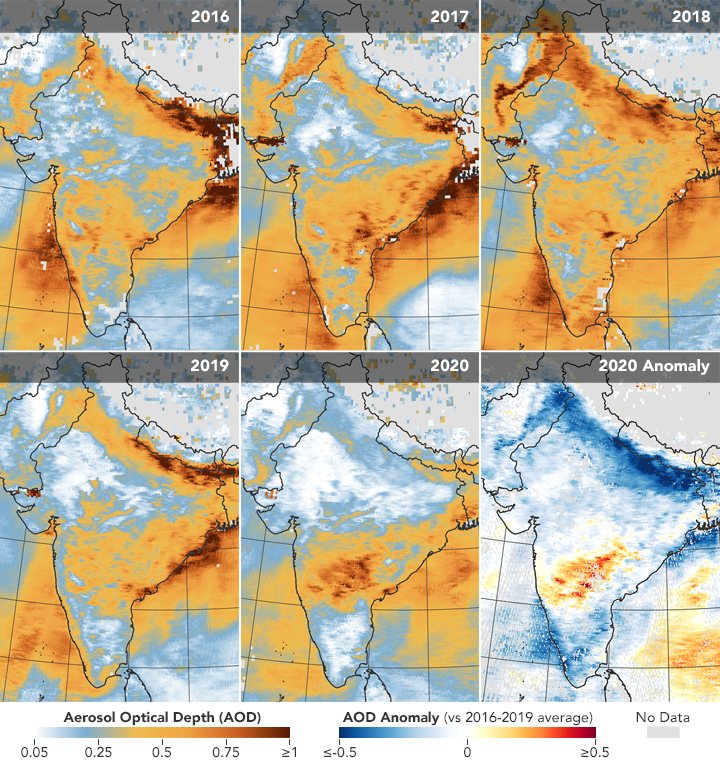
With such a quick and drastic decrease in human activities, NASA satellites have detected the lowest aerosol levels in 20 years over northern India.
Aerosols from human sources like motor vehicles and factory production hugely contribute to air pollution. High levels of aerosols have been a major factor in unhealthy, high levels of air pollution throughout India, especially in urban areas. The smaller particles that make up human-made aerosols, as compared to the typically larger particles in natural aerosols from sources like dust storms or forest fires, can be even more damaging to human health. So this drastic decrease in aerosols could be a small silver lining amidst this global pandemic, even if the effect is only temporary.
"We knew we would see changes in atmospheric composition in many places during the lockdown," Pawan Gupta, a Universities Space Research Association (USRA) scientist at NASA's Marshall Space Flight Center in Huntsville, Alabama, said in a NASA statement. "But I have never seen aerosol values so low in the Indo-Gangetic Plain at this time of year."
In the map above, you can see the drastic difference, as observed by the Moderate Resolution Imaging Spectroradiometer (MODIS) instrument on the Terra satellite, one of NASA's earth-observing missions. These images show aerosol optical depth measurements over India between March 31 and April 5 every year from 2016 to 2020. And, in the most recent image, it is easy to see how significantly aerosols have diminished in the atmosphere.

Aerosol levels have drastically decreased over northern India amidst a strict nationwide lockdown. (Image credit: Joshua Stevens/NASA Earth Observatory/Terra/MODIS/Pawan Gupta/USRA)
Weather, wind and natural sources of aerosols all impact the levels of aerosols in the atmosphere. So it can be difficult to say exactly how much of what is observed comes from humans and, therefore, exactly how much the lockdown is affecting air pollution.
"The hard part with understanding aerosols is that particles can move based on wind patterns and other meteorology," Robert Levy, program leader for NASA's MODIS aerosol products, said in the same statement. "You have to disentangle what is caused by the human fingerprint versus a meteorological factor."
But there has been a significant enough change to show that aerosols aren't dipping low because of any routine reason. For example, in the first week of the shutdown there was a decrease in aerosols, but there was also heavy rainfall, which can clear aerosols out of the air. But typically, after heavy rains like this, aerosol levels increase as things "return to normal."
"After the rainfall, I was really impressed that aerosol levels didn't go up and return to normal," Gupta said. "We saw a gradual decrease, and things have been staying at the level we might expect without anthropogenic emissions."
"This [is] a model scientific experiment," Levy added about the decrease in pollution caused by the strict lockdown. "We have a unique opportunity to learn how the atmosphere reacts to sharp and sudden reductions in emissions from certain sectors. This can help us separate how natural and human sources of aerosols affect the atmosphere."
India will remain in this strict lockdown until May 3, though some aspects of the lockdown have been altered to better support essential employees in the country. Currently, the country has seen 18,985 confirmed cases of the novel coronavirus and 603 residents have so far lost their lives.
 www.space.com
Pollution has plummeted over northern India during the country-wide lockdown, implemented to slow the spread of the novel coronavirus.
On March 24, India put its 1.3 billion citizens into a strict lockdown. Non-essential businesses were temporarily closed, factories have decreased activity, domestic and international flights have been suspended, ground travel has decreased and people across the country are working to try and perform social distancing as much as possible.
With such a quick and drastic decrease in human activities, NASA satellites have detected the lowest aerosol levels in 20 years over northern India.
Aerosols from human sources like motor vehicles and factory production hugely contribute to air pollution. High levels of aerosols have been a major factor in unhealthy, high levels of air pollution throughout India, especially in urban areas. The smaller particles that make up human-made aerosols, as compared to the typically larger particles in natural aerosols from sources like dust storms or forest fires, can be even more damaging to human health. So this drastic decrease in aerosols could be a small silver lining amidst this global pandemic, even if the effect is only temporary.
"We knew we would see changes in atmospheric composition in many places during the lockdown," Pawan Gupta, a Universities Space Research Association (USRA) scientist at NASA's Marshall Space Flight Center in Huntsville, Alabama, said in a NASA statement. "But I have never seen aerosol values so low in the Indo-Gangetic Plain at this time of year."
In the map above, you can see the drastic difference, as observed by the Moderate Resolution Imaging Spectroradiometer (MODIS) instrument on the Terra satellite, one of NASA's earth-observing missions. These images show aerosol optical depth measurements over India between March 31 and April 5 every year from 2016 to 2020. And, in the most recent image, it is easy to see how significantly aerosols have diminished in the atmosphere.
Aerosol levels have drastically decreased over northern India amidst a strict nationwide lockdown. (Image credit: Joshua Stevens/NASA Earth Observatory/Terra/MODIS/Pawan Gupta/USRA)
Weather, wind and natural sources of aerosols all impact the levels of aerosols in the atmosphere. So it can be difficult to say exactly how much of what is observed comes from humans and, therefore, exactly how much the lockdown is affecting air pollution.
"The hard part with understanding aerosols is that particles can move based on wind patterns and other meteorology," Robert Levy, program leader for NASA's MODIS aerosol products, said in the same statement. "You have to disentangle what is caused by the human fingerprint versus a meteorological factor."
But there has been a significant enough change to show that aerosols aren't dipping low because of any routine reason. For example, in the first week of the shutdown there was a decrease in aerosols, but there was also heavy rainfall, which can clear aerosols out of the air. But typically, after heavy rains like this, aerosol levels increase as things "return to normal."
"After the rainfall, I was really impressed that aerosol levels didn't go up and return to normal," Gupta said. "We saw a gradual decrease, and things have been staying at the level we might expect without anthropogenic emissions."
"This [is] a model scientific experiment," Levy added about the decrease in pollution caused by the strict lockdown. "We have a unique opportunity to learn how the atmosphere reacts to sharp and sudden reductions in emissions from certain sectors. This can help us separate how natural and human sources of aerosols affect the atmosphere."
India will remain in this strict lockdown until May 3, though some aspects of the lockdown have been altered to better support essential employees in the country. Currently, the country has seen 18,985 confirmed cases of the novel coronavirus and 603 residents have so far lost their lives.
Air pollution over northern India drops amid coronavirus lockdown
"I have never seen aerosol values so low in the Indo-Gangetic Plain at this time of year."
