Nirbhay Family of Subsonic Cruise Missiles : News and Discussions

what the heck is this obsession with stealth shaping ? this goes for a distance of 1000km with min 10m altitude, will cruise easily at 0.7 mach in a 200-500m altitude which is damn low + have good ram coating likely. That is enough for stealth. The flight envelope itself indicate it will have both terrain contour mapping , radar altimeter & a good low observable feature is built in.
Aerial radar of fighter jets, awacs exist.

US navy regularly practice shooting down anti ship missiles 500+km away from carrier battle group using their superhornets armed with air to air missiles and E-2 Hawkeye awacs.

And pretty sure missile won't be sea skimming 500+km away from target for range reasons.

Air forces on land do the same thing.


So its not just ground based radars limited by earth's curvature.


Stealth shaping is good addition to make it more survivable.
Composite material, ram coating are nice, but add stealth shaping to it and you can decrease the rcs by 10× or more, will decrease the detection range by ~50% or more.
Which will open up lot more safe corridors for the missile to evade aerial radars.
 
Aerial radar of fighter jets, awacs exist.

US navy regularly practice shooting down anti ship missiles 500+km away from carrier battle group using their superhornets armed with air to air missiles and E-2 Hawkeye awacs.

And pretty sure missile won't be sea skimming 500+km away from target for range reasons.

Air forces on land do the same thing.


So its not just ground based radars limited by earth's curvature.


Stealth shaping is good addition to make it more survivable.
Composite material, ram coating are nice, but add stealth shaping to it and you can decrease the rcs by 10× or more, will decrease the detection range by ~50% or more.
Which will open up lot more safe corridors for the missile to evade aerial radars.
Like in the current russo-ukraine conflict.
Both sides are using their fighter jets to shoot down subsonic cruise missiles and drones.
 
Even with China's ability to build so rapidly, why do they field only 500, perhaps as low as 200 of the CJ10s?
Because the days of the Tomahawk are numbered with modern day drones and AD systems.
It's an interesting thought experiment if any of the stealth techniques can extend the life of the subsonic LACMs.
But Speed is the new stealth -- supersonics may be mandatory at a minimum.
 
  • Like
Reactions: RationalGuy
Even with China's ability to build so rapidly, why do they field only 500, perhaps as low as 200 of the CJ10s?
Because the days of the Tomahawk are numbered with modern day drones and AD systems.
It's an interesting thought experiment if any of the stealth techniques can extend the life of the subsonic LACMs.
But Speed is the new stealth -- supersonics may be mandatory at a minimum.
Depends on the target set, imo. The US evaluated both subsonic and supersonic options for LRASM and chose the former. So did MBDA which chose both classes as part of FC/ASW. So subsonics still have a place. In 2001, India was among the first to go the supersonic route w/Brahmos but we're still developing the Nirbhay family.
 
  • Like
Reactions: Shan
Depends on the target set, imo. The US evaluated both subsonic and supersonic options for LRASM and chose the former. So did MBDA which chose both classes as part of FC/ASW. So subsonics still have a place. In 2001, India was among the first to go the supersonic route w/Brahmos but we're still developing the Nirbhay family.
US has decades long history of usage and familairty with subsonic missiles.
Lrasm is a 1.2 tons missile, also supposed to be carried by a fighter jet and has a range of ~1000km.

A supersonic missile with this range cannot be carried by a fighter jet.

US would have to sacrifice range if they go for supersonic missile to be carried by their fighters.

Second thing is defense, US had and still has the most capable naval air defense system in the world, Soviet and russian missiles were/are designed to penetrate that air defense.
While Soviet union's while good naval air defense systems were not as capable as american defenses, hence american anti ship missiles didn't needed to be as potent as Soviet anti ship missiles.

Though given the current pace of development and increasing capable chinese naval air defenses, US most likely will also look for supersonic and even hypersonic anti ship missiles.
Along with stealthy subsonic anti ship missiles.
 
Like in the current russo-ukraine conflict.
Both sides are using their fighter jets to shoot down subsonic cruise missiles and drones.
its the best option of taking down cruise missiles, airborne radars are the best option for early detection of cruise missiles that are flying low, awacs feeding the data to fighter jets for early threats, the chinese are doing the same inducting big awacs and guiding the 5th gen jets and hq systems to the target.
 
US has decades long history of usage and familairty with subsonic missiles.
Lrasm is a 1.2 tons missile, also supposed to be carried by a fighter jet and has a range of ~1000km.

A supersonic missile with this range cannot be carried by a fighter jet.

US would have to sacrifice range if they go for supersonic missile to be carried by their fighters.

Second thing is defense, US had and still has the most capable naval air defense system in the world, Soviet and russian missiles were/are designed to penetrate that air defense.
While Soviet union's while good naval air defense systems were not as capable as american defenses, hence american anti ship missiles didn't needed to be as potent as Soviet anti ship missiles.

Though given the current pace of development and increasing capable chinese naval air defenses, US most likely will also look for supersonic and even hypersonic anti ship missiles.
Along with stealthy subsonic anti ship missiles.
Size and weight are no longer a problem for AL supersonics. At 1.2t, he Brahmos-M weighs less than half the baseline A while providing the same performance.

The West had solved the size, weight problem long ago though. The 80s-era French ASMP-A weighs under 900kg and can target 600km+ away with a decent warhead. Lighter electronics, airframe materials play a huge role in that.

More recently, Japan's ASM-3 ALCM is another weapon that weighs under 1t, does around 400km at M3. ER versions will probably weigh no more than Brahmos-m.

The SU developed supersonics to counter USN CBGs while the US relied on carrier air wings to take care of threats. The future is subsonic + supersonic.
 
Last edited:
  • Like
Reactions: RationalGuy
Like in the current russo-ukraine conflict.
Both sides are using their fighter jets to shoot down subsonic cruise missiles and drones.
Imo, in the next Pakistan confrontation, we need to assign a Netra Mk1 AWACS purely for defence against cruise missiles as well as Tejas Mk1s armed with Astra Mk1. Such a combination can handle Pakistani cruise missles. Anyways Tejas Mk1 is less survivable infront of PAF, may as well use it for cruise missile defence.
Size and weight are no longer a problem for AL supersonics. At 1.2t, he Brahmos-M weighs less than half the baseline A while providing the same performance.

The West had solved the size, weight problem long ago though. The 80s-era French ASMP-A weighs under 900kg and can target 600km+ away with a decent warhead. Lighter electronics, airframe materials play a huge role in that.

More recently, Japan's ASM-3 ALCM is another weapon that weighs under 1t, does around 400km at M3. ER versions will probably weigh no more than Brahmos-m.

The SU developed supersonics to counter USN CBGs while the US relied on carrier air wings to take care of threats. The future is subsonic + supersonic.
Militaries will use SEAD and DEAD, after enemy AD are destroyed, cheaper cruise missiles will be used. This is why we need ARM variant of Brahmos, so that our SEAD and DEAD can be achieved faster and after that we don't need to waste much money on launching expensive Brahmos can can instead launch cheaper LRLACMs.
 
  • Like
Reactions: babablacksheep
Size and weight are no longer a problem for AL supersonics. At 1.2t, he Brahmos-M weighs less than half the baseline A while providing the same performance.

The West had solved the size, weight problem long ago though. The 80s-era French ASMP-A weighs under 900kg and can target 600km+ away with a decent warhead. Lighter electronics, airframe materials play a huge role in that.

More recently, Japan's ASM-3 ALCM is another weapon that weighs under 1t, does around 400km at M3. ER versions will probably weigh no more than Brahmos-m.

The SU developed supersonics to counter USN CBGs while the US relied on carrier air wings to take care of threats. The future is subsonic + supersonic.
🇫🇷 Asmp-a has ~500km range.
And weight of 860kg.

🇯🇵 Asm3 has ~400km range.
Asm3 has a weight of 940kg.

🇺🇸 Subsonic LRASM has range of ~1000km
And weight of 1.2 tons/1200kg.

So how are speed and weight no longer a problem?
You are basically reducing the range by 50% by using a supersonic missile of similar weight.
Also increase in price per missile.
 
  • Like
Reactions: Ashwin
Those boats are drdo own 2 boats, forgot the names read in one tender, plus they hire the ferry and pontoon service, diving support, industry rep that make the submerged platform etc. takes quite some time to set up mid-sea. Very interesting work and quite risky too. Have to take insurance cover for each mission, Govt rule mandatory.
 
  • Like
Reactions: babablacksheep
US has decades long history of usage and familairty with subsonic missiles.
Lrasm is a 1.2 tons missile, also supposed to be carried by a fighter jet and has a range of ~1000km.

A supersonic missile with this range cannot be carried by a fighter jet.
Centerline hard points on most tactical jets like SH are rated for 2t+ (imo). So supersonics in that weight class can easily be carried.

🇫🇷 Asmp-a has ~500km range.
And weight of 860kg.

🇯🇵 Asm3 has ~400km range.
Asm3 has a weight of 940kg.

🇺🇸 Subsonic LRASM has range of ~1000km
And weight of 1.2 tons/1200kg.

So how are speed and weight no longer a problem?
You are basically reducing the range by 50% by using a supersonic missile of similar weight.
Also increase in price per missile.
Subsonics are generally smaller, lighter and longer ranged than both solid rocket (fuel+oxidizer) asm and liquid ramjets like Brahmos. Although both ASMP and ASM-3 use liquid fuelled ramjets and are still lighter compared to the Brahmos. I suspect SFDR powered supersonics ASMs will be even lighter.

I consider LRASM to be a one-off. A better comparison imo would be JASSM-ER which weighs just under 1t and flies out to 980km.
 
Aerial radar of fighter jets, awacs exist.

US navy regularly practice shooting down anti ship missiles 500+km away from carrier battle group using their superhornets armed with air to air missiles and E-2 Hawkeye awacs.

And pretty sure missile won't be sea skimming 500+km away from target for range reasons.

Air forces on land do the same thing.


So its not just ground based radars limited by earth's curvature.


Stealth shaping is good addition to make it more survivable.
Composite material, ram coating are nice, but add stealth shaping to it and you can decrease the rcs by 10× or more, will decrease the detection range by ~50% or more.
Which will open up lot more safe corridors for the missile to evade aerial radars.

You really think stealth aspect is not considered by the designers with years of experience in supersonic launch vehicles specifically built to give enemy little or no chance to counter ?
this is even discounting the required bit of necessary machine, material, passive sensor suite, maintenance, coating technique etc part.
 
You really think stealth aspect is not considered by the designers with years of experience in supersonic launch vehicles specifically built to give enemy little or no chance to counter ?
this is even discounting the required bit of necessary machine, material, passive sensor suite, maintenance, coating technique etc part.
It is considered, but not seriously given stealth shaping is not present.

And its not like they will use stealth jet level RAS & RAM on a one time use cruise missile, not to mention the extensive maintainence that level of stealth coating require that is not suitable for a weapon that Is supoosed to be stored and be ready to fired at a moment.

so, If they were seriously considering lower rcs on Nirbhay missile, especially considering future awacs and other radar potential of china then, they would have went with a stealthy shape.

They are seriously considering stealth aspect for cats hunter, hence it has stealth shaping.
Can't say the same for nirbhay.
 
It is considered, but not seriously given stealth shaping is not present.
Not exactly, to have the specific stealth shaping, the parts needed to be welded via specific machinery. Those machines are often denied for export due to dual use. Go through the export control measure from Germany and other general EU countries. We bring some via Italy, Swiss, Germany and Turkey but many export approval are denied. You can not have the required machines needed and complain why a specific aerodynamic config is not chosen.
Plus, they keep trust on a well proven aerodynamic shaping and all boundary layer condition for which they have good dataset present.
There is a reason the tri services turned the russian subsonic weapons into supersonic via in house method. Almost every export version of Rus armament that are subsonic and need prep work before launch, have been modified. Only the specific cases where you can not bypass the system restriction , do the old system remain.

And its not like they will use stealth jet level RAS & RAM on a one time use cruise missile, not to mention the extensive maintainence that level of stealth coating require that is not suitable for a weapon that Is supoosed to be stored and be ready to fired at a moment.

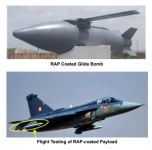
then what is this ?

1752772853136.png

RAM/RAP/RAS use cases vary as per application and even for one use case specifically. A one way mission require much more additional input than others actually. The paint coating are developed in such way for long term use or for one time use.
The ready to fire bit is only applied for a canisterised article and even in that case the actual articles are kept stored inside enclosure and only brought out before canisterisation. Once you have canisterised with the gas generator at the bottom, you can not unplug the spring without firing the missile easily, there is delicate process for that. Before that, the missile is fully prepped & checked digitally, which is few hours work. Unlike the liquid fueling, it can be done prior.

They are seriously considering stealth aspect for cats hunter, hence it has stealth shaping.
Can't say the same for nirbhay.
nirbhay/ITCM conceptualisation was one thing, cats hunter is another. The two are design of 2 different era. One predates the other by over a decade. This does not imply that the stealth aspect was not taken into account.
 
But nirbhay is entering service in this era, with decent no. Of these missiles In service only after 2030+.
But It's design is from an old era.
2 design suitable for 2 different purpose. One is surface launched primarily. So can evade radar detection & a low signature can even evade other tracking means without need for stealth shaping.
Cats hunter is ground up air launched config that is carried in a hardpoint, that itself is enough to create a spike in radar detection. So here the stealth shaping can be considered from the off for standoff distance launch and one that can help even if the jet moves supersonic speed. In this case the primary concern would be to make the carrier platform not appear on radar view early.

Since subsonic so EO seeker can be implemented instead of Rf seeker, that also plays a part. A gimballed EO seeker will feature with live feed via datalink to pick target. But the pointy stealth shaping helps in the carrier jet going supersonic mid flight.
 
I asked Grokv3 DeepSearch to analyze the _cruise missile_ intercept rates based on the speed regime and this is what it spit out.

Query: Compare the number and rate of Russian subsonic, supersonic and hypersonic cruise missiles intercepted in Ukraine.

Result:

Percent Intercepted
Missile TypeCategoryInterception Rate
Cruise Missiles (Kalibr, Kh-555/101, R-500, Iskander-K)Subsonic67%
Guided Missiles (Kh-59, Kh-35, Kh-31)Mixed (Subsonic/Supersonic)22%
Onyx (P-800)Supersonic5.7%
Kh-22 and Kh-32Supersonic0.55%
Zircon (3M22) **Hypersonic33.3%


Numbers intercepted:
Missile TypeCategoryLaunchedIntercepted
Onyx (P-800)Supersonic21112
Kh-22 and Kh-32Supersonic3622
Zircon (3M22)Hypersonic62
Cruise Missiles (Kalibr, etc.)Subsonic *--
Guided Missiles (Kh-59, etc.)Mixed--

* Subsonic Cruise Missiles: The total number launched and intercepted for subsonic cruise missiles is not specified in the data

** Too small a sample to make any reasonable deductions about hypersonics


IMHO, we should assume China's AD will be improved to match these intercept rates and the stockpiling as well as quantity of Nirbhay used in any saturation attacks should be adjusted accordingly.
 
I asked Grokv3 DeepSearch to analyze the _cruise missile_ intercept rates based on the speed regime and this is what it spit out.

Query: Compare the number and rate of Russian subsonic, supersonic and hypersonic cruise missiles intercepted in Ukraine.

Result:

Percent Intercepted
Missile TypeCategoryInterception Rate
Cruise Missiles (Kalibr, Kh-555/101, R-500, Iskander-K)Subsonic67%
Guided Missiles (Kh-59, Kh-35, Kh-31)Mixed (Subsonic/Supersonic)22%
Onyx (P-800)Supersonic5.7%
Kh-22 and Kh-32Supersonic0.55%
Zircon (3M22) **Hypersonic33.3%


Numbers intercepted:
Missile TypeCategoryLaunchedIntercepted
Onyx (P-800)Supersonic21112
Kh-22 and Kh-32Supersonic3622
Zircon (3M22)Hypersonic62
Cruise Missiles (Kalibr, etc.)Subsonic *--
Guided Missiles (Kh-59, etc.)Mixed--

* Subsonic Cruise Missiles: The total number launched and intercepted for subsonic cruise missiles is not specified in the data

** Too small a sample to make any reasonable deductions about hypersonics


IMHO, we should assume China's AD will be improved to match these intercept rates and the stockpiling as well as quantity of Nirbhay used in any saturation attacks should be adjusted accordingly.

Just to make this more explicit.
A single Brahmos has ~95% probability of defeating AD.
To have 95% probability that at least a single Nirbhay defeats AD, you would need to fire 8 Nirbhays!

* Yes, it's not the simple since a mix of drones, BMs, CMs, Brahmos all will be used together to defeat AD, but it's just to illustrate the point.
 
I asked Grokv3 DeepSearch to analyze the _cruise missile_ intercept rates based on the speed regime and this is what it spit out.

Query: Compare the number and rate of Russian subsonic, supersonic and hypersonic cruise missiles intercepted in Ukraine.

Result:

Percent Intercepted
Missile TypeCategoryInterception Rate
Cruise Missiles (Kalibr, Kh-555/101, R-500, Iskander-K)Subsonic67%
Guided Missiles (Kh-59, Kh-35, Kh-31)Mixed (Subsonic/Supersonic)22%
Onyx (P-800)Supersonic5.7%
Kh-22 and Kh-32Supersonic0.55%
Zircon (3M22) **Hypersonic33.3%


Numbers intercepted:
Missile TypeCategoryLaunchedIntercepted
Onyx (P-800)Supersonic21112
Kh-22 and Kh-32Supersonic3622
Zircon (3M22)Hypersonic62
Cruise Missiles (Kalibr, etc.)Subsonic *--
Guided Missiles (Kh-59, etc.)Mixed--

* Subsonic Cruise Missiles: The total number launched and intercepted for subsonic cruise missiles is not specified in the data

** Too small a sample to make any reasonable deductions about hypersonics


IMHO, we should assume China's AD will be improved to match these intercept rates and the stockpiling as well as quantity of Nirbhay used in any saturation attacks should be adjusted accordingly.
Asper this table, super sonic kh 22/32 is much better option than zircon & Russian equivalent of Brahmos.