
Rare footage of a Russian heavy Forpost-RU UAV taking off was published by the Russian Unmanned Systems Troops. The Forpost-RU UAV is not frequently used these days, but videos of it have been available in Ukraine since 2022. Due to the Forpost-RU's large heat signature and size, it is easily detected by air defense systems, limiting its use.
Russian Military Technology : Updates and Discussions
- Thread starter Ashwin
- Start date
You are using an out of date browser. It may not display this or other websites correctly.
You should upgrade or use an alternative browser.
You should upgrade or use an alternative browser.

The Russian Ministry of Defense received a new batch of BMP-3s produced in 2026. Each BMP-3 is now equipped with a more modern electronic warfare system. The underbody has also been reinforced against blasts, and the spall armor of the rear and front has been increased. Each BMP-3 comes with anti-cumulative gratings, armored screens, and "Nakidka" (cape) signature reduction kits. The attachments and protection are installed on the BMP-3 upon arrival at military units.
At the World Defense Show 2026 international defense exhibition in Saudi Arabia, the Russian NPO Bazalt presented the modernized RPG-29M hand-held anti-tank grenade launcher. The original RPG-29 "Vampire" entered service with the Soviet Army in 1989. The RPG-29M has been made lighter, while its power and firing range have increased. The RPG-29M launcher, empty, now weighs 4.4 kg, compared to the standard version's 12.1 kg.
The RPG-29M now weighs even less than the RPG-7, while also carrying a more powerful 105 mm grenade.
The RPG-29M has an integrated fire control system and a new ITP-VG-50 infrared sight. The sight offers 2×, 4×, and 8× digital zoom. This allows for human detection at ranges of up to 1,300–1,500 meters. The RPG-29M uses the PG-29VM tandem munition, designed to destroy armored vehicles at ranges of up to 700 meters. The TBG-29VM thermobaric munition has a firing range of up to 1,000 meters. There is also the MG-29M multipurpose munition with a firing range of up to 1,000 meters. The grenade launcher can also fire incendiary, cluster, and fragmentation-beam munitions.
The RPG-29M now weighs even less than the RPG-7, while also carrying a more powerful 105 mm grenade.
The RPG-29M has an integrated fire control system and a new ITP-VG-50 infrared sight. The sight offers 2×, 4×, and 8× digital zoom. This allows for human detection at ranges of up to 1,300–1,500 meters. The RPG-29M uses the PG-29VM tandem munition, designed to destroy armored vehicles at ranges of up to 700 meters. The TBG-29VM thermobaric munition has a firing range of up to 1,000 meters. There is also the MG-29M multipurpose munition with a firing range of up to 1,000 meters. The grenade launcher can also fire incendiary, cluster, and fragmentation-beam munitions.
The Russian Ministry of Defense unveiled the Pantsir-S air defense system with the new TKB-1055 mini-missiles. The TKB-1055 missile is designed to intercept drones; four missiles of this type are carried in a TKB-1056 container. The TKB-1055 missile was developed as a cost-effective version of the Pantsir-S air defense missiles.
For more information on the TKB-1055 missiles, see the video about the Pantsir-SMD-E air defense system.
For more information on the TKB-1055 missiles, see the video about the Pantsir-SMD-E air defense system.
Russian military personnel unveiled a rare version of the T-90M "Proryv" tank, featuring a lowered version of the "mangal" protection. Tanks with this type of protection were previously unveiled in 2024. This particular T-90M "Proryv" tank was presumably previously used in parades in Russia.
The Barrage-1 stratospheric broadband communications platform was launched in Russia for the first time. The platform is designed to relay 5G NTN communications and can be used in place of the Starlink satellite communications system. The Barrage-1 platform can also be used to provide communications for units, control drones, and transmit data. The Barrage-1 stratospheric platform is designed for extended stays in the stratosphere at an altitude of up to 20 km, from several days to several weeks, with a payload of up to 100 kg. The Barrage-1 platform can be used in areas where it is impractical to install communication towers. A pneumatic ballasting system allows the Barrage-1 to change its flight altitude and navigate in the desired direction using the wind, without the use of engines.
The Russian company Aeroplatforms also launched a stratospheric balloon for broadband internet connectivity. Previously, the Russian broadband communications platform "Barrage-1" was demonstrated launching into the stratosphere. The project is being managed by JSC Aerodrommash.
Aeroplatforms' stratospheric balloon can ascend to an altitude of up to 24 kilometers. It's worth noting that air defense systems have difficulty intercepting targets at such altitudes, as the balloons have low radar and thermal signatures. The balloons will provide Russian troops with an additional channel for controlling drones at ranges over 100 kilometers, a function previously achieved through cellular communications. Ground troops will also be able to utilize alternative communication channels. Stratospheric internet connectivity projects are temporary solutions for providing connectivity to specific areas.
Aeroplatforms' stratospheric balloon can ascend to an altitude of up to 24 kilometers. It's worth noting that air defense systems have difficulty intercepting targets at such altitudes, as the balloons have low radar and thermal signatures. The balloons will provide Russian troops with an additional channel for controlling drones at ranges over 100 kilometers, a function previously achieved through cellular communications. Ground troops will also be able to utilize alternative communication channels. Stratospheric internet connectivity projects are temporary solutions for providing connectivity to specific areas.
Russian Ka-52M attack helicopters have reportedly received the latest 30mm remote-detonating munitions for countering UAVs. The Ka-52 helicopter can reportedly engage 25 or more drones in just a few sorties using the new munitions. Rostec recently announced the development of a 30mm shrapnel projectile with a remote-controlled fuse, designed to effectively engage drones. Such munitions were previously developed by NPO Pribor. The targeting system reportedly calculates the most advantageous detonation point based on the target's flight trajectory, allowing the drone to be hit with shrapnel. Detonation time is entered automatically via an optical line. The remote-detonating projectile is designed for firing from the 2A42 automatic cannon, which is installed, among other things, on airborne combat vehicles, the Terminator BPMT, and the Mi-28NM and Ka-52M helicopters.
Uralvagonzavod has sent a batch of modernized BREM-80 armored recovery vehicles to the Russian Armed Forces. The BREM-80U was also previously demonstrated. "The key upgrade to the BREM-80 is the increased crew protection and a new mechanized coupling. This device allows the BREM crew to recover damaged equipment without abandoning the vehicle. The BREM is sometimes used as an "assault tank," for paving roads in populated areas. The upgraded BREM-80 features side protection similar to that found on the T-80BVM tank, a slatted screen, and an electronic warfare system to protect against drones. The GTD-1250 gas turbine engine increases the BREM's mobility. The BREM-80 has a crew of four and is based on the T-80 tank chassis, modified based on combat experience.
The first footage of the Russian robotic platform NRTK "Courier" being used for radiation reconnaissance. In the video of the exercise, the NRTK "Courier" robot measures background radiation in the area using an IMD-7 dosimeter. The robot places marker flags at suspected points of excess radiation. Technical information on the IMD-7 dosimeter is shown on the screen.
Russian troops from the 244th Artillery Brigade unveiled the new 9K57-1 Uragan-1 MLRS on the new BAZ-69092 chassis from the Bryansk Automobile Plant. Previously, the Uragan MLRS, adopted by the USSR in 1975, used the ZIL-135LM chassis. The new Uragan-1 MLRS offers greater maneuverability, and the use of automation has improved the speed of preparation and target accuracy. The MLRS crew is now protected by an armored cabin. The 220mm Uragan MLRS carries 16 rockets and can engage targets at a range of up to 35 kilometers. The Uragan MLRS's high-explosive projectile has a warhead weighing up to 140 kg and over 50 kg of explosives. The types of projectiles are shown on the screen. The BAZ-69092 chassis, with a payload capacity of up to 14,000 kg and a 450 hp engine, enables speeds of up to 80 km/h. The vehicle's range has reached 1,000 km. It can now cross a 0.9-meter-wide ditch, climb a 30-degree slope, and ford water up to 1.4 meters deep.
Footage of winter training for crews of Russian Terminator tank support combat vehicles (T-44) of the Center Force Group. During the training, the crews practice engaging various types of targets with their standard weapons. The Terminator combat vehicles quickly reach the firing line and engage targets with their twin 30mm 2A42 cannons at ranges of up to 4,000 meters, as well as AGS-17 Plamya automatic grenade launchers.
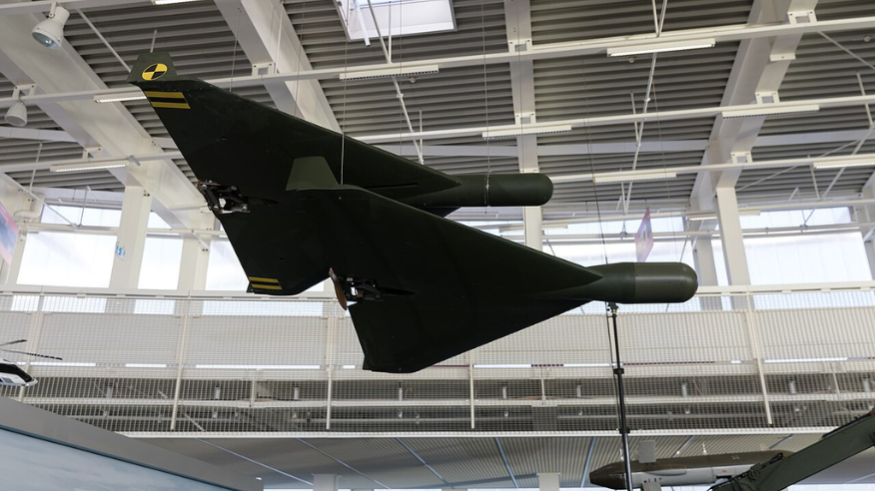
Defence analyst Austin Joseph explains that Russia and not the US or Iran operates the most advanced DAR version.
“Russia’s Geran-3 has a turbojet engine variant.
An air-to-air missile fired by a Geran scored two helicopter hits recently.
Gerans have been acting as mother carriers for other smaller drones.
The Russians have added cameras and computer-vision systems to enable their drones to undertake evasive manoeuvres (to avoid counter-drones) or identify and target air defense systems.”
 chakranewz.com
“Russia’s Geran-3 has a turbojet engine variant.
An air-to-air missile fired by a Geran scored two helicopter hits recently.
Gerans have been acting as mother carriers for other smaller drones.
The Russians have added cameras and computer-vision systems to enable their drones to undertake evasive manoeuvres (to avoid counter-drones) or identify and target air defense systems.”
Fact check: No, Iran didn’t design the Shahed-136
I’d like to point out that these drones were an original Iranian design… we took them back to America, made them better and fired them right back at Iran,” CENTCOM Commander Admiral Brad Cooper said on March 4.
chakranewz.com

The first technical data and launch of the Russian Yolka interceptor drone have been released. It is currently in active use by Russia's mobile air defense forces. The Yolka interceptor drone is manufactured by the Moscow-based company Nashe Nebo. It operates on a "fire and forget" principle. Upon locking on to a target, the Yolka drone's engines fire. The Yolka drone's dual-channel optoelectronic module is capable of identifying enemy drones with a 100-centimeter wingspan in the visible optical spectrum at a range of 700-1000 meters. The Yolka drone can also engage maneuvering FPV drones.
There are two versions of the drone: a civilian version, without a warhead, performs kinetic interception of UAVs. The second version contains a 360-gram fragmentation warhead. The Yolka drone can be launched from handheld devices or a tripod. The Yolka drone can also be mounted on the Impulse-PVO tracked robotic chassis.
The Yolka interceptor drone reaches speeds of up to 200 km/h. Its rate of climb is 40 m/s. The drone can fly 2.5-3 km away from the operator and ascend to an altitude of up to 2,000 meters. The maximum target speed is 115 km/h.
There are two versions of the drone: a civilian version, without a warhead, performs kinetic interception of UAVs. The second version contains a 360-gram fragmentation warhead. The Yolka drone can be launched from handheld devices or a tripod. The Yolka drone can also be mounted on the Impulse-PVO tracked robotic chassis.
The Yolka interceptor drone reaches speeds of up to 200 km/h. Its rate of climb is 40 m/s. The drone can fly 2.5-3 km away from the operator and ascend to an altitude of up to 2,000 meters. The maximum target speed is 115 km/h.
hmmm conflicting reports, i heard it was an R37M. Anyway its still an A-a kill