S-400 'Triumf' News & Discussion


India’s fourth S 400 Triumf air defence system, which has been delayed by nearly three years, is finally ready and undergoing final tests before delivery in the second quarter of this year, ThePrint has learnt.

Sources in the defence and security establishment told ThePrint that the system was to be delivered in March but will now reach the Indian shores by May, or June.The sources said that the fifth S-400 system will be delivered in the last quarter of this year, giving a flip to India’s planned air defence network.

It is learnt that out of the total five systems, three would be deployed along the western border with Pakistan. The sources said that with the three systems deployed, the air defence against threats emanating from Pakistan will be complete.

The deliveries will take place at a time when India is already working on placing an additional order for five new S-400 air defence systems, which will become integral to the Project Sudarshan Chakra, announced by Modi on Independence Day.

The sources said that once all the 10 air defence systems are in place along with India’s own planned Project Khusha, the airspace around the country will almost become impregnable when it comes to drones, 4.5 Gen plus fighters, and missiles.

They explained that the S-400s had performed exceptionally well during Operation Sindoor and was able to keep Pakistani aircraft at bay, including the J-10s.

Not only did the S-400 record its longest hit ever during the 88-hour conflict between India and Pakistan, the sources said the ability of the system to shoot and scoot in a short span of time, which allows it to evade enemy fire, was also proved.

On 7 May, the IAF took down a JF-17 aircraft of the Pakistan Air Force well within the Pakistani airspace and forced their fighters to draw back.

However, the fighters did manage to enter into a missing coverage area for a limited period to launch their munitions.

“Once the third system is deployed, the entire western border becomes a fully secure arc and every single fighter, even deep inside Pakistani airspace, can be targeted,” a source explained.

The S-400 is capable of destroying incoming hostile aircraft, missiles and even drones within a range of up to 400 km. It has a tracking capability of nearly 600 km.

The system has been designed to knock down flying targets, including those equipped with stealth technologies, at a distance of about 400 km. It is also capable of taking out ballistic missiles and hypersonic targets.

Compared to its predecessor the S-300, the S-400 has a firing rate that is 2.5 times faster. The S-400 can be armed with four different types of missiles with ranges of 400 km, 250 km, 120 km and 40 km. The system’s Long Range radar can track more than 100 flying objects simultaneously while being able to engage a dozen targets.

PS: ANI's Ajit Dubey today said in an article, that the 4th system could be delivered in April or May.
Now imagine how long it would take for Russia to fulfil orders for an additional 5 S-400 squadrons if the order was to be placed in the next 6-12 months.
It's better to go full speed forward with Kusha because any additional S-400 systems aren't arriving anytime soon.
 
Looks like DAC did approve additional 5 squadrons of S-400 today and with that one more prediction made by me comes true. @_Anonymous_
Now imagine how long it would take for Russia to fulfil orders for an additional 5 S-400 squadrons if the order was to be placed in the next 6-12 months.
It's better to go full speed forward with Kusha because any additional S-400 systems aren't arriving anytime soon.
There are only very few people on our forum except myself and @randomradio who keep a close watch on Russian military programmes. What few people know is that Russia is in midst of a massive military modernisation drive. All their key military assets like Su-57, Su-35S, Su-35M, S-400 and even S-500 are witnessing substantial surge in production.

IAF & GOI are no fools to sign a deal in 2026 only to get deliveries in 2036. Russia has assured full supply of these additional S-400s by 2030, post which our own Kusha ADS would come online and takeover the mantel from S-400. In fact, we will get remaining 2 S-400 squadrons from first order in this year itself.
 
Looks like DAC did approve additional 5 squadrons of S-400 today and with that one more prediction made by me comes true. @_Anonymous_

There are only very few people on our forum except myself and @randomradio who keep a close watch on Russian military programmes. What few people know is that Russia is in midst of a massive military modernisation drive. All their key military assets like Su-57, Su-35S, Su-35M, S-400 and even S-500 are witnessing substantial surge in production.

IAF & GOI are no fools to sign a deal in 2026 only to get deliveries in 2036. Russia has assured full supply of these additional S-400s by 2030, post which our own Kusha ADS would come online and takeover the mantel from S-400. In fact, we will get remaining 2 S-400 squadrons from first order in this year itself.

Russia's first priority after the war would be to top up its own inventory which has been heavily depleted over the years. They have used up a lot of older stocks as well like Cold War era AS-4 Kitchen, etc.

How much capacity would be made available for exports is anybody guess. ToT may be a better option, imo.

But I expect Kusha to have a far shorter dev cycle since it builds on tech already developed for Akash mk2/MRSAM/BMD P1.

Apparently trials of M1 have already started.
 
Russia's first priority after the war would be to top up its own inventory which has been heavily depleted over the years. They have used up a lot of older stocks as well like Cold War era AS-4 Kitchen, etc.
Undoubtedly, their first priority would be to fulfill domestic demand and stock up for any future confrontation with NATO/US.
How much capacity would be made available for exports is anybody guess. ToT may be a better option, imo.
GOI believes their timeline along with IAF, thus we are going ahead.
But I expect Kusha to have a far shorter dev cycle since it builds on tech already developed for Akash mk2/MRSAM/BMD P1.
Not before 2030. M1 may become operational in 2028 itself, but full system including 350-400kms M3 would take some time.
Apparently trials of M1 have already started.
Yes.
 
It seems that there are folks who are really pushing for the Pantsir.


In order to protect the S-400 systems and improve the anti-drone/loitering ammunition coverage, India is also planning to buy at least 12 Pantsir air defence systems from Russia through govt to govt deal while making another 40 systems under “Make in India” route.
 
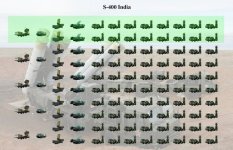
All five of India S-400 System

View attachment 51361

80 TEL, 10 92N6E Grave Stone, 10 96L6E Radar, 5 91N6E big bird radar. All 5 on western sector will be nightmare for *censored* retards basically game over². IAF AWACS need to be linked with LR-SAMs of S-400 to provide over the horizon capabilities & exploit full potential of missile max range.
That's the eventual plan. 5 for Western and 5 for Northern/Eastern Sector. Next batch of S-400 will have even better interoperability with our future/current AWACS fleet. Combine this with MKI launching Mach 6, 400kms range R-37M and our A2/AD coverage extends beyond conventional measures plus our enemy is completely gonna get effed🤣
 
  • Like
Reactions: South block
IMO, he raised a valid point. If S-400 missiles can be tracked and supported by Indian radars deployed near the border in cases where the S-400 radar is switched off, and likewise if the S-400 system can potentially track and guide Astra-series missiles, AD missiles, and even BMD interceptors through data links, it would be a major advantage for our missile kill chain capability.

Since we are looking for five more squadrons, this capability should be part of the negotiations. However, before that, we need to do the groundwork, fully understand the technical solution we are seeking, and ask Russia very specific and detailed questions during the negotiations.

 
Do we know why are we purchasing pantsir instead of using indigenous options such as vlsrsam? Is it because pantsir will use the s400 radar only and our indigenous systems can't talk to russian radar?
 
IMO, he raised a valid point. If S-400 missiles can be tracked and supported by Indian radars deployed near the border in cases where the S-400 radar is switched off, and likewise if the S-400 system can potentially track and guide Astra-series missiles, AD missiles, and even BMD interceptors through data links, it would be a major advantage for our missile kill chain capability.

Since we are looking for five more squadrons, this capability should be part of the negotiations. However, before that, we need to do the groundwork, fully understand the technical solution we are seeking, and ask Russia very specific and detailed questions during the negotiations.

Isn't the data link IAF now uses based on BNET

S400 I suppose may be only connected to AFnet

BNET NETCOR makes it that kill chain which I am not sure Russia will allow
 
Isn't the data link IAF now uses based on BNET

S400 I suppose may be only connected to AFnet

BNET NETCOR makes it that kill chain which I am not sure Russia will allow
In my understanding, sharing tracking information with IACCS is possible, but actually guiding a missile is a completely different challenge. The missile’s data link must be capable of accepting targeting updates either from the S-400 radar or, conversely, the S-400 (40N6) missile must be able to accept inputs from Indian radars through the data link.

That is why we say the Saab Erieye cannot directly guide the PL-15 missile. It can detect and track Indian aircraft and provide coordinates to PAF fighters, but the actual guidance of the PL-15 still has to come from the fighter aircraft itself. Direct Saab Erieye-to-PL-15 guidance is not possible.
 
IMO, he raised a valid point. If S-400 missiles can be tracked and supported by Indian radars deployed near the border in cases where the S-400 radar is switched off, and likewise if the S-400 system can potentially track and guide Astra-series missiles, AD missiles, and even BMD interceptors through data links, it would be a major advantage for our missile kill chain capability.

Since we are looking for five more squadrons, this capability should be part of the negotiations. However, before that, we need to do the groundwork, fully understand the technical solution we are seeking, and ask Russia very specific and detailed questions during the negotiations.

Isn't the data link IAF now uses based on BNET

S400 I suppose may be only connected to AFnet

BNET NETCOR makes it that kill chain which I am not sure Russia will allow
In my understanding, sharing tracking information with IACCS is possible, but actually guiding a missile is a completely different challenge. The missile’s data link must be capable of accepting targeting updates either from the S-400 radar or, conversely, the S-400 (40N6) missile must be able to accept inputs from Indian radars through the data link.

That is why we say the Saab Erieye cannot directly guide the PL-15 missile. It can detect and track Indian aircraft and provide coordinates to PAF fighters, but the actual guidance of the PL-15 still has to come from the fighter aircraft itself. Direct Saab Erieye-to-PL-15 guidance is not possible.
But if it was a Chinese awacs or a common Data Link then it an AWACS can provide ABC kill chain ?

Like Phalcon to Astra from a Su 30
 
IMO, he raised a valid point. If S-400 missiles can be tracked and supported by Indian radars deployed near the border in cases where the S-400 radar is switched off, and likewise if the S-400 system can potentially track and guide Astra-series missiles, AD missiles, and even BMD interceptors through data links, it would be a major advantage for our missile kill chain capability.

Since we are looking for five more squadrons, this capability should be part of the negotiations. However, before that, we need to do the groundwork, fully understand the technical solution we are seeking, and ask Russia very specific and detailed questions during the negotiations.


It's very easy with Russian missiles like RVV-SD, R-37M etc, but with Indian missiles it would need a lot of work.

Back when Virupaksha didn't exist, integrating S-400 with MKI MLU was my pet dream. It would have been possible to integrate S-400's missiles with the MKI. But integrating an Indian radar with Russian is impossible without ToT.

Integrating Indian missiles with Russian radars and vice versa is possible, like Rafale with Astra, but it comes with quite a bit of technical hurdles 'cause the S-400 was not designed for such a high degree of offboard networking.

Integrating Russian missiles with Indian radars would be the way to go.
Do we know why are we purchasing pantsir instead of using indigenous options such as vlsrsam? Is it because pantsir will use the s400 radar only and our indigenous systems can't talk to russian radar?

Low cost, low effort, immediate use work. Pantsir can hit the ground running.
 
Do we know why are we purchasing pantsir instead of using indigenous options such as vlsrsam? Is it because pantsir will use the s400 radar only and our indigenous systems can't talk to russian radar?
Until a deal is officially signed, social media in India will continue to speculate about everything and nothing. As of now, we are only moving ahead with Shilka upgrades, while Pantsir reportedly lost out to the South Korean Biho system.

Instead of relying entirely on foreign systems, we should develop our own Biho-like platform based on the Zorawar chassis. If there is a genuine requirement, DRDO and L&T should work together to develop an indigenous solution tailored to Indian operational needs.
 
  • Like
Reactions: spice and Paro