SAAB Gripen : Updates and Discussions

Agree, @Rajput Lion unnecessarily give too much imp to kinematics and hence is organically baised toward flankers and twin engine rafale.

Modern warfare is more electronics heavy than kinematic heavy

I too believe that even tejas mk1a will kick the *censored* of su35 in a2a when it will get astra mk2/3

Primarily because Flanker RCS is too big to hide with EW alone.

Kinematics are useless without spectrum dominance.

But if you have spectrum equivalence, then kinematics becomes important. Like LCA/Gripen vs Rafale, Rafale will have the advantage But Rafale's superior kinematics does not help much against the F-35's spectrum dominance.
 
The Chinese have praised the Gripen E concept after having dealt with Gripen C. That's the main point. MKIs have performed poorly in BVR against M2000s too. The Irbis-E won't help here. It's the limitation of a large RCS. Gripen C's frontal RCS is half that of the M2000 and Gripen E's is significantly better than that.
You are completely wrong here. Even M-2000 UPG. was overwhelmed by MKI in both WVR & BVR. Go and look it up. Detection is not just about your RCS but combination of your RCS vs your Radar power. This is where Flanker is in a league of its own.

Su-30MKI UPG. will crush Gripen E every single time in BVR or WVR thanks to combination of Virupaksha plus our indigenous RCS reduction programme.
The IAF rates the Meteor higher compared to R-37M as well. The main reason for us is we can't use Meteors on MKIs, so R-37s act as stopgap to compete with LR BVRAAMs. Even with R-37M, Gripen E will consistently defeat Flankers.
Let IAF first have R-37M in active service. Their opinion will soon change;)
MKI MLU is necessary here and still operate at a disadvantage compared to Gripen E and LCA Mk2.
Nope. MKI UPG. will have far far better combat prowess over these two as well as Rafale.
Competition with Su-57 is entirely dependent on its own level of maturity relative to Gripen E. The problem with the Su-57 is its large IR signature relative to Gripen. If Gripen comes with a working ACT, then it could end up within shooting distance of the Su-57 due to IR limitations. The aircraft needs Izd 30 to survive. The F-22 and F-35 with significantly higher levels of RF and IR stealth are naturally better than Gripen E. Of course, if Su-57 actually achieves its design goals, it will become more than competitive, but it's unclear when that's gonna happen.
Mate, with Su-57 there is literally no competition.
As for LCA, it has to come with the same EW capabilities if it has to compete in the export market. Can't expect much with just a price advantage 'cause of F-50. Gripen E has a decade-plus advantage for now.
Give it some time and it shall become clear in the next decade.
 
@randomradio @Picdelamirand-oil @Rajput Lion
What sorcery had done by sweedish people? 650 km detection range for air target for a tiny aews. Not even USA or Israel have such capability

Our netra MK2 will have 500km i think.

I dont want PAF operating Globaleye during round. If they want they can field multiple global eyes such a way that it will be out of S400's range yet will be able to cover entire Pak airspace and few hundred kilometers in to our land.
Its absurdly stupid to quote ranges like 650km. Even Saab dont claim that. Its instrumentation, nothing to do with operational.
 
@randomradio @Picdelamirand-oil @Rajput Lion
What sorcery had done by sweedish people? 650 km detection range for air target for a tiny aews. Not even USA or Israel have such capability

Our netra MK2 will have 500km i think.

I dont want PAF operating Globaleye during round. If they want they can field multiple global eyes such a way that it will be out of S400's range yet will be able to cover entire Pak airspace and few hundred kilometers in to our land.
In fact, SAAB has actually offered us the Globaleye. It is indeed that much superior to Erieye.
Agree, @Rajput Lion unnecessarily give too much imp to kinematics and hence is organically baised toward flankers and twin engine rafale.

Modern warfare is more electronics heavy than kinematic heavy

I too believe that even tejas mk1a will kick the *censored* of su35 in a2a when it will get astra mk2/3
No jet can kick Super Flanker's a*s in a one-on-one duel unless that jet is stealth. All your LCAs, Gripens, Rafales, Typhoons fly with standard two drop tanks, which takes away their RCS advantage over modernised Flankers. Su-35S is around 3m2 in air-to-air configuration while Gripen/Rafale/Typhoon/LCA with 6 BVRs and 2 EFTs, would be around 1.5m2 to 2.5m2. Now factor in huge radar of the Flanker vs puny ones of these Delta/Canards and combined with its kinematics and endurance on internal fuel, latest gen Flanker can harass them all.

Regarding stealth? Well, we are specifically dialling the MKI UPG. programme to develop it as a stealth counter.
 
You are completely wrong here. Even M-2000 UPG. was overwhelmed by MKI in both WVR & BVR. Go and look it up. Detection is not just about your RCS but combination of your RCS vs your Radar power. This is where Flanker is in a league of its own.

Both confirmed. MKI had significant superiority over standard M2000 when it was inroduced, but French M2000s defeated MKI during Garuda exercises in BVR.

The MKIs couldn't detect the M2000s.

Let IAF first have R-37M in active service. Their opinion will soon change;)

There's no opinion to change, the EM diagram of the R-37M is inferior even when compared to RVV-SD. It's a complementary missile, its kill probability only plateaus to 0.4 after 50 km. RVV-SD has twice the kill probability up to 40 km.

The missile cannot consistently defeat a maneuvering target after its been alerted.

Nope. MKI UPG. will have far far better combat prowess over these two as well as Rafale.

Just having radar range isn't enough.

The point of Virupaksha is for other fighters to gain the advantage against adversaries, it does nothing much for the MKI itself against advanced 4.5th and 5th gen jets. That's how the F-15EX is advertised too. With Virupaksha around, LCA can fly passive and maintain stealth. It's the Samurai-Ninja tactic. That's how the IAF gained an advantage over the USAF in CI-2004. Su-30Ks combined with Bisons using this tactic. The Eagles were so busy distracted by Flankers that they didn't see the Bisons killing them. They have adopted this for the F-15EX with the F-35.

So no, mano-a-mano, MKI even with RCS reduction cannot guarantee victory against Gripen E and LCA Mk2. Otherwise there would be no point in pursuing these jets in the first place. These two have actually been designed to compete with 5th gen.

Mate, with Su-57 there is literally no competition.

That's not how things work. With cooperative tactics, Gripen E and LCA Mk2 will be able to detect and track Su-57 from 100-200 km. It's how multistatic systems work.

Virupaksha with its larger array design will detect and track stealth jets from long range via multistatic networks while LCA will move in for the kill.

It's quite improbable for Gripen and LCA to go mano-a-mano against stealth, but they have both been designed to use group tactics against stealth. And it works. The American response to this has been CCAs, ie, gives more targets to track. The CCAs show that the Americans agree even 6th gen class stealth isn't enough, they still need mass to survive.

We do this for BMD too, against tiny warheads with RCS well below what's classified as LO. Many ground-based radars have been doing this for more than a decade against aerial threats. From this decade onwards, this ability has been normalized on modernized fighters too. Rafale F4 recently introduced it. India will introduce it the next decade on MKI and LCA Mk2. Gripen E was the first to do it.
 
  • Like
Reactions: YoungWolf
Gripen/Rafale/Typhoon/LCA with 6 BVRs and 2 EFTs, would be around 1.5m2 to 2.5m2.

Only Gripen C and LCA Mk1/A. All other jets stay well below 0.5 sqm.

In fact, Rafale and Typhoon should easily be able to maintain 0.1 sqm class RCS with 4 and 6 missiles resply. Those fuselage and wingtip missiles won't necessarily add much visibly to RCS. KF-21 has also been designed to have RCS well below 0.1 sqm and maintain it when carrying 6 missiles, like Typhoon.
 
Both confirmed. MKI had significant superiority over standard M2000 when it was inroduced, but French M2000s defeated MKI during Garuda exercises in BVR.
You're mixing up a lot of scenario. M-2000 got BVR kills due to a particular AdLa technique, where it hid behind MKI's BARS(which was in a training mode btw) blindspot by flying very near to it which allowed M-2000 to stay out of its radar cone coverage.

What I am saying is that IAF pitted upgraded M-2000 5 vs MKI in both BVR & WVR and this happened:

1000049194.jpg

MKI has constantly killed smaller RCS jets like LCA, Typhoon, Rafale, M-2000 in BVR combat. MKI can't be compared to old Chinese J-11s at all.
C
The MKIs couldn't detect the M2000s.
Not because of M-2000s low RCS but because of a technique employed by French Airforce, lol.
There's no opinion to change, the EM diagram of the R-37M is inferior even when compared to RVV-SD. It's a complementary missile, its kill probability only plateaus to 0.4 after 50 km. RVV-SD has twice the kill probability up to 40 km.

The missile cannot consistently defeat a maneuvering target after its been alerted.
As I said, let IAF first possess the weapon, then we shall know.
Just having radar range isn't enough.

The point of Virupaksha is for other fighters to gain the advantage against adversaries, it does nothing much for the MKI itself against advanced 4.5th and 5th gen jets. That's how the F-15EX is advertised too. With Virupaksha around, LCA can fly passive and maintain stealth. It's the Samurai-Ninja tactic. That's how the IAF gained an advantage over the USAF in CI-2004. Su-30Ks combined with Bisons using this tactic. The Eagles were so busy distracted by Flankers that they didn't see the Bisons killing them. They have adopted this for the F-15EX with the F-35.

So no, mano-a-mano, MKI even with RCS reduction cannot guarantee victory against Gripen E and LCA Mk2. Otherwise there would be no point in pursuing these jets in the first place. These two have actually been designed to compete with 5th gen.
Not guaranteed but guarandamnteed.
That's not how things work. With cooperative tactics, Gripen E and LCA Mk2 will be able to detect and track Su-57 from 100-200 km. It's how multistatic systems work.
Su-57 can also use these techniques and play hide and seek 1000 times better.
Virupaksha with its larger array design will detect and track stealth jets from long range via multistatic networks while LCA will move in for the kill.

It's quite improbable for Gripen and LCA to go mano-a-mano against stealth, but they have both been designed to use group tactics against stealth. And it works. The American response to this has been CCAs, ie, gives more targets to track. The CCAs show that the Americans agree even 6th gen class stealth isn't enough, they still need mass to survive.

We do this for BMD too, against tiny warheads with RCS well below what's classified as LO. Many ground-based radars have been doing this for more than a decade against aerial threats. From this decade onwards, this ability has been normalized on modernized fighters too. Rafale F4 recently introduced it. India will introduce it the next decade on MKI and LCA Mk2. Gripen E was the first to do it.
Point is MKI UPG. will be our tip along with Su-57 while LCA MK2 & Rafale will be our workhorses.
Only Gripen C and LCA Mk1/A. All other jets stay well below 0.5 sqm.

In fact, Rafale and Typhoon should easily be able to maintain 0.1 sqm class RCS with 4 and 6 missiles resply. Those fuselage and wingtip missiles won't necessarily add much visibly to RCS. KF-21 has also been designed to have RCS well below 0.1 sqm and maintain it when carrying 6 missiles, like Typhoon.
Nope. None of them are below 1m2 with 6 BVRs and 2 EFTs. MKI UPG. will eat them whole in BVR and in WVR it already eats them whole, lol.
 
  • Like
Reactions: PhotonVish
The American response to this has been CCAs, ie, gives more targets to track. The CCAs show that the Americans agree even 6th gen class stealth isn't enough, they still need mass to survive.
Then why not flying wing cca only ??

This has always bothered me, a cca can not manure much due to lack of thrust and ai capabilities, also a cca is expected to fly very close , so in that ranges, opponent's bvr missile will have very high pk

So why not fully devote to stealth (both em +ir)

In india too, it seems the development of cats warrior is stupid idea(specially if it can not carry bvr internally)

Just focus on ghatak and mass produce it like 300-400
 
Only Gripen C and LCA Mk1/A. All other jets stay well below 0.5 sqm.

In fact, Rafale and Typhoon should easily be able to maintain 0.1 sqm class RCS with 4 and 6 missiles resply. Those fuselage and wingtip missiles won't necessarily add much visibly to RCS. KF-21 has also been designed to have RCS well below 0.1 sqm and maintain it when carrying 6 missiles, like Typhoon.
This type of generalized RCS estimation is actually a highly ambiguous weighted value that lacks a unified standard. In reality, a fighter jet's RCS follows a specific profile: it is at its minimum from the rear, slightly higher from the front, and at its absolute maximum from the side. For instance, according to the Su-27 tactical manuals from Russia's Gagarin Air Force Academy, the F-15 has a frontal RCS of 10 square meters and a rear RCS of 10 square meters; its lateral RCS is not explicitly labeled, but based on the radar reflection curves, it is at least 30 square meters.

Stealth aircraft share a similar pattern. The so-called '0.X square meters' claims are merely theoretical simulation values for the frontal aspect, treating the entire aircraft as a metallic blackbody model. Such metrics carry zero value in real-world combat because a real aircraft features a massive radar antenna and a cockpit at its front; therefore, the actual equivalent frontal RCS of an operational aircraft will not fall below 3 square meters. The rear aspect can be reduced to below 3 square meters, and the sides will exceed 3 square meters, but everything becomes incredibly complex depending on the relative geometry between the incoming missile and the aircraft (especially since this doesn't even factor in the top and bottom profiles, which yield the largest RCS signatures). In actual combat, despite all the zeros added to the F-117's heavily marketed RCS figures, it was still shot down by an obsolete air defense missile system.
 
You're mixing up a lot of scenario. M-2000 got BVR kills due to a particular AdLa technique, where it hid behind MKI's BARS(which was in a training mode btw) blindspot by flying very near to it which allowed M-2000 to stay out of its radar cone coverage.

What I am saying is that IAF pitted upgraded M-2000 5 vs MKI in both BVR & WVR and this happened:

View attachment 51928

MKI has constantly killed smaller RCS jets like LCA, Typhoon, Rafale, M-2000 in BVR combat. MKI can't be compared to old Chinese J-11s at all.

Not because of M-2000s low RCS but because of a technique employed by French Airforce, lol.

As I said, let IAF first possess the weapon, then we shall know.

Not guaranteed but guarandamnteed.

Su-57 can also use these techniques and play hide and seek 1000 times better.

Point is MKI UPG. will be our tip along with Su-57 while LCA MK2 & Rafale will be our workhorses.

Nope. None of them are below 1m2 with 6 BVRs and 2 EFTs. MKI UPG. will eat them whole in BVR and in WVR it already eats them whole, lol.

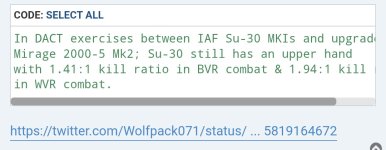
The kill ratios are nonsensical, they are not gonna reveal such details.

Bars wasn't in training mode. It was in training mode only in Red Flag. From the 2010s onwards, Bars was used normally in international exercises.

Anyway:
The parties first agreed that "all participants will only use their available weapons system". In other words, they must be "honest" to use means of detecting and tracking targets, and fight in accordance with their real possibilities. The idea was to come as close to real conditions in missions of interception, fire support and tracking using the latest generations of fighters. At the same time in the most complex scenarios in each camp provided a mixture of aircraft of all three parties.

And as a whole they believe that everything went very well. Of course, recognizes the pilot Mirage 2000-5F, their powerful radar allowed them to recognize earlier the situation in the sky, but radar is not everything.

Especially because the Su-30 can not be called a "discreet" aircraft, in contrast to the much more inconspicuous Rafale. We are talking about a complex system, whose main elements are quite detection and concealment. From this point of view, even the Mirage 2000C RDI and its radar with the NTCR function does not hit the face in the dirt. One cannot fail to speak also about the Spectra system of protection and warning established on Rafale, which aims to identify threats to 360 ° around the plane in active or passive mode. It also suppresses the waves around the plane, which hampers its location even with the aid of the most powerful radar.

Incidentally, a small air defense lesson delivered by a 2000-5 pilot : "To measure the maneuverability of the aircraft, it is necessary that everyone see each other. There are not many conditions to come in within visual range battle. The good hunter is not the one who engage on equal terms ... it's a murderer who kills in the back, who plays of the trick. The goal is to move as close as possible to the enemy radar (a radar, whose beam is similar to a cone, the more you are far, the more you see. The more you approach, the more the angle is poor. So the goal is to pass under the cone. At 10 nautical , the area scanned is smaller than at 40 ...). The goal is to play with the range of adverse party weapons, to pass under the radar cone with a so confused situation that data links do not provide a pilot the information that another aircraft is passing below him ... "

They basically used maneuverability to defeat the Bars to compensate for the inferiority of their radar.

Here's another ironic incident where 4 F-16s were shot down compared to 1 M2000 in a 4v4 in Taiwan. And the F-16s were equipped with AESAs. The F-16 radars are far superior to Bars.

I doubt the M2000s were even picked up on radar in Taiwan, and they use older hardware than we do.

Now combine these two sources of information with the fact that the Chinese praised Gripen C and expect Gripen E to be a true upgrade. The IAF is expecting the same from LCA Mk2 with even better core technologies.

Essentially, Garuda IV and V helped the IAF realize the importance of Mirage 2000 upgrade and Rafale. Garuda IV in 2010 told the IAF exactly what they needed to look for in a fighter jet. Garuda V gave them the reason needed to end the Su-57 program.

Yes, Su-57 can do the same, but basically they all can. Assuming Gripen E uses ACT, it will be harder for Su-57 to keep track of the Gripen E compared to Gripen with cooperative targeting. Su-57 will also need to employ ACT. This is where both cooperative targeting and IR advantages of the Gripen come into play.

These jets don't go into combat with EFTs, they are dropped. So they are typically facing the enemy with just AAMs.
 
The kill ratios are nonsensical, they are not gonna reveal such details.
Wolfpack is a known OSINT. He is seldom wrong.
Bars wasn't in training mode. It was in training mode only in Red Flag. From the 2010s onwards, Bars was used normally in international exercises.

Anyway:
The parties first agreed that "all participants will only use their available weapons system". In other words, they must be "honest" to use means of detecting and tracking targets, and fight in accordance with their real possibilities. The idea was to come as close to real conditions in missions of interception, fire support and tracking using the latest generations of fighters. At the same time in the most complex scenarios in each camp provided a mixture of aircraft of all three parties.

And as a whole they believe that everything went very well. Of course, recognizes the pilot Mirage 2000-5F, their powerful radar allowed them to recognize earlier the situation in the sky, but radar is not everything.

Especially because the Su-30 can not be called a "discreet" aircraft, in contrast to the much more inconspicuous Rafale. We are talking about a complex system, whose main elements are quite detection and concealment. From this point of view, even the Mirage 2000C RDI and its radar with the NTCR function does not hit the face in the dirt. One cannot fail to speak also about the Spectra system of protection and warning established on Rafale, which aims to identify threats to 360 ° around the plane in active or passive mode. It also suppresses the waves around the plane, which hampers its location even with the aid of the most powerful radar.

Incidentally, a small air defense lesson delivered by a 2000-5 pilot : "To measure the maneuverability of the aircraft, it is necessary that everyone see each other. There are not many conditions to come in within visual range battle. The good hunter is not the one who engage on equal terms ... it's a murderer who kills in the back, who plays of the trick. The goal is to move as close as possible to the enemy radar (a radar, whose beam is similar to a cone, the more you are far, the more you see. The more you approach, the more the angle is poor. So the goal is to pass under the cone. At 10 nautical , the area scanned is smaller than at 40 ...). The goal is to play with the range of adverse party weapons, to pass under the radar cone with a so confused situation that data links do not provide a pilot the information that another aircraft is passing below him ... "
I already explained the exact technique the French employed. MKI has whopped every single Delta(like LCA or M-2000) and Delta-Canard like Rafale or Typhoon in BVR. Rafale only bested MKI once it had RBE2 AESA. Once MKI gets Virupaksha, game-over to every other 4.5gen fighter out there.
They basically used maneuverability to defeat the Bars to compensate for the inferiority of their radar.

Here's another ironic incident where 4 F-16s were shot down compared to 1 M2000 in a 4v4 in Taiwan. And the F-16s were equipped with AESAs. The F-16 radars are far superior to Bars.

I doubt the M2000s were even picked up on radar in Taiwan, and they use older hardware than we do.

Now combine these two sources of information with the fact that the Chinese praised Gripen C and expect Gripen E to be a true upgrade. The IAF is expecting the same from LCA Mk2 with even better core technologies.

Essentially, Garuda IV and V helped the IAF realize the importance of Mirage 2000 upgrade and Rafale. Garuda IV in 2010 told the IAF exactly what they needed to look for in a fighter jet. Garuda V gave them the reason needed to end the Su-57 program.
IAF & TACDE refine their tactics based upon these exercises. Why do you think MKI destroyed one of the best 4.5 Delta-Canard Eurofighter Typhoon(which has 0.5m2 RCS with 6 Meteors) during exercise Indradhanush 2015 in both WVR & BVR? MKI is far more effective in BVR than people give it credit for. MKI UPG. will take this several notches higher.
Yes, Su-57 can do the same, but basically they all can. Assuming Gripen E uses ACT, it will be harder for Su-57 to keep track of the Gripen E compared to Gripen with cooperative targeting. Su-57 will also need to employ ACT. This is where both cooperative targeting and IR advantages of the Gripen come into play.

These jets don't go into combat with EFTs, they are dropped. So they are typically facing the enemy with just AAMs.
Su-57 can play any game Gripen or Rafale can play, but they can't fight it 'cause their arms are too short to box with it. No amount of interet arguing will change the fact that it is way superior fighter jet to any other 4.5 gen delta-canard.
 
Wolfpack is a known OSINT. He is seldom wrong.

I already explained the exact technique the French employed. MKI has whopped every single Delta(like LCA or M-2000) and Delta-Canard like Rafale or Typhoon in BVR. Rafale only bested MKI once it had RBE2 AESA. Once MKI gets Virupaksha, game-over to every other 4.5gen fighter out there.

IAF & TACDE refine their tactics based upon these exercises. Why do you think MKI destroyed one of the best 4.5 Delta-Canard Eurofighter Typhoon(which has 0.5m2 RCS with 6 Meteors) during exercise Indradhanush 2015 in both WVR & BVR? MKI is far more effective in BVR than people give it credit for. MKI UPG. will take this several notches higher.

Su-57 can play any game Gripen or Rafale can play, but they can't fight it 'cause their arms are too short to box with it. No amount of interet arguing will change the fact that it is way superior fighter jet to any other 4.5 gen delta-canard.
Any aircraft utilizing a delta-wing or delta-like aerodynamic configuration is inherently designed for high-altitude interception performance. However, when juxtaposed with the Su-35’s massive 11.5-ton internal fuel capacity and its incredibly powerful 117S engines, the delta-wing platforms engineered by these smaller European nations lose all their strategic value. The core reason is that these countries lack powerful engine technology; structural and aerodynamic optimization simply cannot bridge the massive chasm in payload capacity and engine thrust.
Among them, the Eurofighter Typhoon and its EJ200 engines are relatively the strongest. Nevertheless, because the weight class differential is simply too immense, the Typhoon's technological sophistication fails to manifest effectively against the Su-35, while its inherent shortcomings are severely magnified—most notably when contrasted with the Su-35’s robust anti-ship and ground-attack capabilities.
 
  • Like
Reactions: Rajput Lion
Why do you think MKI destroyed one of the best 4.5 Delta-Canard Eurofighter Typhoon(which has 0.5m2 RCS with 6 Meteors) during exercise Indradhanush 2015 in both WVR & BVR?
WVR ? yes. BVR ? NO

This is what ndtv reported(og source):
"Asked about the performance of IAF pilots in these Large Force Engagements, Group Captain Srivastav told NDTV his pilots performed "fairly well" though "quantifying [the results] is difficult". It was not unexpected for the IAF to "lose" one or two jets (over all the Large Force Engagements put together) given that the movement of each formation was directed by fighter controllers coordinating an overall air battle. Both sides agreed to simulate their Beyond Visual Range (BVR) Missiles at 25 miles for offensive missions and 22 miles for defensive scenarios."

As the range will increase for bvr engagement, the more difficulty su30mki(current) will face

For over 100km, Eurofighter or rafale or gripen e or even tejas mk1a will "anhilate" su30mki

All these euro-canarads or mk1a have aesa spj, bars radar wont be able to maintain any good lock on them
 
WVR ? yes. BVR ? NO

This is what ndtv reported(og source):
"Asked about the performance of IAF pilots in these Large Force Engagements, Group Captain Srivastav told NDTV his pilots performed "fairly well" though "quantifying [the results] is difficult". It was not unexpected for the IAF to "lose" one or two jets (over all the Large Force Engagements put together) given that the movement of each formation was directed by fighter controllers coordinating an overall air battle. Both sides agreed to simulate their Beyond Visual Range (BVR) Missiles at 25 miles for offensive missions and 22 miles for defensive scenarios."

As the range will increase for bvr engagement, the more difficulty su30mki(current) will face

For over 100km, Eurofighter or rafale or gripen e or even tejas mk1a will "anhilate" su30mki

All these euro-canarads or mk1a have aesa spj, bars radar wont be able to maintain any good lock on them
Read Vishnu Som's analysis. MKI dominated Typhoon there as well, though its performance wasn't as superlative as it was in WVR(12:0).
Do you understand what OSINT means? And he gets classified information?.

Half the stuff they make up to get engagement from gullible.
Call him defence watcher then. From what I've seen, he seems quite reliable.
 
Then why not flying wing cca only ??

This has always bothered me, a cca can not manure much due to lack of thrust and ai capabilities, also a cca is expected to fly very close , so in that ranges, opponent's bvr missile will have very high pk

So why not fully devote to stealth (both em +ir)

In india too, it seems the development of cats warrior is stupid idea(specially if it can not carry bvr internally)

Just focus on ghatak and mass produce it like 300-400

It's unclear today on how these different types of CCAs will behave in the real world.
 
  • Like
Reactions: PhotonVish
This type of generalized RCS estimation is actually a highly ambiguous weighted value that lacks a unified standard. In reality, a fighter jet's RCS follows a specific profile: it is at its minimum from the rear, slightly higher from the front, and at its absolute maximum from the side. For instance, according to the Su-27 tactical manuals from Russia's Gagarin Air Force Academy, the F-15 has a frontal RCS of 10 square meters and a rear RCS of 10 square meters; its lateral RCS is not explicitly labeled, but based on the radar reflection curves, it is at least 30 square meters.

Stealth aircraft share a similar pattern. The so-called '0.X square meters' claims are merely theoretical simulation values for the frontal aspect, treating the entire aircraft as a metallic blackbody model. Such metrics carry zero value in real-world combat because a real aircraft features a massive radar antenna and a cockpit at its front; therefore, the actual equivalent frontal RCS of an operational aircraft will not fall below 3 square meters. The rear aspect can be reduced to below 3 square meters, and the sides will exceed 3 square meters, but everything becomes incredibly complex depending on the relative geometry between the incoming missile and the aircraft (especially since this doesn't even factor in the top and bottom profiles, which yield the largest RCS signatures). In actual combat, despite all the zeros added to the F-117's heavily marketed RCS figures, it was still shot down by an obsolete air defense missile system.

Yes, as a complex body, a fighter has different RCS numbers from different aspects. That's why cooperative targeting and multistatic radars and sensors are expected to defeat shaping-based stealth.

But for combat, typically, we use frontal figures because that's the aspect that's facing the enemy. The 0-30/60 deg space is crucial here.

The rear becomes important when the objective is to operate inside hostile airspace.

So we are indeed primarily speaking about frontal figures only, the aspect the enemy sees the most of during combat. And as missiles are released and as you fly in closer for merge, the RCS numbers drop commensurately to make up for the closing distance and the reducing effectiveness of EA relative to the hostile fighter.

As for the F-117, Dani simply used a police tactic where he created a SAM blockade using a known route of the F-117. The tactic used wasn't something spectacular, the shoot down was entirely America's own fault for repeatedly using the same route. And the F-117 did not have Prowler support too, like it usually does, so it allowed Dani to keep his radar switched on for longer, and the one that was shot down had its weapons bays open. The Americans changed tactics after that. Even the recent F-35 hit in Iran was likely just a pilot being negligent.


The main advantage of a reduced observable design is EA. The effectiveness of jammers and active decoys are upgraded phenomenally with a reduction in frontal RCS. The KF-21 further enhances signature reduction from the sides with its angled vertical fins.
 
Wolfpack is a known OSINT. He is seldom wrong.

You won't get such kill ratios from mixed fleet combat. Without the scenario in question, it's just numbers without meaning.

I already explained the exact technique the French employed. MKI has whopped every single Delta(like LCA or M-2000) and Delta-Canard like Rafale or Typhoon in BVR. Rafale only bested MKI once it had RBE2 AESA. Once MKI gets Virupaksha, game-over to every other 4.5gen fighter out there.

IAF & TACDE refine their tactics based upon these exercises. Why do you think MKI destroyed one of the best 4.5 Delta-Canard Eurofighter Typhoon(which has 0.5m2 RCS with 6 Meteors) during exercise Indradhanush 2015 in both WVR & BVR? MKI is far more effective in BVR than people give it credit for. MKI UPG. will take this several notches higher.

MKI defeated the Tyhoon in WVR combat, the reported kill ratio there was 12:0. Typhoon's not designed for that fight, while the MKI is.

And to reduce the reliance on EW to determine the outcome, BVR combat saw the Typhoons carrying EFTs so it's easily visible on radar and no EW was used by either side. The IAF already knows the Typhoon has the first look and first kill advantages against MKI.

Su-57 can play any game Gripen or Rafale can play, but they can't fight it 'cause their arms are too short to box with it. No amount of interet arguing will change the fact that it is way superior fighter jet to any other 4.5 gen delta-canard.

Again, that's not how combat works. It's about the effectiveness of the avionics relative to the adversary's capabilities.

Spec-for-spec, Su-57 is superior. But you don't need to have superior baseline specs to make a kill, you need the right weapon, tactics, and circumstances. Like Javelin against a tank.

Su-57 is designed to defeat an adversary "air force," Gripen E is designed to defeat the "Su-57." That's the logic, it makes a huge difference. The only way Su-57 survives is if its own weaknesses that the Gripen's planning to exploit are not vulnerabilities against the Gripen.

Like how Javelin's top attack makes a tank vulnerable. If the tank's top armor can stop Javelin, then you need a new weapon. So if the Su-57's weakness cannot be exploited by Gripen, then they would need a new jet. That's how this works.
 
Last edited:
Any aircraft utilizing a delta-wing or delta-like aerodynamic configuration is inherently designed for high-altitude interception performance. However, when juxtaposed with the Su-35’s massive 11.5-ton internal fuel capacity and its incredibly powerful 117S engines, the delta-wing platforms engineered by these smaller European nations lose all their strategic value. The core reason is that these countries lack powerful engine technology; structural and aerodynamic optimization simply cannot bridge the massive chasm in payload capacity and engine thrust.
Among them, the Eurofighter Typhoon and its EJ200 engines are relatively the strongest. Nevertheless, because the weight class differential is simply too immense, the Typhoon's technological sophistication fails to manifest effectively against the Su-35, while its inherent shortcomings are severely magnified—most notably when contrasted with the Su-35’s robust anti-ship and ground-attack capabilities.

Typhoon surpasses the Su-35 by a wide margin in terms of kinematics for BVR; climb, acceleration, supercruise etc. And the Typhoon's baseline RCS, airframe design, and advanced avionics also give it a significant leg up against the Su-35's. It's effectively a generation ahead in all three areas.

The Su-35's only advantage is range.

Payload is entirely up to the type of weapons you integrate with the jets, so that's up for grabs using whatever your budget allows.

Weaker engine sure, there are advantages to have with Su-35's more powerful engines, but they haven't given the Su-35 any real advantages over the Typhoon specifically. Decent engines, but old gen airframe and avionics.

Su-35 definitely surpasses the Gripen E in kinematics though, but still suffers from lack of advanced airframe and avionics tech.
 
  • Like
Reactions: PhotonVish