
When Leftist Media created a fictional divide between South India and Union of India

Toggle navigation
CURRENT AFFAIRS
As the anger against the central government was rising in AP, an article appeared on the controversial leftist website, The Wire in February, 2018. This article was trying to analyze just one term of reference, of the 15thFinance Commission (that will come into effect for the years 2020 – 2025), and came up with an atrocious byline – “It is becoming almost untenable for Tamil Nadu and Kerala to thrive in the Indian union as rational, self-interested sub-units.”
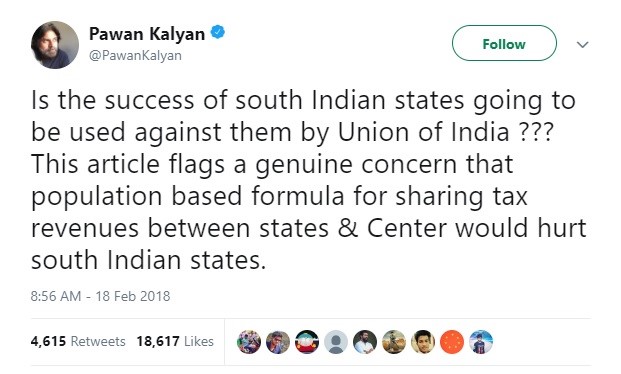
Popular Telegu actor, and Jana Sena party chief plugged this article and added his opinion as follows:
“Is the success of south Indian states going to be used against them by Union of India??? This article flags a genuine concern that population-based formula for sharing tax revenues between states & Center would hurt south Indian states.”
 This argument started gaining slow traction. TDP MP Mr. Murali Mohan made a statementthat 5 south Indian states wouldn’t mind separating from the country too. This has created enough outrage on Social media, but the source of this outrage wasn’t too well known then. News reports have also mentioned that Chandrababu Naidu made an argument that South Indian states are being penalized, in his 2 hour 20 minute speech in the state Assembly. I haven’t heard the speech yet, so I have no way of verifying it. TRP-centric TV media even ran programs that discussed “Pawan Kalyan & Kamal Haasan to end South India's slavery?”
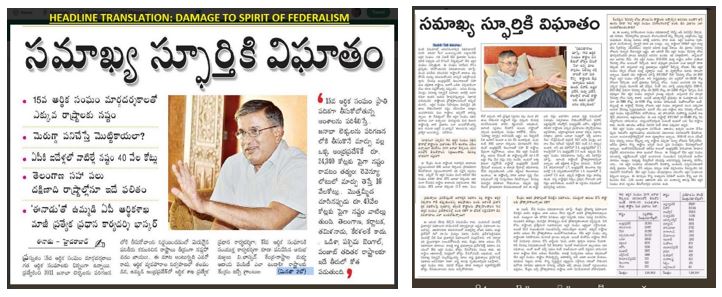
On Sunday, March 11th, Eenadu, the largest circulated telugu newspaper (And 9th largest circulated in the country), put this argument on the front page. They interviewed Shri V. Bhaskar, secretary to the 13th Finance Commission. The headline screamed – “Damage to the spirit of Federalism”. Below is a snapshot of their coverage on this issue.
What is the crux of the argument these folks are making?
While reading the article in Eenadu, I was perplexed when Shri Bhaskar made the following statement:
“From the 7th FC to the 14th FC, all of them used the 1971 census data as reference”.
This is reconfirmed when we visit the Finance Commission website and look at the terms of reference of all the finance commissions. Up until the 6th finance commission, no specific guideline was given on which census data to be used. From the 7th FC (set up in 1977) onwards till the 14th FC (2015 to 2020), every single FC used 1971 data! Imagine using 1971 data for distribution model in 2015 – what explains this status quo for so many years? Isn’t it surprising that we used 1971 census data even 40 years later?
The issue of Tiny Fonts.
The Wire says that the change of criteria from 1971 to 2011 census “was done with such little fanfare and in fonts so tiny that it made one wonder if those who sought it wanted no one to take notice.”
Fonts so tiny? Such little fanfare? Please take a look at the Gazette notification. The font is the same across the entire document! The population criteria is placed at a similar place, as was done in all previous FC references. I, for one, fail to understand this penchant to dramatize non-existing problems?
Was any weightage given to 2011 census in 14th FC?
The Wire tells us that “… the 14th Finance Commission…. gave a weightage of 10% for Census 2011 data”. So is it fair enough to assume that the remaining 90% weightage was from the Census 1971 data?
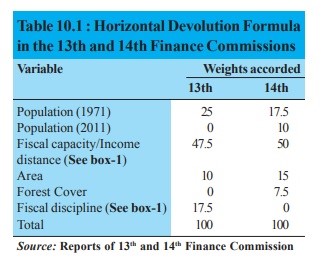
Shri V. Bhaskar, Secretary of 13th Finance Commission told in his interview - “The 14thFC gave 17.5% weightage to the Census 1971 data”.
At first look, these numbers itself were very perplexing! Because the automatic assumption is that the remaining percentage is from the other census. It turns out that my assumption is wrong. The devolution formula has always included other aspects, outside of population. For example, this table picked up from a government website confirms such findings for 13th and 14th FC
 What about the other key argument – should performing states be penalized?
Both the articles in The Wire and in Eenadu have suggested that the performing states of South India are at a heavy loss. In fact the eenadu article even gave us the losses that the performing states would have entailed, if the 2011 census was considered for the 14thFC (whose period is 2015 – 2020). The table told us that AP would have lost ~24,000 crores, TN ~22,000 crores, Kerala and WB ~20,000 crores each and so on. It also told us that UP would have gained ~35000 crores, Bihar ~32000 crores etc.
And here’s where the chicanery of websites of The Wire, and the insincerity of bureaucrats (covered in Eenadu) come to the fore. Since most readers don’t bother to go and actually check the terms of 15th FC, they will automatically believe that there is no provision for rewarding the performing states.
Here is the truth. For the first time ever, the terms of reference for a finance commission included a number of “proposing measurable performance-based incentives for States”. A few earlier commissions considered fiscal discipline for incentives, but never has an entire section been dedicated to this.
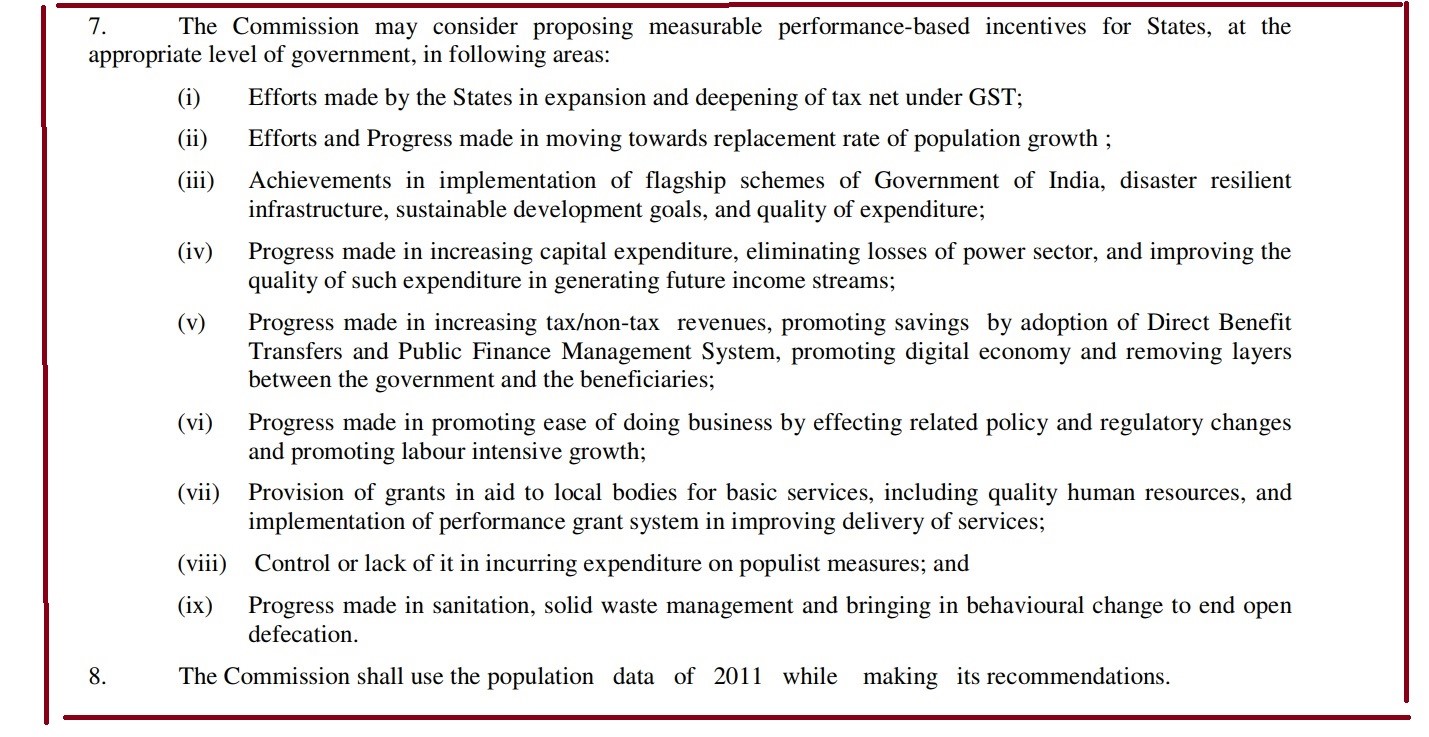
There are a total of 9 parameters under which it has been recommended that performance can be measured. Previous FC’s for sure did not have so many parameters explicitly mentioned. The second parameter recommended is “Efforts and Progress made in moving towards replacement rate of population growth”.
The Wire article told us that – “Some experts have argued that having a weightage factor for dropping fertility rates is a possibility.” Possibility? They have been mandated to consider dropping fertility rates!
In his interview, Shri V. Bhaskar has told us that a good “Replacement Fertility rate” should be less than 2.1. And there are many states that are currently higher than this. The terms of reference clearly indicates that states that have moved towards this rate should be considered for incentives.
The entire premise of the North India – South India argument was based on a lie that states that have made progress in terms of containing their population will be heavily penalized. The truth is that they will in fact get incentivized!
Not just that, please take a look at other parameters too. States that have done good in GST, Ease of doing business, grants for local bodies, sanitation, waste management etc – will all get incentivized. This is the first time that such measurable parameters have been placed in the FC terms of reference. The 15th FC is currently accepting suggestions too - shouldn’t we be spending our time in giving these inputs to the FC?
What then explains the deliberate attempt to spread such lies and mis-information? What the Wire published got mainstreamed into the politics of a state in India. A lie travels far before the truth wakes up. It is one thing to cast aspersions on methodology of a commission, or give suggestions based on available information. It is a whole different ball game to arrive at dangerous conclusions based on half assumptions! A ball game that many sections of media are perfecting!
Disclaimer: The opinions expressed within this article are the personal opinions of the author. MyIndMakers is not responsible for the accuracy, completeness, suitability, or validity of any information on this article. All information is provided on an as-is basis. The information, facts or opinions appearing in the article do not reflect the views of MyindMakers and it does not assume any responsibility or liability for the same.
When Leftist Media created a fictional divide between South India and Union of India
Toggle navigation
CURRENT AFFAIRS
- Share Article
- In article
- 02:43 AM, Mar 15, 2018
- S Sudhir Kumar
As the anger against the central government was rising in AP, an article appeared on the controversial leftist website, The Wire in February, 2018. This article was trying to analyze just one term of reference, of the 15thFinance Commission (that will come into effect for the years 2020 – 2025), and came up with an atrocious byline – “It is becoming almost untenable for Tamil Nadu and Kerala to thrive in the Indian union as rational, self-interested sub-units.”
Popular Telegu actor, and Jana Sena party chief plugged this article and added his opinion as follows:
“Is the success of south Indian states going to be used against them by Union of India??? This article flags a genuine concern that population-based formula for sharing tax revenues between states & Center would hurt south Indian states.”
On Sunday, March 11th, Eenadu, the largest circulated telugu newspaper (And 9th largest circulated in the country), put this argument on the front page. They interviewed Shri V. Bhaskar, secretary to the 13th Finance Commission. The headline screamed – “Damage to the spirit of Federalism”. Below is a snapshot of their coverage on this issue.
What is the crux of the argument these folks are making?
- The terms of reference of the 15thFinance Commission (FC) tell us that “The Commission shall use the population data of 2011 while making its recommendations.”
- The Wire, and subsequent experts have argued that this is grossly unfair because this basically means all those states that have made progress on controlling population and increasing tax productivity will be at a loss.
- By the same logic, states that have not bothered about implementing these measures will immensely gain.
While reading the article in Eenadu, I was perplexed when Shri Bhaskar made the following statement:
“From the 7th FC to the 14th FC, all of them used the 1971 census data as reference”.
This is reconfirmed when we visit the Finance Commission website and look at the terms of reference of all the finance commissions. Up until the 6th finance commission, no specific guideline was given on which census data to be used. From the 7th FC (set up in 1977) onwards till the 14th FC (2015 to 2020), every single FC used 1971 data! Imagine using 1971 data for distribution model in 2015 – what explains this status quo for so many years? Isn’t it surprising that we used 1971 census data even 40 years later?
The issue of Tiny Fonts.
The Wire says that the change of criteria from 1971 to 2011 census “was done with such little fanfare and in fonts so tiny that it made one wonder if those who sought it wanted no one to take notice.”
Fonts so tiny? Such little fanfare? Please take a look at the Gazette notification. The font is the same across the entire document! The population criteria is placed at a similar place, as was done in all previous FC references. I, for one, fail to understand this penchant to dramatize non-existing problems?
Was any weightage given to 2011 census in 14th FC?
The Wire tells us that “… the 14th Finance Commission…. gave a weightage of 10% for Census 2011 data”. So is it fair enough to assume that the remaining 90% weightage was from the Census 1971 data?
Shri V. Bhaskar, Secretary of 13th Finance Commission told in his interview - “The 14thFC gave 17.5% weightage to the Census 1971 data”.
At first look, these numbers itself were very perplexing! Because the automatic assumption is that the remaining percentage is from the other census. It turns out that my assumption is wrong. The devolution formula has always included other aspects, outside of population. For example, this table picked up from a government website confirms such findings for 13th and 14th FC
Both the articles in The Wire and in Eenadu have suggested that the performing states of South India are at a heavy loss. In fact the eenadu article even gave us the losses that the performing states would have entailed, if the 2011 census was considered for the 14thFC (whose period is 2015 – 2020). The table told us that AP would have lost ~24,000 crores, TN ~22,000 crores, Kerala and WB ~20,000 crores each and so on. It also told us that UP would have gained ~35000 crores, Bihar ~32000 crores etc.
And here’s where the chicanery of websites of The Wire, and the insincerity of bureaucrats (covered in Eenadu) come to the fore. Since most readers don’t bother to go and actually check the terms of 15th FC, they will automatically believe that there is no provision for rewarding the performing states.
Here is the truth. For the first time ever, the terms of reference for a finance commission included a number of “proposing measurable performance-based incentives for States”. A few earlier commissions considered fiscal discipline for incentives, but never has an entire section been dedicated to this.
There are a total of 9 parameters under which it has been recommended that performance can be measured. Previous FC’s for sure did not have so many parameters explicitly mentioned. The second parameter recommended is “Efforts and Progress made in moving towards replacement rate of population growth”.
The Wire article told us that – “Some experts have argued that having a weightage factor for dropping fertility rates is a possibility.” Possibility? They have been mandated to consider dropping fertility rates!
In his interview, Shri V. Bhaskar has told us that a good “Replacement Fertility rate” should be less than 2.1. And there are many states that are currently higher than this. The terms of reference clearly indicates that states that have moved towards this rate should be considered for incentives.
The entire premise of the North India – South India argument was based on a lie that states that have made progress in terms of containing their population will be heavily penalized. The truth is that they will in fact get incentivized!
Not just that, please take a look at other parameters too. States that have done good in GST, Ease of doing business, grants for local bodies, sanitation, waste management etc – will all get incentivized. This is the first time that such measurable parameters have been placed in the FC terms of reference. The 15th FC is currently accepting suggestions too - shouldn’t we be spending our time in giving these inputs to the FC?
What then explains the deliberate attempt to spread such lies and mis-information? What the Wire published got mainstreamed into the politics of a state in India. A lie travels far before the truth wakes up. It is one thing to cast aspersions on methodology of a commission, or give suggestions based on available information. It is a whole different ball game to arrive at dangerous conclusions based on half assumptions! A ball game that many sections of media are perfecting!
Disclaimer: The opinions expressed within this article are the personal opinions of the author. MyIndMakers is not responsible for the accuracy, completeness, suitability, or validity of any information on this article. All information is provided on an as-is basis. The information, facts or opinions appearing in the article do not reflect the views of MyindMakers and it does not assume any responsibility or liability for the same.
When Leftist Media created a fictional divide between South India and Union of India